LONDON--(BUSINESS WIRE)--Feb 4, 2026--
Metapack, a leading intelligent delivery platform, today released the Ecommerce Delivery Benchmark Report 2026 in partnership with Retail Economics. The report reveals that UK retailers are forecasting online sales growth to accelerate in 2026 as AI adoption expands to enhance shopping experiences and improve delivery performance, strengthening customer loyalty. This optimism is driven by rapid changes in consumer behaviour, with almost half of UK adults under 45 already using AI tools for ecommerce tasks such as product research, price comparison, and exploring delivery options. In response, retailers are increasing investment to keep pace, with 90% globally planning to boost spending on AI to optimise ecommerce operations over the next 12 to 24 months.
This press release features multimedia. View the full release here: https://www.businesswire.com/news/home/20260204939235/en/
The new research, which surveyed over 8,000 consumers and 400 retailers, examines how AI is transforming the consumer shopping journey and how retailers are positioning AI investment as a direct driver of conversion, delivery performance, and online sales growth in 2026 and beyond.
AI Moves Into the Mainstream
Globally, 78% of consumers used AI tools such as ChatGPT in the past 12 months, rising to 93% among those under 35. In the UK, this shift is reflected in shopping behaviour, with 30% of adults open to AI acting as a personal shopping agent, recommending products, checking delivery and returns options, and even making certain purchases on their behalf once preferences are set. As a result, chat-based platforms including ChatGPT are emerging as a major retail channel, generating 50.2 million monthly shopping-intent visits in the UK, ranking alongside the country’s biggest ecommerce sites.
“AI is changing the way people find, choose and buy products, as well as how they are delivered,” said Al Ko, CEO of Auctane, Metapack’s parent company. “Retailers who adopt AI now will get ahead. Those who hesitate will fall behind as AI reshapes every part of retail, from discovery to delivery.”
Across the eight international markets in the study, UK consumers stand out as the most confident in Europe when it comes to AI-assisted ecommerce, with almost two-thirds (64%) expressing trust in AI tools. Retailers are increasingly using AI to optimise product discovery and fulfilment, improve warehouse efficiency and delivery speed, to directly impact customer satisfaction and online sales growth.
Tech-Anxiety: Retailers Face Adoption Challenges
Retailers see AI as a key lever to drive growth and succeed in a competitive market, but adoption remains uneven. More than a third of European retailers (36%) cite keeping pace with AI and emerging technologies as a major challenge for their business in 2026, compared with 33% in North America.
Barriers vary by size. Larger retailers (£500m+ turnover) are more likely to point to skills gaps and the complexity of integrating AI with legacy systems (54%), while smaller firms (under £100m turnover) cite high development costs (35%) and data security or compliance concerns. These challenges are reflected in adoption maturity, with 28% of North American retailers having AI embedded and scaled across multiple functions, compared with just 17% of retailers in Europe, highlighting a competitive gap.
“AI is reshaping retail strategy, not just the customer experience,” said Richard Lim, CEO of Retail Economics. “Retailers clearly see the potential across conversion, delivery and customer experience, and consumers are increasingly comfortable with AI playing a role in how they shop. In 2026, the focus shifts from experimentation to execution, where success will be shaped by how effectively retailers can embed AI into their data, systems and everyday operations.”
Delivery: The New Baseline
In the AI-driven shopping era, delivery performance has shifted from a differentiator to a baseline expectation. Most UK shoppers now expect two-day delivery as standard, without paying extra. However, for faster or more convenient delivery on a typical £30–£50 order, £5–£8 is viewed as the optimum price range, with higher fees seen as poor value and more likely to deter purchases. Even as expectations continue to rise, cost remains the top delivery priority globally for 36% of shoppers.
To meet these demands at scale, retailers are increasingly turning to AI to improve delivery execution. 38% of European firms identify speed, tracking, and proactive communication as the areas where AI can deliver the greatest impact. This is particularly critical for high value AI Delegators, who make up 17% of shoppers and prioritise fast next day or paid same day delivery, highlighting how intelligent fulfilment can directly drive revenue and loyalty.
AI Shopper Personas
The report identifies four distinct AI-driven shopper personas, reflecting how consumers are adopting AI in different ways across the shopping journey:
Looking ahead, expectations for AI in retail continue to evolve. By 2030, nearly half of shoppers (48%) expect AI to act as a helpful assistant across the shopping journey, while a further 25% anticipate it evolving into a trusted co-shopper that automates some decisions.
NOTES TO EDITORS
Express permission is granted for a link to Metapack to be included in online news articles, blogs and posts . Please reach out to munveer.garcha@auctane.com for a full copy of the report.
Methodology
Consumer surveys were undertaken by Retail Economics in November 2025 and include answers from a sample of more than 8,000 nationally representative consumers, additionally insights from 400 senior decision makers at ecommerce businesses with an annual revenue of $12.5m or more were collected, across the UK, US, Germany, France, Spain, Italy, Canada and Australia.
About Metapack
Metapack helps ecommerce and delivery professionals meet consumers’ growing expectations of delivery while maintaining and optimising operational efficiency. Metapack’s solution offers a wide range of personalised services, from delivery options to tracking and returns, through a catalogue of 350+ carriers and 4,000+ services available that span every country in the world. Thanks to Metapack, more than a billion packages are sent annually by many of the world’s leading ecommerce retailers. Metapack is a member of the Auctane family of companies and is headquartered in London. Find out more at www.metapack.com.
About Retail Economics
Retail Economics is an independent economics research consultancy focused on the consumer, retail and leisure industries. We analyse the complex retail economic landscape and draw out actionable insight for our clients. Leveraging our own proprietary retail data and applying rigorous economic analysis, we transform information into points of action. Find out more at www.retaileconomics.co.uk.
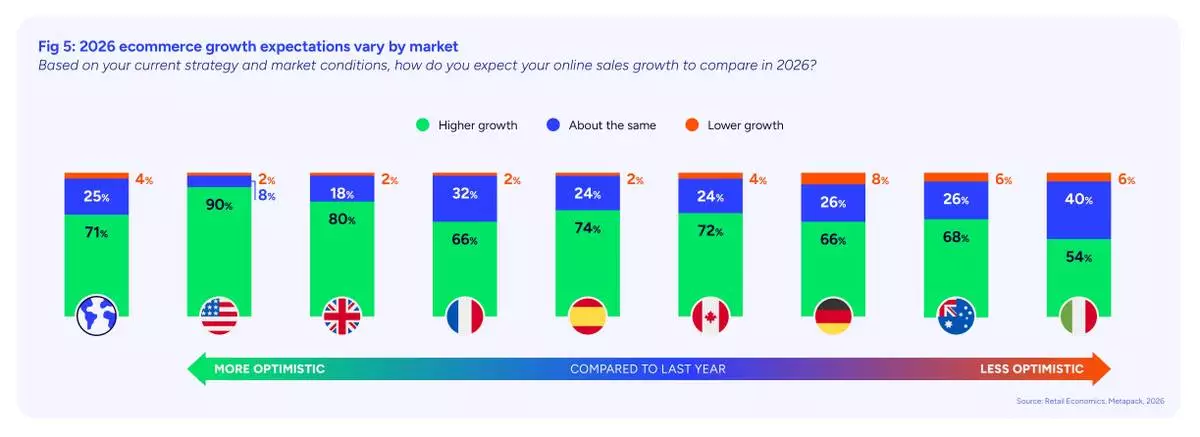
New research shows retailers remain broadly optimistic about ecommerce growth in 2026, with UK retailers reporting high confidence in online sales.