LONDON--(BUSINESS WIRE)--Feb 4, 2026--
Loop, the leading commerce operations platform for Shopify brands, today announced the launch of Ship by Loop 2.0, an upgraded version of its integrated return shipping service that now includes Sendcloud, Europe’s leading shipping platform. The enhancement adds access to a wider range of ready-to-use UK and EU carriers, giving merchants more flexibility, lower rates and an even smoother return experience for shoppers.
This press release features multimedia. View the full release here: https://www.businesswire.com/news/home/20260204034670/en/
Ship by Loop allows merchants to manage every aspect of their return shipments directly within the Loop platform, connecting their own carrier accounts or using Loop’s pre-discounted global rates. With the new Sendcloud integration, Loop merchants will gain access to an expanded carrier network across Europe, including leading couriers and locker services, all available without leaving Loop’s returns portal.
The enhancement also introduces QR code returns and InPost locker drop-offs, reducing the need for printed labels and supporting a more convenient, sustainable returns experience.
“With Ship by Loop 2.0, we’re making global returns logistics even simpler for brands,” said John-David Klausner, GM International at Loop. “Integrating Sendcloud directly into our platform means merchants can access top UK and EU carriers instantly, benefit from more competitive rates and deliver a frictionless experience that keeps customers coming back.”
By integrating Sendcloud alongside Loop’s previously existing shipping functionality, Ship by Loop now offers merchants the best of multiple shipping partners: Sendcloud’s rich European network and Loop’s existing strong coverage in North America. Merchants can rate-shop across multiple carriers to find the lowest-cost return shipping option for each order, achieving meaningful savings on every parcel while streamlining operations in one unified workflow.
“We’re excited to power Ship by Loop’s return shipping across Europe,” said Rob van den Heuvel, CEO at Sendcloud. “By combining Loop’s returns platform with Sendcloud’s carrier network, we’re removing complexity for merchants and making returns easier and more convenient for shoppers.”
The latest upgrade reflects Loop’s ongoing commitment to expanding its global shipping profile, enabling merchants to scale efficiently across regions while optimising reverse logistics and reducing operational overhead.
To learn more about how Ship by Loop 2.0 can help your brand simplify returns and save on international shipping, visit loopreturns.com/returns/logistics
About Loop
Loop is the industry’s leading commerce operations platform that empowers Shopify brands to streamline their entire customer journey, reduce friction, and maximize revenue. Its end-to-end approach integrates capabilities that help brands simplify their operations and delight customers, from initial orders to returns and exchanges. Offering features like Workflows, Instant Exchanges, Checkout+, and AI-powered tracking and visibility, Loop reduces costs, increases customer lifetime value, and retains revenue for more than 5,000 of the world’s most-loved Shopify brands. Loop has processed over 55 million returns and counting, and has helped merchants capture more than $2 billion in revenue over the past five years while delivering exceptional customer experiences. Learn more at www.loopreturns.com.
About Sendcloud
Sendcloud is the leading shipping platform that empowers e-commerce merchants to scale their shipping operations effortlessly and deliver a customer-first experience. Backed by Softbank and trusted by 35,000+ brands across Europe, Sendcloud has the vision to solve shipping globally.

New enhancements to Ship by Loop (SBL) will unlock more carriers, better rates and QR code drop-offs across the UK and EU.
DUBAI, United Arab Emirates (AP) — Semiofficial news agencies in Iran published a chart Thursday suggesting the country’s paramilitary Revolutionary Guard put sea mines into the Strait of Hormuz during the war, in a message that may be intended to pressure the U.S. as uncertainty hangs over a days-old two-week ceasefire and further negotiations are expected in Pakistan.
The shaky ceasefire has been largely holding between the U.S., Israel and Iran, although Tehran and Washington have offered vastly different explanations of the initial terms.
Israel insists the agreement does not apply to their war against Hezbollah militants in Lebanon and have escalated deadly strikes there, leading Iran to claim it is violating the deal. Meanwhile, Iran said it had won agreement that it would control the Strait of Hormuz, charge tolls and enrich uranium — while Trump said the deal called for the strait to be reopened and Iran to hand over its uranium stockpile.
The chart of the Strait of Hormuz was released by the ISNA news agency, as well as Tasnim, which is believed to be close to the Guard. They showed a large circle marked “danger zone” in Farsi over the Traffic Separation Scheme, which was the route ships take through the strait, the narrow mouth of the Persian Gulf through which 20% of all oil and natural gas traded once passed.
The chart suggested ships travel further north through waters closer to Iran’s mainland near Larak Island, a route some ships were observed taking during the war. It was dated from Feb. 28 until Thursday, April 9, and it was unclear if the Guard had cleared any mining on the route since then.
Iran’s deputy foreign minister, Saeed Khatibzadeh, said his country will allow ships to pass through the Strait of Hormuz in accordance with “international norms and international law” once the United States ends its “aggression” in the Middle East and Israel stops attacking Lebanon.
Khatibzadeh told the BBC on Thursday that Iran had closed the strait after U.S. ally Israel committed an “intentional grave violation of the ceasefire.”
He added that "we have shown to everybody that energy security is pivotal for Iran, is pivotal for this body of water in the Persian Gulf, and we are going to be abided by the international norms and international law.”
Oil rose again to above $97 a barrel and Asian stocks were trading lower Thursday on skepticism over the ceasefire. Brent crude, the international standard, was up 2.9% to $97.46 per barrel. It had fallen briefly to below $92 following the temporary ceasefire announcement.
Ship-tracking data from Kpler showed only four vessels with their Automatic Identification System trackers on passed through the Strait of Hormuz on Wednesday, the first day of the ceasefire. However, that does not include so-called “dark fleet” vessels, which travel with their AIS trackers turned off. Many of those “dark fleet” ships carry sanctioned Iranian crude oil out to the open market.
U.S. President Donald Trump posted a statement insisting that his surge of warships and troops will remain around Iran “until such time as the REAL AGREEMENT reached is fully complied with.”
Trump’s comments on his Truth Social platform appeared to be a way to pressure Iran.
“If for any reason it is not, which is highly unlikely, then the ‘Shootin’ Starts,’ bigger, and better, and stronger than anyone has ever seen before,” Trump wrote.
He also insisted Iran would not be able to build nuclear weapons and “the Strait of Hormuz WILL BE OPEN & SAFE.”
The U.S. and Iran both claimed victory after reaching the ceasefire agreement, and world leaders expressed relief. But more drones and missiles hit Iran and Gulf Arab countries after the deal was announced.
Israel also intensified its attacks on the Hezbollah militant group in Lebanon on Wednesday, hitting commercial and residential areas in Beirut. At least 182 people were killed in the deadliest day of fighting there. First responders searched overnight for missing people still under the rubble after the deadly Israeli strikes.
Israel said Thursday it had killed an aide to Hezbollah leader Naim Kassem in its airstrikes on Beirut. It identified the man killed as Ali Yusuf Harshi, a secretary and nephew to Kassem. Hezbollah did not immediately respond to a request for comment.
Lebanon's state-run National News Agency reported Thursday that an Israeli strike overnight had killed at least seven people in southern Lebanon. The Israeli military did not immediately acknowledge the strike.
The violence threatens to scuttle what U.S. Vice President JD Vance called a “fragile” deal.
Iran's parliament speaker said Wednesday that planned talks were “unreasonable” because Washington had broken three of Tehran’s 10 conditions for an end to the fighting. In a social media post, Mohammad Bagher Qalibaf objected to Israeli attacks on Hezbollah, an alleged drone incursion into Iranian airspace after the ceasefire took effect and U.S. refusal to accept any Iranian enrichment capabilities in a final agreement.
Iranian Foreign Minister Abbas Araghchi insisted an end to the war in Lebanon was part of the ceasefire deal, but Israeli Prime Minister Benjamin Netanyahu and Trump said the truce did not cover Lebanon. When the deal was announced, the prime minister of Pakistan, which served as a mediator, said in a social media post that it applied to “everywhere including Lebanon and elsewhere.”
A New York-based think tank warned the ceasefire “hovers on the verge of collapse.”
The Soufan Center said Israel's strikes on Lebanon on Wednesday added to the risk the deal would fall apart.
“Even if Lebanon was formally outside the deal, the scale of Israel’s strikes was likely to be viewed as escalatory, nonetheless,” it wrote in an analysis published Thursday. “Israel’s strikes can be understood both as an effort to drive a wedge between Iran and its proxies and as a response to being allegedly sidelined in the original ceasefire discussions.”
The White House said that Vice President JD Vance would lead the U.S. delegation to talks in Islamabad aimed at ending the war, which are set to start Saturday.
Iran's ambassador in Islamabad, Reza Amiri Moghadam, wrote on X that Iran's negotiating team would arrive in the Pakistani capital Thursday night, but later deleted the post without providing further comment.
His initial post said the talks would be "based on 10 points proposed by Iran.”
Those include Iran enriching uranium, maintaining its control of the Strait of Hormuz and other issues that have been nonstarters in the past for Trump. The White House has repeatedly described the 10 points issued by Iran as false.
Becatoros reported from Athens, Greece. Chan Ho-him in Hong Kong, Zeke Miller in Washington and Kareem Chehayeb and Hussein Malla contributed to this report.

A rescue worker extinguishes burning cars at the site of an Israeli airstrike in central Beirut, Lebanon, Wednesday, April 8, 2026. (AP Photo/Hussein Malla)

Smoke rises following several Israeli airstrikes in Beirut, Lebanon, Wednesday, April 8, 2026. (AP Photo/Hassan Ammar)

Ali, 4, holds a toy horse next to the tent his family uses as a shelter after fleeing Israeli bombardment in southern Lebanon, in Beirut, Lebanon, Wednesday, April 8, 2026. (AP Photo/Emilio Morenatti)
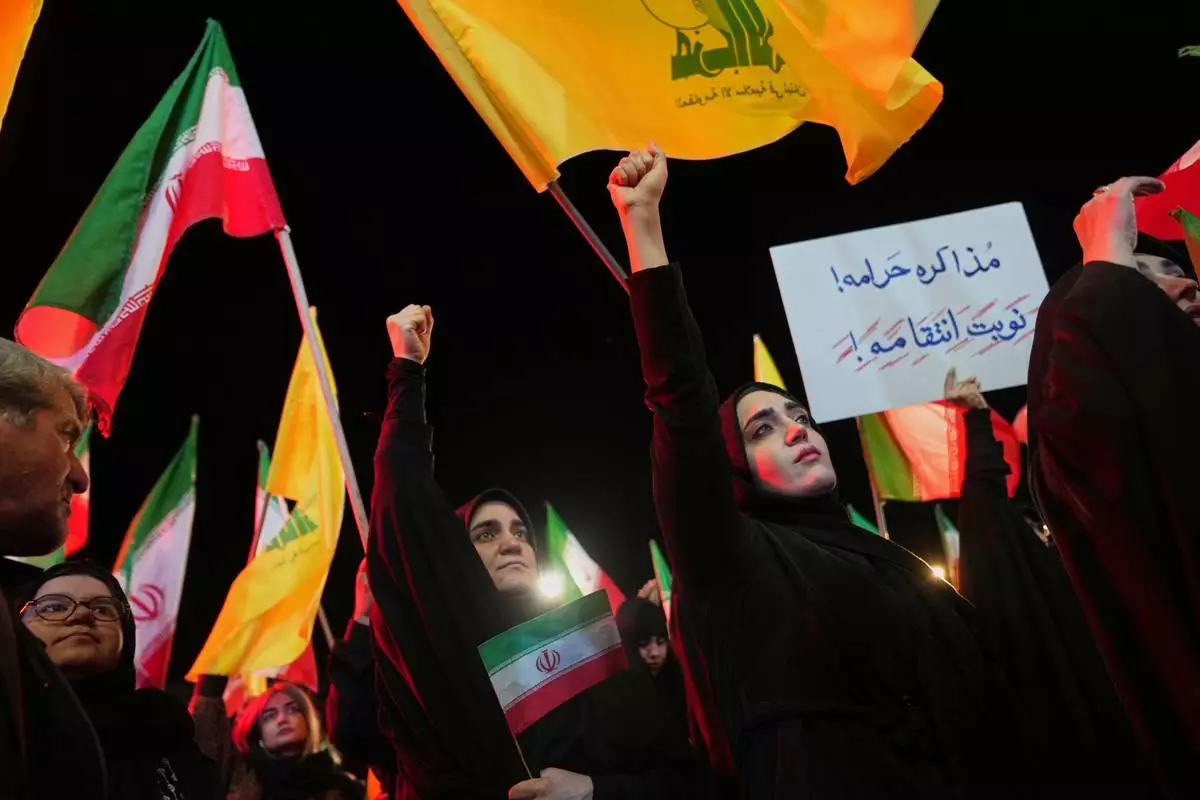
Government supporters gather ahead of the funeral procession for Maj. Gen. Majid Khademi, head of intelligence for Iran's paramilitary Revolutionary Guard, in Tehran, Iran, Wednesday, April 8, 2026. (AP Photo/Francisco Seco)
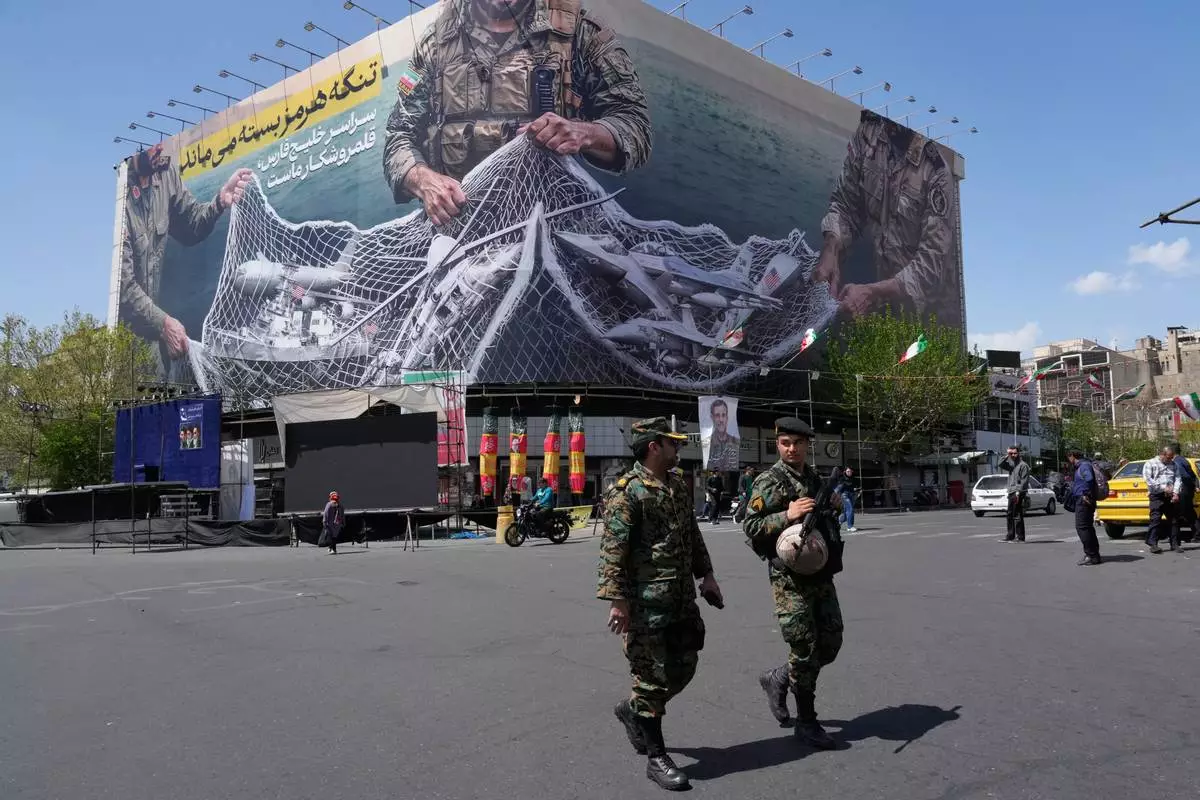
FILE - Two police officers walk in front of an anti-U.S. billboard depicting American aircraft being caught by Iranian armed forces in a fishing net beneath the words in Farsi, "The Strait of Hormuz will remain closed, The entire Persian Gulf is our hunting ground," in Tehran, Iran, Sunday, April 5, 2026. (AP Photo/Vahid Salemi, File)