LONDON (AP) — A 300-million-year-old tentacled sea creature has lost its crown as the world’s oldest octopus, after scientists found evidence that it’s not an octopus at all.
Newly published research concludes that fossilized remains listed by Guinness World Records as the earliest known octopus belong instead to a relative of a nautilus, a cephalopod with both tentacles and a shell.
University of Reading zoologist Thomas Clements, the lead researcher behind the new findings, said the fossil, Pohlsepia mazonensis, has long been the subject of scientific debate.
“It’s a very difficult fossil to interpret,” he said. “To look at it, it kind of just looks like a white mush.
“If you look at it and you are a cephalopod researcher and you’re interested in everything octopus, it does superficially look a lot like a deep-water octopus.”
The creature, a blob about the size of a human hand, was found in the Mazon Creek area of Illinois, about 50 miles southwest of Chicago, that is rich in fossils from a period before dinosaurs walked the Earth.
Its identification by paleontologists as an octopus in 2000 upended ideas about the evolution of the eight-tentacled cephalopods, suggesting they emerged much earlier than previously thought. The next oldest-known octopus fossil is only about 90 million years old.
“It’s a huge gap,” Clements said. “And so that big gap got researchers sort of questioning, ‘Is this thing actually an octopus?”
To solve the mystery of the “weird blob,” Clements and his team used a synchrotron — which uses fast-moving electrons to create beams of light brighter than the sun — to look inside the fossil rock. They found a ribbon of teeth known as a radula that is common to all mollusks, including nautiluses and octopuses. Each row had 11 teeth. Octopuses have either seven or nine.
“This has too many teeth, so it can’t be an octopus,” Clements said. “And that’s how we realize that the world’s oldest octopus is actually a fossil nautilus, not an octopus.”
The teeth matched those of a fossil nautiloid called Paleocadmus pohli that had been found in the same area. Clements said the mistaken identification may have happened because the creature decomposed and lost its telltale shell before it was fossilized, complicating identification.
As a result of the findings published this week in the journal Proceedings of the Royal Society B, Guinness World Records said it will no longer list Pohlsepia mazonensis as the earliest known octopus.
Managing Editor Adam Millward said the scientists had made “a fascinating discovery.”
“We will be resting the original ‘oldest octopus fossil’ title and look forward to reviewing this new evidence,” he said.
Pohlsepia mazonensis is named for its discoverer James Pohl, and is in the collection of the Field Museum in Chicago.
Clements said the museum should not be disappointed by the new evidence, which means it now has “the oldest soft tissue nautilus in the world.
“The Field Museum have a small collection of these ancient nautiluses, which I think as a cephalopod worker is probably the best thing ever,” he said.
The museum has been approached for comment.

FILE -Field Museum and Chicago's skyline is seen from Soldier Field prior to an NFL preseason football game between the Chicago Bears and the Tennessee Titans, Aug. 12, 2023, in Chicago. (AP Photo/Kamil Krzaczynski, File)
DUBAI, United Arab Emirates (AP) — Semiofficial news agencies in Iran published a chart Thursday suggesting the country’s paramilitary Revolutionary Guard put sea mines into the Strait of Hormuz during the war, in a message that may be intended to pressure the U.S. as uncertainty hangs over a days-old two-week ceasefire and further negotiations are expected in Pakistan.
The shaky ceasefire has been largely holding between the U.S., Israel and Iran, although Tehran and Washington have offered vastly different explanations of the initial terms.
Israel insists the agreement does not apply to their war against Hezbollah militants in Lebanon and have escalated deadly strikes there, leading Iran to claim it is violating the deal. Meanwhile, Iran said it had won agreement that it would control the Strait of Hormuz, charge tolls and enrich uranium — while Trump said the deal called for the strait to be reopened and Iran to hand over its uranium stockpile.
The chart of the Strait of Hormuz was released by the ISNA news agency, as well as Tasnim, which is believed to be close to the Guard. They showed a large circle marked “danger zone” in Farsi over the Traffic Separation Scheme, which was the route ships take through the strait, the narrow mouth of the Persian Gulf through which 20% of all oil and natural gas traded once passed.
The chart suggested ships travel further north through waters closer to Iran’s mainland near Larak Island, a route that some ships were observed taking during the war. It was dated from Feb. 28 until Thursday, April 9, and it was unclear if the Guard had cleared any mining on the route since then.
Oil rose again to above $97 a barrel and Asian stocks were trading lower Thursday on skepticism over the ceasefire. Brent crude, the international standard, was up 2.9% to $97.46 per barrel. It had fallen briefly to below $92 following the temporary ceasefire announcement. Benchmark U.S. crude was 3.7% higher Thursday at $97.94 per barrel.
Ship-tracking data from Kpler showed only four vessels with their Automatic Identification System trackers on passed through the Strait of Hormuz on Wednesday, the first day of the ceasefire. However, that does not include so-called “dark fleet” vessels, which travel with their AIS trackers turned off. Many of those “dark fleet” ships carry sanctioned Iranian crude oil out to the open market.
U.S. President Donald Trump posted a statement insisting that his surge of warships and troops will remain around Iran “until such time as the REAL AGREEMENT reached is fully complied with.”
Trump’s comments on his Truth Social platform appeared to be a way to pressure Iran.
“If for any reason it is not, which is highly unlikely, then the ‘Shootin’ Starts,’ bigger, and better, and stronger than anyone has ever seen before,” Trump wrote.
He also insisted Iran would not be able to build nuclear weapons and “the Strait of Hormuz WILL BE OPEN & SAFE.”
The U.S. and Iran both claimed victory after reaching the ceasefire agreement, and world leaders expressed relief. But more drones and missiles hit Iran and Gulf Arab countries after the deal was announced.
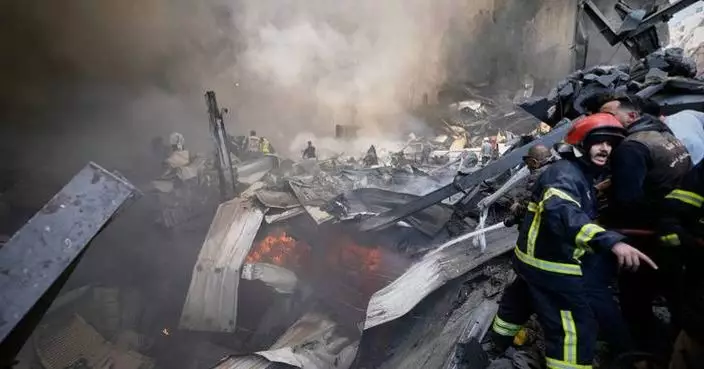
Israel also intensified its attacks on the Hezbollah militant group in Lebanon on Wednesday, hitting commercial and residential areas in Beirut. At least 182 people were killed in the deadliest day of fighting there. First responders searched overnight for missing people still under the rubble after the deadly Israeli strikes.
Lebanon's state-run National News Agency reported Thursday that an Israeli strike overnight had killed at least seven people in southern Lebanon. The Israeli military did not immediately acknowledge the strike.
The violence threatens to scuttle what U.S. Vice President JD Vance called a “fragile” deal.
Iran's parliament speaker said Wednesday that planned talks were “unreasonable” because Washington had broken three of Tehran’s 10 conditions for an end to the fighting. In a social media post, Mohammad Bagher Qalibaf objected to Israeli attacks on Hezbollah, an alleged drone incursion into Iranian airspace after the ceasefire took effect and U.S. refusal to accept any Iranian enrichment capabilities in a final agreement.
Iranian Foreign Minister Abbas Araghchi insisted an end to the war in Lebanon was part of the ceasefire deal, but Israeli Prime Minister Benjamin Netanyahu and Trump said the truce did not cover Lebanon. When the deal was announced, the prime minister of Pakistan, which served as a mediator, said in a social media post that it applied to “everywhere including Lebanon and elsewhere.”
A New York-based think tank warned the ceasefire “hovers on the verge of collapse.”
The Soufan Center said Israel's strikes on Lebanon on Wednesday added to the risk the deal would fall apart.
“Even if Lebanon was formally outside the deal, the scale of Israel’s strikes was likely to be viewed as escalatory, nonetheless,” it wrote in an analysis published Thursday. “Israel’s strikes can be understood both as an effort to drive a wedge between Iran and its proxies and as a response to being allegedly sidelined in the original ceasefire discussions.”
The White House said that Vice President JD Vance would lead the U.S. delegation to talks in Islamabad aimed at ending the war, which are set to start Saturday.
Iran's ambassador in Islamabad, Reza Amiri Moghadam, wrote on X that Iran's negotiating team would arrive in the Pakistani capital Thursday night, but later deleted the post without providing further comment.
His initial post said the talks would be "based on 10 points proposed by Iran.”
Those include Iran enriching uranium, maintaining its control of the Strait of Hormuz and other issues that have been nonstarters in the past for Trump. The White House has repeatedly described the 10 points issued by Iran as false.
Becatoros reported from Athens, Greece. Chan Ho-him in Hong Kong, Zeke Miller in Washington and Kareem Chehayeb and Hussein Malla contributed to this report.

A rescue worker extinguishes burning cars at the site of an Israeli airstrike in central Beirut, Lebanon, Wednesday, April 8, 2026. (AP Photo/Hussein Malla)
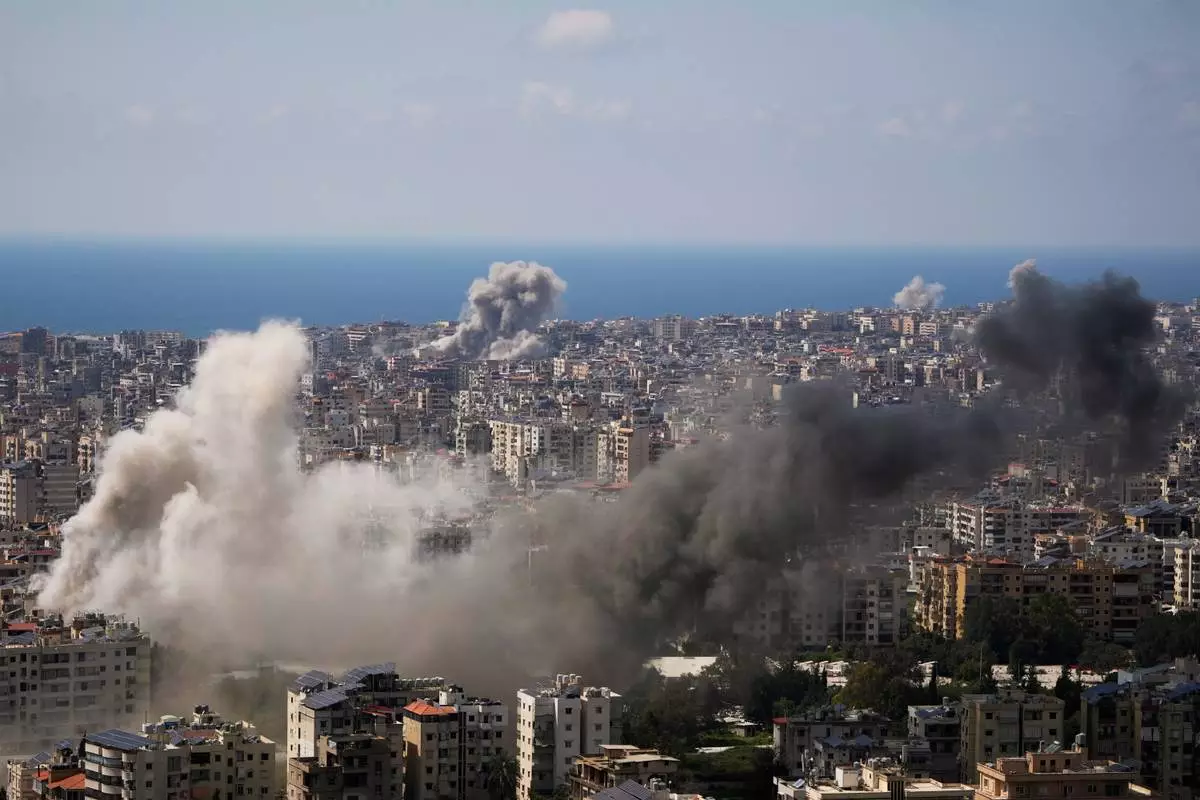
Smoke rises following several Israeli airstrikes in Beirut, Lebanon, Wednesday, April 8, 2026. (AP Photo/Hassan Ammar)
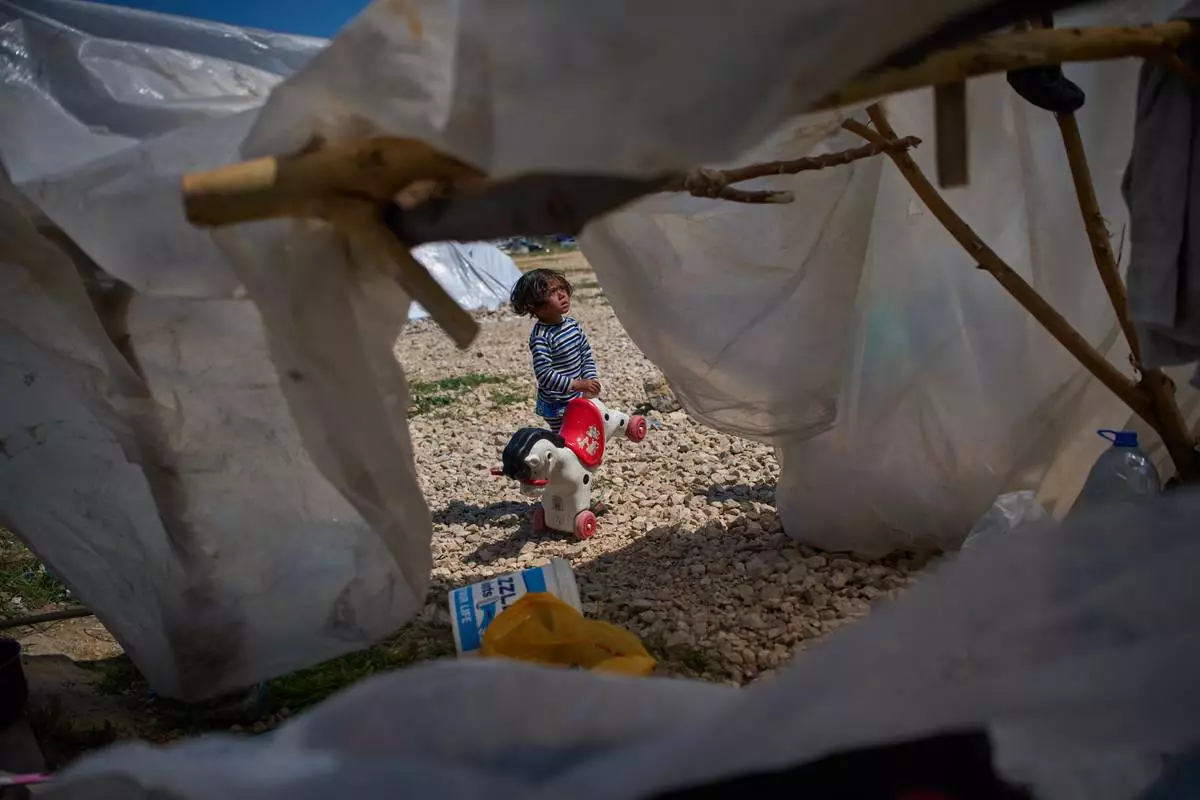
Ali, 4, holds a toy horse next to the tent his family uses as a shelter after fleeing Israeli bombardment in southern Lebanon, in Beirut, Lebanon, Wednesday, April 8, 2026. (AP Photo/Emilio Morenatti)
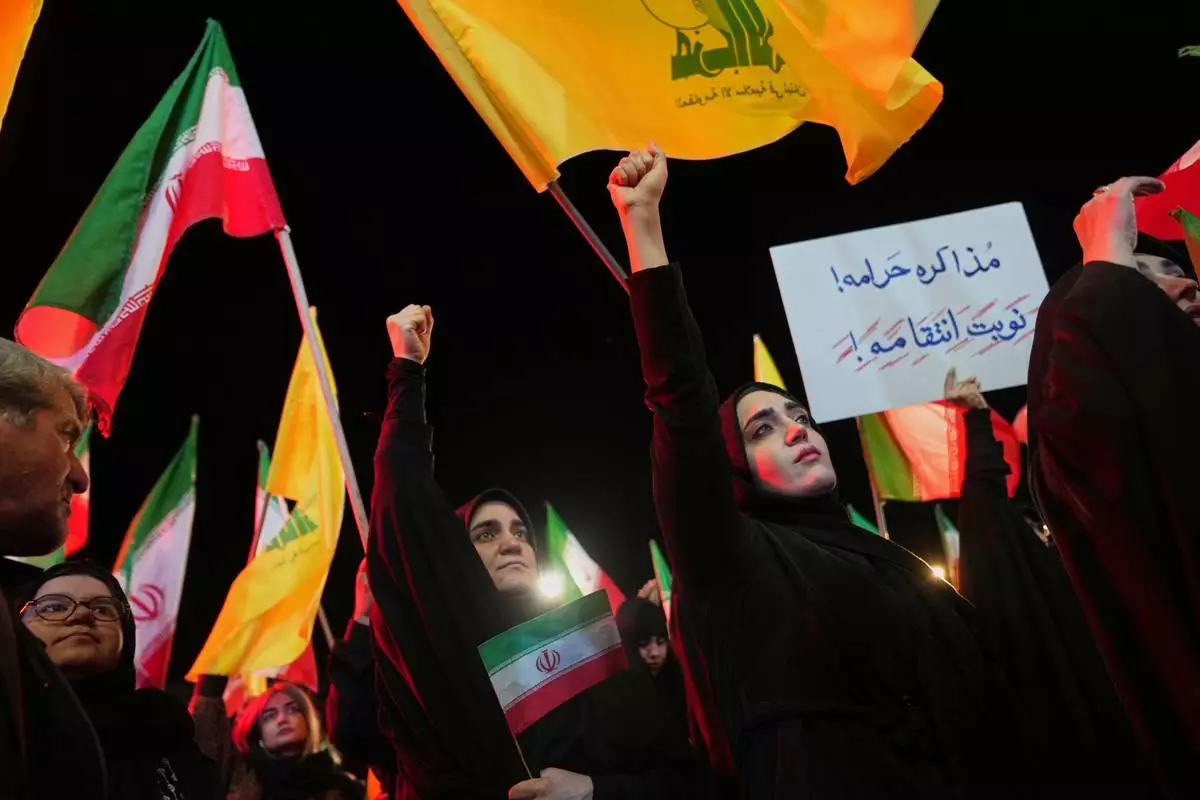
Government supporters gather ahead of the funeral procession for Maj. Gen. Majid Khademi, head of intelligence for Iran's paramilitary Revolutionary Guard, in Tehran, Iran, Wednesday, April 8, 2026. (AP Photo/Francisco Seco)
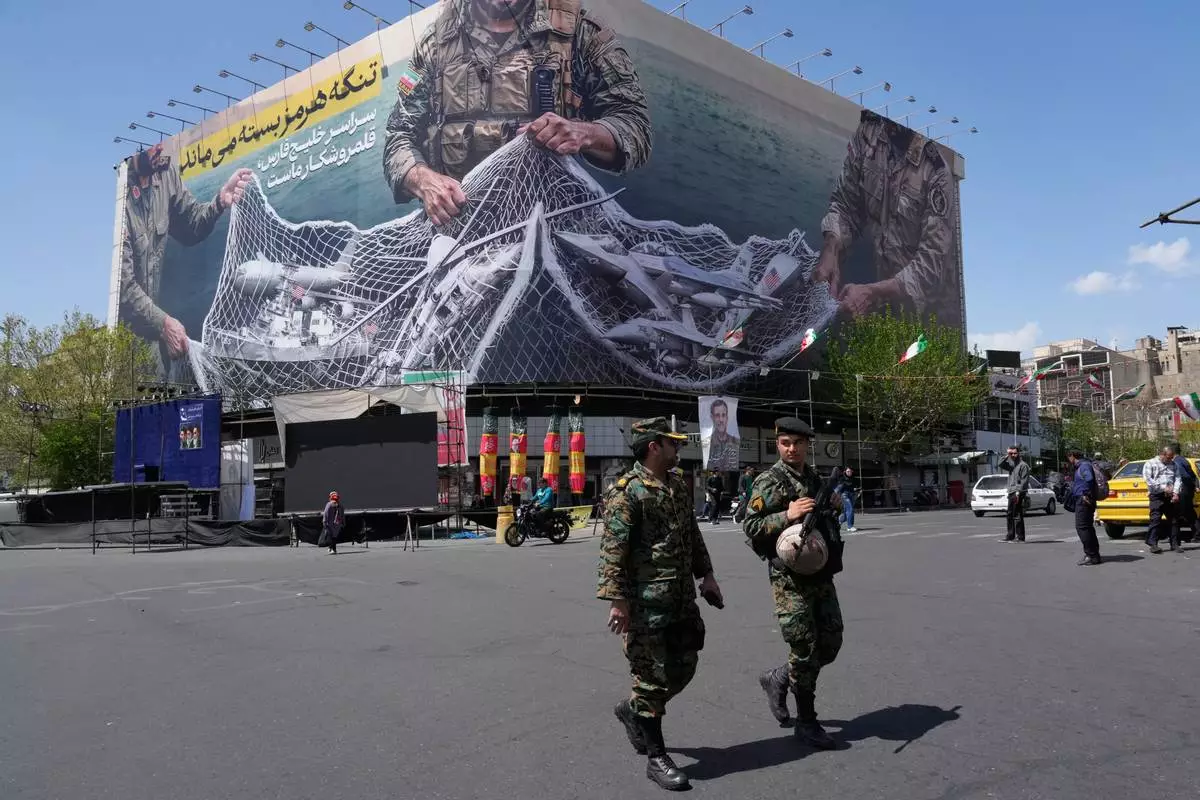
FILE - Two police officers walk in front of an anti-U.S. billboard depicting American aircraft being caught by Iranian armed forces in a fishing net beneath the words in Farsi, "The Strait of Hormuz will remain closed, The entire Persian Gulf is our hunting ground," in Tehran, Iran, Sunday, April 5, 2026. (AP Photo/Vahid Salemi, File)