WASHINGTON (AP) — Despite rare negotiations between Democrats and President Donald Trump, a bipartisan agreement on new restrictions for federal immigration enforcement in the next two weeks will be exceedingly difficult — or even “an impossibility,” as Republican Senate Majority Leader John Thune said.
Congress is discussing potential new rules for Immigration and Customs Enforcement and U.S. Customs and Border Protection after officers shot and killed two Minneapolis protesters in January. The negotiations come amid some bipartisan sentiment that Congress should step in to de-escalate tensions over the enforcement operations that have rocked Minnesota and other states.
President Donald Trump last week agreed to a Democratic request that funding for the Department of Homeland Security be separated from a larger spending bill and extended at current levels for two weeks while the two parties discuss possible requirements for the federal agents. House Speaker Mike Johnson, R-La., said this weekend that he was at the White House when Trump spoke with Senate Democratic leader Chuck Schumer of New York and that they were “on the path to get agreement.”
But it’s unclear if the president or enough congressional Republicans will agree to any of the Democrats’ larger demands that the officers unmask and identify themselves, obtain judicial warrants in certain cases and work with local authorities, among other asks. Republicans have already pushed back.
And House GOP lawmakers are demanding that some of their own priorities be added to the Homeland Security spending bill, including legislation that would require proof of citizenship before Americans register to vote. South Carolina Sen. Lindsey Graham and other Republican senators are pushing for restrictions on sanctuary cities that they say don't do enough to crack down on illegal immigration. There’s no clear definition of sanctuary jurisdictions, but the term is generally applied to state and local governments that limit cooperation with federal immigration authorities.
It’s also uncertain if Democrats who are furious over the Trump administration’s increasingly aggressive immigration enforcement operations would be willing to compromise.
“We don’t need promises. We need law,” Schumer said, adding that Democrats would present Republicans with a “serious, detailed proposal” soon.
A look at Democrats’ demands and what Republicans are saying about them:
Republicans say they are open to officer-worn body cameras, a change that was already in the underlying Homeland Security spending bill. Homeland Security Secretary Kristi Noem backed that up on Monday when she ordered body-worn cameras to be issued to every Homeland Security officer on the ground in Minneapolis, including those from ICE. She said the policy would expand nationwide as funding becomes available.
The bill already directed $20 million to outfit immigration enforcement agents with body-worn cameras.
Gil Kerlikowske, who served as commissioner of U.S. Customs and Border Protection from 2014 to 2017, said that most agents are “very supportive” of cameras because they could help exonerate officers. But he added that complex questions remain, including when footage should be released and when cameras must be activated.
“When do you turn it on? And if you got into a problem and didn’t have it on, are you going to be disciplined? It’s really pretty complex,” he said.
Schumer said Tuesday that the body cameras “need to stay on.”
As videos and photos of aggressive immigration tactics and high-profile shootings circulate nationwide, agents covering their faces with masks has become a flashpoint. Democrats argue that removing the masks would increase accountability. Republicans warn it could expose agents to harassment and threats.
“State law enforcement, local folks don’t do it," said Rep. Bennie Thompson, the top Democrat on the Committee for Homeland Security. "I mean, what’s so special about an ICE law enforcement agency that they have to wear a mask?”
But Republicans appear unlikely to agree.
“Unlike your local law enforcement in your hometown, ICE agents are being doxed and targeted. We have evidence of that,” Johnson said on Tuesday. He added that if you “unmask them and you put all their identifying information on their uniform, they will obviously be targeted.”
Immigration officers are already required to identify themselves “as soon as it is practical and safe to do so,” according to federal regulations. ICE officials insist those rules are being followed.
Critics, however, question how closely officers adhere to the regulations.
“We just see routinely that that’s not happening,” said Nithya Nathan Pineau, a policy attorney with the Immigrant Legal Resource Center.
Democrats have also demanded stricter use of judicial warrants and an end to roving patrols of agents who are targeting people in the streets and in their homes. Schumer said Tuesday that they want “arrest warrants and an end to racial profiling.”
Most immigration arrests are carried out under administrative warrants, internal documents issued by immigration authorities that authorize the arrest of a specific person but do not permit officers to forcibly enter private homes or other non-public spaces without consent. Traditionally, only warrants signed by judges carry that authority.
But an internal ICE memo obtained by The Associated Press last month authorizes ICE officers to use force to enter a residence based solely on a more narrow administrative warrant to arrest someone with a final order of removal, a move that advocates say collides with Fourth Amendment protections.
Democrats have not made clear how broadly they want judicial warrants used. House Democratic leader Hakeem Jeffries of New York said that Democrats want to see “an end to the targeting of sensitive locations like houses of worship, schools and hospitals.”
Johnson said Tuesday that Democrats are trying to “add an entirely new layer” by seeking warrants signed by a judge rather than the administrative warrants that are signed by the department. “We can’t do that,” he said.
The speaker has said that an end to roving patrols is a potential area of agreement, but he did not give details.
Democrats have also called for a uniform code of conduct for all ICE and federal agents similar to that for state and local law enforcement officers.
Federal officials blocked state investigators from accessing evidence after protester Renee Good was shot and killed by an ICE agent on Jan. 7. Gov. Tim Walz, a Democrat, demanded that the state be allowed to take part, saying that it would be “very difficult for Minnesotans” to accept that an investigation excluding the state could be fair.
Any deal Democrats strike on the Department of Homeland Security is unlikely to satisfy everyone in the party. Rep. Ayanna Pressley of Massachusetts said she would never support an agreement that didn't require unmasking.
“I ran for Congress in 2018 on abolish ICE,” Pressley said. “My position has not changed.”
Thune, of South Dakota, has repeatedly said it's an “impossibility” to negotiate and pass something so complicated in two weeks. He said any talks should be between Democrats and Trump.
“I don’t think it’s very realistic," Thune said Tuesday about finding quick agreement. “But there’s always miracles, right?”
Associated Press writer Rebecca Santana contributed to this report.
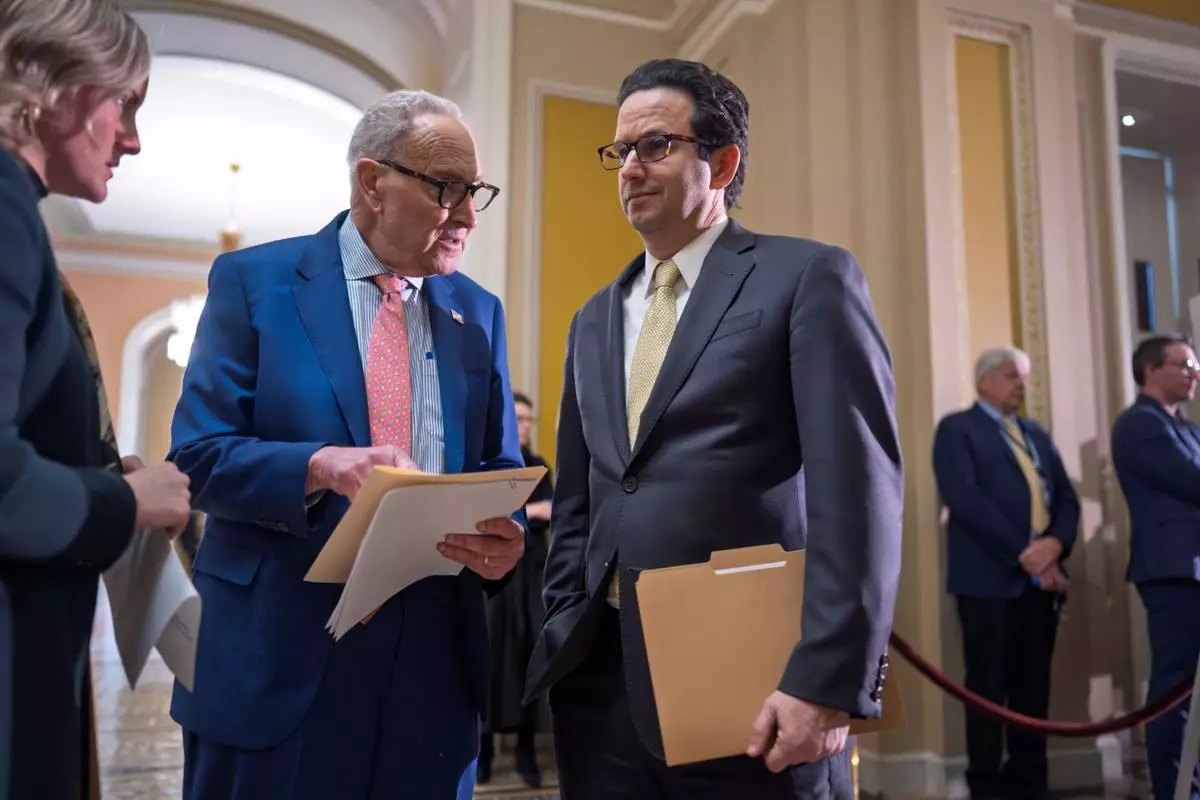
Senate Minority Leader Chuck Schumer, D-N.Y., center, confers with Sen. Brian Schatz, D-Hawaii, talk following a Senate Democratic Caucus meeting, at the Capitol in Washington, Tuesday, Feb. 3, 2026. (AP Photo/J. Scott Applewhite)
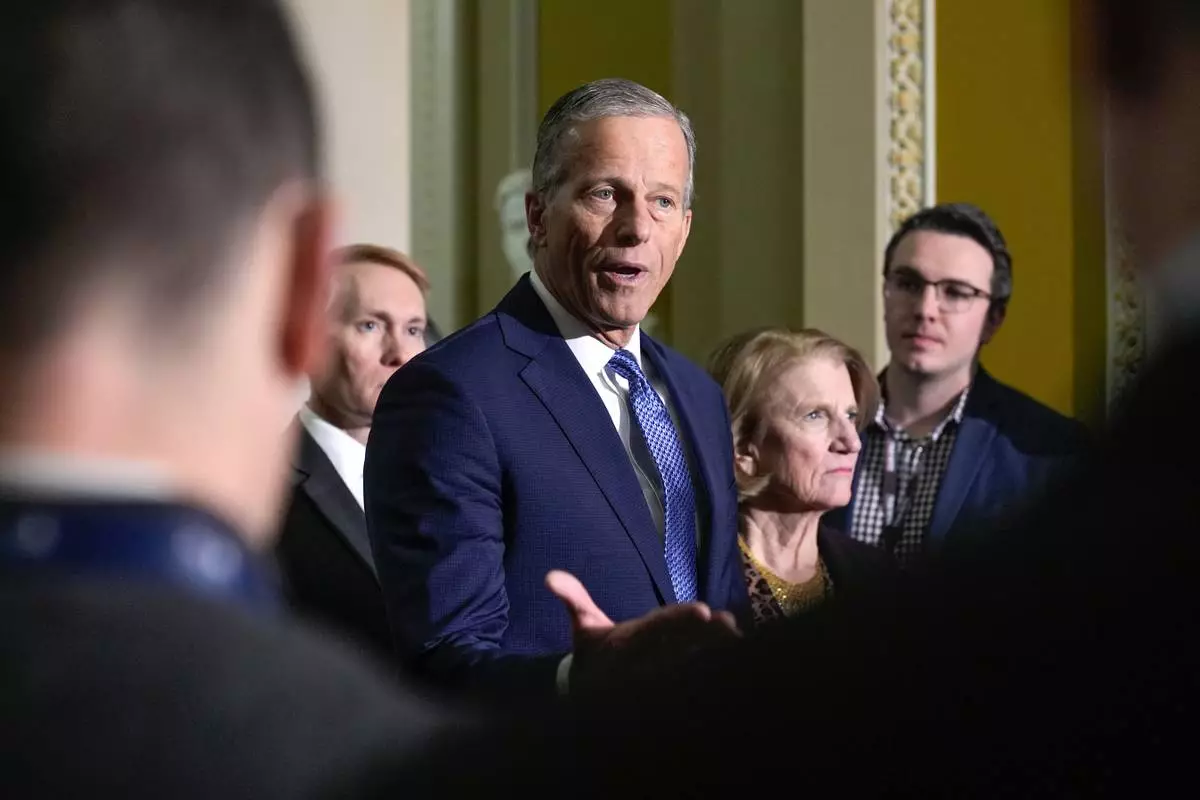
Senate Majority Leader John Thune, R-S.D., speaks during a news conference after a policy luncheon on Capitol Hill, Tuesday, Feb. 3, 2026, in Washington. (AP Photo/Mariam Zuhaib)
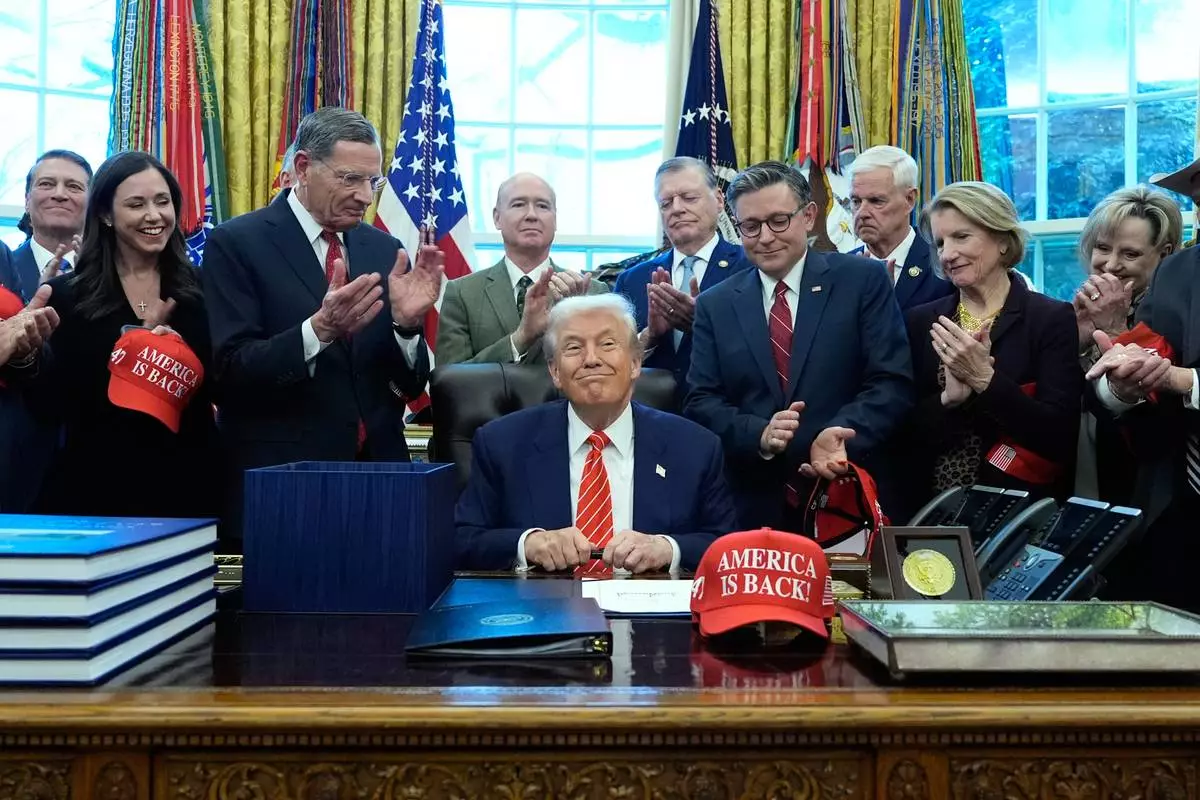
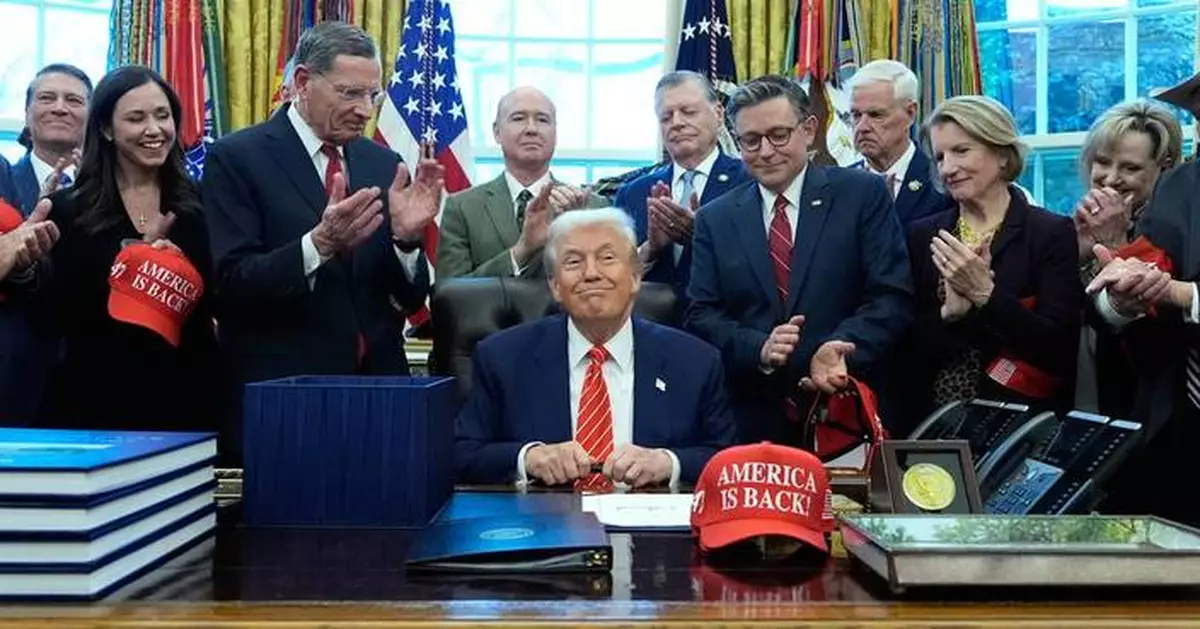
President Donald Trump smiles after signing a spending bill that ends a partial shutdown of the federal government in the Oval Office of the White House, Tuesday, Feb. 3, 2026, in Washington. (AP Photo/Alex Brandon)