REDWOOD CITY, Calif.--(BUSINESS WIRE)--Feb 4, 2026--
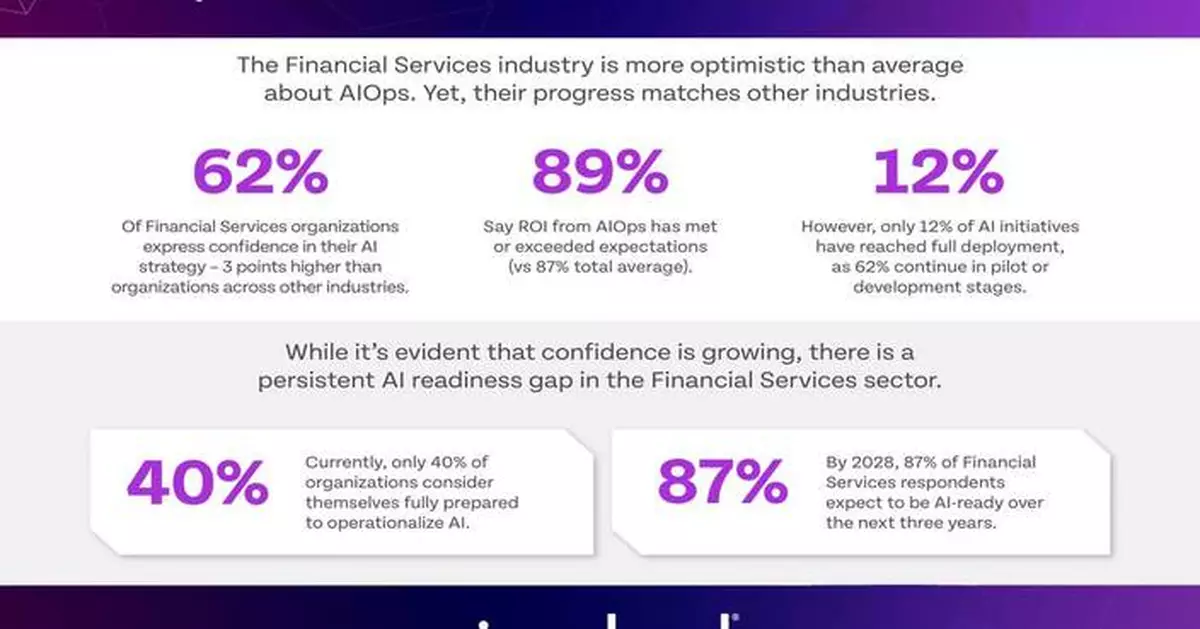
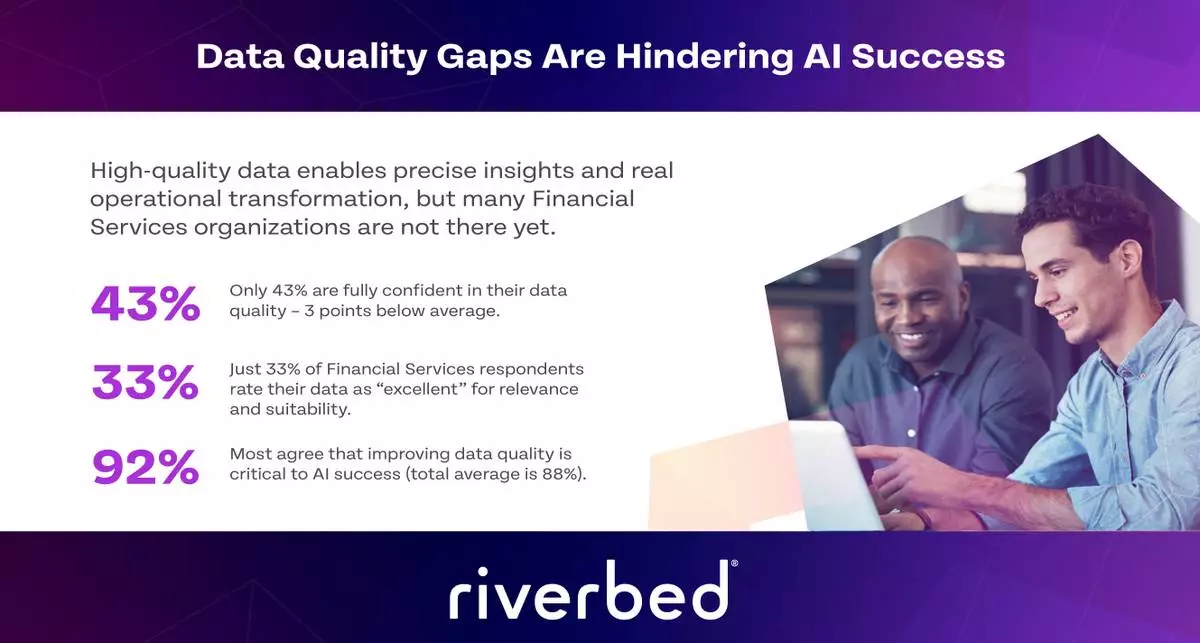
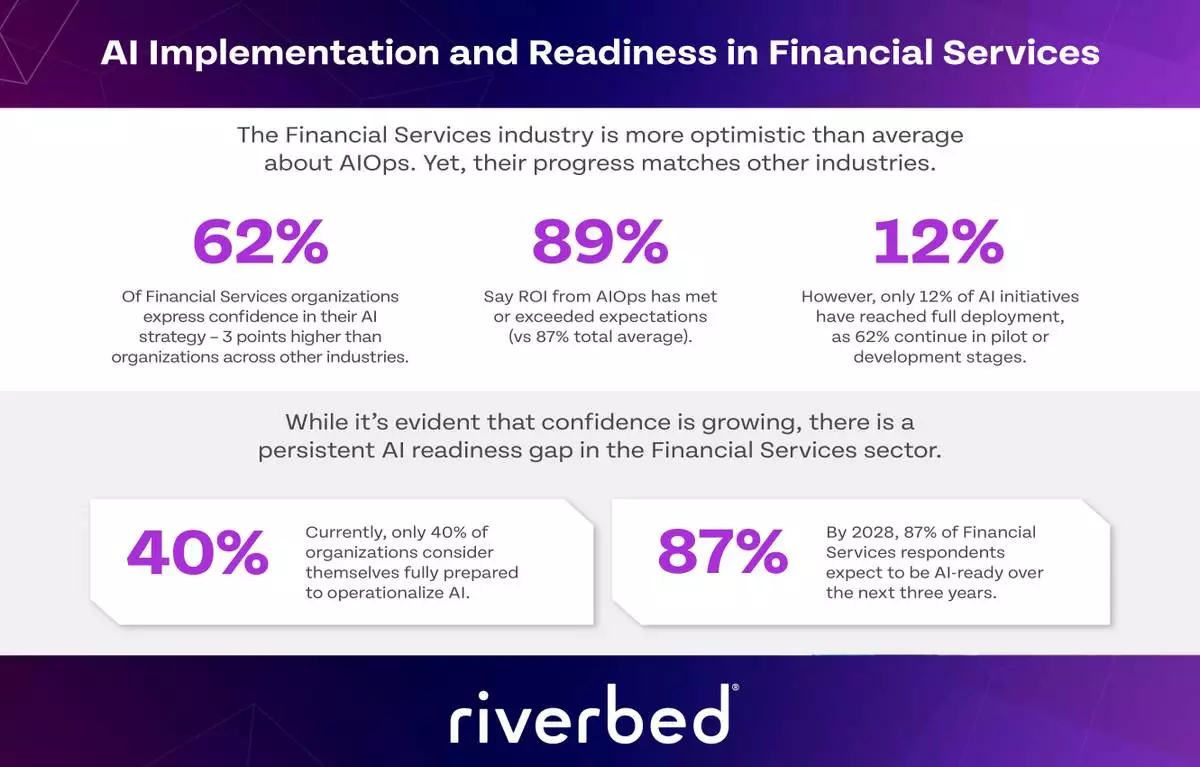
Riverbed, the leader in AIOps for observability, today released Financial Services industry findings from its global survey, ‘The Future of IT Operations in the AI Era, ’ which examines the level of AI readiness across the Financial Services Sector. The results highlight a growing implementation gap as organizations move from AI ambition to real-world impact. While nearly all Financial Services decision-makers (92%) agree that improving data quality is critical to AI success, progress remains uneven: only 12% of AI initiatives have achieved full enterprise-wide deployment, while a significant 62% still remain in pilot or development stages, underscoring the challenges of operationalizing AI in one of the world’s most regulated and risk-sensitive industries.
This press release features multimedia. View the full release here: https://www.businesswire.com/news/home/20260204852231/en/
View the Financial Services Infographic here:riverbed.com/aiops-survey25/
However, the Financial Services sector continues to demonstrate strong confidence in the value of AI and AIOps, with 89% of organizations reporting that ROI from their AIOps investments has met or exceeded expectations, reinforcing the industry’s reputation for disciplined, value-driven technology adoption. Nearly two-thirds (62%) of respondents also express a high degree of confidence in their AI strategy. Yet despite this optimism, Financial Services organizations continue to be affected by AI implementation gaps. Amid mounting pressures to optimize operations, strengthen compliance, mitigate risk, and deliver superior digital experiences, this industry is increasingly constrained by data readiness, operational complexity, and the ability to scale AI beyond pilot initiatives.
“Financial Services organizations are among the most sophisticated and disciplined adopters of AI, and our research shows they’re already seeing strong returns,” said Jim Gargan, Chief Marketing Officer, at Riverbed. “However, the sector operates under unique pressures, including rigorous regulatory scrutiny, zero tolerance for downtime and a critical need for data accuracy. What’s clear is that success now depends on simplifying IT, consolidating observability tools and vendors, improving data quality, embracing open standards like OpenTelemetry, and ensuring network and application performance can support AI at scale. At Riverbed, we are actively supporting some of the world’s largest Financial Services organizations as they bridge this gap and turn AI ambition into operational reality.”
AI ambition meets operational reality
For Financial Services institutions, AI success is not defined by experimentation alone; it depends on operational readiness. The research shows that just 40% of Financial Services organizations feel fully prepared to operationalize their AI strategy today. Data remains the most significant constraint as only 43% are fully confident in the accuracy and completeness of all their organizations data, the lowest level of confidence across all industries surveyed.
Crucially, the sector understands what is at stake. 92% of Financial Services respondents agree that improving data quality is critical to AI success, the highest proportion of any industry. This reflects a deep awareness that without trusted, high-quality data, AI initiatives struggle to move from proof-of-concept to production.
Operational complexity drives the push for simplification
These data challenges are compounded by the complexity of today’s IT environments. To support digital services, real-time transactions and growing AI workloads, Financial Services organizations have accumulated fragmented toolsets that limit visibility and slow decision-making. On average, IT teams currently have 13 observability tools from nine different vendors, creating blind spots across applications, networks and user experience.
As a result, 96% of organizations in this sector are actively consolidating tools and vendors across IT operations, with 95% agreeing that a unified observability platform would make it easier to identify and resolve operational issues. Notably, 95% are considering new vendors as part of this consolidation – the highest level among all industries surveyed – signaling a willingness to rethink long-standing technology relationships in favor of a platform that can reduce risk, improve integration and support AI at scale.
Unified communications performance becomes business-critical
As Financial Services continue to digitize client engagement and internal workflows, the performance of unified communications (UC) tools has become business-critical. Employees now spend 41% of their working week using UC tools, and nearly two-thirds say they are essential to operating effectively. Yet performance remains inconsistent. Only 47% of Financial Services organizations are very satisfied with UC performance, while 44% report regular issues across video calls, messaging platforms, and collaborative workspaces.
These challenges create significant operational constraints. UC-related issues account for 16% of all IT tickets, taking an average of 41 minutes to resolve, with nearly one in five tickets requiring more than an hour. In a sector where responsiveness and availability directly affect customer trust, limited visibility and high support demands continue to hinder productivity and experience.
OpenTelemetry underpins observability at scale
To overcome fragmented visibility and support AI-driven operations, Financial Services organizations are increasingly turning to open, standardized observability frameworks. OpenTelemetry plays a critical role by enabling consistent data collection and correlation across applications, infrastructure and user experience, a prerequisite for trustworthy AI in complex, regulated environments.
Encouragingly, the survey shows that Financial Services organizations lead all sectors in OpenTelemetry adoption, with 92% already leveraging the framework. Nearly all respondents (96%) say that cross-domain correlation is critical to their observability strategy, while 99% agree that OpenTelemetry reduces vendor lock-in and increases flexibility. Importantly, 97% view it as a foundation for future initiatives such as AI-driven automation, reinforcing its role as an enabler of long-term AI scalability.
AI data movement and network performance take center stage
As AI initiatives mature, attention is shifting from models to the movement of data that fuels them. Financial Services organizations place greater importance on AI data movement than any other sector surveyed, with 94% viewing it as important to their overall AI strategy and 37% describing it as critical and foundational to how they design and execute AI.
With AI data increasingly distributed across public cloud, edge and co-location environments, network performance and security emerge as decisive success factors, cited as essential by 81% of respondents, the highest of any industry. Looking ahead, 76% of Financial Services organizations plan to establish an AI data repository strategy by 2028, underscoring the need for governed, high-performance architectures that balance innovation with compliance and control.
Find out more about how organizations are overcoming gaps and navigating AI adoption and implementation by viewing the full report here.
* Note: Unless otherwise noted, all data and percentages referenced in the press release are percentages calculated from responses to the Riverbed Global Survey 2025: The Future of IT Operations in the AI Era. Respondents included business and IT leaders and technical specialists across seven countries in the Financial Services industry.
Methodology:
The Riverbed Global Survey on the Future of IT Operations in the AI Era polled 1,200 business decision-makers, IT leaders and technical specialists across seven countries and multiple industries, including financial services. The research was conducted by Coleman Parkes Research in July 2025.
About Riverbed
Riverbed, the leader in AIOps for observability, helps organizations optimize their users’ experiences by leveraging AI automation for the prevention, identification, and resolution of IT issues. With over 20 years of experience in data collection and AI and machine learning, Riverbed’s open and AI-powered observability platform and solutions optimize digital experiences and greatly improves IT efficiency. Riverbed also offers industry-leading Acceleration solutions that provide fast, agile, secure acceleration of any app, over any network, to users anywhere. Together with our thousands of market-leading customers globally – including 95% of the FORTUNE 100 – we are empowering next-generation digital experiences. Learn more at riverbed.com
Riverbed and certain other terms used herein are trademarks of Riverbed Technology LLC. All other trademarks used herein belong to their respective owners.
About Coleman Parkes
Coleman Parkes is a full-service B2B market research agency specializing in IT/technology studies, targeting senior decision makers in SMB to large enterprises across multiple sectors globally. For more information, contact IanBeston@coleman-parkes.co.uk
Connect with Riverbed
Riverbed Study Finds 92% of Decision Makers in the Financial Services Industry Agree that Improving Data Quality is Critical to AI Success
Riverbed Study Finds 92% of Decision Makers in the Financial Services Industry Agree that Improving Data Quality is Critical to AI Success