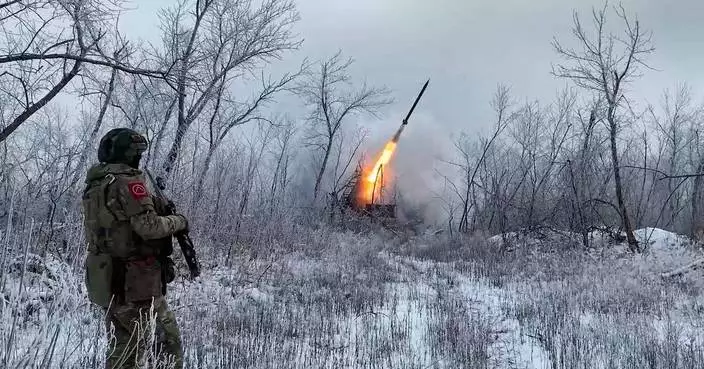
THE HAGUE, Netherlands (AP) — Russian missiles and drones have pounded Ukraine’s energy grid in recent weeks, plunging people into frozen darkness in one of the country’s coldest winters on record.
Ukraine has accused Russia of illegally targeting power infrastructure during the war to deny civilians light, heating and running water.
"Taking advantage of the coldest days of winter to terrorize people is more important to Russia than diplomacy,” Ukrainian President Volodymyr Zelenskyy said Tuesday, on the eve of a new round of talks about ending the conflict and as temperatures in Kyiv hovered around minus 20 C (minus 3 F).
Russia says its attacks are a legitimate part of its military campaign against its neighbor. Moscow's invasion of Ukraine itself is widely regarded as an illegal act of aggression.
So, are attacks on energy installations allowed during war?
Combatants can legally target a power grid if the attack “directly affects a valid military target” — but they cannot cause excessive civilian casualties, said David Crane, former chief prosecutor at the United Nations Special Court for Sierra Leone.
In the case of Russia's attacks on Ukraine, “the indiscriminate and widespread targeting does not come close to what is legal,” he said in an emailed response to questions from The Associated Press.
The International Committee of the Red Cross says that parts of energy systems providing essential services to civilians “are in principle civilian objects, and as such are protected against direct attack and reprisals as well as incidental harm.”
Pretrial judges from the International Criminal Court, in fact, issued arrest warrants in 2024 for top Russian military brass and the country’s former defense minister for their alleged involvement in missile strikes targeting electricity infrastructure.
In announcing warrants for former Defense Minister Sergei Shoigu and Russia’s chief military officer, Gen. Valery Gerasimov, the court said that judges found “reasonable grounds to believe that the alleged strikes were directed against civilian objects, and for those installations that may have qualified as military objectives at the relevant time, the expected incidental civilian harm and damage would have been clearly excessive to the anticipated military advantage.”
Russia is not a member of the court, rejects its jurisdiction, and refuses to extradite suspects to face justice in the ICC’s courtrooms in The Hague, Netherlands.
The Russian military has repeatedly said that it has targeted energy facilities and other infrastructure that support Ukrainian military industries and armed forces. It has denied targeting residential areas despite daily evidence to the contrary.
Kremlin spokesman Dmitry Peskov insisted Wednesday that “our military is striking the targets that they believe are associated with the military complex of the Kyiv regime, the operation is continuing.”
Kyiv accuses Russia of seeking to wear down Ukrainians’ appetite for the fight by inflicting grinding hardship on civilians forced to live in dark, freezing homes.
Authorities say Russia has tried to cripple Ukraine's electricity network by targeting substations, transformers, turbines and generators at power plants. Ukraine’s largest private power company, DTEK, said that this week's overnight attack was the ninth major assault on the company’s thermal power plants since October.
Ukraine’s energy sector has suffered more than $20 billion in direct war damage, according to a joint estimate by the World Bank, the European Commission and the United Nations.
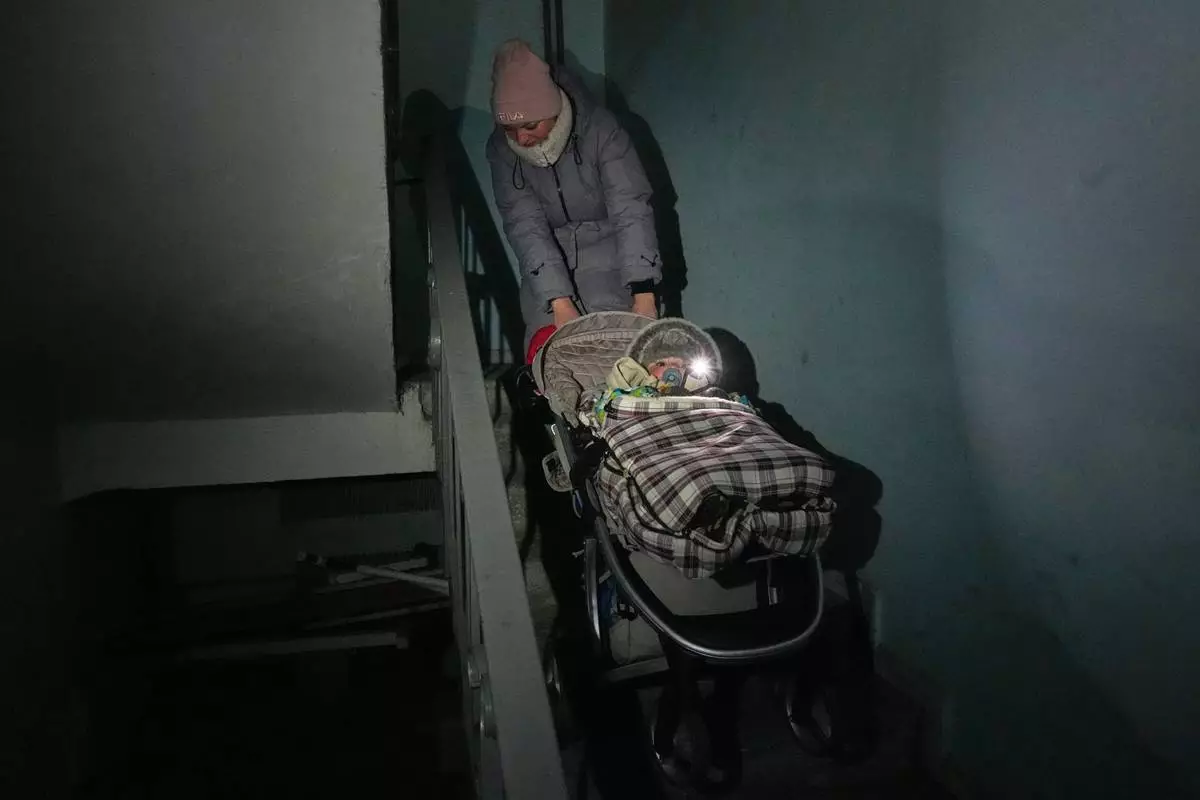
Yuliia Dolotova, 37, pulls her son in his stroller up the stairs in an apartment block during a power outage caused by Russia’s repeated air strikes on the country’s power grid, in Kyiv, Ukraine, Monday, Feb. 2, 2026. (AP Photo/Sergey Grits)

Yuliia Dolotova, 37, receives hot food at a distribution point during a power outage caused by Russia’s repeated air strikes on the country’s power grid, in Kyiv, Ukraine, Monday, Feb. 2, 2026. (AP Photo/Sergey Grits)

An elderly woman carries her bags out of a hot food distribution point during a power outage caused by Russia's repeated air strikes on the country's power grid, in Kyiv, Ukraine, Monday, Feb. 2, 2026. (AP Photo/Sergey Grits)
CORTINA D'AMPEZZO, Italy (AP) — Lindsey Vonn needed to use a crutch to get around over the weekend. Now she’s performing box jumps, working out in a pool while wearing a weighted vest and skiing at high speed.
No wonder the 41-year-old American is so optimistic that she can compete in the Milan Cortina Winter Olympics downhill on Sunday despite a ruptured ACL in her left knee.
“I’m pretty confident that she can still pull off this dream,” Chris Knight, Vonn’s head coach, told The Associated Press on Wednesday. “I’ve got no doubts in my mind that this is going to be OK.”
Vonn’s team of two physical therapists — Lindsay Winninger and Andi Mitterfellner — and fitness trainer Peter Meliessnig have been working overtime with her.
“She’s been doing box jumps, she’s trying everything out, loads and stresses and things like that to just see where she’s at and see how she feels and she’s pulled up great from everything,” Knight said. “No swelling, no pain.”
Vonn said on Tuesday that surgery “hasn’t been discussed."
“It’s not really on my radar screen right now. The Olympics are the only thing that I’m thinking about,” she said. “Every day my knee’s gotten better. And every day we’re discussing with a full medical team, doctors, physios, everyone, to make sure we’re doing everything to make sure I am making smart and safe decisions.”
Vonn had a partial titanium replacement inserted into her right knee in 2024 and returned to ski racing last season after nearly six years of retirement.
Now she also has bone bruising and meniscal damage in her left knee, though her doctors are not sure if the meniscal issue is a result of her latest injury or from her long series of mishaps earlier in her career.
“She’s not 20 years old, she’s 40 years old. And we’re not looking at anything past this year anyway,” Knight said. “Obviously there’s some risks to just to be able to even ski at the level she wants to ski at. And nobody knows 100% what’s going to happen. But all the right markers and factors are there for us. … It’s a pretty easy decision to keep moving forward.”
Vonn was injured when she lost control landing a jump in Crans-Montana, Switzerland, on Friday, and ended up crashing into the safety nets.
“She did have a crutch up until yesterday,” Knight said. “Just to help with a little bit of the load-bearing, but now that’s gone, too."
After using a crutch on Monday, Vonn tried some free skiing on Tuesday.
“She did some high-speed skiing,” Knight said, “and had no issues.”
Still, Vonn and her team could use some more time for recovery. Knight said she wouldn’t mind if there’s a weather-related cancellation and they got their wish Wednesday when organizers announced that Thursday’s opening downhill training session would not be held due to the heavy ongoing snowfall on the course.
“But we also need to get out of the start gate on one training run in case something happens further along the line and they have to cancel something else,” Knight said.
Two more training sessions are scheduled for Friday and Saturday, and Vonn needs to start at least one session to take part in Sunday’s race. She might only do just one.
“We have to see what the conditions are like,” Knight said. “There’s lots of options.”
Vonn holds the record of 12 World Cup wins in Cortina and has been racing here for nearly a quarter century, since before some of her current competitors were born. She's also come back successfully from injuries of this magnitude before.
“We’re on familiar territory,” Knight said. “That’s always been the most important part of it, going into this whole comeback 18-month project, is that we knew that we would get to a spot where she’s very, very familiar with. … Nothing is unknown apart from what’s just happened.”
There’s also this: Vonn wants to race in honor of her late mother, Lindy, who died in 2022 of ALS, otherwise known as Lou Gehrig’s disease, and her childhood coach, Erich Sailer, who died in August aged 99.
She stopped to visit Sailer’s grave in Austria on her way to Cortina.
“It’s just so many reasons for her to not let go that they’re powering her along and keeping the adrenaline high,” Knight said. “You don’t want to slow down in these situations.”
AP Winter Olympics: https://apnews.com/hub/milan-cortina-2026-winter-olympics

United States' Lindsey Vonn holds her left knee after crashing, during an alpine ski, women's World Cup downhill, in Crans Montana, Switzerland, Friday, Jan. 30, 2026. (Jean-Christophe Bott/Keystone via AP)

United States' Lindsey Vonn, Isabella Wright, Mary Bocock and Breezy Johnson, from left, attend a press conference by the U.S. ski team at the 2026 Winter Olympics, in Cortina d'Ampezzo, Italy, Tuesday, Feb. 3, 2026. (AP Photo/Fatima Shbair)

United States' Lindsey Vonn smiles during a press conference by the U.S. ski team at the 2026 Winter Olympics, in Cortina d'Ampezzo, Italy, Tuesday, Feb. 3, 2026. (AP Photo/Fatima Shbair)

United States' Lindsey Vonn approaches the finish area after crashing, during an alpine ski, women's World Cup downhill, in Crans Montana, Switzerland, Friday, Jan. 30, 2026. (Jean-Christophe Bott/Keystone via AP)

United States' Lindsey Vonn attends a press conference by the U.S. ski team at the 2026 Winter Olympics, in Cortina d'Ampezzo, Italy, Tuesday, Feb. 3, 2026. (AP Photo/Fatima Shbair)