Skip to Content Facebook Feature Image

Musk vows to put data centers in space and run them on solar power but experts have their doubts

News

Musk vows to put data centers in space and run them on solar power but experts have their doubts
News

News

Musk vows to put data centers in space and run them on solar power but experts have their doubts

2026-02-05 04:27 Last Updated At:04:40

NEW YORK (AP) — Elon Musk vowed this week to upend another industry just as he did with cars and rockets — and once again he's taking on long odds.

The world's richest man said he wants to put as many as a million satellites into orbit to form vast, solar-powered data centers in space — a move to allow expanded use of artificial intelligence and chatbots without triggering blackouts and sending utility bills soaring.

To finance that effort, Musk combined SpaceX with his AI business on Monday and plans a big initial public offering of the combined company.

“Space-based AI is obviously the only way to scale,” Musk wrote on SpaceX’s website Monday, adding about his solar ambitions, “It’s always sunny in space!”

But scientists and industry experts say even Musk — who outsmarted Detroit to turn Tesla into the world’s most valuable automaker — faces formidable technical, financial and environmental obstacles.

Here’s a look:

Capturing the sun’s energy from space to run chatbots and other AI tools would ease pressure on power grids and cut demand for sprawling computing warehouses that are consuming farms and forests and vast amounts of water to cool.

But space presents its own set of problems.

Data centers generate enormous heat. Space seems to offer a solution because it is cold. But it is also a vacuum, trapping heat inside objects in the same way that a Thermos keeps coffee hot using double walls with no air between them.

“An uncooled computer chip in space would overheat and melt much faster than one on Earth,” said Josep Jornet, a computer and electrical engineering professor at Northeastern University.

One fix is to build giant radiator panels that glow in infrared light to push the heat “out into the dark void,” says Jornet, noting that the technology has worked on a small scale, including on the International Space Station. But for Musk's data centers, he says, it would require an array of “massive, fragile structures that have never been built before.”

Then there is space junk.

A single malfunctioning satellite breaking down or losing orbit could trigger a cascade of collisions, potentially disrupting emergency communications, weather forecasting and other services.

Musk noted in a recent regulatory filing that he has had only one “low-velocity debris generating event" in seven years running Starlink, his satellite communications network. Starlink has operated about 10,000 satellites — but that's a fraction of the million or so he now plans to put in space.

“We could reach a tipping point where the chance of collision is going to be too great," said University at Buffalo's John Crassidis, a former NASA engineer. “And these objects are going fast -- 17,500 miles per hour. There could be very violent collisions."

Even without collisions, satellites fail, chips degrade, parts break.

Special GPU graphics chips used by AI companies, for instance, can become damaged and need to be replaced.

“On Earth, what you would do is send someone down to the data center," said Baiju Bhatt, CEO of Aetherflux, a space-based solar energy company. "You replace the server, you replace the GPU, you’d do some surgery on that thing and you’d slide it back in.”

But no such repair crew exists in orbit, and those GPUs in space could get damaged due to their exposure to high-energy particles from the sun.

Bhatt says one workaround is to overprovision the satellite with extra chips to replace the ones that fail. But that’s an expensive proposition given they are likely to cost tens of thousands of dollars each, and current Starlink satellites only have a lifespan of about five years.

Musk is not alone trying to solve these problems.

A company in Redmond, Washington, called Starcloud, launched a satellite in November carrying a single Nvidia-made AI computer chip to test out how it would fare in space. Google is exploring orbital data centers in a venture it calls Project Suncatcher. And Jeff Bezos’ Blue Origin announced plans in January for a constellation of more than 5,000 satellites to start launching late next year, though its focus has been more on communications than AI.

Still, Musk has an edge: He's got rockets.

Starcloud had to use one of his Falcon rockets to put its chip in space last year. Aetherflux plans to send a set of chips it calls a Galactic Brain to space on a SpaceX rocket later this year. And Google may also need to turn to Musk to get its first two planned prototype satellites off the ground by early next year.

Pierre Lionnet, a research director at the trade association Eurospace, says Musk routinely charges rivals far more than he charges himself —- as much as $20,000 per kilo of payload versus $2,000 internally.

He said Musk’s announcements this week signal that he plans to use that advantage to win this new space race.

“When he says we are going to put these data centers in space, it’s a way of telling the others we will keep these low launch costs for myself,” said Lionnet. “It’s a kind of powerplay.”

Elon Musk and Shivon Zillis arrive at The Mar-a-Lago Club, Sunday, Feb. 1, 2026, in Palm Beach, Fla., to attend the wedding of White House deputy chief of staff Dan Scavino and Erin Elmore, the director of Art in Embassies at the U.S. Department of State. (AP Photo/Mark Schiefelbein)
Elon Musk and Shivon Zillis arrive at The Mar-a-Lago Club, Sunday, Feb. 1, 2026, in Palm Beach, Fla., to attend the wedding of White House deputy chief of staff Dan Scavino and Erin Elmore, the director of Art in Embassies at the U.S. Department of State. (AP Photo/Mark Schiefelbein)

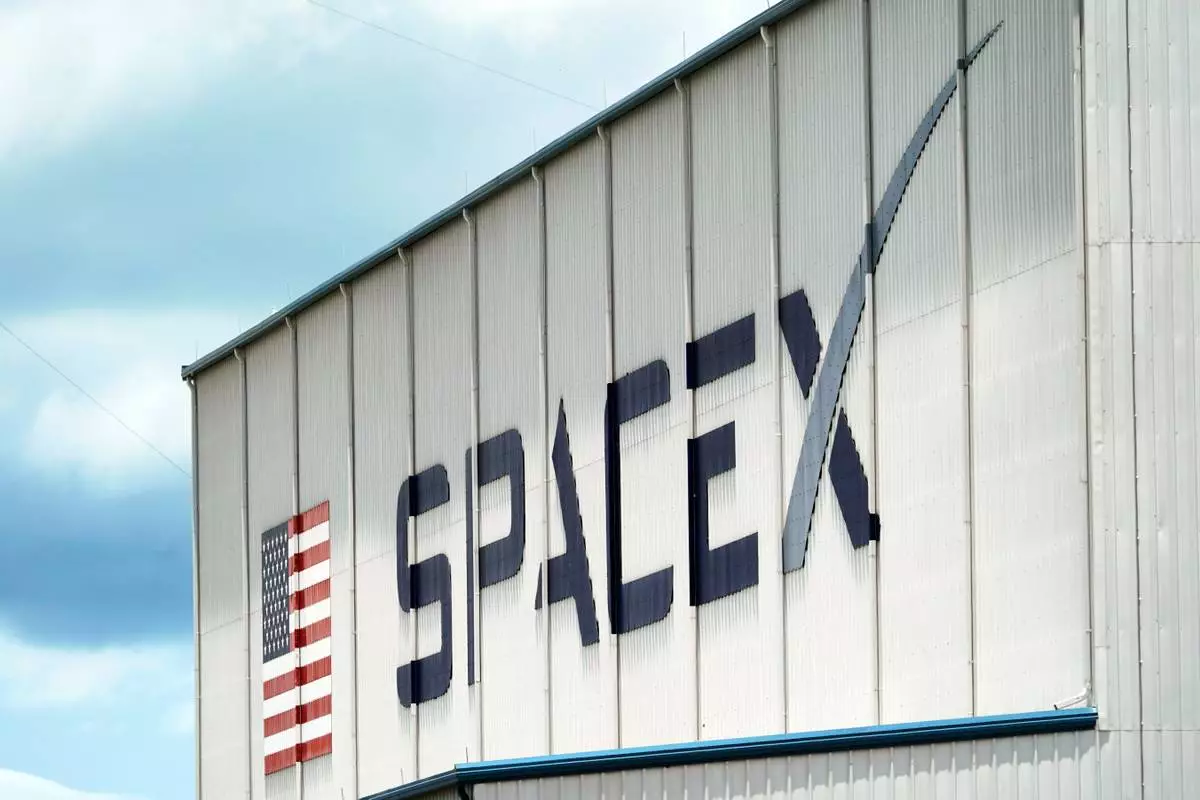
FILE - A SpaceX logo is displayed on a building, May 26, 2020, at the Kennedy Space Center in Cape Canaveral, Fla. (AP Photo/David J. Phillip, File)


FILE - A SpaceX logo is displayed on a building, May 26, 2020, at the Kennedy Space Center in Cape Canaveral, Fla. (AP Photo/David J. Phillip, File)

DUBAI (AP) — Nuclear talks between Iran and the United States will take place Friday in Oman, the Iranian foreign minister said, as tensions between the countries remain high following Tehran's bloody crackdown on nationwide protests last month.

The announcement by Iranian Foreign Minister Abbas Araghchi on Wednesday came after hours of indications that the anticipated talks were faltering over changes in the format and content of the talks.

”I’m grateful to our Omani brothers for making all necessary arrangements,” Araghchi wrote on X on Wednesday evening.

Earlier Wednesday, a regional official said Iran was seeking a “different” type of meeting than that what had been proposed by Turkey, one focused exclusively on the issue of Iran’s nuclear program, with participation limited to Iran and the United States. The official spoke on condition of anonymity because they were not authorized to brief the media.

The Trump administration confirmed the U.S. will take part in high-level talks with Iran in Oman instead of Turkey as originally planned, according to White House official.

The official, who was not authorized to comment publicly and spoke on the condition of anonymity, said that several Arab and Muslim leaders urged the Trump administration on Wednesday not to walk away from talks even as Iranian officials pressed to narrow the scope of talks and change the venue for the negotiations.

The official added that the White House remains “very skeptical” that the talks will be successful but have agreed to go along with the change in plans out of respect from allies in the region.

Tensions between the countries spiked after U.S. President Donald Trump suggested the U.S. might use force against Iran in response to the crackdown on protesters. Trump also has been pushing Tehran for a deal to constrain its nuclear program.

Iran’s reformist President Masoud Pezeshkian on Tuesday said he had instructed the foreign minister to “pursue fair and equitable negotiations” with the U.S., in the first clear sign from Tehran it wants to try to negotiate. That signaled the move is supported by Supreme Leader Ayatollah Ali Khamenei, who has the final say on all matters of state and previously dismissed any negotiations.

Rubio said the U.S. hoped to discuss a number of concerns beyond the nuclear issue, including discussions on Iran's ballistic missiles, support for proxy networks across the region and the “treatment of their own people."

“The leadership of Iran at the clerical level does not reflect the people of Iran. I know of no other country where there’s a bigger difference between the people who lead the country and the people who live there,” he told reporters.

Vice President JD Vance told “The Megyn Kelly Show” that diplomatic talks with Iran are challenging because of Tehran’s political system, overseen by Khamenei.

“It’s a very weird country to conduct diplomacy with when you can’t even talk to the person who’s in charge of the country. That makes all of this much more complicated, and it makes the whole situation much more absurd,” Vance said, noting that Trump could speak directly by phone with the leaders of Russia, China or North Korea.

Vance said Trump’s bottom line is that Iran cannot be allowed to develop a nuclear weapon, asserting that other states in the region would quickly do the same.

Iran long has insisted its nuclear program is peaceful. However, Iranian officials in recent years have increasingly threatened to pursue the bomb.

Vance said he believed Trump would work to “accomplish what he can through non-military means. And if he feels like the military is the only option, then he’s ultimately going to choose that option.”

On Tuesday, a U.S. Navy fighter jet shot down an Iranian drone that approached an American aircraft carrier. Iranian fast boats from its paramilitary Revolutionary Guard also tried to stop a U.S.-flagged ship in the Strait of Hormuz, the narrow mouth of the Persian Gulf, the Navy said.

Iran did not immediately acknowledge either incident, which strained but apparently did not derail hopes for talks with the U.S.

On Wednesday, Iranian military chiefs visited a missile base in an attempt to highlight its military readiness after a 12-day war with Israel in June devastated Iran’s air defenses. The base holds the Khorramshahr missile, which has a range of more than 2,000 kilometers (1,250 miles) and was launched towards Israel during the war last year.

Also Wednesday, Turkish President Recep Tayyip Erdogan reiterated Turkey’s opposition to foreign intervention in neighboring Iran, calling for the resolution of issues through dialogue.

Turkey has been urgently working for the past week to bring the U.S. and Iran to the negotiating table, and was previously expected to host the talks.

“We believe that external interventions involving our neighbor Iran would pose significant risks for the entire region,” Erdogan said during a visit to Cairo. “Resolving issues with Iran, including the nuclear file, through diplomatic means is the most appropriate approach.”

Associated Press writers Suzan Fraser in Ankara, Farnoush Amiri in New York, Aamer Madhani in Washington, Moriah Balingit in Washington, and Melanie Lidman in Jerusalem contributed.

FILE - In this photo released by the Iranian Foreign Ministry, Iranian Foreign Minister Abbas Araghchi, left, is welcomed by an unidentified Omani official, center, upon his arrival at Muscat, Oman, for negotiations with U.S. Mideast envoy Steve Witkoff, as Iranian Ambassador to Oman Mousa Farhang walks at right, May 11, 2025. (Iranian Foreign Ministry via AP, File)

FILE - In this photo released by the Iranian Foreign Ministry, Iranian Foreign Minister Abbas Araghchi, left, is welcomed by an unidentified Omani official, center, upon his arrival at Muscat, Oman, for negotiations with U.S. Mideast envoy Steve Witkoff, as Iranian Ambassador to Oman Mousa Farhang walks at right, May 11, 2025. (Iranian Foreign Ministry via AP, File)

Recommended Articles