Skip to Content Facebook Feature Image

Zach Werenski's milestone season propels Blue Jackets defenseman to 1st Olympics

Sport

Zach Werenski's milestone season propels Blue Jackets defenseman to 1st Olympics
Sport

Sport

Zach Werenski's milestone season propels Blue Jackets defenseman to 1st Olympics

2026-02-05 12:25 Last Updated At:12:40

COLUMBUS, Ohio (AP) — Things could not be going any better for Zach Werenski as he prepares for his first appearance in the Olympics.

The Columbus Blue Jackets defenseman, who'll play for Team USA in the Milan Cortina Games, has a point in seven straight games and is the first blueliner to score 20 goals before an Olympic break.

Werenski reached the milestone goal during the first period of the Blue Jackets' 4-0 victory over the Chicago Blackhawks on Wednesday night. The goal also made him the third American defenseman in NHL history with consecutive 20-goal seasons, joining Phil Housley and Reed Larson.

The 28-year old Grosse Pointe, Michigan, native also has the most points by a defenseman before an Olympic break with 62 (20 goals, 42 assists).

Mike Green had the previous mark with 60 points for the Washington Capitals before the 2010 Vancouver Games. Green, however, did not make the roster for Team Canada.

“I feel like I can kind of do anything that I’m asked of," said Werenski, who has two goals and eight assists in his last seven games. “And it’s important in a tournament like that where you have guys coming together in a short amount of time, you have to accept the role you’re given and the minutes you’re given. I feel like I’m ready for whatever they give me.”

Werenski served notice during last year's 4 Nations Face-Off that he can excel on both ends of the ice with six assists. It was the first time in NHL-sanctioned international tournaments — which include the Canada Cup, World Cup of Hockey and 4 Nations Face-Off — that a defenseman led all skaters in assists and points.

“I feel like I’m playing probably some of the best defensive hockey I’ve played in a long time, which is important since Bones (coach Rick Bowness) has gotten here to kind of clean up that area," Werenski said. “The offense is still coming. So yeah, I feel really good about my game.”

Werenski will fly to Milan on Thursday and participate in Friday's opening ceremony. He decided to arrive a couple days early after watching the Netflix documentary “Miracle: The Boys of ’80” and hearing about the experiences those players had going to the Olympics.

Werenski also said it was important to make sure he didn't have any regrets about missing anything.

“At first, I kind of thought it would be nice to get a few days rest here, but this is once in a lifetime and I want to be there for it and I want to experience everything I can,” Werenski said. “I felt like getting there a few days early wouldn’t hurt to get acclimated, either, to the time zone and I can rest a few days there and get on that schedule and just enjoy everything it has to offer.”

Werenski isn't the only Blue Jackets player headed to Milan. Goaltender Elvis Merzlikins will represent Latvia, which opens against the United States on Tuesday.

“Honestly, I hope he goes over there and has an unbelievable tournament and shows everyone how good of a goalie he is,” Werenski said of Merzlikins. “I’m rooting for him. Obviously not against the U.S., but I hope he plays great. When we’re playing him, it’s all business, but when we’re not, I’m a fan of his.”

The Blue Jackets go into the Olympic break on a seven-game winning streak and are 10-1 since Bowness replaced Dean Evason on Jan. 12. Columbus has gone from last place in the Eastern Conference to only two points out of a playoff spot.

“As excited as I am to go to Milan and represent our country in the Olympics, I’m close to equally excited to get back here and get back with the guys already,” Werenski said. “It’s something special in here and we’ve put in the hard work recently and we’re getting rewarded for it.”

AP NHL: https://apnews.com/hub/nhl

Dallas Stars' Mavrik Bourque, left, controls the puck as Columbus Blue Jackets' Zach Werenski defends during the third period of an NHL hockey game, Thursday, Jan. 22, 2026, in Columbus, Ohio. (AP Photo/Jay LaPrete)

Dallas Stars' Mavrik Bourque, left, controls the puck as Columbus Blue Jackets' Zach Werenski defends during the third period of an NHL hockey game, Thursday, Jan. 22, 2026, in Columbus, Ohio. (AP Photo/Jay LaPrete)
NEW YORK (AP) — During the early years of the COVID-19 pandemic, experts worried that disruptions to cancer diagnosis and treatment would cost lives. A new study suggests they were right.

The federally funded study published Thursday by the medical journal JAMA Oncology is being called the first to assess the effects of pandemic-related disruptions on the short-term survival of cancer patients.

Researchers found that people diagnosed with cancer in 2020 and 2021 had worse short-term survival than those diagnosed between 2015 and 2019. That was true across a range of cancers, and whether they were diagnosed at a late or early stage.

Of course, COVID-19 itself was especially dangerous to patients already weakened by cancer, but the researchers worked to filter out deaths mainly attributed to the coronavirus, so they could see if other factors played a role.

The researchers were not able to definitively show what drove worse survival, said Todd Burus of the University of Kentucky, the study’s lead author.

“But disruptions to the health care system were probably a key contributor,” said Burus, who specializes in medical data analysis.

COVID-19 forced many people to postpone cancer screenings — colonoscopies, mammograms and lung scans — as the coronavirus overwhelmed doctors and hospitals, especially in 2020.

Earlier research had shown that overall cancer death rates in the U.S. continued to decline throughout the pandemic, and there weren’t huge shifts in late diagnoses.

Recinda Sherman, a researcher on that earlier paper, applauded the new work.

“As this study is the first to document pandemic-related, cause-specific survival, I think it is important," said Sherman, of the North American Association of Central Cancer Registries. “The more we understand about the impact of COVID-19, the better we will be able to prepare for the next one.”

How could overall cancer death rates decline in 2020 and 2021, while short-term survival worsen for newly diagnosed patients?

Cancer prevention, diagnosis and treatment measures that for years had been pushing cancer death rates down did not suddenly disappear during the pandemic, Burus noted.

“We didn’t forget how to do those things," he said. “But disruptions could have changed access, could have changed how quickly people were getting treated.”

Further research will show if any impact was lasting, said Hyuna Sung, senior principal scientist and cancer epidemiologist at the American Cancer Society.

“Transient declines in survival that quickly recover may have little impact on long-term mortality trends," she said.

The new study tapped national cancer registry data to focus more specifically on patients who had a first diagnosis of a malignant cancer in 2020 and 2021. More than 1 million people were diagnosed with cancer in those two years, and about 144,000 died within one year, according to the researchers' data.

The researchers looked at one-year survival rates for those patients, checking for what stage they were at the time of diagnosis.

They calculated that one-year survival was lower for both early- and late-stage diagnoses, for all cancer sites combined. Most worrisome were large differences seen in colorectal, prostate and pancreatic cancers, they said.

The Associated Press Health and Science Department receives support from the Howard Hughes Medical Institute’s Department of Science Education and the Robert Wood Johnson Foundation. The AP is solely responsible for all content.

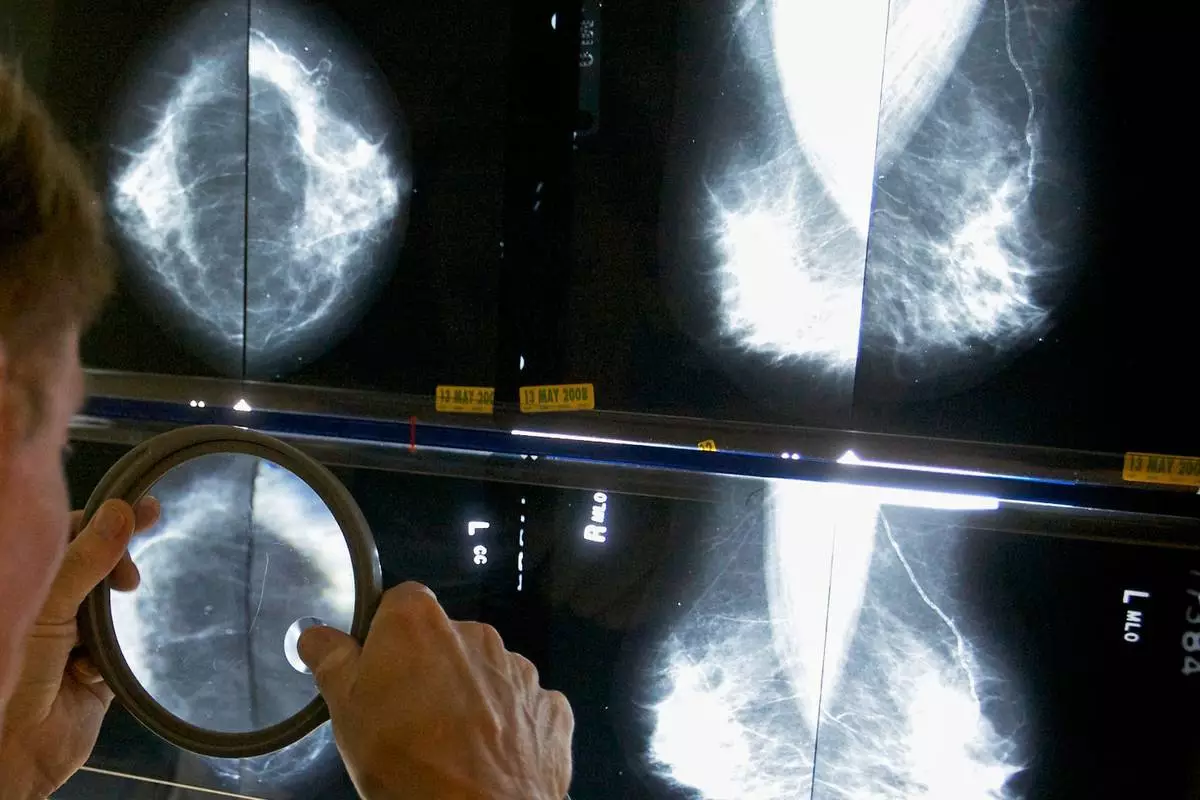
FILE - A radiologist uses a magnifying glass to check mammograms for breast cancer in Los Angeles, May 6, 2010. (AP Photo/Damian Dovarganes, File)

FILE - A radiologist uses a magnifying glass to check mammograms for breast cancer in Los Angeles, May 6, 2010. (AP Photo/Damian Dovarganes, File)

Recommended Articles