KUALA LUMPUR, Malaysia (AP) — Malaysia has announced an immediate and full ban on the importation of electronic waste, as the government vowed the country would not be a “dumping ground” for the world's waste.
The Malaysian Anti-Corruption Commission said in a statement late Wednesday that all electronic waste, commonly known as e-waste, would be reclassified under the “absolute prohibition” category effective immediately. This removes the discretionary power previously given to the Department of Environment to grant exemptions for importation of certain e-waste.
“E-waste is no longer permitted,” MACC chief Azam Baki said in the statement, vowing “firm and integrated enforcement action” to prevent illegal imports.
Malaysia has previously grappled with large volumes of imported e-waste, much of it suspected to be illegal and hazardous to human health and the environment. Authorities have seized hundreds of containers of suspected e-waste at ports in recent years and issued notices for return to exporters.
Environmental advocates have long urged stronger action. E-waste — discarded electronic products such as computers, phones and appliances — can contain toxic substances and heavy metals including lead, mercury and cadmium that pollute soil and water resources if improperly processed or dumped.
The ban comes as authorities widen a corruption inquiry tied to e-waste management. Last week, the MACC detained and remanded the director-general of the environment department and his deputy over alleged abuse of power and corruption involving e-waste oversight. The probe has also seen authorities freeze bank accounts and seize cash linked to the case.
The Home Ministry in a social media post Wednesday vowed the government would bolster efforts to combat the smuggling of e-waste into the country.
“Malaysia is not a dumping ground for the world's waste,” it said. “E-waste is not just garbage but a serious threat to the environment, people's health and national security.”

FILE - Thai officials show samples of illegally imported electronic waste from the United States which they said they seized at Bangkok Port during a press conference in Bangkok, Thailand, Wednesday, May 14, 2025. (AP Photo/Sakchai Lalit,File)

FILE -Used charging cables and power adapters are piled up at a shop in Nhat Tao market, the largest informal recycling market in Ho Chi Minh City, Vietnam, Jan. 28, 2024. (AP Photo/Jae C. Hong, File)
MILAN, Italy (AP) — Annika Malacinski remembers the moment the door to the Milan Cortina Winter Olympics was slammed shut.
On a flight from Munich to Denver, she bought airplane Wi-Fi to join a conference call with the International Olympic Committee, certain that Nordic combined competition would at last be opened up to female athletes.
“Then the decision came: ‘no.’ No explanation, no discussion. Just ‘no,’ and then they moved on to the next topic,” she told The Associated Press from her training base in Norway. “I cried for eight hours straight on that flight. When I arrived in Denver, my eyes were swollen shut. It felt like my world had crashed.”
That was in June, 2022. And despite an ongoing campaign led by Malacinski, an athlete from Colorado now aged 24, her sport remains the last to exclude women – even as Milan Cortina is showcasing the highest level of female participation in Winter Games history at 47%.
Malacinski is a frequent top-10 finisher at elite competitions in the sport that combines ski jumping and cross-country skiing and demands rigorous year-round training.
Her younger brother, Niklas, will compete in the men’s event for the United States and she plans to travel to northern Italy to cheer him on.
“It’s bittersweet. I know how hard he works, and he absolutely deserves it,” Malacinski said. “I do the same sport as him. I jump the same ski jumps and ski the same courses. The only difference is that I’m a woman.”
Female skiers racing in Seefeld, Austria, last weekend protested the exclusion by raising their poles overhead to form an X.
Men have competed in the Nordic combined since the first Winter Games more than a century ago, at Chamonix, France in 1924.
The sport is now at risk of being removed from the program at the next Winter Olympics in 2030. The IOC says Nordic combined has struggled to attract participation from enough countries and draws a limited television audience.
Women were excluded entirely from the first modern Olympics in 1896. When they were allowed to compete in Paris four years later, participation was limited to a handful of sports, including tennis, archery and croquet.
Track and field opened to women only in 1928, at the Amsterdam Games – but restrictions were imposed around beliefs of female fragility. Although the 800 meters was originally included, it was later withdrawn for more than three decades.
The first women’s Olympic marathon did not take place until 1984 in Los Angeles – 88 years after the race inspired by an ancient Greek battle debuted.
Nearly all differences have since been eliminated, though some disparities remain. At the Summer Olympics, women compete in the seven-event heptathlon, while men contest the 10-event decathlon.
At the Winter Games, progress arrived even later. Ski jumping was off-limits to women as recently as the 2010 Vancouver Olympics and was introduced four years later at Sochi.
Cross-country skiing’s distance overhaul is the most recent and sweeping change. At Milan Cortina, men and women will race the same distances across all events for the first time in Olympic history.
Previously, the longest women’s race topped out at 30 kilometers, compared with 50 for men. Both will now have 50-kilometer mass start races — like at Nordic Ski World Championships last year.
Malacinski says she will continue her campaign for inclusion, now focused on 2030 Winter Games in the French Alps.
“I’m a very gritty person,” she said. “If I put my mind to something, I know I can do it.”
AP Winter Olympics: https://apnews.com/hub/milan-cortina-2026-winter-olympics
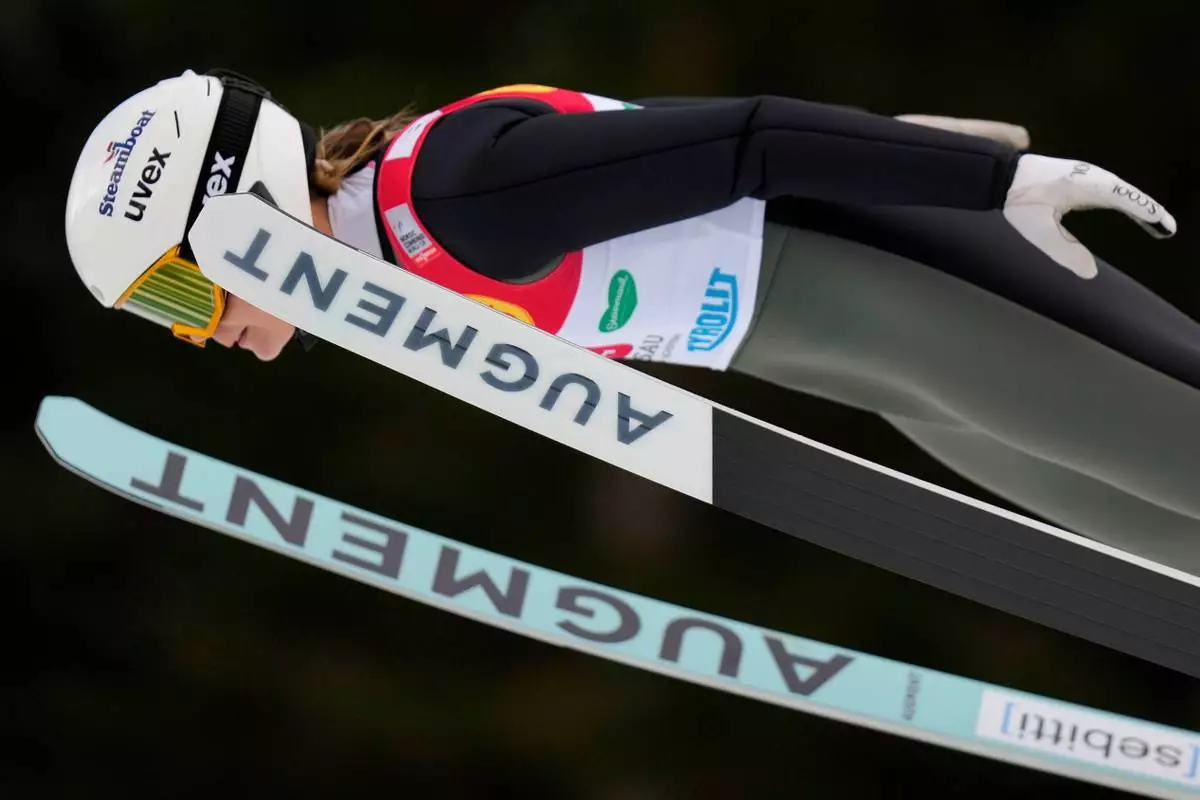
FILE - Annika Malacinski of the United States soars through the air during the women's individual compact NH 5km competition at the Nordic Combined World Cup in Ramsau, Austria, Saturday, Dec.16, 2023. (AP Photo/Matthias Schrader, File)