|
DUBAI, UAE, Feb. 5, 2026 /PRNewswire/ -- Messari has released its State of Mantle Q4 2025 report, providing an in-depth analysis of Mantle's network design, treasury strategy, and ecosystem development as the protocol advances its role as a coordinated distribution layer for institutional onchain finance.
The report examines Mantle's transition toward active capital deployment, exchange-led distribution, and institutional-grade infrastructure spanning real-world assets (RWAs), DeFi, and treasury-backed yield products.
Activating Treasury Capital to Anchor Onchain Liquidity
Messari highlights Mantle's $4.2 billion community-owned treasury, one of the largest in the industry, as a central pillar of its distribution strategy. In Q4 2025, Mantle shifted from passive treasury management toward active capital deployment, executing a proposal to migrate previously idle assets into Mantle Index Four (MI4), its institutional crypto index fund.
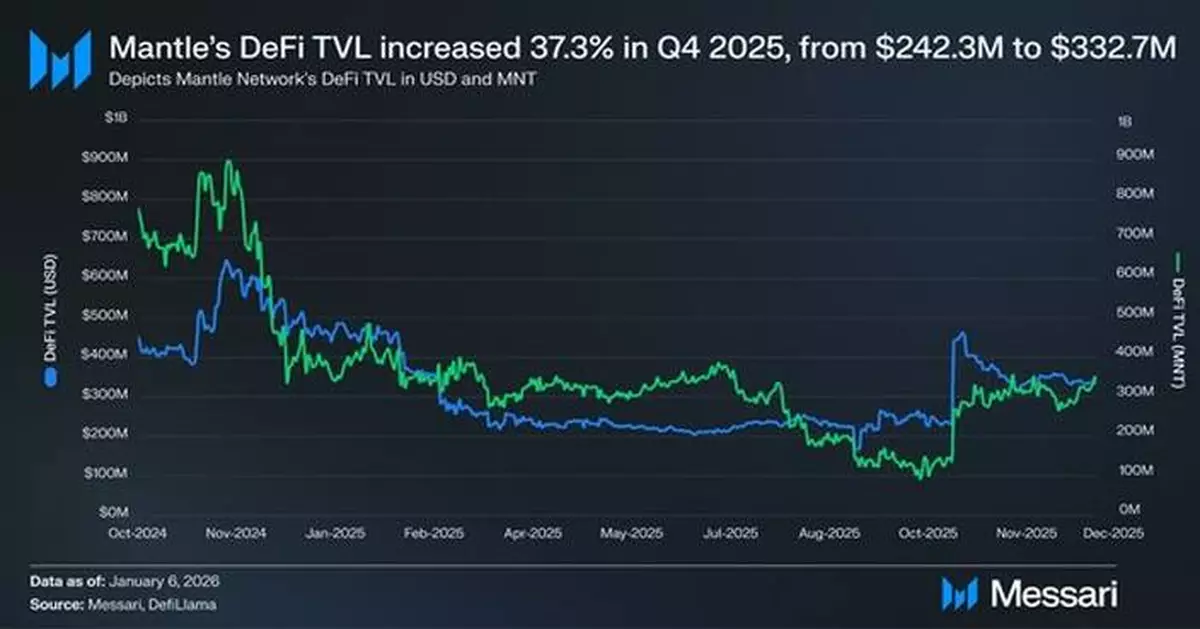
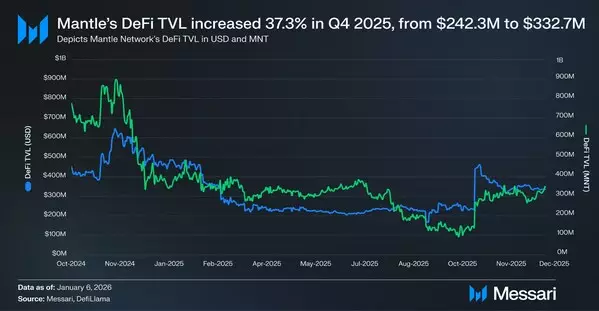
This deployment drove a 37.3% quarter-over-quarter increase in DeFi TVL, lifting Mantle's onchain TVL from $242.3 million to $332.7 million by quarter end. As of December 31, 2025, MI4 managed approximately $173 million in assets, delivering a 27.9% year-to-date return, underscoring Mantle's approach to treasury-backed, yield-bearing liquidity.
Exchange-Led Distribution and Infrastructure Alignment
The report underscores Mantle's deepening integration with Bybit, where MNT functions as a core platform asset across trading, fee payments, VIP programs, and institutional products. While onchain activity moderated in Q4 following Q3's incentive-driven expansion, Messari positions exchange-led distribution as a long-term structural advantage rather than a short-term growth lever.
Bybit's role as a distribution partner continues to anchor Mantle's liquidity chain, connecting centralized exchange liquidity with onchain yield strategies, stablecoin settlement, and institutional access points across the Mantle ecosystem.
Institutional Stack Expansion Across RWAs and DeFi
Messari highlights Mantle's growing institutional stack, particularly its focus on RWA and compliant onchain infrastructure. Mantle's Tokenization-as-a-Service (TaaS) platform supports end-to-end RWA issuance, enabling institutional participation through products such as Ondo Finance's USDY, which reached approximately $29 million tokenized on Mantle.
In Q4 2025, Mantle also expanded its RWA ecosystem through integrations including USDT0 for stablecoin settlement, a co-announcement with Bybit for the deployment of xStocks to support tokenized equities, and the deployment of QCDT, a regulated yield-bearing RWA product. These initiatives reinforce Mantle's positioning as infrastructure for compliant, institutional-scale onchain finance.
"Institutions don't adopt isolated execution layers; they adopt ecosystems that coordinate capital, liquidity, and distribution," said Emily, Key Advisor at Mantle. "In Q4, Mantle focused on activating treasury capital and strengthening institutional-grade infrastructure, rather than pursuing short-term, incentive-driven activity."
"Mantle's Q4 performance reflects a broader shift among Layer 2s toward coordinating capital, applications, and distribution rather than optimizing execution in isolation," said Evan Zakhary, Protocol Research Analyst at Messari. "The quarter was defined by treasury-backed TVL growth and normalization in onchain activity following earlier exchange-led expansion."
Positioning Mantle as a Distribution Layer for Onchain Finance
Messari's Q4 analysis positions Mantle as a Layer 2 evolving beyond execution into a distribution layer that coordinates capital, infrastructure, and access across CeFi and DeFi. Despite a broader market drawdown in Q4, Mantle closed the year with one of the largest treasuries in crypto, rising institutional participation, and a growing suite of yield-generating products backed by active DAO capital deployment.
As Mantle continues to deepen exchange integration, expand its RWA ecosystem, and deploy treasury assets into productive onchain strategies, Messari frames the protocol as increasingly defined by its role in enabling institutional onchain finance at scale.
About Mantle
Mantle positions itself as the premier distribution layer and gateway for institutions and TradFi to connect with onchain liquidity and access real-world assets, powering how real-world finance flows.
With over $4B+ in community-owned assets, Mantle combines credibility, liquidity, and scalability with institutional-grade infrastructure to support large-scale adoption. The ecosystem is anchored by $MNT within Bybit, and built out through core ecosystem projects like mETH, fBTC, MI4 and more. This is complemented by Mantle Network's partnerships with leading issuers and protocols such as Ethena USDe, Ondo USDY, OP-Succinct and EigenLayer.
For more information about Mantle, please visit: mantle.xyz
For more social updates, please follow: Mantle Official X & Mantle Community Channel
For media enquiries, please contact: contact@mantle.xyz
About Bybit
Bybit is the world's second-largest cryptocurrency exchange by trading volume, serving a global community of over 80 million users. Founded in 2018, Bybit is redefining openness in the decentralized world by creating a simpler, open and equal ecosystem for everyone. With a strong focus on Web3, Bybit partners strategically with leading blockchain protocols to provide robust infrastructure and drive on-chain innovation. Renowned for its secure custody, diverse marketplaces, intuitive user experience, and advanced blockchain tools, Bybit bridges the gap between TradFi and DeFi, empowering builders, creators, and enthusiasts to unlock the full potential of Web3. Discover the future of decentralized finance at Bybit.com.
For more details about Bybit, please visit Bybit Press
For media inquiries, please contact: media@bybit.com
For updates, please follow: Bybit's Communities and Social Media
Discord | Facebook | Instagram | LinkedIn | Reddit | Telegram | TikTok | X | Youtube
DUBAI, UAE, Feb. 5, 2026 /PRNewswire/ -- Messari has released its State of Mantle Q4 2025 report, providing an in-depth analysis of Mantle's network design, treasury strategy, and ecosystem development as the protocol advances its role as a coordinated distribution layer for institutional onchain finance.
The report examines Mantle's transition toward active capital deployment, exchange-led distribution, and institutional-grade infrastructure spanning real-world assets (RWAs), DeFi, and treasury-backed yield products.
Activating Treasury Capital to Anchor Onchain Liquidity
Messari highlights Mantle's $4.2 billion community-owned treasury, one of the largest in the industry, as a central pillar of its distribution strategy. In Q4 2025, Mantle shifted from passive treasury management toward active capital deployment, executing a proposal to migrate previously idle assets into Mantle Index Four (MI4), its institutional crypto index fund.
This deployment drove a 37.3% quarter-over-quarter increase in DeFi TVL, lifting Mantle's onchain TVL from $242.3 million to $332.7 million by quarter end. As of December 31, 2025, MI4 managed approximately $173 million in assets, delivering a 27.9% year-to-date return, underscoring Mantle's approach to treasury-backed, yield-bearing liquidity.
Exchange-Led Distribution and Infrastructure Alignment
The report underscores Mantle's deepening integration with Bybit, where MNT functions as a core platform asset across trading, fee payments, VIP programs, and institutional products. While onchain activity moderated in Q4 following Q3's incentive-driven expansion, Messari positions exchange-led distribution as a long-term structural advantage rather than a short-term growth lever.
Bybit's role as a distribution partner continues to anchor Mantle's liquidity chain, connecting centralized exchange liquidity with onchain yield strategies, stablecoin settlement, and institutional access points across the Mantle ecosystem.
Institutional Stack Expansion Across RWAs and DeFi
Messari highlights Mantle's growing institutional stack, particularly its focus on RWA and compliant onchain infrastructure. Mantle's Tokenization-as-a-Service (TaaS) platform supports end-to-end RWA issuance, enabling institutional participation through products such as Ondo Finance's USDY, which reached approximately $29 million tokenized on Mantle.
In Q4 2025, Mantle also expanded its RWA ecosystem through integrations including USDT0 for stablecoin settlement, a co-announcement with Bybit for the deployment of xStocks to support tokenized equities, and the deployment of QCDT, a regulated yield-bearing RWA product. These initiatives reinforce Mantle's positioning as infrastructure for compliant, institutional-scale onchain finance.
"Institutions don't adopt isolated execution layers; they adopt ecosystems that coordinate capital, liquidity, and distribution," said Emily, Key Advisor at Mantle. "In Q4, Mantle focused on activating treasury capital and strengthening institutional-grade infrastructure, rather than pursuing short-term, incentive-driven activity."
"Mantle's Q4 performance reflects a broader shift among Layer 2s toward coordinating capital, applications, and distribution rather than optimizing execution in isolation," said Evan Zakhary, Protocol Research Analyst at Messari. "The quarter was defined by treasury-backed TVL growth and normalization in onchain activity following earlier exchange-led expansion."
Positioning Mantle as a Distribution Layer for Onchain Finance
Messari's Q4 analysis positions Mantle as a Layer 2 evolving beyond execution into a distribution layer that coordinates capital, infrastructure, and access across CeFi and DeFi. Despite a broader market drawdown in Q4, Mantle closed the year with one of the largest treasuries in crypto, rising institutional participation, and a growing suite of yield-generating products backed by active DAO capital deployment.
As Mantle continues to deepen exchange integration, expand its RWA ecosystem, and deploy treasury assets into productive onchain strategies, Messari frames the protocol as increasingly defined by its role in enabling institutional onchain finance at scale.
About Mantle
Mantle positions itself as the premier distribution layer and gateway for institutions and TradFi to connect with onchain liquidity and access real-world assets, powering how real-world finance flows.
With over $4B+ in community-owned assets, Mantle combines credibility, liquidity, and scalability with institutional-grade infrastructure to support large-scale adoption. The ecosystem is anchored by $MNT within Bybit, and built out through core ecosystem projects like mETH, fBTC, MI4 and more. This is complemented by Mantle Network's partnerships with leading issuers and protocols such as Ethena USDe, Ondo USDY, OP-Succinct and EigenLayer.
For more information about Mantle, please visit: mantle.xyz
For more social updates, please follow: Mantle Official X & Mantle Community Channel
For media enquiries, please contact: contact@mantle.xyz
About Bybit
Bybit is the world's second-largest cryptocurrency exchange by trading volume, serving a global community of over 80 million users. Founded in 2018, Bybit is redefining openness in the decentralized world by creating a simpler, open and equal ecosystem for everyone. With a strong focus on Web3, Bybit partners strategically with leading blockchain protocols to provide robust infrastructure and drive on-chain innovation. Renowned for its secure custody, diverse marketplaces, intuitive user experience, and advanced blockchain tools, Bybit bridges the gap between TradFi and DeFi, empowering builders, creators, and enthusiasts to unlock the full potential of Web3. Discover the future of decentralized finance at Bybit.com.
For more details about Bybit, please visit Bybit Press
For media inquiries, please contact: media@bybit.com
For updates, please follow: Bybit's Communities and Social Media
Discord | Facebook | Instagram | LinkedIn | Reddit | Telegram | TikTok | X | Youtube
** The press release content is from PR Newswire. Bastille Post is not involved in its creation. **
Mantle's Evolution Into an Institutional Distribution Layer for Onchain Finance, Marked by 37% QoQ TVL Growth in Messari Report
|
Announced alongside M Series Smart Assist Module launch on Kickstarter
NEW YORK, April 4, 2026 /PRNewswire/ -- Yarbo, a company focused on intelligent yard robotics, today announced the Yarbo Open Platform, a long-term initiative currently under development and planned for release in early 2027. Designed to expand Yarbo's modular yard robot system across both software and hardware, the platform is intended to support deeper customization, broader smart home connectivity, and new forms of user and developer-driven functionality over time. The announcement coincides with the launch of the Smart Assist Module (SAM) for the M Series on Kickstarter.
The Open Platform is not available today. Instead, it reflects Yarbo's roadmap for how its ecosystem may evolve over time, including a three-layer software architecture built around an Open API, SDK, and no-code Automation Editor, as well as a hardware expansion framework designed to support future user-built and developer-built modules.
A Structured Approach to Software Integration and Automation
The Yarbo Open Platform is structured to accommodate different levels of technical expertise, from everyday users to experienced developers. It is designed to provide multiple entry points into the Yarbo ecosystem, enabling both software-driven automation and hardware-level expansion.
On the software side, the platform consists of three layers:
- Yarbo Open API — intended to enable connectivity between Yarbo devices and external platforms, allowing them to participate in broader home automation scenarios.
- Yarbo SDK — a set of development tools, including code libraries and documentation, designed for developers building custom features or integrations.
- Yarbo Automation Editor — a visual, drag-and-drop interface within the Yarbo app that allows users to create automation workflows without writing code.
Together, these components are intended to make automation accessible to a wide range of users, while also supporting more advanced development use cases.
The platform is also designed to support compatibility with widely used smart home ecosystems, including Home Assistant, Google Home, and Amazon Alexa, enabling users to incorporate Yarbo into existing connected home setups.
Extending Capability Through Hardware
In addition to software capabilities, the Open Platform introduces a hardware expansion approach designed to extend Yarbo's functionality beyond its existing modules.
At the center of this is CoreBridge, a standardized hardware interface currently in development that is intended to provide access to Yarbo's mechanical mounting points, power system, and data connections. It is designed to support third-party development and user-built extensions, allowing new types of functionality beyond pre-defined modules.
One example of this extensibility is an electromagnet-based module, which can be attached via CoreBridge to enable Yarbo to latch onto and move objects such as garbage bins. In a potential use scenario, this could enable automated movement of a bin to the curb on collection day and its return afterward.
This combination of software and hardware openness reflects an effort to expand the role of outdoor robotics beyond fixed-function devices.
Smart Assist Module Launch on Kickstarter
Alongside the Open Platform announcement, Yarbo is launching the Smart Assist Module (SAM) for the M Series on Kickstarter.
The module introduces two primary features designed to expand how users interact with their yard robot in everyday use:
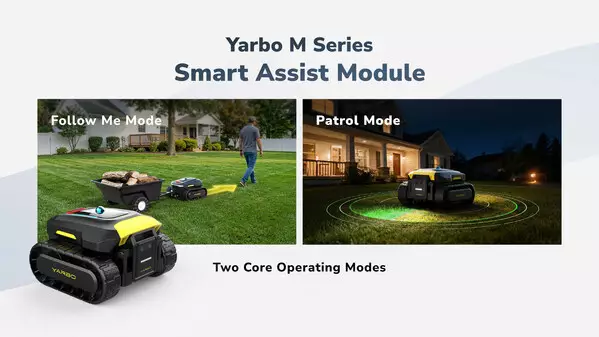
- Follow Me Mode — enabling Yarbo to move alongside the user while carrying tools or materials, reducing the need for manual transport during yard work.
- Patrol Mode — allowing Yarbo to move along customizable routes around the property, with features such as remote live view, app-based alerts, and optional audio notifications via its built-in speaker, providing an added layer of awareness and convenience for users managing outdoor spaces.
The Smart Assist Module is positioned as part of Yarbo's broader effort to extend the practical use cases of its modular system.
Looking Ahead
The Yarbo Open Platform is planned for release in early 2027 and is being developed to support both the Y Series and M Series. By introducing a framework that combines software integration, developer tools, and hardware extensibility, Yarbo aims to enable a broader range of applications while allowing users to define how the system evolves over time.
Further details will be shared as development progresses.
About Yarbo
Yarbo is defining a new category of outdoor robotics with its Modular Yard Robot. Known for its automated snow blower robots, Yarbo introduced a modular system designed for year-round use. Powered by a single intelligent core unit, the system supports interchangeable modules for mowing, leaf blowing, snow clearing, and more—creating a more efficient approach to outdoor maintenance for homeowners.
Announced alongside M Series Smart Assist Module launch on Kickstarter
NEW YORK, April 4, 2026 /PRNewswire/ -- Yarbo, a company focused on intelligent yard robotics, today announced the Yarbo Open Platform, a long-term initiative currently under development and planned for release in early 2027. Designed to expand Yarbo's modular yard robot system across both software and hardware, the platform is intended to support deeper customization, broader smart home connectivity, and new forms of user and developer-driven functionality over time. The announcement coincides with the launch of the Smart Assist Module (SAM) for the M Series on Kickstarter.
The Open Platform is not available today. Instead, it reflects Yarbo's roadmap for how its ecosystem may evolve over time, including a three-layer software architecture built around an Open API, SDK, and no-code Automation Editor, as well as a hardware expansion framework designed to support future user-built and developer-built modules.
A Structured Approach to Software Integration and Automation
The Yarbo Open Platform is structured to accommodate different levels of technical expertise, from everyday users to experienced developers. It is designed to provide multiple entry points into the Yarbo ecosystem, enabling both software-driven automation and hardware-level expansion.
On the software side, the platform consists of three layers:
- Yarbo Open API — intended to enable connectivity between Yarbo devices and external platforms, allowing them to participate in broader home automation scenarios.
- Yarbo SDK — a set of development tools, including code libraries and documentation, designed for developers building custom features or integrations.
- Yarbo Automation Editor — a visual, drag-and-drop interface within the Yarbo app that allows users to create automation workflows without writing code.
Together, these components are intended to make automation accessible to a wide range of users, while also supporting more advanced development use cases.
The platform is also designed to support compatibility with widely used smart home ecosystems, including Home Assistant, Google Home, and Amazon Alexa, enabling users to incorporate Yarbo into existing connected home setups.
Extending Capability Through Hardware
In addition to software capabilities, the Open Platform introduces a hardware expansion approach designed to extend Yarbo's functionality beyond its existing modules.
At the center of this is CoreBridge, a standardized hardware interface currently in development that is intended to provide access to Yarbo's mechanical mounting points, power system, and data connections. It is designed to support third-party development and user-built extensions, allowing new types of functionality beyond pre-defined modules.
One example of this extensibility is an electromagnet-based module, which can be attached via CoreBridge to enable Yarbo to latch onto and move objects such as garbage bins. In a potential use scenario, this could enable automated movement of a bin to the curb on collection day and its return afterward.
This combination of software and hardware openness reflects an effort to expand the role of outdoor robotics beyond fixed-function devices.
Smart Assist Module Launch on Kickstarter
Alongside the Open Platform announcement, Yarbo is launching the Smart Assist Module (SAM) for the M Series on Kickstarter.
The module introduces two primary features designed to expand how users interact with their yard robot in everyday use:
- Follow Me Mode — enabling Yarbo to move alongside the user while carrying tools or materials, reducing the need for manual transport during yard work.
- Patrol Mode — allowing Yarbo to move along customizable routes around the property, with features such as remote live view, app-based alerts, and optional audio notifications via its built-in speaker, providing an added layer of awareness and convenience for users managing outdoor spaces.
The Smart Assist Module is positioned as part of Yarbo's broader effort to extend the practical use cases of its modular system.
Looking Ahead
The Yarbo Open Platform is planned for release in early 2027 and is being developed to support both the Y Series and M Series. By introducing a framework that combines software integration, developer tools, and hardware extensibility, Yarbo aims to enable a broader range of applications while allowing users to define how the system evolves over time.
Further details will be shared as development progresses.
About Yarbo
Yarbo is defining a new category of outdoor robotics with its Modular Yard Robot. Known for its automated snow blower robots, Yarbo introduced a modular system designed for year-round use. Powered by a single intelligent core unit, the system supports interchangeable modules for mowing, leaf blowing, snow clearing, and more—creating a more efficient approach to outdoor maintenance for homeowners.
** This press release is distributed by PR Newswire through automated distribution system, for which the client assumes full responsibility. **
Yarbo Introduces Open Platform Strategy, Opening Its Robotics System to Developers and Smart Home Ecosystems

Yarbo Introduces Open Platform Strategy, Opening Its Robotics System to Developers and Smart Home Ecosystems