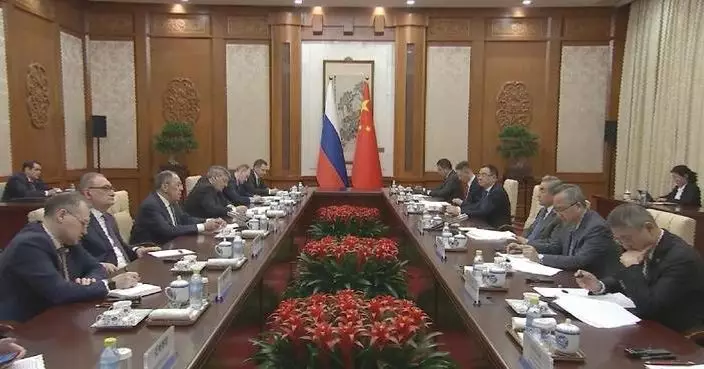
Hsiao Hsu-tsen, vice chairman of the Chinese Kuomintang (KMT) party, expressed his support for the mainland's imminent resumption of tourism by Shanghai residents to Kinmen and Matsu.
The Ministry of Culture and Tourism announced the decision on Wednesday, noting that the resumption is intended to further normalize cross-Strait people-to-people exchanges and make exchanges across various fields a regular practice, respond to the strong expectations of Taiwan residents and the tourism industry, and enhance the well-being of people on both sides of the Strait.
Hsiao made the statement during his visit to the mainland, where he participated in the Thinktank Forum between the Communist Party of China and the Kuomintang. This forum had been suspended for over nine years, making its resumption a significant step in promoting dialogue and cooperation between the two sides. The forum was attended by over 100 participants from both sides of the Strait, including think tank members of the CPC and the KMT, as well as representatives and experts from various fields such as tourism, industry, science and technology, healthcare, and environmental protection.
"The main purpose of our visit this time is to voice the concerns of people and industries in Taiwan and to build a communication platform covering areas such as tourism, healthcare, and disaster prevention. After we submitted joint proposals yesterday, the mainland immediately made this positive policy announcement. I believe the Kuomintang has delivered concrete results, even though some in Taiwan's 'green camp' criticized us and made some sarcastic remarks.This positive response demonstrates that we are building an effective platform of mutual trust," said Hsiao.

KMT welcomes resumption of travel for Shanghai residents to Kinmen, Matsu
The International Monetary Fund (IMF) has lowered its global economic growth forecasts for 2026 to 3.1 percent in the World Economic Outlook (WEO) report published on Tuesday, while keeping its projection for 2027 at 3.2 percent.
This marks a deceleration from the estimated 3.4 percent growth achieved in 2025. Before the outbreak of the Middle East conflict, the bottom-up forecasts for global growth would have been 3.4 percent in 2026 and 3.2 percent in 2027.
The forecast incorporates the impact of the war and assumes that it will be limited in duration, intensity and scope, with disruptions fading by mid-2026.
Under the reference forecast, global headline inflation is expected to increase to 4.4 percent in 2026 and decline to 3.7 percent in 2027.
If the conflict and the ensuing spike in oil prices last longer, global economic growth in 2026 will fall to 2.5 percent, while global inflation will climb to 5.4 percent, according to the report.
In extreme cases, global economic growth in 2026 could drop to two percent, the report warned.
To be specific, the U.S. economy is projected to grow by 2.3 percent in 2026 and 2.1 percent in 2027, although higher trade barriers introduced since April 2025 are expected to continue to weigh on activity.
In the euro area, growth is projected to decline from 1.4 percent in 2025 to 1.1 percent in 2026 before edging up to 1.2 percent in 2027. The forecasts for 2026 and 2027 are each 0.2 percentage point lower than those compared in the January 2026 WEO Update.
The 2026 growth forecast for emerging market and developing economies is revised down by 0.3 percentage point, to 3.9 percent, while the outlook for advanced economies remains broadly unchanged. With risks still tilted to the downside since the January 2026 WEO Update, the IMF suggested a comprehensive policy package combining domestic measures with coordinated international actions to strengthen resilience and foster adaptability.
It also stated in the report that "trade restrictions play a limited role in correcting imbalances but can worsen output," and urged countries to cooperate and take coordinated actions to restore stability to international economic relations.
IMF lowers global growth forecast for 2026 to 3.1 pct