CAIRO (AP) — Famine is threatening more areas in war-torn Sudan's western Darfur region, a global hunger monitoring group said Thursday as an attack by paramilitary forces on a military hospital in the country's south killed 22 people, including the hospital’s director and three members of its medical staff.
Since April 2023, Sudan has been in the throes of war after a power struggle erupted between the military and the powerful paramilitary Rapid Support Forces, or RSF. The conflict has triggered what the United Nations calls the world’s worst humanitarian crisis.
The Integrated Food Security Phase Classification, or IPC, released a new report saying that acute malnutrition has reached famine levels in two more towns in Darfur. It stopped short of confirming a full famine in the towns.
Last year, the group said that people in Darfur’s major city of el-Fasher, overrun by the paramilitary forces after an 18-month siege, were enduring famine.
The attack Thursday in the town of Kouik in South Kordofan province, also left eight people wounded, the Sudan Doctors’ Network, a group of medical professionals tracking the war said. It was not immediately clear how many of the casualties were civilians.
The attack was “not an isolated incident, but rather part of a series of attacks that have plagued South Kordofan," the network said, adding that the assaults have left "several hospitals inoperable.”
The U.N. estimates that over 40,000 people have been killed in the war in Sudan, but aid agencies consider that the true number could be many times higher. Over 14 million people have been forced to flee their homes.
The IPC report said famine-level malnutrition has been registered in the towns of Umm Baru and Kernoi in North Darfur province. In November, the group said that along with el-Fasher, the city of Kadugli in South Kordofan was also enduring famine. At the time, it also said 20 other areas across Sudan were at risk of famine.
In Umm Baru, nearly 53% of children between aged between 6 months and nearly 5 years suffered from acute malnutrition, the IPC said — almost double the famine threshold, which stands at 30%. In Kernoi, 32% of children are suffering from malnutrition, the group said.
“These alarming rates suggest an increased risk of excess mortality and raise concern that nearby areas may be experiencing similar catastrophic conditions,” the report said.
Since the eruption of Sudan’s civil war, the IPC has confirmed famine in a total of seven areas. The group said it could not confirm a full famine in Umm Baru and Kernoi as access and lack of data makes it difficult to confirm the other two thresholds — access to food and mortality — that need to be reached for a famine to be confirmed.
The fall of el-Fasher in October 2025 to the RSF set off an exodus of people to nearby towns, straining the resources of neighboring communities and driving up food insecurity rates, the report said.
The IPC has confirmed famine only a few times, most recently in 2025 in northern Gaza during the Israel-Hamas war. It also confirmed famine in Somalia in 2011, and in South Sudan in 2017 and 2020.
In 2024, famine had struck five other areas in North Darfur and also Sudan’s Nuba Mountains region.
The IPC report also warned that more people might face extreme hunger in Kordofan, where the conflict has disrupted food production and supply lines in besieged towns and isolated areas.
“An immediate and sustained ceasefire is critical to avert further destitution, starvation, and death in the affected parts of Sudan,” pled the Rome-based group.
According to experts, famine is determined in areas where deaths from malnutrition-related causes reach at least two people, or four children under 5 years of age, per 10,000 people; at least one in five people or households severely lack food and face starvation; and at least 30% of children under age 5 suffer from acute malnutrition based on a weight-to-height measurement — or 15% based on upper-arm circumference.
Since the RSF overran el-Fasher, which had been one of the army’s last strongholds in Darfur, fighting has recently concentrated in various areas of Kordofan. Lately, the Sudanese military began making gains in Kordofan after breaking a siege in Kadugli and the neighboring town of Dilling.
On Tuesday, the Sudanese military announced that it had opened a crucial road between Dilling and Kadugli, which had been under siege by the RSF since the start of the war. The RSF launched a drone attack Tuesday that hit a medical center in Kadugli, killing 15 people including seven children, according to Sudan Doctors Network.
Also this week, the United States and the U.N. said they are seeking to rally international support for humanitarian aid to Sudan, kicking off a new Sudan Humanitarian Fund with $700 million in contributions from the United Arab Emirates and the U.S.
The Trump administration said Tuesday it would contribute $200 million to the initiative from a basket of $2 billion it set aside late last year to fund humanitarian projects around the world. The UAE said it would contribute $500 million. Saudi Arabia and several other participants promised they would make pledges but did not specify amounts.
Associated Press writer Fay Abuelgasim in Cairo contributed to this report.
This story has been corrected throughout to say that the expert group did not confirm a full famine in the Darfur towns of Umm Baru and Kernoi but said that malnutrition there had reached famine-levels.
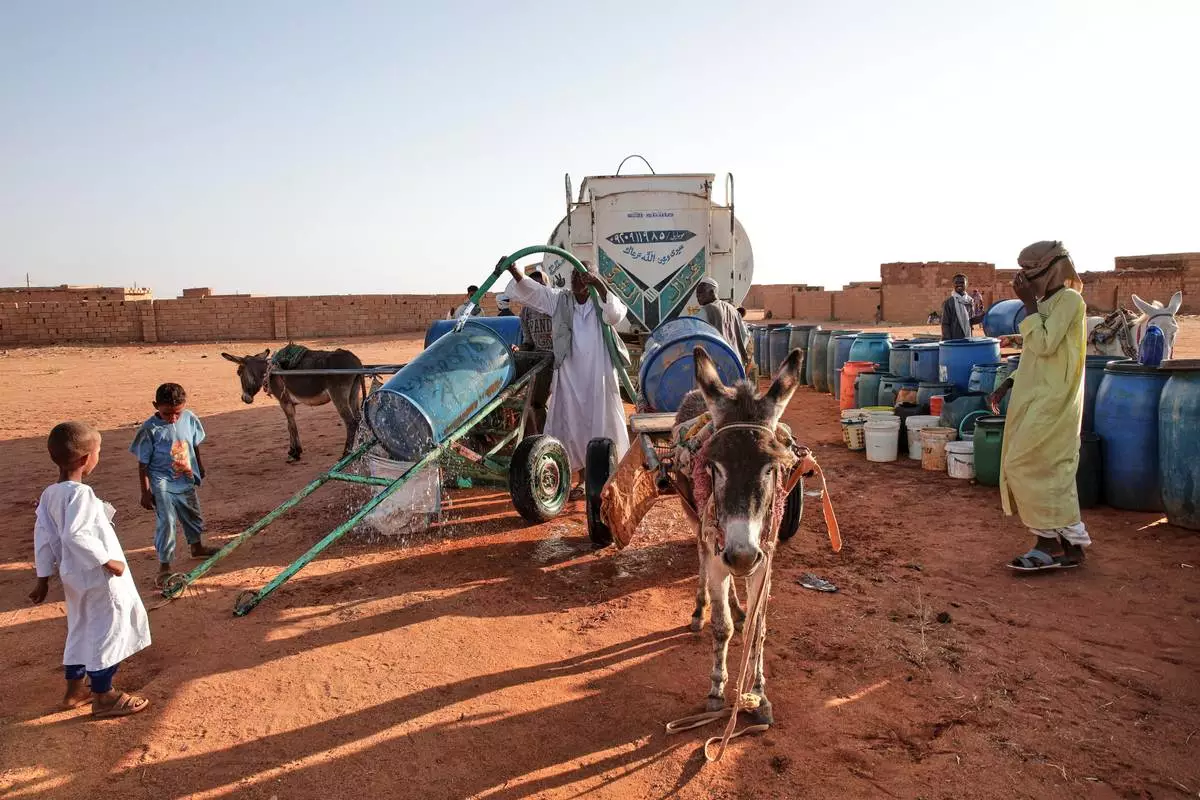
FILE - People fill water containers at a free distribution point due to water outages in Khartoum, Sudan, on Jan. 30, 2026. (AP Photo/Marwan Ali, File)
NEW YORK (AP) — This is not the run-up to the midterm elections that Republicans wanted.
A year and a half after winning the White House by promising to lower costs and end wars, Donald Trump is a wartime president overseeing surging energy costs and an escalating overseas conflict that many in his own party do not like.
He offered little clarity to a nation eager for answers this week during a prime-time address from the White House, his first since the U.S. and Israel attacked Iran more than a month ago, simultaneously suggesting that the war was ending and expanding.
“Thanks to the progress we’ve made, I can say tonight that we are on track to complete all of America’s military objectives shortly, very shortly,” Trump said. “We’re going to hit them extremely hard over the next two to three weeks.”
Trump's comments come roughly six months before voters across the nation begin to cast ballots in elections that will decide control of Congress and key governorships for Trump’s final two years in office. For now, Republicans, who control all branches of government in Washington, are bracing for a painful political backlash.
“You’re looking at an ugly November,” warned veteran Republican pollster Neil Newhouse. “At a point in time when we need every break possible to hold the House and Senate, our edge is being chipped away.”
It’s hard to overstate how dramatically the political landscape has shifted.
At this time last year, many Republican leaders believed there was a path to preserve their narrow House majority and easily hold the Senate. Now they privately concede that the House is all but lost and Democrats have a realistic shot at taking the Senate.
Republicans are also struggling to coalesce around a clear midterm message on Iran.
The Republican National Committee has largely avoided the war in talking points issued to surrogates over the last month. The leaders of the party's campaign committees responsible for the House and Senate declined interview requests. Many vulnerable Republican candidates sidestep the issue, unwilling to defend or challenge Trump publicly.
The president remains deeply popular with Republican voters, and he has vocal supporters like Sen. Lindsey Graham of South Carolina.
“That was the best speech I could’ve hoped for,” he wrote on social media after Trump's address on Wednesday evening. Graham said Trump “gave the American people a clear and coherent pathway forward.”
Trump made little effort to sell the conflict to Americans before the initial attack. Five weeks later, at least 13 U.S. service members have been killed and hundreds more injured. Thousands more troops have converged on the region, and the Pentagon requested $200 billion in new funding.
The Strait of Hormuz, a key passage for a fifth of the world’s oil, remains closed. The average price for a gallon of gasoline in the U.S. was $4.08 on Thursday, according to AAA, almost a full dollar higher than on President Joe Biden's last day in office.
On Wednesday, Trump insisted that gas prices would fall quickly once the war concluded but offered no solution for reopening the Strait of Hormuz. Instead, he invited skeptical U.S. allies to do it themselves.
He insisted that the war would be worth it.
“This is a true investment in your grandchildren and your grandchildren’s future,” Trump said. “When it’s all over, the United States will be safer, stronger, more prosperous and greater than it has ever been before.”
Former Rep. Marjorie Taylor Greene, a Georgia Republican who was once among Trump's most vocal allies in Congress, lashed out against his Iran policy.
“I wanted so much for President Trump to put America First. That’s what I believed he would do. All I heard from his speech tonight was WAR WAR WAR,” she wrote on social media. “Nothing to lower the cost of living for Americans.”
About 6 in 10 U.S. adults say the U.S. military action in Iran has “gone too far,” according to AP-NORC polling from March. Roughly a third approve of how he’s handling Iran overall.
The possibility of sending U.S. forces into Iran also appears politically unpalatable.
About 6 in 10 adults are “strongly” or “somewhat” opposed to deploying U.S. troops on the ground to fight Iran. That includes about half of Republicans. Only about 1 in 10 favor deploying troops.
At the same time, Trump’s approval ratings have remained consistently weak. About 4 in 10 Americans approve of how he’s handling the presidency, roughly in line with how it’s been throughout his second term.
Republican strategist Ari Fleischer, a senior aide in former President George W. Bush’s administration, acknowledged that Trump has not received the polling bump in this war that Bush got after invading Iraq.
Bush, of course, worked to build public backing for the Iraq War before going in. Immediately after the 2003 invasion, Bush's popularity soared, as did the stock market.
Public sentiment and the economy soured only after the conflict stretched on. It ultimately spanned more than eight years, spawning a generation of anti-war Republicans — and sowing the seeds of Trump's “America First” foreign policy.
“My hope is that the Trump experience is the exact opposite of the Bush experience,” Fleischer said.
He said Trump must win the war decisively and quickly to avoid a further backlash, saying there could be a “very significant political upside if things end well, oil comes down and markets rally.”
Fleischer added that Trump's actions will matter much more than his words.
“Ultimately, he is not going to get judged on his persuasion or his explanations or his assertions, he’s going to get judged on results,” he said.
Associated Press writer Linley Sanders in Washington contributed to this report.

In this image made with a long exposure, President Donald Trump speaks about the Iran war from the Cross Hall of the White House on Wednesday, April 1, 2026, in Washington. (AP Photo/Alex Brandon, Pool)