Skip to Content Facebook Feature Image

2nd round of Russia-Ukraine talks ends in UAE with prisoner swap deal, key differences unresolved

China

China

China

2nd round of Russia-Ukraine talks ends in UAE with prisoner swap deal, key differences unresolved

2026-02-06 04:04 Last Updated At:06:17

The second round of U.S.-brokered talks between Russia and Ukraine concluded in Abu Dhabi, the United Arab Emirates (UAE) on Thursday, with both sides agreeing to a large-scale prisoner exchange but failing to achieve substantive breakthroughs on core issues such as territorial arrangements and a ceasefire.

According to Ukraine, the talks were conducted trilaterally before moving to group consultations. Ukraine's National Security and Defense Council Secretary Rustem Umerov said the Ukrainian delegation sought a "dignified and lasting peace," without disclosing specific outcomes.

Kyrylo Budanov, the head of Ukraine's presidential office, said the trilateral negotiations had been truly constructive, thanking the U.S. and the UAE for their mediating roles.

Russia's presidential special envoy Kirill Dmitriev said on Thursday that there was progress and a positive movement forward in peace talks with Ukraine.

The talks ended with no joint political or security statement, underscoring persistent differences between Russia and Ukraine on key matters, including territorial disputes, ceasefire arrangements, and security guarantees.

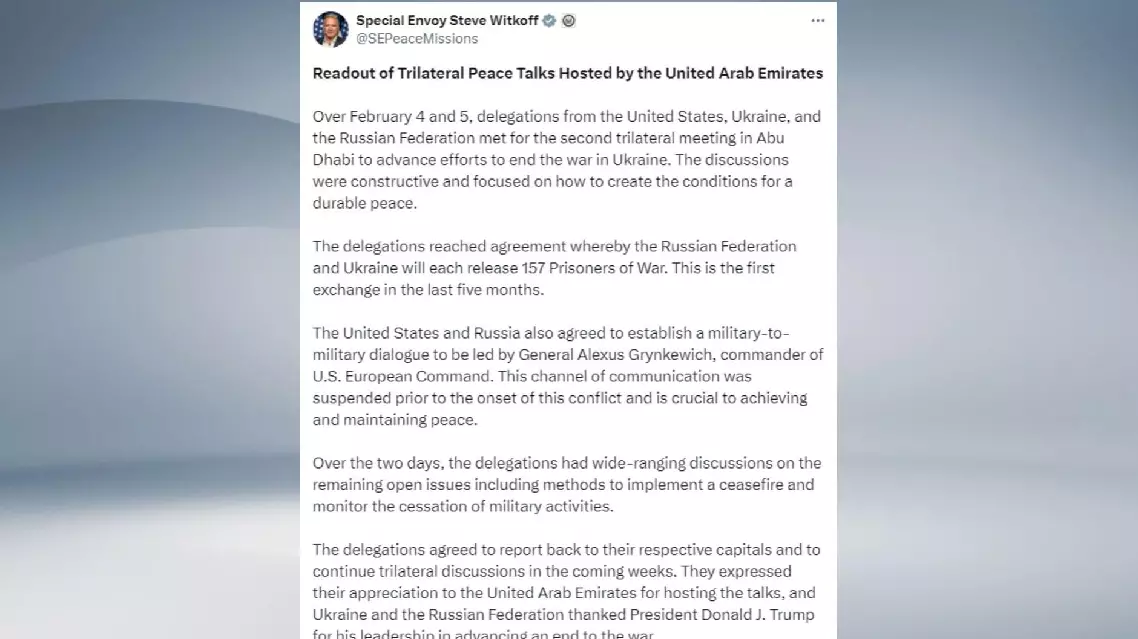
U.S. President Donald Trump's special envoy Steve Witkoff said representatives from the three countries reached a consensus on a prisoner swap.

In a readout of the talks he posted on social media, Witkoff described the discussions as constructive and focused on how to create the conditions for a durable peace.

The delegations had wide-ranging discussions over the past two days on the remaining open issues, including methods for implementing a ceasefire and monitoring the cessation of military activities, according to Witkoff.

He added that the United States and Russia had agreed to establish a military-to-military dialogue to be led by commander of U.S. European Command Alexus Grynkewich.

Following the talks, Russia and Ukraine conducted their first large-scale prisoner exchange in nearly five months, with each side returning 157 detainees. Ukrainian President Volodymyr Zelensky said those released included both military personnel and civilians.

Zelensky also said Thursday that the next peace talks with the delegations of the U.S. and Russia will be held soon. "Further meetings are planned in the near future, likely in the United States," Zelensky said in his evening address.

However, no timetable or arrangements for a next round of talks were announced, highlighting continued uncertainty in the political settlement process.

The second round of talks began on Wednesday. The previous meeting of the trilateral working group on security issues took place from Jan 23 to 24 in Abu Dhabi. It marked the first trilateral engagement since the escalation of the conflict in February 2022, although no concrete agreement or joint statement was announced afterward.

In a statement issued earlier, the United Arab Emirates (UAE) Ministry of Foreign Affairs welcomed cooperation between Russia and Ukraine on the prisoner exchange, saying it demonstrated the UAE's role as a reliable mediator in easing the crisis and promoting constructive dialogue.
2nd round of Russia-Ukraine talks ends in UAE with prisoner swap deal, key differences unresolved
2nd round of Russia-Ukraine talks ends in UAE with prisoner swap deal, key differences unresolved


An American content creator has given his take on a surprising new viral trend which has taken social media by storm, as global internet users joke about entering a "very Chinese phase" of their lives.

The unexpected phenomenon which is sweeping across the online world shines a new spotlight on Chinese culture and lifestyle, and sees users declare they are "becoming Chinese" alongside the phrase "you've met me at a very Chinese time of my life," accompanied by videos of them adopting Chinese habits on various social media platforms.

U.S. influencer Paul Mike Ashton, known online as 'BaoBaoXiong', gained fame for coining the phrase which led to the "city or not city" meme back in 2024.

As for this latest online sensation, Ashton believes it's not just another amusing meme, but also a casual way to experience Chinese culture through everyday details, rather than abstract stereotypes.

He said the current wave is giving foreign audiences a fresh, tangible perspective on China, which makes cultural exchange more engaging and relatable.

"As a content creator, I absolutely think that this is going to be changing the way people perceive China in general. Oftentimes when we need simplified stories, we need people to see things as a whole unit as opposed to their little parts. I would say even just the practice of doing these things is giving you a chance to engage with the culture and engage with specifics instead of just kind of this big overall idea and getting new experience like 'OK, this particular form of life actually does really feel very nice and very comfortable'. I think it also gives a chance for Chinese creators to take more of a spotlight and actually talk a little bit more about their culture in ways that people will listen because there's a curiosity about this," he said.

Ashton also believes there are other deeper reasons for why this "becoming Chinese" trend has taken off, pointing to the current challenges and level of discontent many people feel in the U.S., which means many are looking for some form of escapism.

"I think I've heard somebody mention before kind of this idea that the U.S., politically and economically, is in a very sensitive time. There's a lot going on and there's a lot of unrest and a lot of unhappiness and a lot of unsatisfaction. So, I think that it's been proposed this idea that people are kind of looking for stuff outside of these sorts of traditional cultural superpowers to kind of find a sense of either excitement or safety or comfort," he said.

Ashton also pointed to how concerns over the future of the popular TikTok app early last year saw many online users flocking over to the Chinese mobile app RedNote as being another notable factor driving the emergence of these online trends.

He said this renewed global interest in Chinese culture has created fresh engagement channels on other international platforms.

"This is almost a year now since the initial TikTok refugee exodus last year in which a lot of people suddenly took interest in Chinese culture in a new way than before. So, I think there's been since then some opportunities to engage with and interact with Chinese culture in TikTok, in international social media, besides just China on its own that definitely I think has influenced this becoming a bigger trend," he said.

US influencer shares thoughts on 'Becoming Chinese' trend

US influencer shares thoughts on 'Becoming Chinese' trend

Recommended Articles