|
CHENNAI, India, Feb. 6, 2026 /PRNewswire/ -- India's top-ranked higher education, the Indian Institute of Technology Madras (IIT Madras), has established a new entity, IIT Madras Global Research Foundation (IITM Global) with a charter to take IIT Madras' research and innovation ecosystem into multiple geographies.
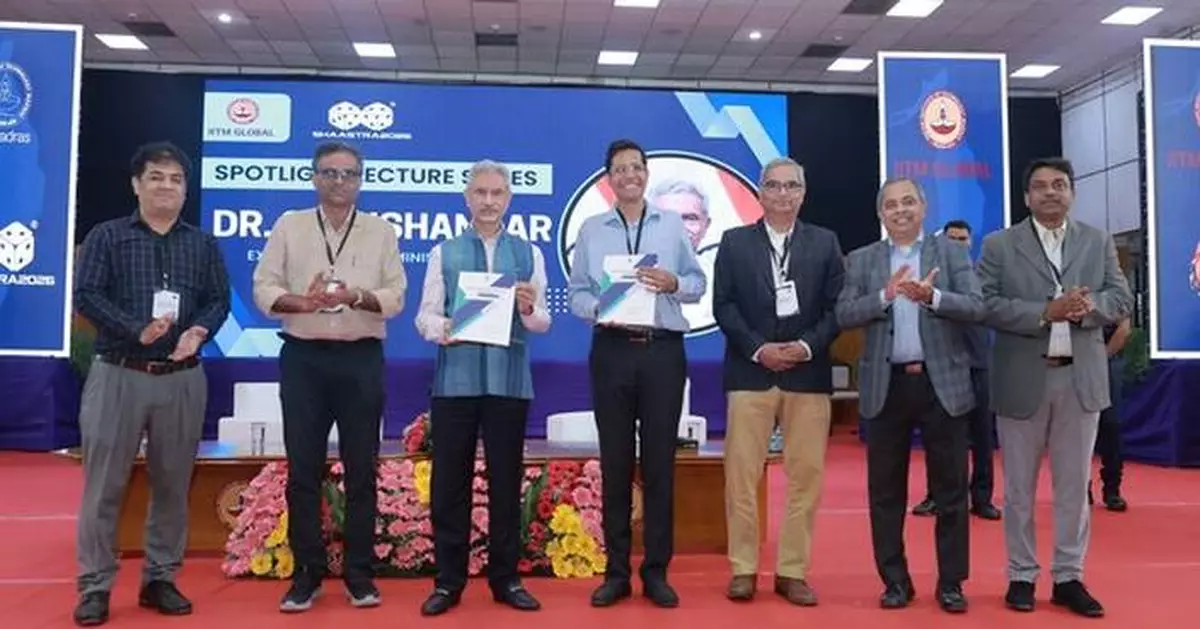
IITM Global is strengthening its engagement in Southeast Asia through strategic partnerships in Malaysia. IITM Global was newly-launched by Dr. S. Jaishankar, Hon'ble Minister of External Affairs, Government of India.
The initiative supports IIT Madras's vision to become the world's first multinational university by positioning it as a globally networked hub for education, research, innovation and entrepreneurship.
Addressing the IITM Global launch event at IIT Madras Campus on 2nd Jan 2026, Dr. S. Jaishankar said, "An IIT Madras Campus in Tanzania is a way by which Indian Foreign Policy has leveraged the capabilities of an Institution here to make a huge impact. In ten years from now, think how many Students of Africa would have passed through its portals. We are a human resource power and we should play to our strengths. We now have the capability to start doing so. When institutions of excellence in the country start going abroad, the business of foreign policy gains a huge addition to our arsenal. This is something very transformational."
As part of its Malaysia-focused expansion, IIT Madras has entered into a collaboration with ASEM (Advanced Semiconductor Academy of Malaysia) to deepen academic cooperation and innovation-led engagement in the region. The partnership will focus on delivering joint certification programs, enabling student exchange and faculty mobility, and supporting education and skilling initiatives tailored to Malaysian and regional needs with a focus on Semiconductors & Semiconductor design.
In addition, the partnership envisions setting up an Overseas Research Centre in Malaysia to support high-potential deep-tech startups seeking to expand into the Southeast Asian market.
IITM Global has also formalised a collaboration framework with Aisling Group. The partnership is designed to build synergies aligned with IITM Global's mission to internationalise Indian innovation, technology and startups.
Areas of collaboration include startup scaling support, Skilling and short term certification programs, collaborative research initiatives, and intellectual property and technology transfer, enabling closer integration between Indian and Malaysian innovation ecosystems.
IITM Global has been conceived as a strategic, scalable 'plug-and-play' platform that enables researchers, students, startups and industry partners to access global markets, capital and collaborative research opportunities.
Widely recognised as India's top-ranked institution for higher education, IIT Madras is ranked #1 Overall and #1 Engineering Institute in India's National Institutional Ranking Framework (NIRF), #180 in the QS World University Rankings and #56 in the QS Asian University Rankings. The institute brings a strong research ecosystem to its global partnerships, comprising 18 academic departments, 15 Centres of Excellence, 23 research centres and nearly 100 advanced laboratories, supported by more than 650 faculty members and over 10,000 students.
CHENNAI, India, Feb. 6, 2026 /PRNewswire/ -- India's top-ranked higher education, the Indian Institute of Technology Madras (IIT Madras), has established a new entity, IIT Madras Global Research Foundation (IITM Global) with a charter to take IIT Madras' research and innovation ecosystem into multiple geographies.
IITM Global is strengthening its engagement in Southeast Asia through strategic partnerships in Malaysia. IITM Global was newly-launched by Dr. S. Jaishankar, Hon'ble Minister of External Affairs, Government of India.
The initiative supports IIT Madras's vision to become the world's first multinational university by positioning it as a globally networked hub for education, research, innovation and entrepreneurship.
Addressing the IITM Global launch event at IIT Madras Campus on 2nd Jan 2026, Dr. S. Jaishankar said, "An IIT Madras Campus in Tanzania is a way by which Indian Foreign Policy has leveraged the capabilities of an Institution here to make a huge impact. In ten years from now, think how many Students of Africa would have passed through its portals. We are a human resource power and we should play to our strengths. We now have the capability to start doing so. When institutions of excellence in the country start going abroad, the business of foreign policy gains a huge addition to our arsenal. This is something very transformational."
As part of its Malaysia-focused expansion, IIT Madras has entered into a collaboration with ASEM (Advanced Semiconductor Academy of Malaysia) to deepen academic cooperation and innovation-led engagement in the region. The partnership will focus on delivering joint certification programs, enabling student exchange and faculty mobility, and supporting education and skilling initiatives tailored to Malaysian and regional needs with a focus on Semiconductors & Semiconductor design.
In addition, the partnership envisions setting up an Overseas Research Centre in Malaysia to support high-potential deep-tech startups seeking to expand into the Southeast Asian market.
IITM Global has also formalised a collaboration framework with Aisling Group. The partnership is designed to build synergies aligned with IITM Global's mission to internationalise Indian innovation, technology and startups.
Areas of collaboration include startup scaling support, Skilling and short term certification programs, collaborative research initiatives, and intellectual property and technology transfer, enabling closer integration between Indian and Malaysian innovation ecosystems.
IITM Global has been conceived as a strategic, scalable 'plug-and-play' platform that enables researchers, students, startups and industry partners to access global markets, capital and collaborative research opportunities.
Widely recognised as India's top-ranked institution for higher education, IIT Madras is ranked #1 Overall and #1 Engineering Institute in India's National Institutional Ranking Framework (NIRF), #180 in the QS World University Rankings and #56 in the QS Asian University Rankings. The institute brings a strong research ecosystem to its global partnerships, comprising 18 academic departments, 15 Centres of Excellence, 23 research centres and nearly 100 advanced laboratories, supported by more than 650 faculty members and over 10,000 students.
** The press release content is from PR Newswire. Bastille Post is not involved in its creation. **
India's No: 1 Institute IIT Madras partners with Malaysian institutions to advance education, research and innovation
SHANGHAI, April 3, 2026 /PRNewswire/ -- As AI becomes essential in K–12 education, many teachers face a practical question: How to teach AI through hands-on, project-based learning without advanced coding skills?
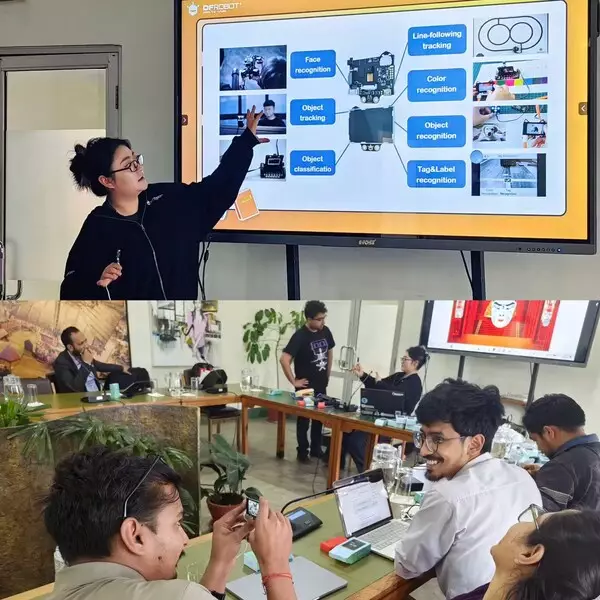
A recent workshop in Kathmandu University offers a clear answer. Conducted by DFRobot, an innovator in STEAM education, the three-hour workshop at the School of Engineering brought together teachers and department heads from across disciplines. Participants completed two hands-on AI projects while exploring how to translate these experiences into their own classroom teaching.
From Awareness to Classroom Practice
According to the Computer Science Teachers Association, while most educators support AI in the curriculum, many lack confidence in teaching it effectively. This workshop directly addressed that gap—moving from awareness to practical implementation.
Learning AI Through Hands-On Building
The training adopted a face-to-face, project-based approach, combining technical learning with pedagogy. It focused on deploying AI capabilities—such as speech and vision—on edge devices, connecting abstract concepts to interactive classroom applications.
Using UNIHIKER K10 hardware and Mind+ graphical programming software, participants completed two progressive projects:
Voice Interaction
Using the UNIHIKER K10 and the Mind+ graphical programming platform software, the workshop introduced voice-based human–machine interaction as an accessible entry point into AI learning. Teachers began by creating a simple voice-controlled system with commands such as "turn on the light," experiencing a fundamental AI interaction loop: wake → recognize → execute.
Building on this foundation, they extended the system to control on-screen movement through voice directions, transforming a basic function into a more engaging and interactive experience. Rather than focusing on complex programming, the training emphasized how simple voice commands can be translated into practical classroom applications.
Through this process, teachers gained a clear understanding of real-time voice interaction and its classroom potential.
Vision Interaction
The workshop introduced the HUSKYLENS AI vision sensor and its face recognition capabilities, helping teachers understand how machines perceive the world through visual data. Trainers explained the core workflow of face recognition—including detection, alignment, encoding, and matching—providing a clear technical framework for classroom application. Building on this foundation, teachers connected HUSKYLENS with the Mind+ programming environment and implemented real-time recognition tasks. Extending this approach, they developed a "Smart Pet" system by integrating HUSKYLENS with the UNIHIKER K10. The system could recognize different types of cats—such as Orange Tabby, Striped Tabby, and Siamese—and respond with corresponding interactive states.
Through this hands-on process, teachers gained a clear understanding of computer vision concepts and how visual input can drive interactive systems, enabling more engaging and project-based learning in the classroom.
A Model That Can Be Applied in AI Classrooms
The workshop highlights a practical approach to AI education that can be replicated across schools:
Accessible: Entry-level coding is all that's needed — suitable for K–12 learners.
Adaptable: Projects can be transformed into games, smart systems, or classroom tools
Structured: Aligned with project-based learning and real-world problem-solving
As part of the assessment, each teacher was asked to outline how the projects could be adapted for their own classrooms—highlighting a core objective of the training: not just using tools, but enabling curriculum design and effective knowledge transfer.
More importantly, it emphasized a critical shift—from understanding AI to applying it. By experiencing the full creation process, teachers gained the confidence to bring AI into their own classrooms.
** This press release is distributed by PR Newswire through automated distribution system, for which the client assumes full responsibility. **
How to Teach AI in the Classroom: A Hands-On Teacher Training Workshop at Kathmandu University