Skip to Content Facebook Feature Image

Italy braces for Winter Olympics with high security and decree targeting violent protesters

Sport

Italy braces for Winter Olympics with high security and decree targeting violent protesters
Sport

Sport

Italy braces for Winter Olympics with high security and decree targeting violent protesters

2026-02-06 22:41 Last Updated At:22:51

MILAN (AP) — Italy has ramped up security ahead of the opening ceremony of the Milan Cortina Winter Olympics Friday, with thousands of agents protecting athletes, spectators and global leaders at locations spanning from Milan to the Dolomites.

Prime Minister Giorgia Meloni's Cabinet on Thursday approved a security decree including stricter measures to counter violent protests, just ahead of fresh demonstrations planned around the opening ceremony. Opposition lawmakers criticized the measure, saying it muzzles freedom of expression.

More Images
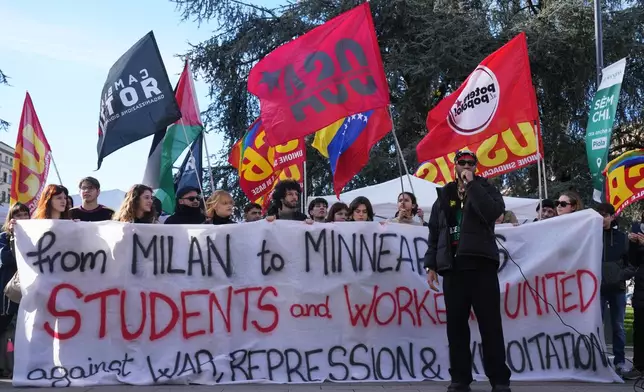
United States' activist Chris Smalls speaks during a protest against ICE, at the 2026 Winter Olympics, in Milan, Italy, Friday, Feb. 6, 2026. (AP Photo/Antonio Calanni)
United States' activist Chris Smalls speaks during a protest against ICE, at the 2026 Winter Olympics, in Milan, Italy, Friday, Feb. 6, 2026. (AP Photo/Antonio Calanni)

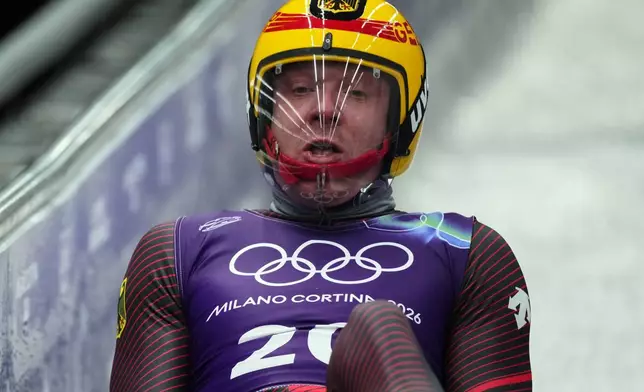
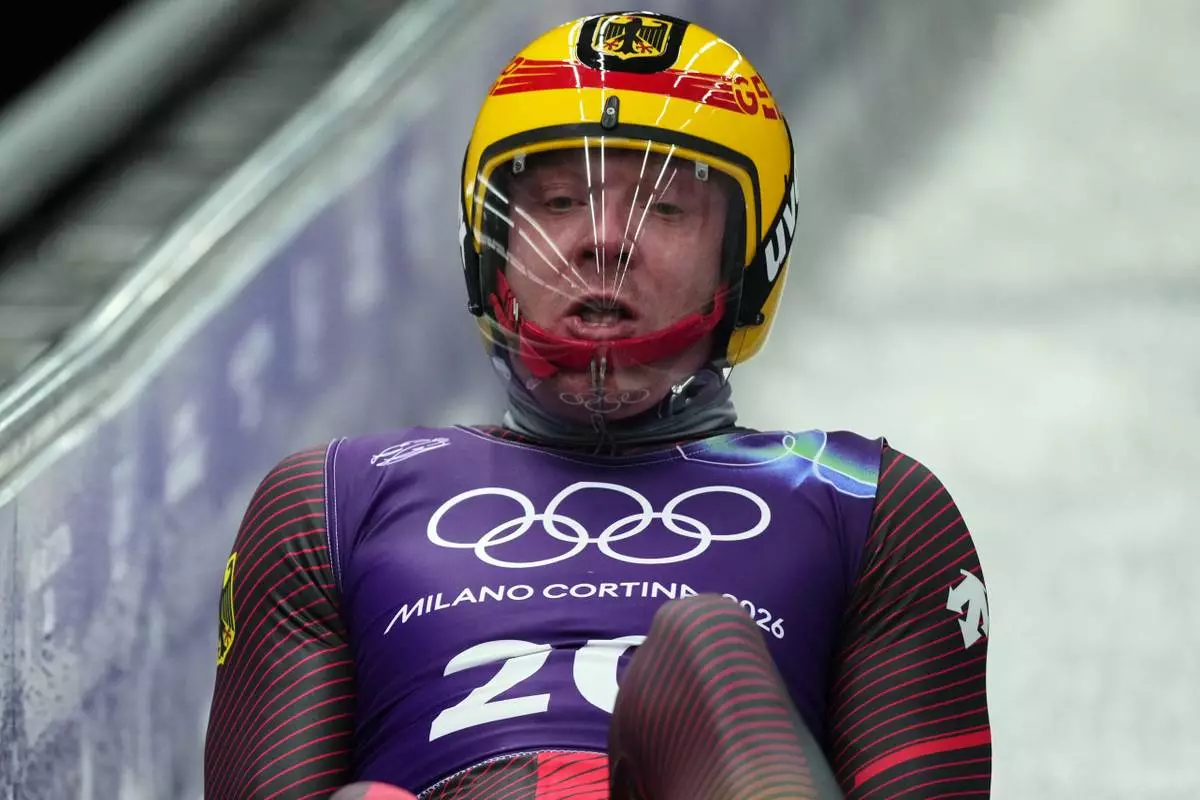
at the 2026 Winter Olympics, in Cortina d'Ampezzo, Italy, Thursday, Feb. 5, 2026. (AP Photo/Alessandra Tarantino)

at the 2026 Winter Olympics, in Cortina d'Ampezzo, Italy, Thursday, Feb. 5, 2026. (AP Photo/Alessandra Tarantino)

France's Nils Alphand speeds down the course during an alpine ski, men's downhill official training, at the 2026 Winter Olympics, in Bormio, Italy, Thursday, Feb. 5, 2026. (AP Photo/Gabriele Facciotti)
France's Nils Alphand speeds down the course during an alpine ski, men's downhill official training, at the 2026 Winter Olympics, in Bormio, Italy, Thursday, Feb. 5, 2026. (AP Photo/Gabriele Facciotti)

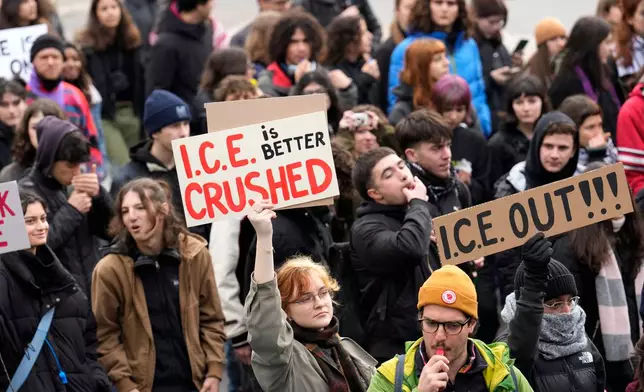
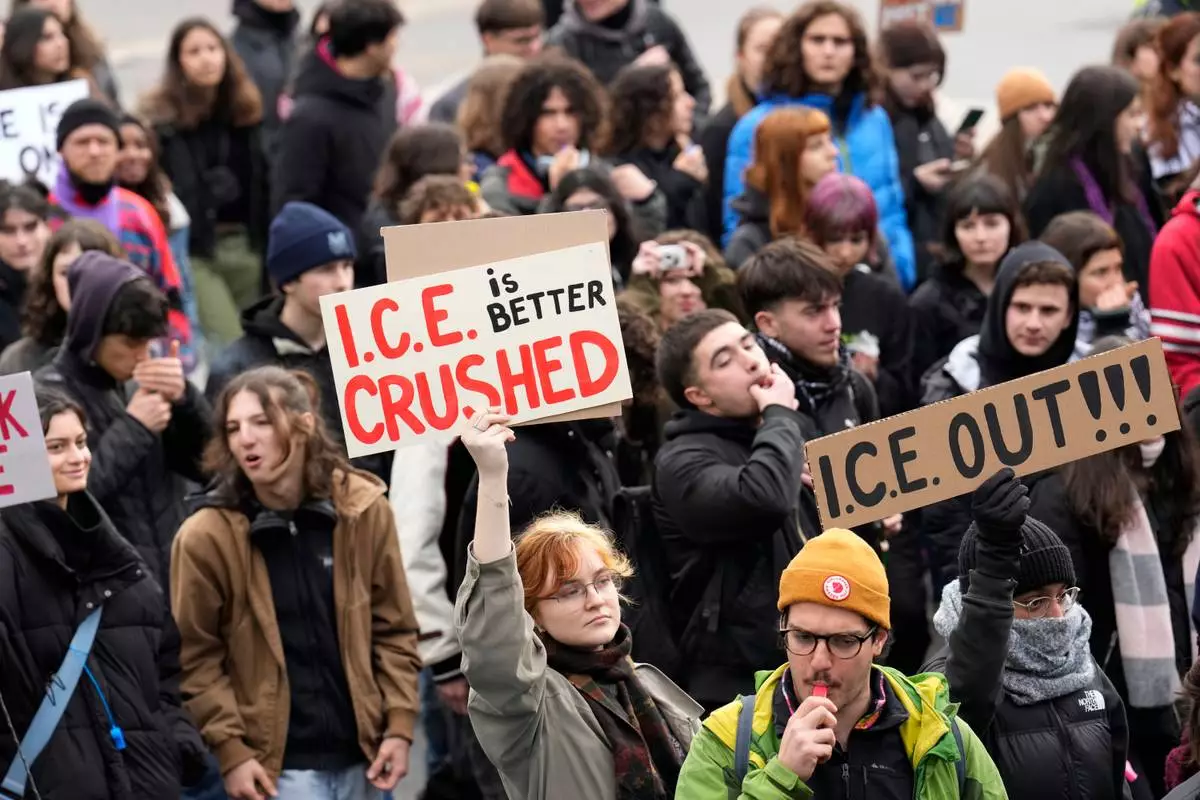
Protesters walk with signs during a demonstration against ICE organized by students at the 2026 Winter Olympics, in Milan, Italy, Friday, Feb. 6, 2026. (AP Photo/Luca Bruno)
Protesters walk with signs during a demonstration against ICE organized by students at the 2026 Winter Olympics, in Milan, Italy, Friday, Feb. 6, 2026. (AP Photo/Luca Bruno)

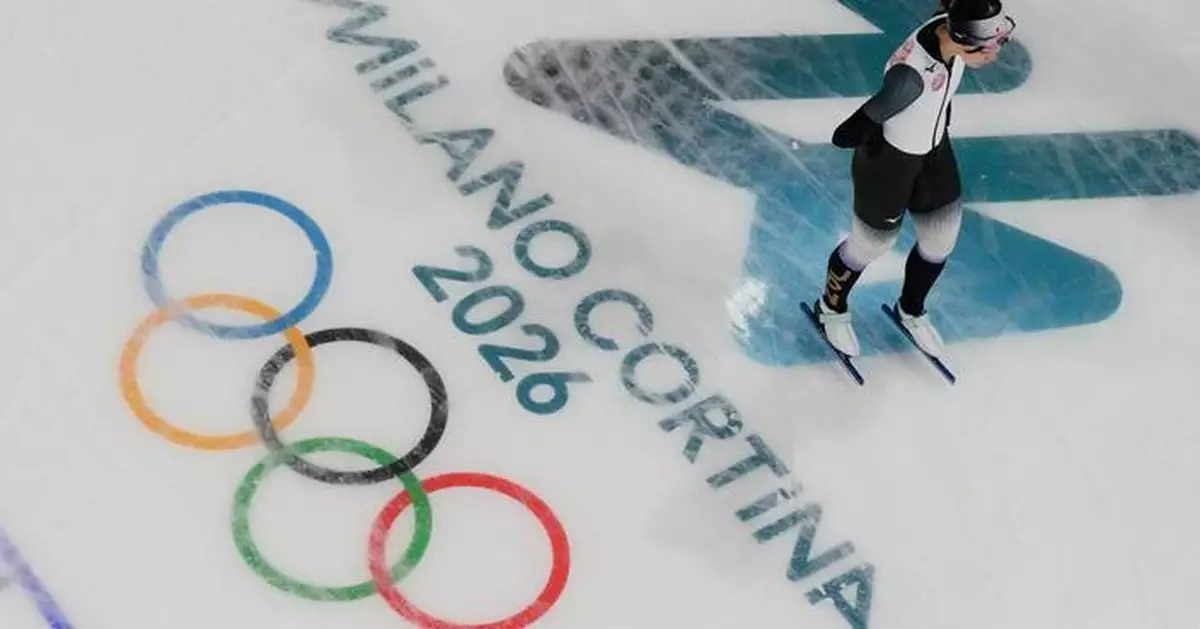
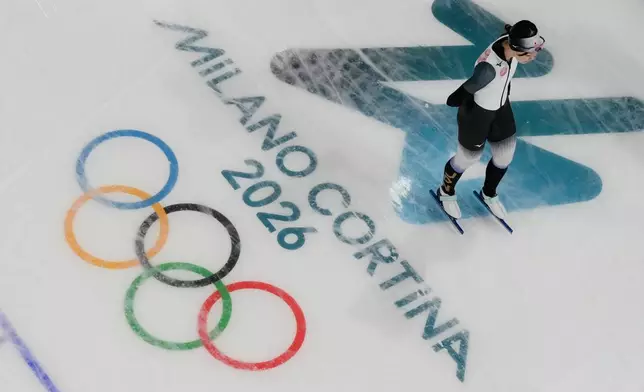
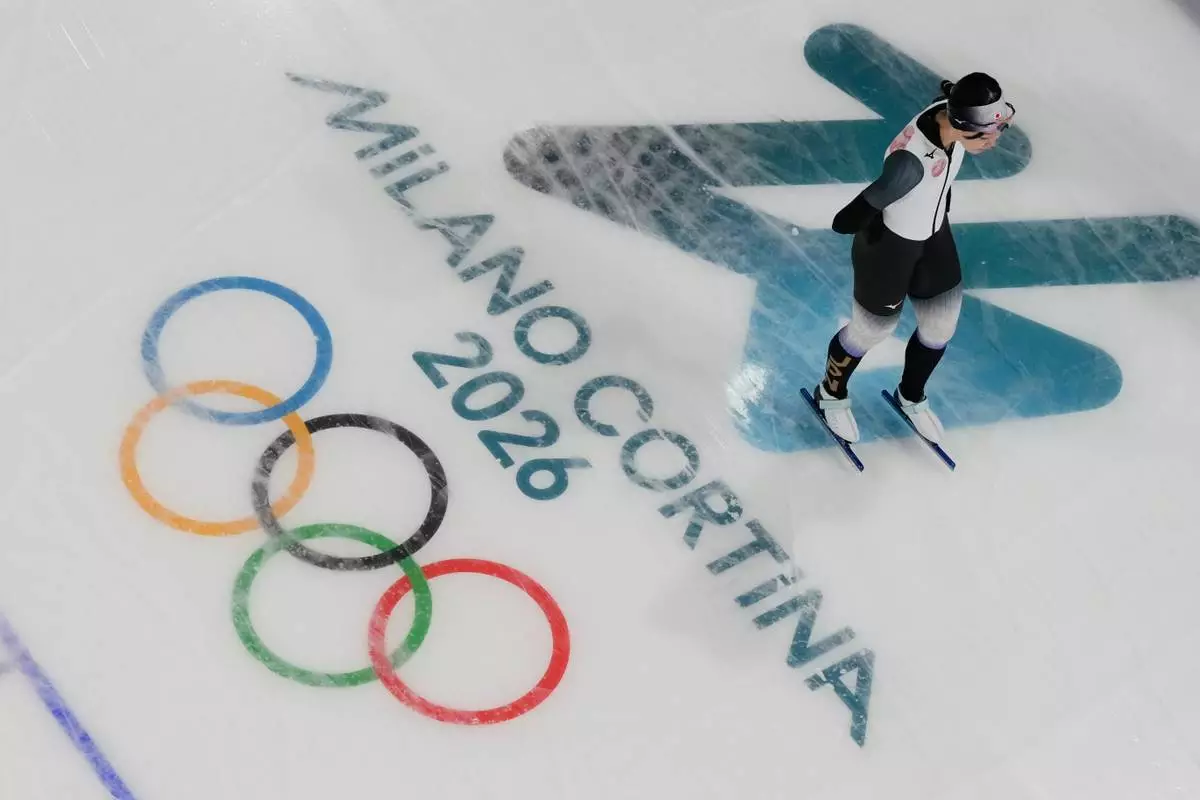
An athlete from Japan trains inside the speed skating venue at the 2026 Winter Olympics, in Milan, Italy, Thursday, Feb. 5, 2026. (AP Photo/David J. Phillip)

An athlete from Japan trains inside the speed skating venue at the 2026 Winter Olympics, in Milan, Italy, Thursday, Feb. 5, 2026. (AP Photo/David J. Phillip)

While some preliminary hockey and curling events started on Wednesday, the Games officially kick off with the opening ceremony at Milan’s San Siro Stadium on Friday evening, featuring global music stars and high-profile guests.

Around 6,000 security personnel will be deployed across the Olympic sites during the Games, including bomb disposal experts, snipers and counter-terrorism units, Italian authorities said.

Security at the Milan Games are particularly complicated because this is the most geographically dispersed in Olympics history, with events spread across Milan to three clusters in the mountains.

Italian police will rely on a network of operations centers to manage security and react to alerts quickly, and share information between them. The Associated Press on Thursday toured the main operations center in Milan, where dozens of police officers sat in front of computers and giant screens and kept eyes on various locations.

“The aim is to monitor in real time, in an absolutely timely and immediate manner, what is happening across the territory,” Sabrina Pane, Milan's deputy prefect, told the AP. “We can do this thanks to a very fast, constant flow of information.

Other centers are located in Bolzano, Trento, Venice, Verona, Belluno, Sondrio and Varese, where some Games venues are located.

Foreign police officers, as well as personnel from security agencies Interpol and Europol, will work with Italy’s public security department to quickly handle critical situations requiring international cooperation.

On Wednesday, Foreign Affairs Minister Antonio Tajani revealed that Italian police had already foiled a series of Russian-linked cyberattacks targeting several foreign ministry offices, as well as websites linked to the Winter Olympics and hotels in Cortina.

Interforce teams are operating around the clock to monitor both the territory and the internet to prevent further cyberattacks.

“We are committed to a dual approach,” said chief police commissioner Luisa Massaro. “The first is the protection of critical computerized infrastructure. The second is web monitoring."

Last week, news that a unit of U.S. Immigration and Customs Enforcement (ICE) would be present during the Winter Games set off concerns and protests across Italy, where people expressed outrage at the inclusion of an agency that has dominated headlines for leading the Trump administration’s immigration crackdown.

Homeland Security Investigations, a unit within ICE that focuses on cross-border crimes, frequently sends its officers to overseas events like the Olympics to assist with security. HSI officers are separate from the ICE arm at the forefront of the immigration crackdown known as Enforcement and Removal Operations, and there was no indication ERO officers were being sent to Italy.

Hundreds of protesters gathered on Saturday in Milan to voice opposition to the security force — both the entry of its agents to Italy and their deportation actions in the U.S. Italy's Interior Minister Matteo Piantedosi told parliament this week that ICE agents would only have an advisory role and would not operate on Italian territory. ICE’s unit will function solely within U.S. diplomatic missions, he said.

That hasn't completely quelled discontent. At least three rallies were set to take place in Milan on Friday before the opening ceremony, including two targeting ICE's deployment during the Games.

Dozens of students gathered Friday morning at Milan’s Leonardo da Vinci plaza to protest, blowing whistles and shouting “We don’t want ICE in our city!” as they marched under drifting clouds of pink smoke.

“It’s not only that I don’t like what they are doing to immigrants, I also don’t like what they are doing to protesters,” said Andrea Cucuzza, 18. “That’s why we are protesting. They don’t like manifestations, protests? Then we are doing one.”

A small group of protesters also gathered in the same piazza holding Palestine flags and a large white banner that read, “From Milan to Minneapolis, students and workers united against war, repression and exploitation.” The protest, organized by Amazon unionist Chris Smalls, targeted Israel’s participation in the Olympics.

Under the new security rules introduced by the government decree, police are allowed to detain people for up to 12 hours when there are reasonable grounds to believe they may act as agitators and disrupt peaceful protests. The decree takes immediate effect upon publication in the government’s official gazette.

Center-left opposition lawmakers strongly criticized the measure, saying they impose dangerous limitations to freedom of expression and exploit security worries around the Olympics to toughen state control over ordinary citizens. But the government holds a majority in parliament, ensuring the decree’s ratification before the 60-day deadline.

The move also comes several days after violent clashes between police and demonstrators erupted in the northern city of Turin. Tens of thousands of people gathered Saturday to protest the December eviction of a community center that had been occupied by leftist activists for three decades.

That peaceful demonstration turned violent when a small group of masked protesters started attacking police officers, pushing Meloni's conservative government to speed up approval of a security package that had been discussed for months.

Zampano reported from Rome. Associated Press writer María Teresa Hernández and Fernanda Figueroa reported from Milan.

AP Olympics: https://apnews.com/hub/milan-cortina-2026-winter-olympics
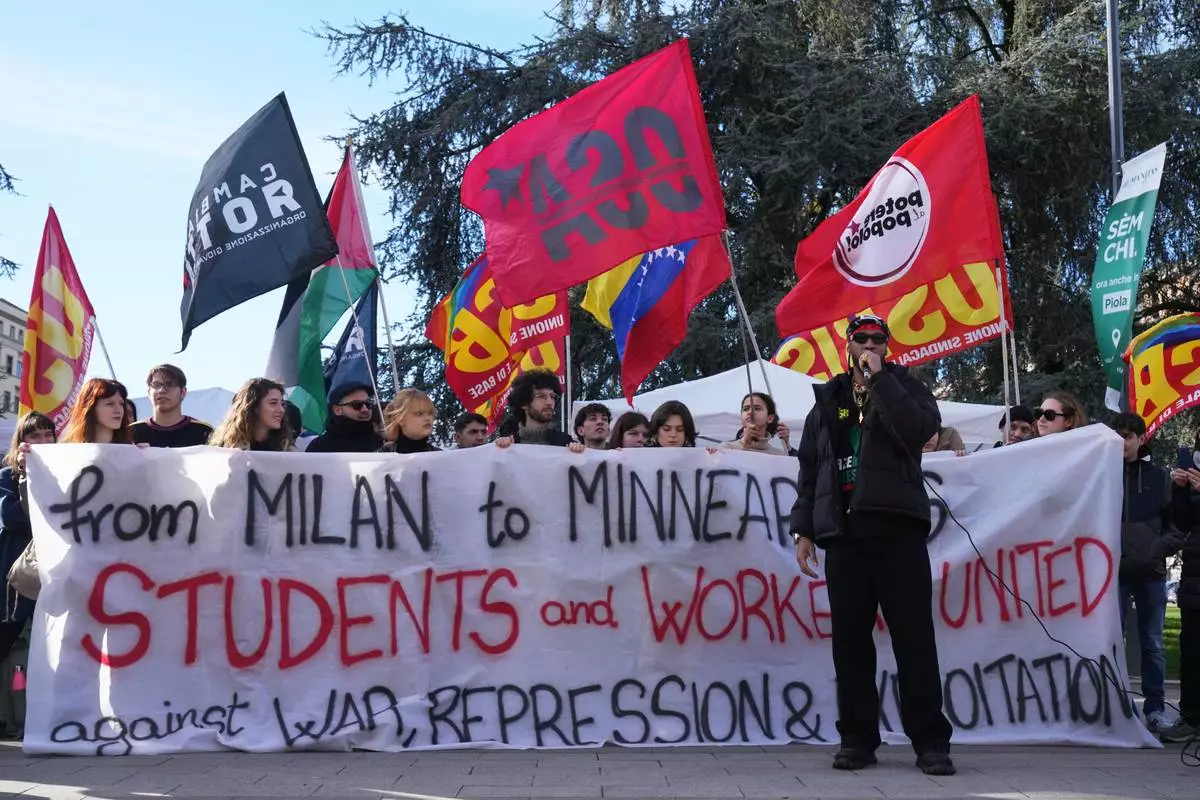
United States' activist Chris Smalls speaks during a protest against ICE, at the 2026 Winter Olympics, in Milan, Italy, Friday, Feb. 6, 2026. (AP Photo/Antonio Calanni)
United States' activist Chris Smalls speaks during a protest against ICE, at the 2026 Winter Olympics, in Milan, Italy, Friday, Feb. 6, 2026. (AP Photo/Antonio Calanni)

at the 2026 Winter Olympics, in Cortina d'Ampezzo, Italy, Thursday, Feb. 5, 2026. (AP Photo/Alessandra Tarantino)

at the 2026 Winter Olympics, in Cortina d'Ampezzo, Italy, Thursday, Feb. 5, 2026. (AP Photo/Alessandra Tarantino)

France's Nils Alphand speeds down the course during an alpine ski, men's downhill official training, at the 2026 Winter Olympics, in Bormio, Italy, Thursday, Feb. 5, 2026. (AP Photo/Gabriele Facciotti)
France's Nils Alphand speeds down the course during an alpine ski, men's downhill official training, at the 2026 Winter Olympics, in Bormio, Italy, Thursday, Feb. 5, 2026. (AP Photo/Gabriele Facciotti)

Protesters walk with signs during a demonstration against ICE organized by students at the 2026 Winter Olympics, in Milan, Italy, Friday, Feb. 6, 2026. (AP Photo/Luca Bruno)
Protesters walk with signs during a demonstration against ICE organized by students at the 2026 Winter Olympics, in Milan, Italy, Friday, Feb. 6, 2026. (AP Photo/Luca Bruno)

An athlete from Japan trains inside the speed skating venue at the 2026 Winter Olympics, in Milan, Italy, Thursday, Feb. 5, 2026. (AP Photo/David J. Phillip)
An athlete from Japan trains inside the speed skating venue at the 2026 Winter Olympics, in Milan, Italy, Thursday, Feb. 5, 2026. (AP Photo/David J. Phillip)

NEW YORK (AP) — Technology stocks are recovering some of their losses on Friday, and bitcoin has halted its plunge, as Wall Street bounces back from big losses taken earlier in the week, at least for now.

The S&P 500 rose 0.9% and was heading for just its second gain in the last eight days. The Dow Jones Industrial Average was up 610 points, or 1.2%, as of 9:35 a.m. Eastern time, and the Nasdaq composite was 0.7% higher.

Chip companies helped drive the gains, and Nvidia rose 2.9% to trim into its loss for the week, which came into the day at just over 10%. Broadcom climbed 3.4% to eat into its drop for the week of 6.3%.

They benefited from hopes for continued spending by companies on chips to drive their forays into artificial-intelligence technology. Amazon, for example, said late Thursday it expects to spend about $200 billion on investments this year to take advantage of “seminal opportunities like AI, chips, robotics, and low earth orbit satellites.”

Such heavy spending, similar to what Alphabet announced just a day earlier, is creating concerns of their own, though. The question is whether all those dollar will prove to be worth it through bigger profits in the future. With doubt remaining about that, Amazon’s stock tumbled 9.6%.

The tentative trading means the S&P 500 is still flirting with its worst weekly loss since November, and its third in the last four weeks. Besides worries about big spending on AI by Big Tech companies, whose stocks are the most influential on Wall Street, concerns about AI potentially stealing customers away from software companies also hurt the market through the week.

Bitcoin, meanwhile, steadied itself somewhat following a weekslong plunge that had sent it more than halfway below its record set in October. It climbed back above $68,000 after briefly dropping around $60,000 late Thursday.

Prices in the metals market also calmed a bit following their own wild swings. Gold rose 0.7% to $4,924.40 per ounce, while silver fell 3.2%.

Their prices suddenly ran out of momentum last week following jaw-dropping rallies, driven by the desire among investors to own something safe amid worries about political turmoil, a U.S. stock market that critics called expensive and huge debt loads for governments worldwide. By January, though, prices were surging so quickly that critics called it unsustainable.

On Wall Street, the recovery for bitcoin helped stocks of companies enmeshed in the crypto economy. Robinhood Markets jumped nearly 12% for the biggest gain in the S&P 500. Crypto trading platform Coinbase Global rose 6.6%. Strategy, the company that’s made a business of buying and holding bitcoin, soared 15.1%.

In stock markets abroad, indexes ticked higher in Europe.

That was even though Stellantis, the auto giant whose stock trades in Milan, lost roughly a quarter of its value after saying it would take a charge of 22 billion euros, or $26 billion, as it dials back its electric vehicle production. The automaker acknowledged “over-estimating the pace of the energy transition” and said it was resetting its business “to align the company with the real-world preferences of its customers.”

Stocks fell across much of Asia, but Japan’s Nikkei 225 rose 0.8%. It benefited from a 2% climb for Toyota Motor, which said CEO Koji Sato will step down in April and will be replaced by the company’s chief financial officer, Kenta Kon.

In the bond market, the yield on the 10-year Treasury edged down to 4.20% from 4.21% late Thursday.

AP Business Writers Chan Ho-him and Matt Ott contributed.

Traders Edward McCarthy, left, and Edward Curran work on the floor of the New York Stock Exchange, Thursday, Feb. 5, 2026. (AP Photo/Richard Drew)

Traders Edward McCarthy, left, and Edward Curran work on the floor of the New York Stock Exchange, Thursday, Feb. 5, 2026. (AP Photo/Richard Drew)

Bob's Discount Furniture President & CEO Bill Barton rings a ceremonial bell on the floor of the New York Stock Exchange as his company's IPO begins trading, Thursday, Feb. 5, 2026. (AP Photo/Richard Drew)

Bob's Discount Furniture President & CEO Bill Barton rings a ceremonial bell on the floor of the New York Stock Exchange as his company's IPO begins trading, Thursday, Feb. 5, 2026. (AP Photo/Richard Drew)

Trader Robert FInnerty Jr. works on the floor of the New York Stock Exchange, Thursday, Feb. 5, 2026. (AP Photo/Richard Drew)

Trader Robert FInnerty Jr. works on the floor of the New York Stock Exchange, Thursday, Feb. 5, 2026. (AP Photo/Richard Drew)

Trader Michael Conlon, right, works on the floor of the New York Stock Exchange, Thursday, Feb. 5, 2026. (AP Photo/Richard Drew)

Trader Michael Conlon, right, works on the floor of the New York Stock Exchange, Thursday, Feb. 5, 2026. (AP Photo/Richard Drew)

Trader Jeffrey Vazquez works on the floor of the New York Stock Exchange, Thursday, Feb. 5, 2026. (AP Photo/Richard Drew)

Trader Jeffrey Vazquez works on the floor of the New York Stock Exchange, Thursday, Feb. 5, 2026. (AP Photo/Richard Drew)

Currency traders watch monitors near a screen showing the Korea Composite Stock Price Index (KOSPI), left, at the foreign exchange dealing room of the Hana Bank headquarters in Seoul, South Korea, Friday, Feb. 6, 2026. (AP Photo/Ahn Young-joon)

Currency traders watch monitors near a screen showing the Korea Composite Stock Price Index (KOSPI), left, at the foreign exchange dealing room of the Hana Bank headquarters in Seoul, South Korea, Friday, Feb. 6, 2026. (AP Photo/Ahn Young-joon)

Currency traders work near a screen showing the Korea Composite Stock Price Index (KOSPI), top center, and the foreign exchange rate between U.S. dollar and South Korean won, top left, at the foreign exchange dealing room of the Hana Bank headquarters in Seoul, South Korea, Friday, Feb. 6, 2026. (AP Photo/Ahn Young-joon)

Currency traders work near a screen showing the Korea Composite Stock Price Index (KOSPI), top center, and the foreign exchange rate between U.S. dollar and South Korean won, top left, at the foreign exchange dealing room of the Hana Bank headquarters in Seoul, South Korea, Friday, Feb. 6, 2026. (AP Photo/Ahn Young-joon)

Currency traders watch monitors near a screen showing the Korea Composite Stock Price Index (KOSPI), top center, and the foreign exchange rate between U.S. dollar and South Korean won, top center left, at the foreign exchange dealing room of the Hana Bank headquarters in Seoul, South Korea, Friday, Feb. 6, 2026. (AP Photo/Ahn Young-joon)

Currency traders watch monitors near a screen showing the Korea Composite Stock Price Index (KOSPI), top center, and the foreign exchange rate between U.S. dollar and South Korean won, top center left, at the foreign exchange dealing room of the Hana Bank headquarters in Seoul, South Korea, Friday, Feb. 6, 2026. (AP Photo/Ahn Young-joon)

Recommended Articles