Skip to Content Facebook Feature Image

Ledecka's quest for Olympic three-peat comes to a shocking halt but a Czech gets the gold anyway

Sport

Ledecka's quest for Olympic three-peat comes to a shocking halt but a Czech gets the gold anyway
Sport

Sport

Ledecka's quest for Olympic three-peat comes to a shocking halt but a Czech gets the gold anyway

2026-02-09 00:08 Last Updated At:00:10

LIVIGNO, Italy (AP) — The fans from the Czech Republic clanged cowbells and waved their red-white-and-blue tricolor for a sun-splashed Olympic victory they simply knew was coming.

Then, they all looked down and checked their programs.

More Images
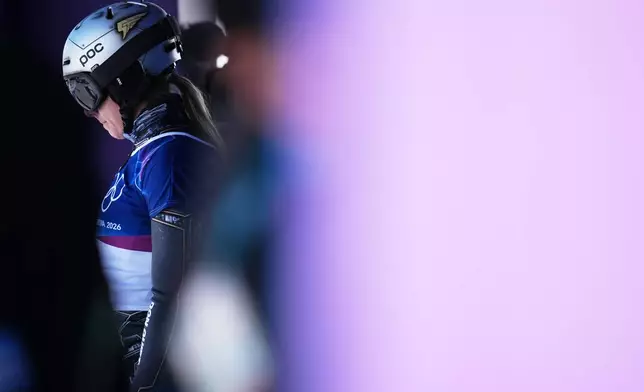
Czechia's Ester Ledecka waits to compete during the women's snowboarding parallel giant slalom finals at the 2026 Winter Olympics, in Livigno, Italy, Sunday, Feb. 8, 2026. (AP Photo/Gregory Bull)
Czechia's Ester Ledecka waits to compete during the women's snowboarding parallel giant slalom finals at the 2026 Winter Olympics, in Livigno, Italy, Sunday, Feb. 8, 2026. (AP Photo/Gregory Bull)
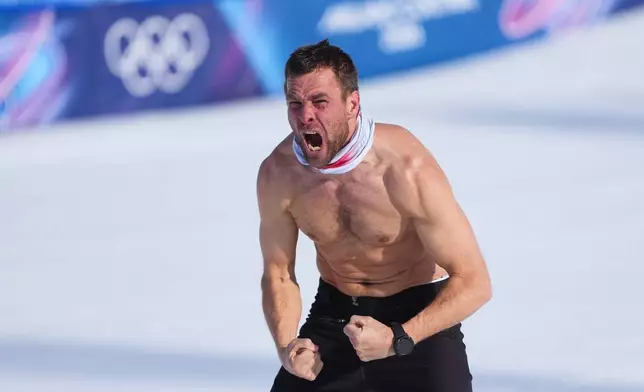
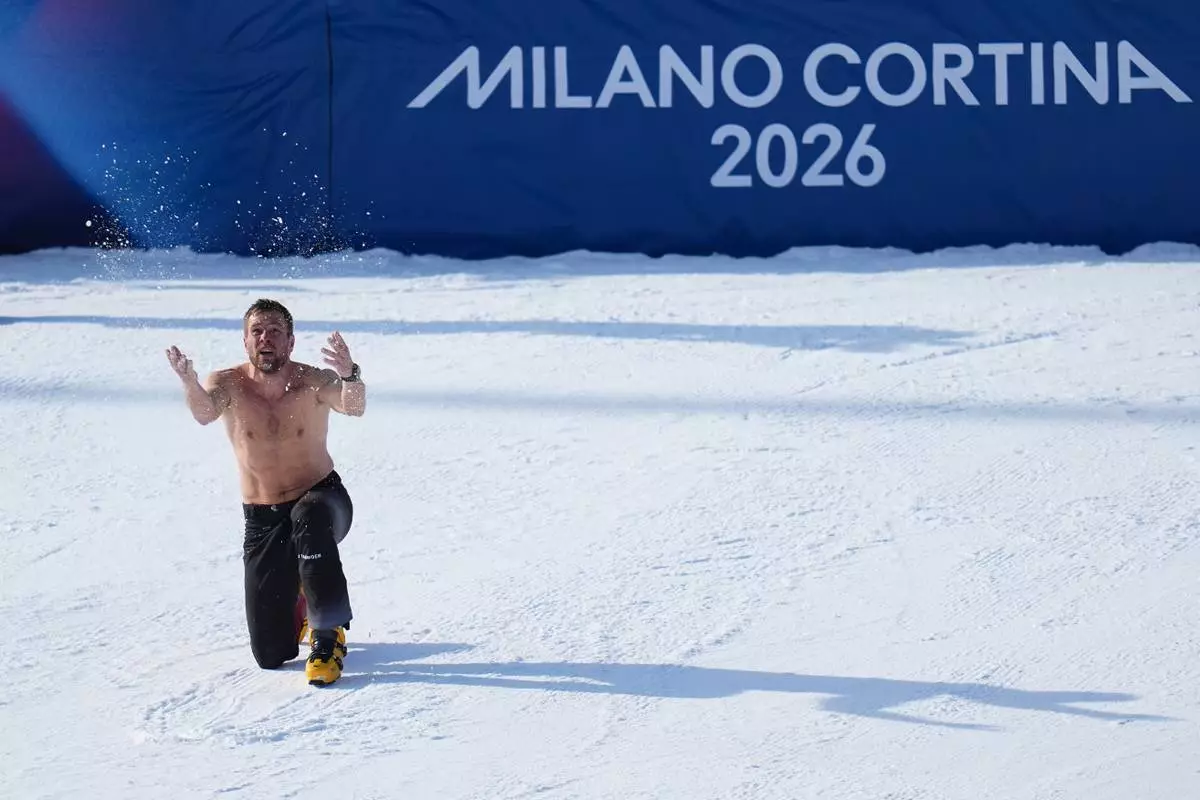
Austria's Benjamin Karl celebrates after winning the gold medal in men's snowboarding parallel giant slalom finals at the 2026 Winter Olympics, in Livigno, Italy, Sunday, Feb. 8, 2026. (AP Photo/Gregory Bull)

Austria's Benjamin Karl celebrates after winning the gold medal in men's snowboarding parallel giant slalom finals at the 2026 Winter Olympics, in Livigno, Italy, Sunday, Feb. 8, 2026. (AP Photo/Gregory Bull)

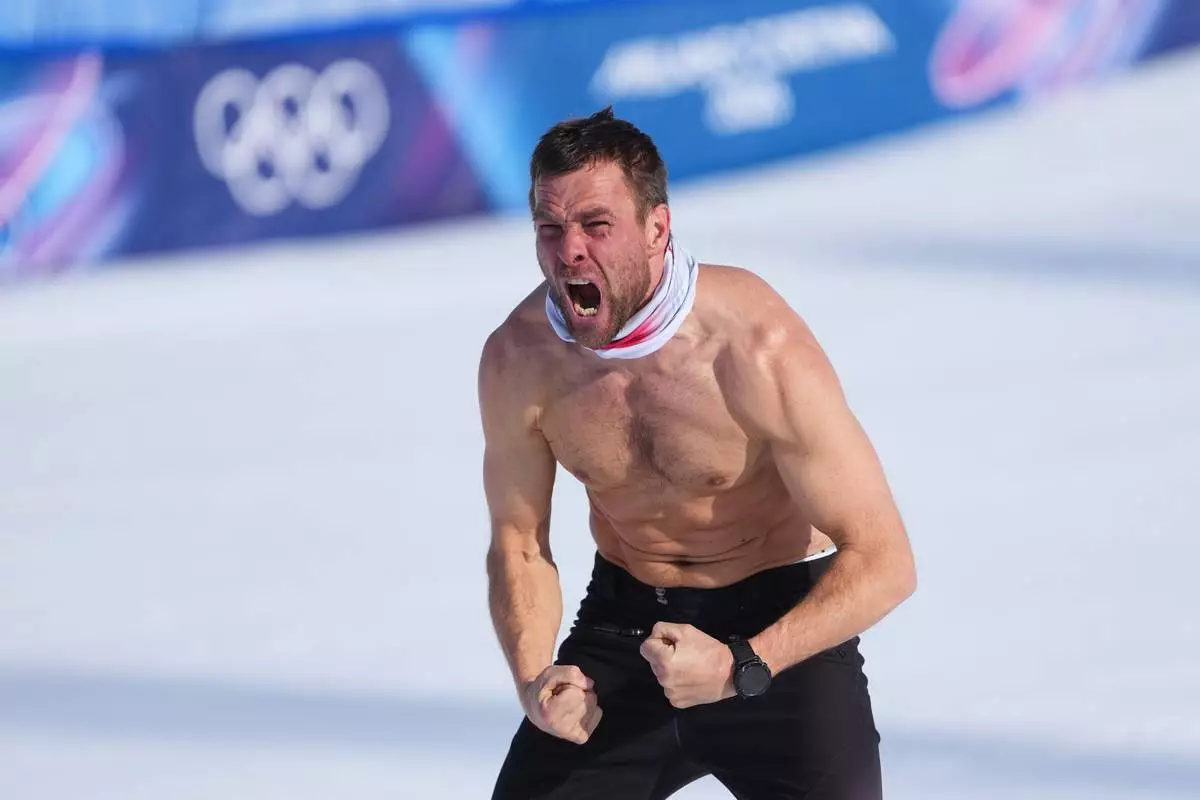
Austria's Benjamin Karl celebrates winning the gold medal in the men's snowboarding parallel giant slalom finals at the 2026 Winter Olympics, in Livigno, Italy, Sunday, Feb. 8, 2026. (AP Photo/Lindsey Wasson)
Austria's Benjamin Karl celebrates winning the gold medal in the men's snowboarding parallel giant slalom finals at the 2026 Winter Olympics, in Livigno, Italy, Sunday, Feb. 8, 2026. (AP Photo/Lindsey Wasson)
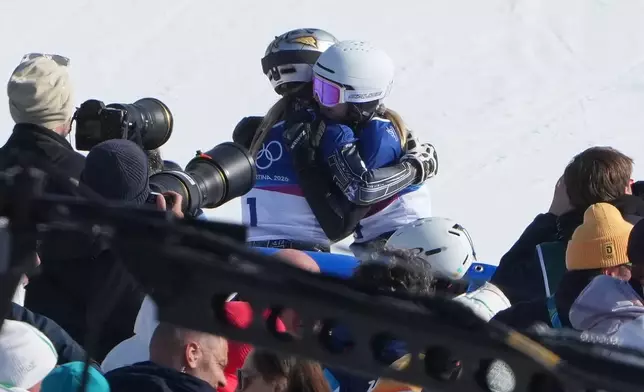
Czechia's Ester Ledecka, left, and Austria's Sabine Payer hug after Payer advanced during the women's snowboarding parallel giant slalom finals at the 2026 Winter Olympics, in Livigno, Italy, Sunday, Feb. 8, 2026. (AP Photo/Lindsey Wasson)

Czechia's Ester Ledecka, left, and Austria's Sabine Payer hug after Payer advanced during the women's snowboarding parallel giant slalom finals at the 2026 Winter Olympics, in Livigno, Italy, Sunday, Feb. 8, 2026. (AP Photo/Lindsey Wasson)

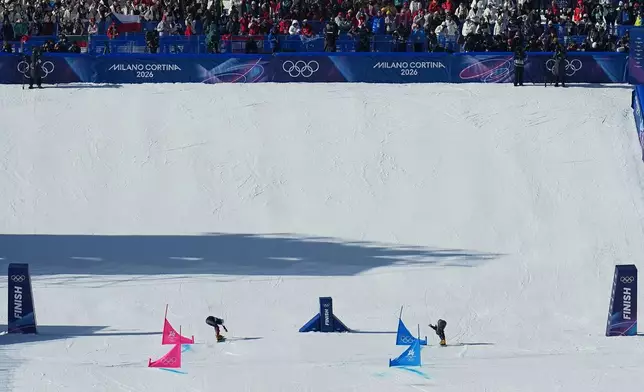
Austria's Sabine Payer, left, beats out Czechia's Ester Ledecka during the women's snowboarding parallel giant slalom finals at the 2026 Winter Olympics, in Livigno, Italy, Sunday, Feb. 8, 2026. (AP Photo/Gregory Bull)
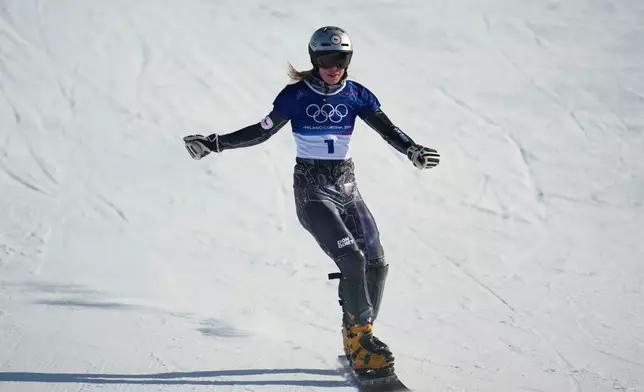
Austria's Sabine Payer, left, beats out Czechia's Ester Ledecka during the women's snowboarding parallel giant slalom finals at the 2026 Winter Olympics, in Livigno, Italy, Sunday, Feb. 8, 2026. (AP Photo/Gregory Bull)

Czechia's Ester Ledecka reacts after finishing behind Austria's Sabine Payer during the women's snowboarding parallel giant slalom finals at the 2026 Winter Olympics, in Livigno, Italy, Sunday, Feb. 8, 2026. (AP Photo/Abbie Parr)

Czechia's Ester Ledecka reacts after finishing behind Austria's Sabine Payer during the women's snowboarding parallel giant slalom finals at the 2026 Winter Olympics, in Livigno, Italy, Sunday, Feb. 8, 2026. (AP Photo/Abbie Parr)

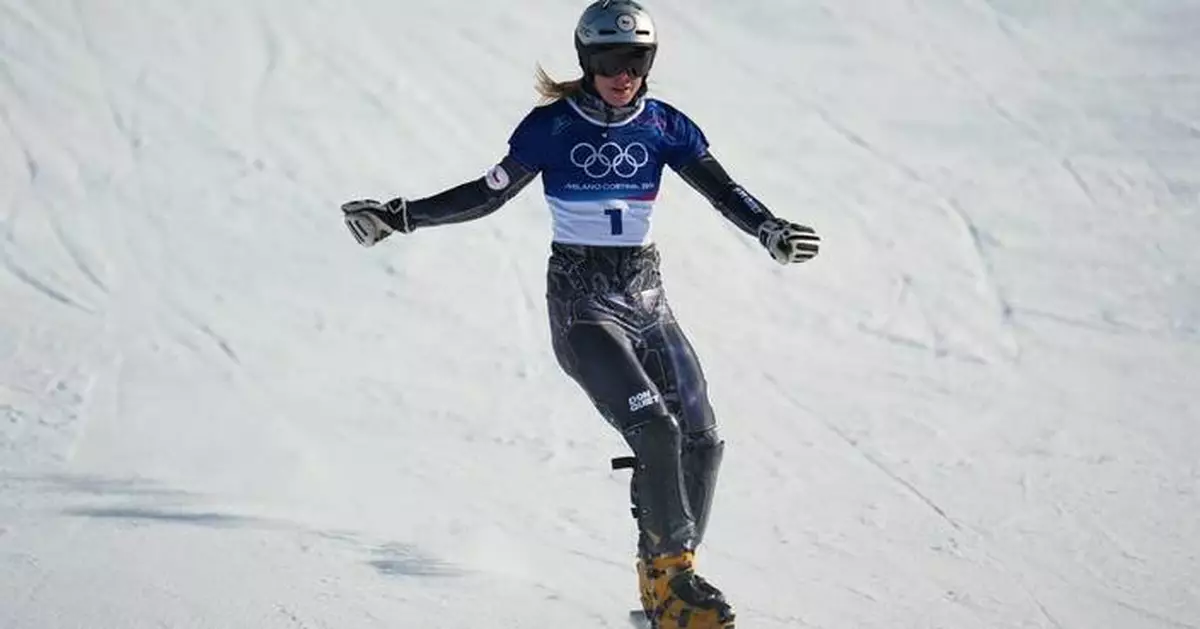
Their favorite speed racer, Ester Ledecka, her quest for a third straight title vanquished early, was a mere spectator Sunday when another Czech, eight years younger and without a single big-time win in her career, zoomed across the line to keep the gold medal in snowboarding's parallel giant slalom safely in the republic.

Her name: Zuzana Maderova.

“I can’t believe it now," the 22-year-old said, “but I’m an Olympic champion.”

A few hours after Lindsey Vonn wiped out on an Alpine downhill course a mountain range away in Cortina D'Ampezzo, Ledecka — and Maderova — reinforced the obvious to the Winter Olympic world: There are no sure things when these racers hit the slippery ice and snow.

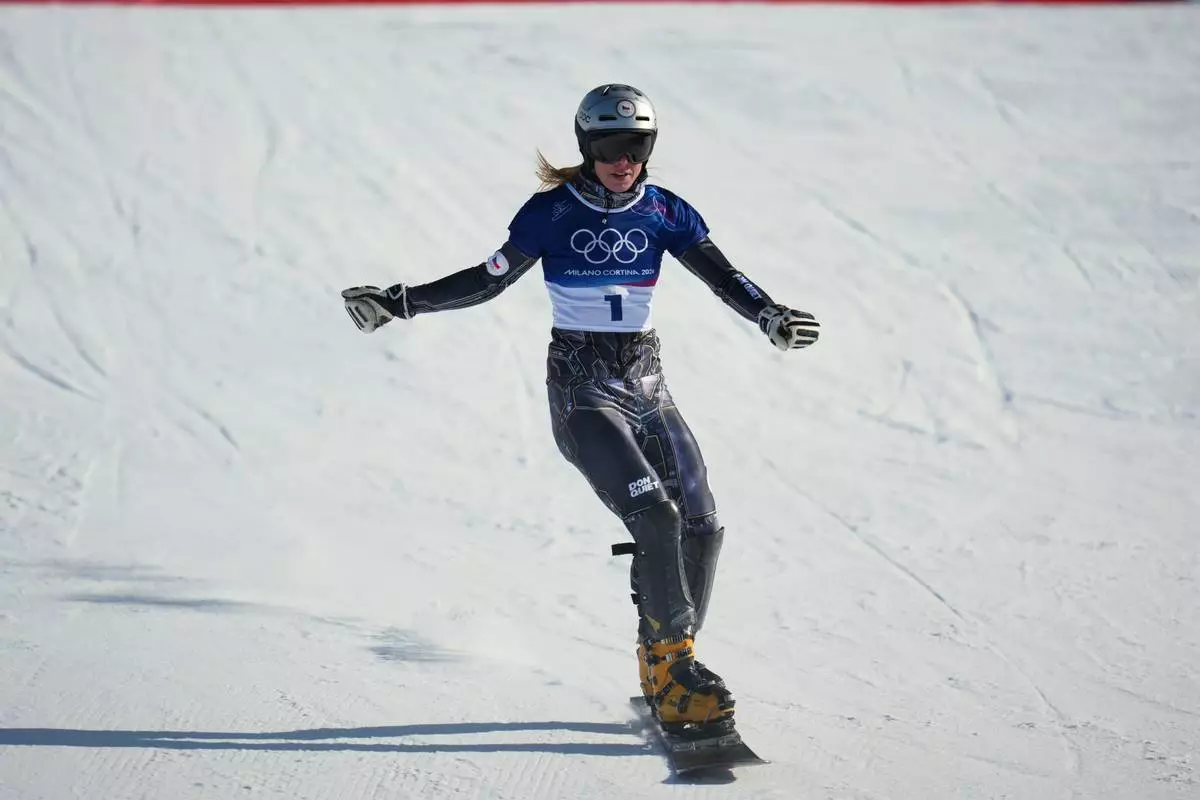
“Suddenly, I made a mistake in the quarterfinals,” said Ledecka, who skittered and put her hand down at the sixth gate in the quarterfinal, costing her precious time and a chance at another title. “I did my best. It’s what can happen in this sport.”

Her country's president, Petr Pavel, came to Livigno expecting to celebrate a win. It was a good bet. Ledecka hadn't lost a PGS race in nearly two years or missed a podium in five.

But after the second round (quarterfinals) of head-to-head action in a single-elimination format, she was only a bystander.

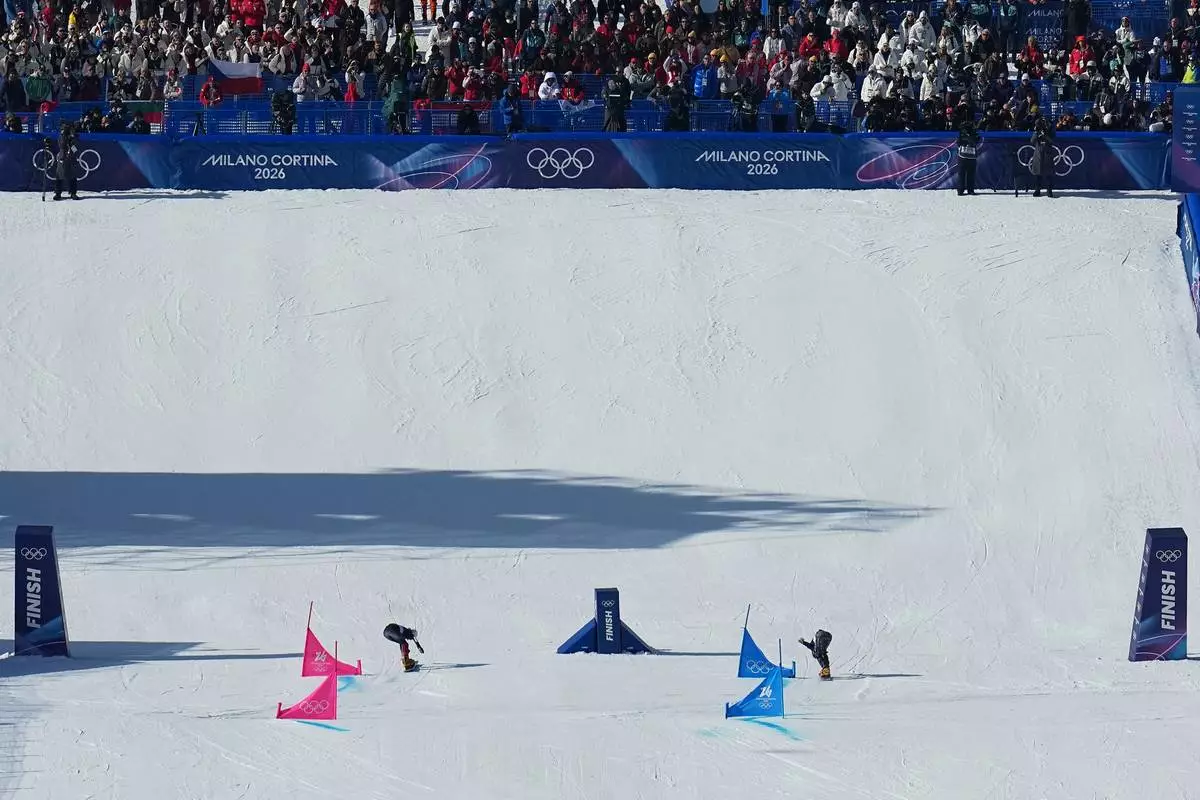
Her opponent, Sabine Payer of Austria, won the quarterfinal by 0.06 seconds.

Asked what she would've done differently, Ledecka focused on her form.

“I would do the toe side much better. I would probably put my inner shoulder up and do it better,” she said.

Ledecka first shocked the Olympic world eight years ago when she became the first athlete to win gold medals in both a skiing and a snowboarding event. Even she didn't quite believe she had won the ski race. Nobody was surprised about the snowboarding.

She has been splitting time ever since — she'll head to Cortina for a super-G race next Thursday. But in deciphering the reasons for this shocking loss, her coach, Justin Reiter, said her nine ski races versus one in snowboarding in the leadup to Milan Cortina wasn’t that big a factor.

“I take the responsibility there, maybe not being as prepared as we could've been,” he told The Associated Press. “Adapting her training a little bit. ... She has so much more in the tank. She can ride so much faster. But she didn't gear up. She geared down.”

There were no such regrets from Maderova, and certainly not from Payer, who raced her way to the silver medal. She lost to Maderova by 0.83 seconds in the final, but will go down as the woman who took down this sport's GOAT.

“The win against Ester, I think it was not expected, I would say,” Payer said. “I knew I had to risk everything and go all-in. Mistakes can happen. I think she might have helped me a bit. I don't know how her run was, but I'm really, really happy.”

Ledecka’s loss now gives Austria’s Anna Gasser a chance to become the first snowboarder to win three straight Olympic titles. Gasser takes the hill in big air qualifying later Sunday. Also trying for a three-peat is Chloe Kim. Her halfpipe contest starts Wednesday.

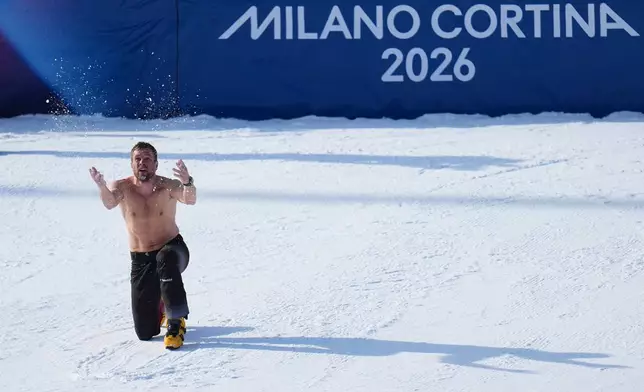
The only repeat on this day belonged to Austria's Benjamin Karl, who won his second straight title, then celebrated by stripping off his shirt, doing a huge weightlifter flex, then falling, bare-chested, into the snow.

The 40-year-old Karl, who also has a silver and a bronze in his career, said that belly flop was a tribute to alpine skiing legend Hermann Maier. It was pure joy to cool off with the mountain sun beating down.

“We have four runs, it was really long, we are sweating full gas — it’s like you’re coming out from the sauna," he said. “I wanted to lay longer in the snow to cool down.”

The day also included an all-Italian race for third in the women's bracket; Lucia Dalmasso won it by 0.11 seconds and was weeping near the finish line. At the time, it marked Italy's sixth medal of the games and put the home country at the top of the medals table.

The men's third-place race was a photo finish that put Bulgaria into the medal column thanks to Tervel Zamfirov's lean at the line.

All in all, it was a wild, unpredictable day at the snow park for PGS, a sport whose Olympic future is under review, leaving Ledecka, 30, unsure of whether she'll get another chance for that third gold in 2030.

“I don't think anyone will give a (expletive) about what the athletes think, to be very honest," she said. "It's always like that with the Olympic committees. I wish this time will be different and they'll go see how much crowd we brought in, how excited everyone was, how amazing this race was and think, ‘Oh, why would we cancel this race?’”

AP Winter Olympics: https://apnews.com/hub/milan-cortina-2026-winter-olympics
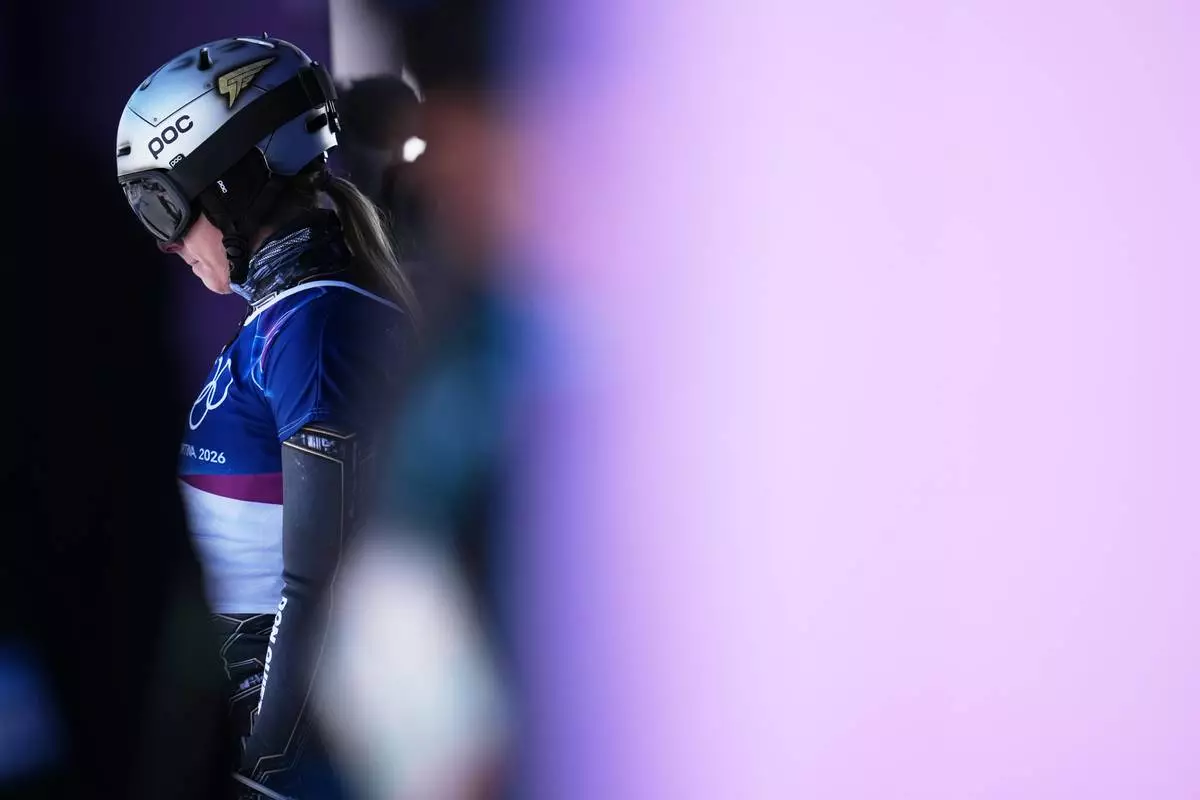
Czechia's Ester Ledecka waits to compete during the women's snowboarding parallel giant slalom finals at the 2026 Winter Olympics, in Livigno, Italy, Sunday, Feb. 8, 2026. (AP Photo/Gregory Bull)
Czechia's Ester Ledecka waits to compete during the women's snowboarding parallel giant slalom finals at the 2026 Winter Olympics, in Livigno, Italy, Sunday, Feb. 8, 2026. (AP Photo/Gregory Bull)
Austria's Benjamin Karl celebrates after winning the gold medal in men's snowboarding parallel giant slalom finals at the 2026 Winter Olympics, in Livigno, Italy, Sunday, Feb. 8, 2026. (AP Photo/Gregory Bull)

Austria's Benjamin Karl celebrates after winning the gold medal in men's snowboarding parallel giant slalom finals at the 2026 Winter Olympics, in Livigno, Italy, Sunday, Feb. 8, 2026. (AP Photo/Gregory Bull)

Austria's Benjamin Karl celebrates winning the gold medal in the men's snowboarding parallel giant slalom finals at the 2026 Winter Olympics, in Livigno, Italy, Sunday, Feb. 8, 2026. (AP Photo/Lindsey Wasson)
Austria's Benjamin Karl celebrates winning the gold medal in the men's snowboarding parallel giant slalom finals at the 2026 Winter Olympics, in Livigno, Italy, Sunday, Feb. 8, 2026. (AP Photo/Lindsey Wasson)
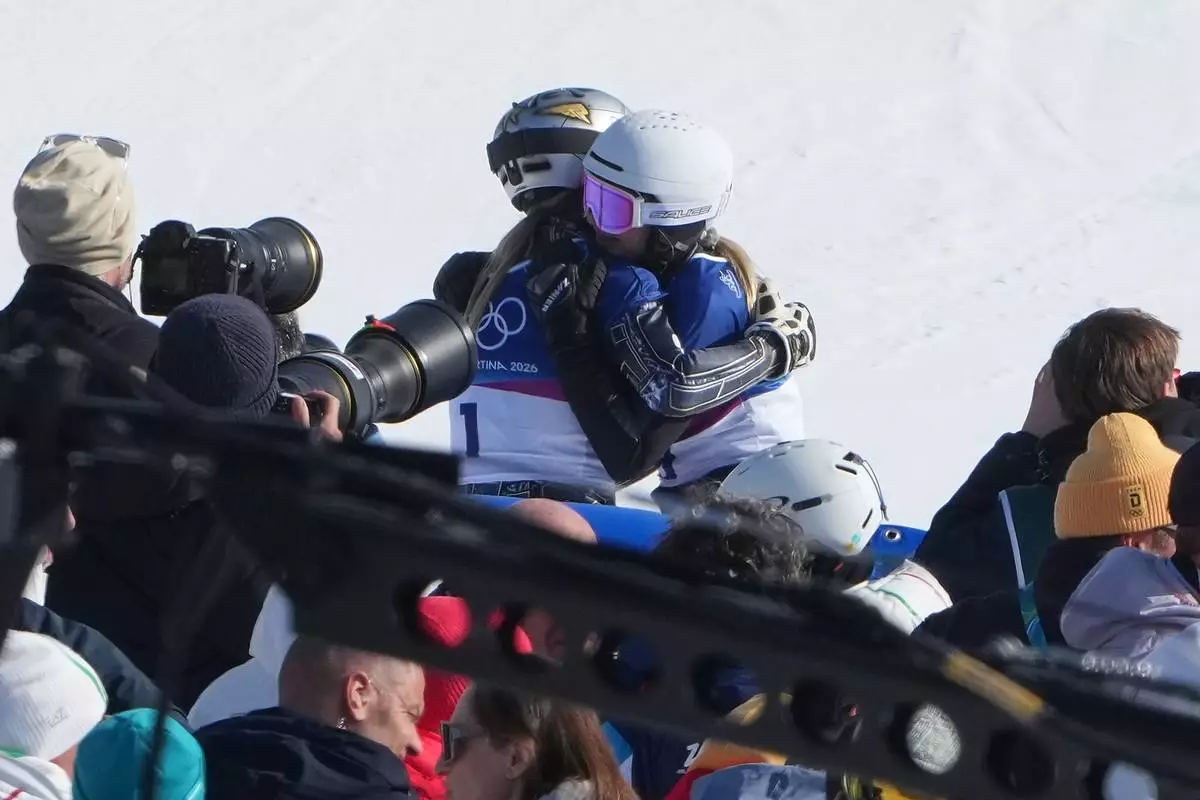
Czechia's Ester Ledecka, left, and Austria's Sabine Payer hug after Payer advanced during the women's snowboarding parallel giant slalom finals at the 2026 Winter Olympics, in Livigno, Italy, Sunday, Feb. 8, 2026. (AP Photo/Lindsey Wasson)

Czechia's Ester Ledecka, left, and Austria's Sabine Payer hug after Payer advanced during the women's snowboarding parallel giant slalom finals at the 2026 Winter Olympics, in Livigno, Italy, Sunday, Feb. 8, 2026. (AP Photo/Lindsey Wasson)

Austria's Sabine Payer, left, beats out Czechia's Ester Ledecka during the women's snowboarding parallel giant slalom finals at the 2026 Winter Olympics, in Livigno, Italy, Sunday, Feb. 8, 2026. (AP Photo/Gregory Bull)
Austria's Sabine Payer, left, beats out Czechia's Ester Ledecka during the women's snowboarding parallel giant slalom finals at the 2026 Winter Olympics, in Livigno, Italy, Sunday, Feb. 8, 2026. (AP Photo/Gregory Bull)

Czechia's Ester Ledecka reacts after finishing behind Austria's Sabine Payer during the women's snowboarding parallel giant slalom finals at the 2026 Winter Olympics, in Livigno, Italy, Sunday, Feb. 8, 2026. (AP Photo/Abbie Parr)

Czechia's Ester Ledecka reacts after finishing behind Austria's Sabine Payer during the women's snowboarding parallel giant slalom finals at the 2026 Winter Olympics, in Livigno, Italy, Sunday, Feb. 8, 2026. (AP Photo/Abbie Parr)
President Donald Trump tried to put some teeth into his latest attempt to save college sports.

The threat of cutting funding to cash-starved schools that don’t comply is real, even if the stricter rules that come out of the executive order he signed Friday could take a while to figure out.

In the order signed hours before the women’s Final Four tipped off one of the biggest weekends in college sports Trump went after eligibility rules, transfers and the spiraling costs associated with an industry that now pays its players millions of dollars per year.

He called on federal agencies to ensure schools are following the rules and threatened to choke off federal grants and funding, a similar approach his administration has taken to force universities around the country to alter policies involving diversity, equity and inclusion, transgender rights and even the kinds of classes they offer.

In some ways, forcing those changes might seem like child’s play once college sports figures this out. The NCAA, the newly created College Sports Commission, the four power conferences, dozens more smaller ones and hundreds of educational institutions all have a say here: It’s a big reason Congress, which Trump instructed to act quickly, has been stuck for more than a year on this.

Trump’s order was his second since one last July and it was a laundry list of proposed fixes, many of which lawmakers and college leaders have been pushing for since the approval of a $2.8 billion settlement changed the face of games that were once played by pure amateurs.

He called for “clear, consistent and fair eligibility limits, including a five-year participation window," and wants to limit athletes to one transfer with one more available once they get a four-year degree.

At a college sports roundtable last month, Trump said he anticipated any order he signed would trigger litigation. Athletes have largely won the freedom to transfer almost at will via the portal along with the ability to be paid by schools that are now doling out more than $20 million a year to their athletes.

As much as the changes he directs, Trump’s call for the Education Department, the Federal Trade Commission and the attorney general’s office to evaluate “whether violations of such rules render a university unfit for Federal grants and contracts” stands out as a way to force change.

Several universities across the country have made policy changes to comply with federal orders and avoid funding-related showdowns with the government. Yet big-named schools like Penn State and Florida State are facing huge debts.

“I haven’t read it, obviously, but I certainly appreciate his interest in the issue," NCAA President Charlie Baker said at the women's Final Four in Phoenix. "And from what I saw, some of the social media traffic, it’s pretty clear that he made clear that we need congressional action to sort of seal the deal on a number of these things, which is good, because we do.”

ACC Commissioner Jim Phillips praised the president's order, saying “there continues to be significant momentum to preserve the athletic and academic opportunities for the next generation of student-athletes and we appreciate the ongoing efforts.”

Attorney Mit Winter, who follows college sports law, said the order is likely to set up a situation where the NCAA and schools have to decide whether to follow a federal court order or an executive order.

“Federal court orders prohibit the NCAA from making athletes sit out a season if they transfer more than once and prohibit the NCAA from enforcing rules that limit collectives from being involved in recruiting,” he said. "The EO appears to direct the NCAA to create rules that would likely violate both of these court orders. Will the NCAA create rules that do that? And if they do, will schools follow them?

"Either way, we’re likely going to see litigation challenging the EO by athletes and third parties.”

Winter added that the order also appears to urge schools to pay new revenue share amounts.

“Most schools are paying 90-95% of their rev-share funds to men's basketball and football players,” he said. "And those funds are already promised via contracts signed with those athletes. Will the order purport to make schools not adhere to those contracts?”

AP Sports Writers Maura Carey, David Brandt and Eric Olson contributed.

Get poll alerts and updates on the AP Top 25 throughout the season. Sign up here. AP college football: https://apnews.com/hub/ap-top-25-college-football-poll and https://apnews.com/hub/college-football

President Donald Trump pauses as he finishes speaking about the Iran war from the Cross Hall of the White House on Wednesday, April 1, 2026, in Washington. (AP Photo/Alex Brandon, Pool)

President Donald Trump pauses as he finishes speaking about the Iran war from the Cross Hall of the White House on Wednesday, April 1, 2026, in Washington. (AP Photo/Alex Brandon, Pool)

Recommended Articles