|
MUMBAI, India, Feb. 9, 2026 /PRNewswire/ -- Made in India, written by Sundeep Khanna and Manish Sabharwal, traces three remarkable journeys: the rise of India's pharma industry, the birth and evolution of Lupin (BSE: 500257) (NSE: LUPIN) (REUTERS: LUPIN.BO) (BLOOMBERG: LPCIN) and the extraordinary life of its founder, Desh Bandhu Gupta. Together, the three journeys illuminate how a country once completely dependent on imported medicines became the world's pharmacy. The book shares how an individual's life, shaped early by adversity, growing up without privilege or patronage, unpredictably nurtured hunger and drive, to navigate an unforgiving state, blend national health priorities and global standards, to build a multibillion-dollar enterprise whose medicines reach patients in over 120 countries.
Made in India shows the distance travelled by a village boy from Rajasthan, who went on to become a teacher, professor and pharmaceutical employee, before founding a company worth $10 billion. It is the story of how an unlikely entrepreneur, given his role models, fought the system and left teaching and pharma jobs, going on to build a successful company, giving wings to a world-class industry and became a business icon for a nation.
Written with candor by TeamLease Services co-founder Manish Sabharwal and journalist Sundeep Khanna, the book confronts failures, financial crises, and the personal toll of leadership, alongside achievement and success, in the building of one of the world's biggest generics firms. This is a riveting portrait of entrepreneurship without mythmaking – of how institutions are built slowly, tested severely and rebuilt with resolve. Made in India weaves vivid anecdotes tracing Desh Bandhu Gupta's transformation from a humble professor to a pharma titan, finding his true calling in tending to the unmet needs of people. It issues a powerful call to future leaders, showcasing his journey of visionary entrepreneurship: rising from setbacks with raw grit and unshakeable conviction.
Made in India also spotlights Desh Bandhu Gupta's wife Manju Gupta's pivotal role amid the trials and triumphs of building Lupin. Together, the couple also built community service and rural support programs, even as Lupin and India became a reliable global supplier of pharmaceuticals.
India has today become the world's pharmacy: Nearly half of the 400 billion pills Americans consume every year are made in India, as are 60 per cent of the world's vaccines. Of the 700 US Food and Drug Administration-approved factories that sell medicines in the US, a third are located in India. The co-creators of Indian pharma – Dr. Yusuf Hamied (Cipla), Anji Reddy (Dr. Reddy's), Parvinder Singh (Ranbaxy), Dilip Shanghvi (Sun), Ramanbhai Patel (Zydus-Cadila), Habil Khorakiwala (Wockhardt) and DBG (Lupin) – matter more to India than their companies' revenues, exports or profits because they saw something no one else did. Together, they raised India's soft and hard power, demolished the myth that multinationals possess unfair advantages over Indian companies, and ended pessimism about India's ability to export goods, making pharma India's biggest manufacturing success. Together, they showed the world that a developing nation can dominate a complex industry when brilliant entrepreneurs meet smart policy. Together, they made India 'Pharmacy to the world'.
Made in India came alive during the launch as the authors, and the publisher shared their journeys, followed by a rich and engaging panel discussion on 'Past and Future of Indian Pharma' with pharma leaders Dilip Shanghvi, Sun Pharma, Dr. Yusuf Hamied, Cipla, G.V. Prasad, Dr. Reddy's, Vinita Gupta, Lupin, and Prof. M. M. Sharma, Ex-(UDCT) ICT. The panel discussed insights on leadership, nation-building, and the Indian pharma industry's crucial role in making healthcare affordable and accessible globally.
Praise for the book:
Dilip Sanghvi of Sun Pharma said, "DBG was a visionary whose heart beat for India and for Indian patients. His relentless focus on excellence defined his personality. He was a remarkable role model for all of us and one of the true architects who helped shape India's journey to becoming the pharmacy to the world".
Yusuf Hamied of Cipla said, "DBG built Lupin from extremely modest beginnings, guided by determination and a deep commitment to serving patients. DBG's life story is not only inspiring, but also a reminder of how one individuals purpose can make healthcare accessible and affordable across the world".
Made in India is a book for everyone thinking about India's place in the world, seeking role models of a world leading industry from India, entrepreneurs and business people looking for inspiration about building a valuable company, and finally, India's young and their parents, aiming to build ambition, exploration and determination.
About Lupin
Lupin Limited is a global pharmaceutical leader headquartered in Mumbai, India, with products distributed in over 120 markets. Lupin specializes in pharmaceutical products, including branded and generic formulations, complex generics, biotechnology products, and active pharmaceutical ingredients. Trusted by healthcare professionals and consumers globally, the company enjoys a strong position in India and the U.S. across multiple therapy areas, including respiratory, cardiovascular, anti-diabetic, anti-infective, gastrointestinal, central nervous system, and women's health. Lupin has 15 state-of-the-art manufacturing sites and 7 research centers globally, along with a dedicated workforce of over 24,000 professionals. Lupin is committed to improving patient health outcomes through its subsidiaries - Lupin Diagnostics, Lupin Digital Health, and Lupin Manufacturing Solutions. Lupin Human Welfare and Research Foundation has impacted more than 2.02 million beneficiaries across 5400 villages in 26 districts, spread across eight states in India.
To know more, visit www.lupin.com or follow us on LinkedIn https://www.linkedin.com/company/lupin
MUMBAI, India, Feb. 9, 2026 /PRNewswire/ -- Made in India, written by Sundeep Khanna and Manish Sabharwal, traces three remarkable journeys: the rise of India's pharma industry, the birth and evolution of Lupin (BSE: 500257) (NSE: LUPIN) (REUTERS: LUPIN.BO) (BLOOMBERG: LPCIN) and the extraordinary life of its founder, Desh Bandhu Gupta. Together, the three journeys illuminate how a country once completely dependent on imported medicines became the world's pharmacy. The book shares how an individual's life, shaped early by adversity, growing up without privilege or patronage, unpredictably nurtured hunger and drive, to navigate an unforgiving state, blend national health priorities and global standards, to build a multibillion-dollar enterprise whose medicines reach patients in over 120 countries.
Made in India shows the distance travelled by a village boy from Rajasthan, who went on to become a teacher, professor and pharmaceutical employee, before founding a company worth $10 billion. It is the story of how an unlikely entrepreneur, given his role models, fought the system and left teaching and pharma jobs, going on to build a successful company, giving wings to a world-class industry and became a business icon for a nation.
Written with candor by TeamLease Services co-founder Manish Sabharwal and journalist Sundeep Khanna, the book confronts failures, financial crises, and the personal toll of leadership, alongside achievement and success, in the building of one of the world's biggest generics firms. This is a riveting portrait of entrepreneurship without mythmaking – of how institutions are built slowly, tested severely and rebuilt with resolve. Made in India weaves vivid anecdotes tracing Desh Bandhu Gupta's transformation from a humble professor to a pharma titan, finding his true calling in tending to the unmet needs of people. It issues a powerful call to future leaders, showcasing his journey of visionary entrepreneurship: rising from setbacks with raw grit and unshakeable conviction.
Made in India also spotlights Desh Bandhu Gupta's wife Manju Gupta's pivotal role amid the trials and triumphs of building Lupin. Together, the couple also built community service and rural support programs, even as Lupin and India became a reliable global supplier of pharmaceuticals.
India has today become the world's pharmacy: Nearly half of the 400 billion pills Americans consume every year are made in India, as are 60 per cent of the world's vaccines. Of the 700 US Food and Drug Administration-approved factories that sell medicines in the US, a third are located in India. The co-creators of Indian pharma – Dr. Yusuf Hamied (Cipla), Anji Reddy (Dr. Reddy's), Parvinder Singh (Ranbaxy), Dilip Shanghvi (Sun), Ramanbhai Patel (Zydus-Cadila), Habil Khorakiwala (Wockhardt) and DBG (Lupin) – matter more to India than their companies' revenues, exports or profits because they saw something no one else did. Together, they raised India's soft and hard power, demolished the myth that multinationals possess unfair advantages over Indian companies, and ended pessimism about India's ability to export goods, making pharma India's biggest manufacturing success. Together, they showed the world that a developing nation can dominate a complex industry when brilliant entrepreneurs meet smart policy. Together, they made India 'Pharmacy to the world'.
Made in India came alive during the launch as the authors, and the publisher shared their journeys, followed by a rich and engaging panel discussion on 'Past and Future of Indian Pharma' with pharma leaders Dilip Shanghvi, Sun Pharma, Dr. Yusuf Hamied, Cipla, G.V. Prasad, Dr. Reddy's, Vinita Gupta, Lupin, and Prof. M. M. Sharma, Ex-(UDCT) ICT. The panel discussed insights on leadership, nation-building, and the Indian pharma industry's crucial role in making healthcare affordable and accessible globally.
Praise for the book:
Dilip Sanghvi of Sun Pharma said, "DBG was a visionary whose heart beat for India and for Indian patients. His relentless focus on excellence defined his personality. He was a remarkable role model for all of us and one of the true architects who helped shape India's journey to becoming the pharmacy to the world".
Yusuf Hamied of Cipla said, "DBG built Lupin from extremely modest beginnings, guided by determination and a deep commitment to serving patients. DBG's life story is not only inspiring, but also a reminder of how one individuals purpose can make healthcare accessible and affordable across the world".
Made in India is a book for everyone thinking about India's place in the world, seeking role models of a world leading industry from India, entrepreneurs and business people looking for inspiration about building a valuable company, and finally, India's young and their parents, aiming to build ambition, exploration and determination.
About Lupin
Lupin Limited is a global pharmaceutical leader headquartered in Mumbai, India, with products distributed in over 120 markets. Lupin specializes in pharmaceutical products, including branded and generic formulations, complex generics, biotechnology products, and active pharmaceutical ingredients. Trusted by healthcare professionals and consumers globally, the company enjoys a strong position in India and the U.S. across multiple therapy areas, including respiratory, cardiovascular, anti-diabetic, anti-infective, gastrointestinal, central nervous system, and women's health. Lupin has 15 state-of-the-art manufacturing sites and 7 research centers globally, along with a dedicated workforce of over 24,000 professionals. Lupin is committed to improving patient health outcomes through its subsidiaries - Lupin Diagnostics, Lupin Digital Health, and Lupin Manufacturing Solutions. Lupin Human Welfare and Research Foundation has impacted more than 2.02 million beneficiaries across 5400 villages in 26 districts, spread across eight states in India.
To know more, visit www.lupin.com or follow us on LinkedIn https://www.linkedin.com/company/lupin
** The press release content is from PR Newswire. Bastille Post is not involved in its creation. **

'Made in India - The story of Desh Bandhu Gupta, Lupin and Indian Pharma' Book Launched in Mumbai

'Made in India - The story of Desh Bandhu Gupta, Lupin and Indian Pharma' Book Launched in Mumbai
|
Announced alongside M Series Smart Assist Module launch on Kickstarter
NEW YORK, April 4, 2026 /PRNewswire/ -- Yarbo, a company focused on intelligent yard robotics, today announced the Yarbo Open Platform, a long-term initiative currently under development and planned for release in early 2027. Designed to expand Yarbo's modular yard robot system across both software and hardware, the platform is intended to support deeper customization, broader smart home connectivity, and new forms of user and developer-driven functionality over time. The announcement coincides with the launch of the Smart Assist Module (SAM) for the M Series on Kickstarter.
The Open Platform is not available today. Instead, it reflects Yarbo's roadmap for how its ecosystem may evolve over time, including a three-layer software architecture built around an Open API, SDK, and no-code Automation Editor, as well as a hardware expansion framework designed to support future user-built and developer-built modules.
A Structured Approach to Software Integration and Automation
The Yarbo Open Platform is structured to accommodate different levels of technical expertise, from everyday users to experienced developers. It is designed to provide multiple entry points into the Yarbo ecosystem, enabling both software-driven automation and hardware-level expansion.
On the software side, the platform consists of three layers:
- Yarbo Open API — intended to enable connectivity between Yarbo devices and external platforms, allowing them to participate in broader home automation scenarios.
- Yarbo SDK — a set of development tools, including code libraries and documentation, designed for developers building custom features or integrations.
- Yarbo Automation Editor — a visual, drag-and-drop interface within the Yarbo app that allows users to create automation workflows without writing code.
Together, these components are intended to make automation accessible to a wide range of users, while also supporting more advanced development use cases.
The platform is also designed to support compatibility with widely used smart home ecosystems, including Home Assistant, Google Home, and Amazon Alexa, enabling users to incorporate Yarbo into existing connected home setups.
Extending Capability Through Hardware
In addition to software capabilities, the Open Platform introduces a hardware expansion approach designed to extend Yarbo's functionality beyond its existing modules.
At the center of this is CoreBridge, a standardized hardware interface currently in development that is intended to provide access to Yarbo's mechanical mounting points, power system, and data connections. It is designed to support third-party development and user-built extensions, allowing new types of functionality beyond pre-defined modules.
One example of this extensibility is an electromagnet-based module, which can be attached via CoreBridge to enable Yarbo to latch onto and move objects such as garbage bins. In a potential use scenario, this could enable automated movement of a bin to the curb on collection day and its return afterward.
This combination of software and hardware openness reflects an effort to expand the role of outdoor robotics beyond fixed-function devices.
Smart Assist Module Launch on Kickstarter
Alongside the Open Platform announcement, Yarbo is launching the Smart Assist Module (SAM) for the M Series on Kickstarter.
The module introduces two primary features designed to expand how users interact with their yard robot in everyday use:
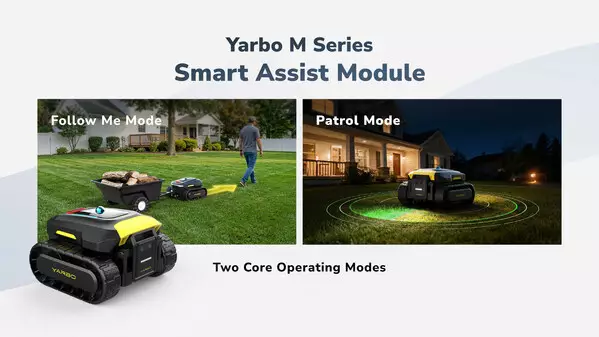
- Follow Me Mode — enabling Yarbo to move alongside the user while carrying tools or materials, reducing the need for manual transport during yard work.
- Patrol Mode — allowing Yarbo to move along customizable routes around the property, with features such as remote live view, app-based alerts, and optional audio notifications via its built-in speaker, providing an added layer of awareness and convenience for users managing outdoor spaces.
The Smart Assist Module is positioned as part of Yarbo's broader effort to extend the practical use cases of its modular system.
Looking Ahead
The Yarbo Open Platform is planned for release in early 2027 and is being developed to support both the Y Series and M Series. By introducing a framework that combines software integration, developer tools, and hardware extensibility, Yarbo aims to enable a broader range of applications while allowing users to define how the system evolves over time.
Further details will be shared as development progresses.
About Yarbo
Yarbo is defining a new category of outdoor robotics with its Modular Yard Robot. Known for its automated snow blower robots, Yarbo introduced a modular system designed for year-round use. Powered by a single intelligent core unit, the system supports interchangeable modules for mowing, leaf blowing, snow clearing, and more—creating a more efficient approach to outdoor maintenance for homeowners.
Announced alongside M Series Smart Assist Module launch on Kickstarter
NEW YORK, April 4, 2026 /PRNewswire/ -- Yarbo, a company focused on intelligent yard robotics, today announced the Yarbo Open Platform, a long-term initiative currently under development and planned for release in early 2027. Designed to expand Yarbo's modular yard robot system across both software and hardware, the platform is intended to support deeper customization, broader smart home connectivity, and new forms of user and developer-driven functionality over time. The announcement coincides with the launch of the Smart Assist Module (SAM) for the M Series on Kickstarter.
The Open Platform is not available today. Instead, it reflects Yarbo's roadmap for how its ecosystem may evolve over time, including a three-layer software architecture built around an Open API, SDK, and no-code Automation Editor, as well as a hardware expansion framework designed to support future user-built and developer-built modules.
A Structured Approach to Software Integration and Automation
The Yarbo Open Platform is structured to accommodate different levels of technical expertise, from everyday users to experienced developers. It is designed to provide multiple entry points into the Yarbo ecosystem, enabling both software-driven automation and hardware-level expansion.
On the software side, the platform consists of three layers:
- Yarbo Open API — intended to enable connectivity between Yarbo devices and external platforms, allowing them to participate in broader home automation scenarios.
- Yarbo SDK — a set of development tools, including code libraries and documentation, designed for developers building custom features or integrations.
- Yarbo Automation Editor — a visual, drag-and-drop interface within the Yarbo app that allows users to create automation workflows without writing code.
Together, these components are intended to make automation accessible to a wide range of users, while also supporting more advanced development use cases.
The platform is also designed to support compatibility with widely used smart home ecosystems, including Home Assistant, Google Home, and Amazon Alexa, enabling users to incorporate Yarbo into existing connected home setups.
Extending Capability Through Hardware
In addition to software capabilities, the Open Platform introduces a hardware expansion approach designed to extend Yarbo's functionality beyond its existing modules.
At the center of this is CoreBridge, a standardized hardware interface currently in development that is intended to provide access to Yarbo's mechanical mounting points, power system, and data connections. It is designed to support third-party development and user-built extensions, allowing new types of functionality beyond pre-defined modules.
One example of this extensibility is an electromagnet-based module, which can be attached via CoreBridge to enable Yarbo to latch onto and move objects such as garbage bins. In a potential use scenario, this could enable automated movement of a bin to the curb on collection day and its return afterward.
This combination of software and hardware openness reflects an effort to expand the role of outdoor robotics beyond fixed-function devices.
Smart Assist Module Launch on Kickstarter
Alongside the Open Platform announcement, Yarbo is launching the Smart Assist Module (SAM) for the M Series on Kickstarter.
The module introduces two primary features designed to expand how users interact with their yard robot in everyday use:
- Follow Me Mode — enabling Yarbo to move alongside the user while carrying tools or materials, reducing the need for manual transport during yard work.
- Patrol Mode — allowing Yarbo to move along customizable routes around the property, with features such as remote live view, app-based alerts, and optional audio notifications via its built-in speaker, providing an added layer of awareness and convenience for users managing outdoor spaces.
The Smart Assist Module is positioned as part of Yarbo's broader effort to extend the practical use cases of its modular system.
Looking Ahead
The Yarbo Open Platform is planned for release in early 2027 and is being developed to support both the Y Series and M Series. By introducing a framework that combines software integration, developer tools, and hardware extensibility, Yarbo aims to enable a broader range of applications while allowing users to define how the system evolves over time.
Further details will be shared as development progresses.
About Yarbo
Yarbo is defining a new category of outdoor robotics with its Modular Yard Robot. Known for its automated snow blower robots, Yarbo introduced a modular system designed for year-round use. Powered by a single intelligent core unit, the system supports interchangeable modules for mowing, leaf blowing, snow clearing, and more—creating a more efficient approach to outdoor maintenance for homeowners.
** This press release is distributed by PR Newswire through automated distribution system, for which the client assumes full responsibility. **
Yarbo Introduces Open Platform Strategy, Opening Its Robotics System to Developers and Smart Home Ecosystems

Yarbo Introduces Open Platform Strategy, Opening Its Robotics System to Developers and Smart Home Ecosystems