KINSHASA, Congo (AP) — Rebels backed by the Islamic State group killed at least 20 people in an attack over the weekend on a village in eastern Congo, the military said Monday.
The attack by the Allied Democratic Forces, or ADF, took place early Saturday in the village of Mambimbi-Isigo in the Lubero territory of North Kivu province, military administrator Col. Alain Kiwewa Mitela told The Associated Press over the phone.
There was no immediate comment from the ADF.
The attack has caused a mass displacement of residents, aggravating an already dire humanitarian situation, Mitela said.
According to civil society activists in the area, the rebels first raided several farmers’ fields before attacking civilians with knives and firearms.
“This toll is still provisional because many civilians are missing,” Kinos Kitwa, head of civil society in Bapere, said. He criticized the small number of Congolese army troops in the area.
Armed groups, including the ADF and Rwanda-backed M23 rebels, have carried out several deadly attacks in eastern Congo. The ADF, which pledged allegiance to the Islamic State group in 2019, operates along the border with Uganda and often targets civilians.
At least 62 civilians have been killed since the beginning of the year by ADF fighters in the Beni and Lubero territories, according to the North Kivu Provincial Civil Society Coordination.
On Monday, U.N. peacekeeping chief Jean-Pierre Lacroix began a two-day official visit to eastern Congo, including Beni, which has been particularly affected by ADF attacks.
The ADF was formed by disparate small groups in Uganda in the late 1990s following discontent with President Yoweri Museveni. In 2002, following Ugandan military strikes, the group moved to neighboring Congo and has been blamed for the killings of thousands of civilians.In July 2025, the group carried out a series of attacks that killed more than 100 people.

FILE - Congolese Defense Forces soldiers and United Nation forces patrol the area of an attack near the town of Oicha, 30 kms (20 miles) from Beni, Democratic Republic of Congo, July 23, 2021. (AP Photo/Al-hadji Kudra Maliro, file)
Pakistani officials said Tuesday that Islamabad has proposed a second round of talks to the U.S. and Iran, while U.S. Vice President JD Vance earlier said negotiations with Iran “did make some progress" and U.S. President Donald Trump said Monday “we’ve been called by the other side” and “they want to work a deal.”
The Pakistani officials spoke on condition of anonymity because they were not authorized to discuss the matter with the press.
A senior Hezbollah official on Monday said the Lebanese militant group will not abide by any agreements that may result from direct Lebanon-Israel talks set to start Tuesday in Washington.
Lebanese officials hope to broker a ceasefire in the Israel-Hezbollah war that has killed at least 2,089 people in Lebanon. Israeli Prime Minister Benjamin Netanyahu has said he doesn’t want a ceasefire and the goal is Hezbollah’s disarmament and a potential peace agreement between Lebanon and Israel.
A U.S. blockade of Iranian ports that began Monday and Iran’s threatened retaliation set up an extraordinary showdown posing serious risks for the global economy and raising the specter of a ceasefire collapse and resumed fighting.
Here is the latest:
Egyptian Foreign Minister Badr Abdelatty discussed de-escalation efforts in the region with Kaja Kallas, the European Union’s High Representative for Foreign Affairs and Security Policy.
During a Monday phone call, both assessed the situation in the region following the U.S.-Iran talks in Islamabad.
The foreign minister urged the international community, along with the EU, to play a role in advancing diplomacy and political solutions.
French Foreign Affairs Minister Jean-Noël Barrot reaffirmed Tuesday that Lebanon must be included in the initial ceasefire agreement.
“The ceasefire must absolutely include Lebanon, which under no circumstances can be the scapegoat of the Israeli government,” Barrot said on French radio RFI.
Israel’s strikes on Lebanon are “intolerable,” he said, because they undermine the ceasefire reached between the United States and Iran and because it strengthens militant group Hezbollah.
“Destroying Lebanon, targeting the Lebanese state, does not weaken Hezbollah — quite the opposite, it strengthens it,” Barrot said.
Spain’s Prime Minister Pedro Sánchez said he sees China as the main global interlocutor that can help end the war in Iran and other conflicts, such as Ukraine, and urged the Asian giant to do more on the diplomatic front.
“I find it very difficult to find other interlocutors, beyond China, who can resolve this situation created in Iran and the Strait of Hormuz,” he said Tuesday after meeting Chinese President Xi Jinping.
Sánchez is in China for his fourth trip in just over three years as Spain looks to strengthen its political and commercial ties with the world’s second-largest economy.
Sánchez said Spain wants to avoid impunity for those who commit crimes and described what has happened in Gaza as “genocide.”
“International law is being violated today, fundamentally by one country: the government of Israel,” he said. “There is also an absolutely illegal response from the Iranian regime regarding a war that we have described from the very beginning as a mistake and an illegality.”
German Chancellor Friedrich Merz said in a phone call with Israeli Prime Minister Benjamin Netanyahu that he supports direct peace talks between the Israeli and Lebanese governments, which are set to start Tuesday in Washington.
Merz called for an end to hostilities in southern Lebanon and said militant group Hezbollah must lay down its arms, the German chancellery said in a statement Monday night.
Merz reaffirmed his government’s strong support of a diplomatic understanding between the U.S. and Iran and its readiness to contribute to freedom of navigation in the Strait of Hormuz if the necessary conditions are met, his office said.
Merz also expressed deep concern about developments in the Palestinian territories and said there must be no de facto partial annexation of the West Bank.
Chinese President Xi Jinping floated a four-point proposal for promoting Middle East peace during a meeting Tuesday with Sheikh Khaled bin Mohamed bin Zayed Al Nahyan, the crown prince of Abu Dhabi, Chinese official news agency Xinhua reported.
Xi’s proposal calls for upholding the principle of regional peaceful coexistence and respecting national sovereignty while underscoring the principles of coordinating development and security, Xinhua reported.
“Safeguard the authority of the international rule of law. It can’t be ‘use it when it suits us, discard it when it doesn’t,’ and we cannot allow the world to revert to the law of the jungle,” Xi said.
Asian stocks were trading higher tracking and oil fell on Tuesday as expectations rose over a possible second round of talks between the U.S. and Iran.
Benchmark U.S. crude fell 1.7% early Tuesday to $97.37 a barrel. Brent crude, the international standard, was down 0.9% to $98.49 per barrel.
Tokyo’s Nikkei 225 was up 2.3% to 57,804.81. South Korea’s Kospi jumped 2.7% to 5,968.06.
Hong Kong’s Hang Seng rose 0.5% to 25,783.41, while the Shanghai Composite index climbed 0.5% to 4,007.93.
Oil prices continued to pull back on Tuesday from earlier gains.
Pakistan has proposed hosting a second round of talks between the United States and Iran in Islamabad in the coming days, before the end of the ceasefire, two Pakistani officials said.
The officials, who spoke on condition of anonymity because they were not authorized to discuss the matter with the press, said the proposal would depend on whether the parties request a different location.
One of the officials said that, despite ending without an agreement, the first talks were part of an ongoing diplomatic process rather than a one-off effort.
— By Munir Ahmed
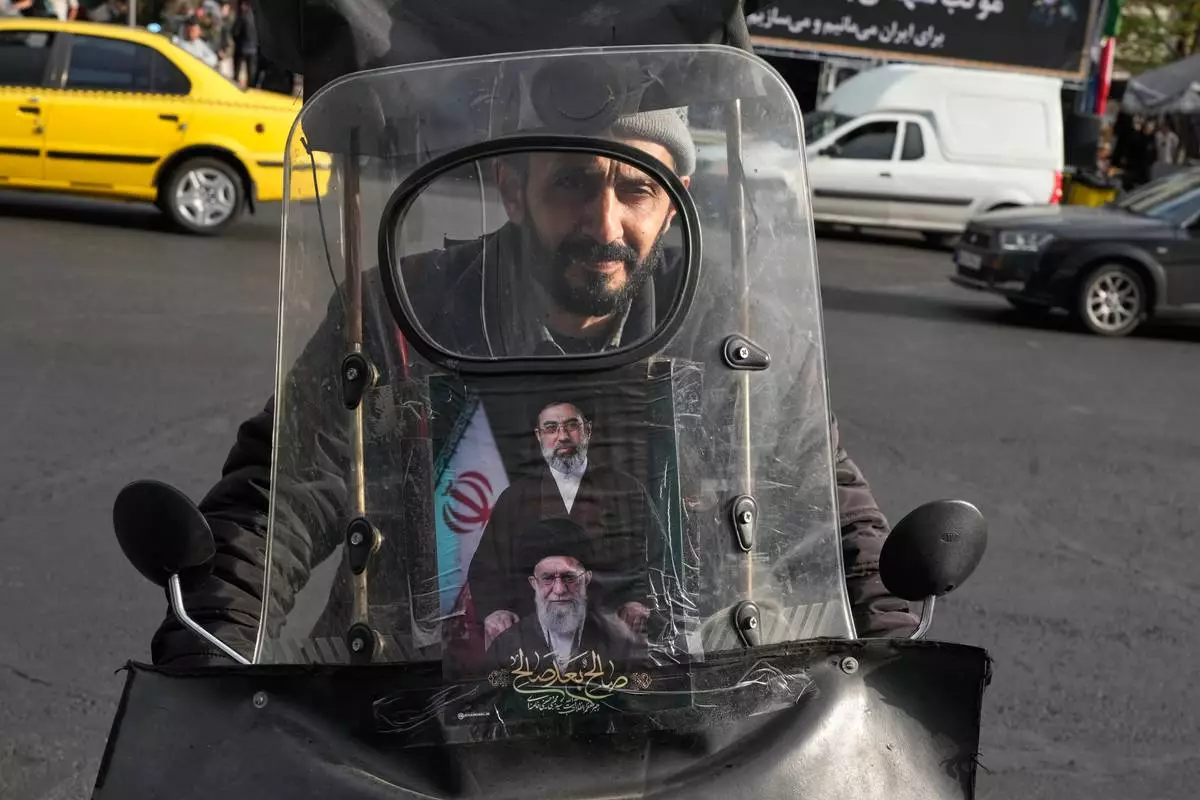
A man drives his motorbike with a poster on its windshield depicting Iran's Supreme Leader Ayatollah Mojtaba Khamenei, top, and his father, the slain Supreme Leader Ayatollah Ali Khamenei, who was killed in the U.S. and Israel strikes on Feb. 28, in downtown Tehran, Iran, Monday, April 13, 2026. (AP Photo/Vahid Salemi)
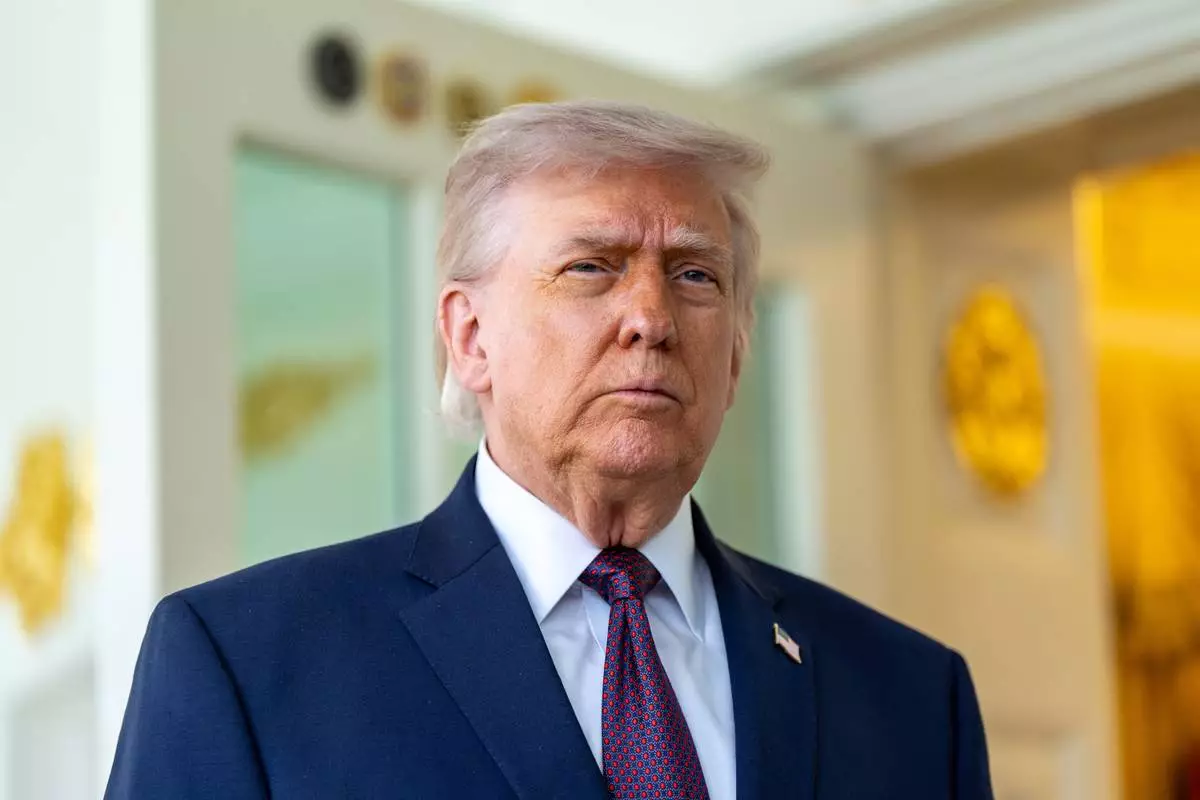
President Donald Trump speaks with reporters outside the Oval Office of the White House, Monday, April 13, 2026, in Washington. (AP Photo/Alex Brandon)
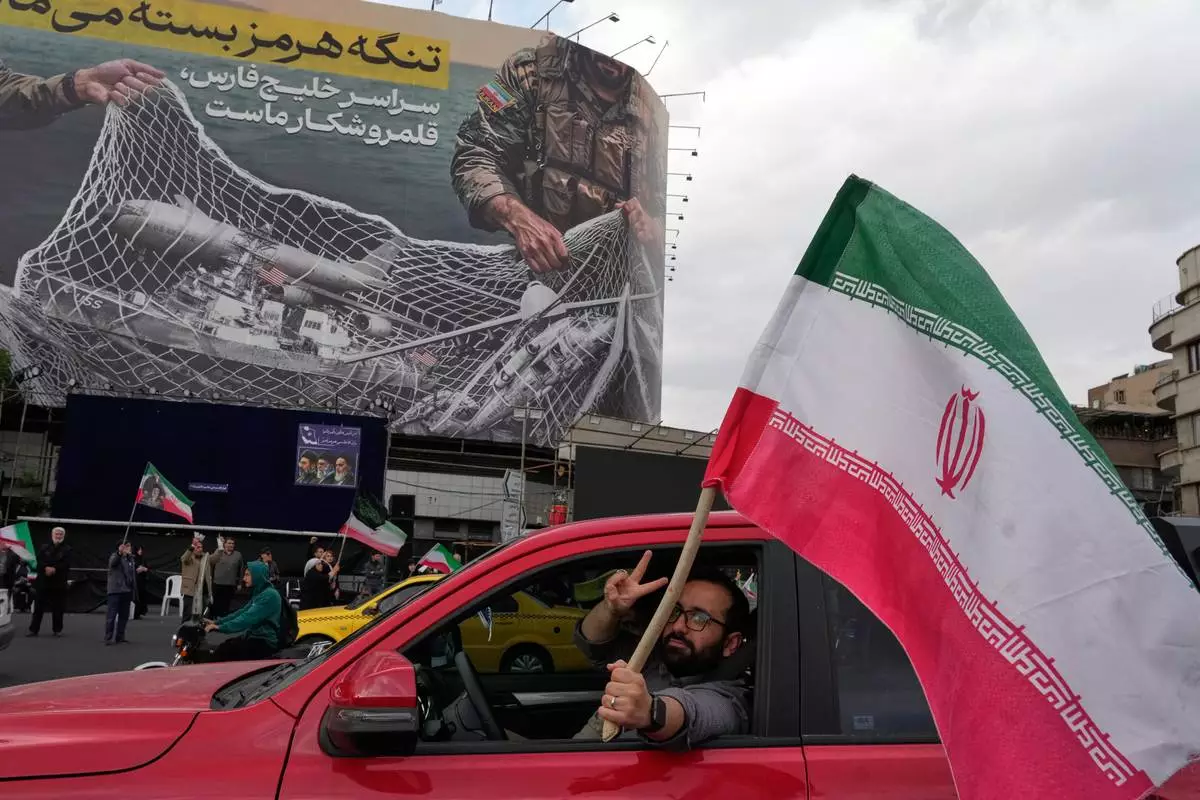
A man flashes a victory sign as he carries an Iranian flag in front of an anti-U.S. billboard depicting the American aircrafts into the Iranian armed forces fishing net with signs that read in Farsi: "The Strait of Hormuz will remain closed, The entire Persian Gulf is our hunting ground," at the Eqelab-e-Eslami, or Islamic Revolution Square in downtown Tehran, Iran, Monday, April 13, 2026. (AP Photo/Vahid Salemi)
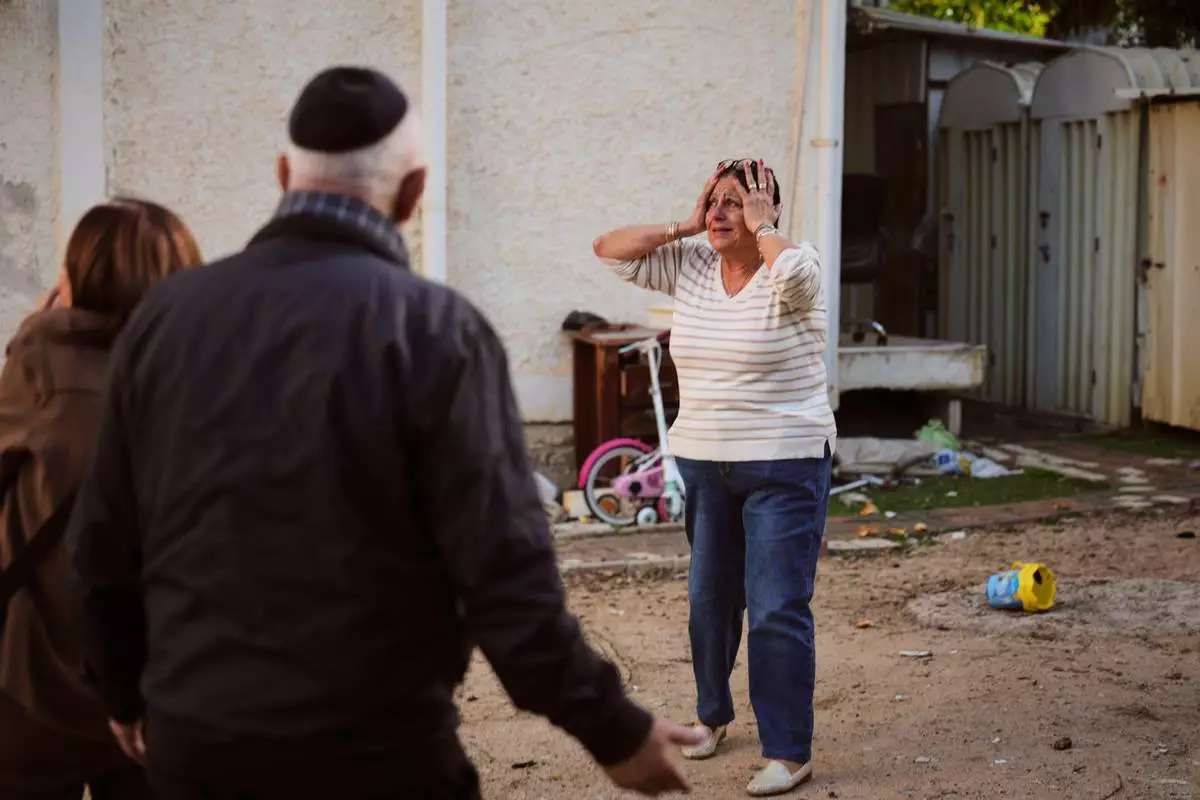
A woman reacts at the site of a damaged residential building after it was struck by a projectile fired from Lebanon, in Nahariya, northern Israel Monday, April 13, 2026. (AP Photo/Ariel Schalit)
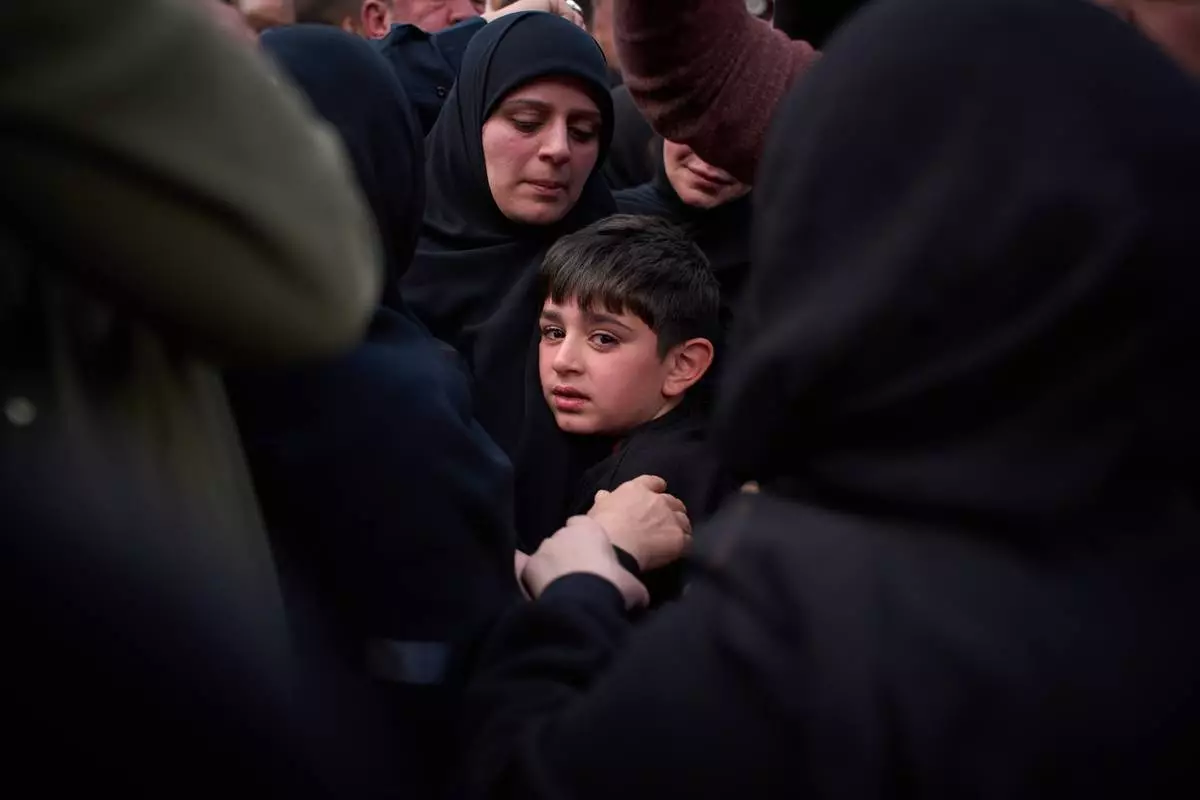
Mohammed, 8, cries next to the coffin of his father, Hussein Makkah, during the funeral of 13 state security officers killed the previous day in an Israeli strike in Lebanon’s coastal city of Sidon, Lebanon, Saturday, April 11, 2026. (AP Photo/Emilio Morenatti)