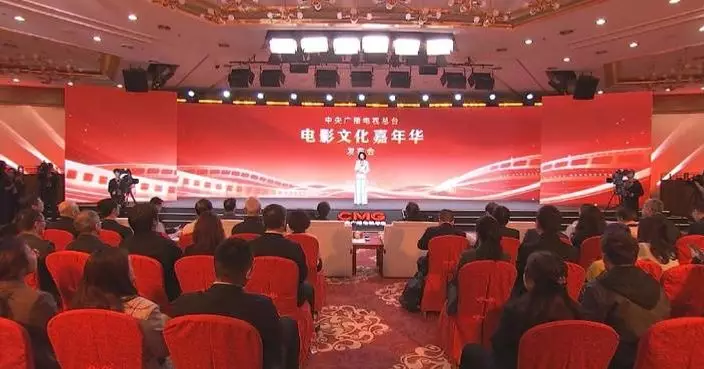
More than 250 representatives from the Chinese and U.S. business communities participated in an event marking the 20th anniversary of the U.S.-China Commercial Match-Making Program in Beijing on Monday, with many of them expressing optimism in the Chinese market and bilateral business cooperation.
The event was jointly hosted by the China Council for the Promotion of International Trade (CCPIT), the U.S. Embassy in China, and the U.S. Department of Commerce's International Trade Administration.
The U.S.-China Commercial Match-Making Program was jointly established in 2005 by the CCPIT and the U.S. Department of Commerce's International Trade Administration. Over the past two decades, more than 100 economic and trade events have been organized under the program, serving over 3,000 enterprises from both countries. It has become a landmark initiative for practical cooperation between the business communities of the two nations.
"In recent years, the exchanges between both sides around green and low-carbon initiatives, rail transit, and financial investment have actually been increasing. This aligns with the expanding scope of cooperation between the two sides, and I believe it also conforms to the trend of China-U.S. cooperation," said Li Xiang, deputy director of CCPIT's Department of Industry Promotion.
Moving forward, said Li, the CCPIT will leverage the U.S.-China Commercial Match-Making Program to further consolidate and deepen areas of bilateral cooperation. It will actively promote in-depth collaboration between enterprises of both countries in fields such as the digital economy, business services, healthcare, and new energy vehicles, aiming to achieve more tangible results, he added.
This sentiment of growing collaboration and mutual benefit was echoed by American business leaders present at the event, who shared their insights on the vast opportunities and evolving focus areas of U.S. enterprises operating in the Chinese market.
"China's rapid development and its huge market, I believe, have potential in various industries and are attractive to all companies. In the next step, we are not only focusing on intelligence, but also on how to be more environmentally friendly and reduce environmental pollution. This is also one aspect we are considering," said Harry Song, managing director of Greater China, Korea, Singapore at Harsco Rail.
"I think there are actually a great many opportunities in China, and we are very optimistic about the future prospects. Therefore, we will definitely continue to increase our investment in China. In the future, we may also further enhance our service capabilities in China," said Shan Wenjun, general manager of government affairs at GE Aerospace in Greater China.
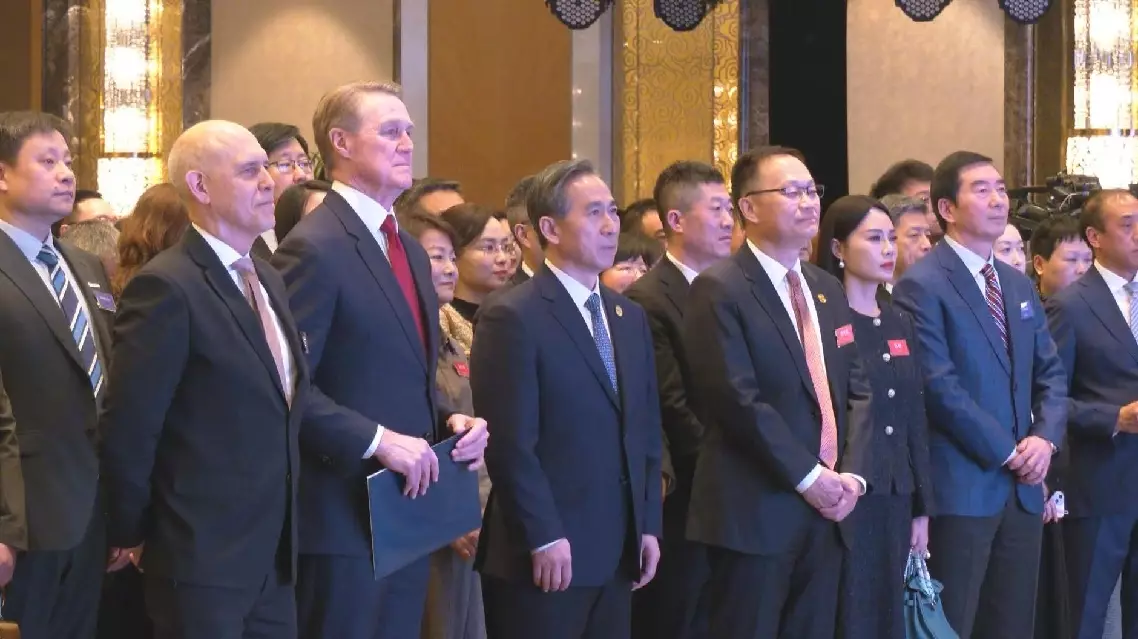
China, US business leaders celebrate 20th anniversary of cooperation program

John Lee, chief executive of China's Hong Kong Special Administrative Region (HKSAR), on Tuesday welcomed the white paper "Hong Kong: Safeguarding China's National Security Under the Framework of One Country, Two Systems" released by the State Council Information Office.
Lee said in a statement that he will fully support and implement the content and requirements of the white paper.
The white paper detailed how the fight for safeguarding national security in Hong Kong is an unrelenting one. Lee said that since Hong Kong's return to the motherland, the manipulation of anti-China agitators in Hong Kong and hostile external forces had long stalled legislation under Article 23 of the Basic Law of the HKSAR, creating destabilizing opportunities.
Today, while Hong Kong is making every effort to boost the economy, pursue development, undertake construction and improve people's livelihood, it must be remembered that national security risks still exist among us and can arise all of a sudden, he added.
The white paper stated that the central government has the fundamental responsibility for national security matters concerning Hong Kong. Lee expressed support and gratefulness for the central government's decisive act at a critical moment in Hong Kong, formulating the national security law in Hong Kong at the state level for the HKSAR's promulgation and implementation locally.
The national security law in Hong Kong ended the state of defenselessness regarding national security that had persisted for over two decades since Hong Kong's return, and ended the "black-clad violence" prevailing in Hong Kong at the time, Lee said, adding that the HKSAR government has been combating acts and activities endangering national security with full force and in accordance with the law, and as a result, order returned to the community.
The white paper illustrated the HKSAR's achievements in fulfilling its constitutional responsibility for safeguarding national security. Lee said that the national security law in Hong Kong and the Safeguarding National Security Ordinance function as an integral whole to build a solid shield for safeguarding national security in Hong Kong, effectively protecting the rights and freedoms enjoyed by Hong Kong residents in accordance with the law and providing a solid foundation for Hong Kong's security and development.
The white paper stated that Hong Kong is progressing from disorder to stability and prosperity. Lee said that under the auspices of the national security law in Hong Kong and the Safeguarding National Security Ordinance, Hong Kong society is stable and prosperous, the normal lives and development of the people of Hong Kong are firmly guaranteed, and international rating agencies continue to give Hong Kong positive assessments.
The white paper laid down the practical requirements of creating high-standard security for the high-quality development of the "one country, two systems." Lee said that Hong Kong must work under the guidance of a holistic approach to national security, firmly safeguard national sovereignty, security and development interests, safeguarding of national security throughout the entire process of the implementation of the "one country, two systems" principle.
Lee said that security is the prerequisite for development, and development is the guarantee of security. The HKSAR government will steadfastly safeguard national security and promote economic development and is committed to advancing the high-quality development of the cause of "one country, two systems" under the auspices of high-level security, and to achieving high-level security through high-quality development.
HKSAR chief executive welcomes white paper on Hong Kong's efforts in safeguarding national security