Skip to Content Facebook Feature Image

CFS Urges Caution Amid Rising Food Poisoning Cases Linked to Raw Oysters in Hong Kong

HK

CFS Urges Caution Amid Rising Food Poisoning Cases Linked to Raw Oysters in Hong Kong
HK

HK

CFS Urges Caution Amid Rising Food Poisoning Cases Linked to Raw Oysters in Hong Kong

2026-02-10 23:02 Last Updated At:23:18

FEHD continues to actively follow up on food poisoning cases related to consumption of raw oysters and steps up inspections of food premises selling raw oysters

The Centre for Food Safety (CFS) of the Food and Environmental Hygiene Department (FEHD) today (February 10) expressed deep concern over recent food poisoning cases related to the consumption of raw oysters.Officers from the CFS and the Environmental Hygiene Branch of the FEHD immediately conducted investigations at the restaurants concerned, reviewing their food handling procedures and tracing the sources of the oysters. Since February this year, investigations revealed that 10 cases involved the consumption of raw oysters supplied by Seojun Mulsan Co., Ltd. of Korea. For the sake of prudence, the CFS instructed the trade to stop the import and sale in Hong Kong of raw oysters supplied by this company on February 5. In addition, the CFS found 11 cases wereinvolved the consumption of raw oysters supplied by the food factory Jeton International Foods and 88 Investment Holdings Limited. The CFS has promptly instructedthe company to suspend the sale and supply of raw oysters, and issued a press release on related follow-up work on February 6, requiring the trade to stop selling oysters supplied by the company concerned. Investigations into other cases, which involve consumption of oysters from various countries, are still ongoing.

In view of the recent surge in food poisoning cases related to the consumption of raw oysters, the FEHD has carried out special operations and stepped up inspections of various licensed or permitted food premises across Hong Kong, thereby safeguarding food safety and protecting public health. The focuses of the inspections included the storage temperature of raw oysters, storage conditions in designated refrigerators, the sources of supply, the personal hygiene of food handlers, the hygienic condition of the premises, verifying source documents and health certificates, and collecting samples for testing. Over the past five days, the FEHD has inspected about 430 food premises selling oysters, providing immediate advice on food storage, handling and environmental hygiene. Inspections will continue to ensure licensees/permittees comply with licensing conditions and statutory hygiene standards.

The spokesman reminded that as oysters feed by filtering a large volume of seawater and absorbing suspended food particles therein, bacteria (e.g. Vibrio parahaemolyticus and Vibrio vulnificus) and viruses (e.g. norovirus and Hepatitis A virus) may accumulate in them if they are grown in or harvested from contaminated water. Consuming oysters without thorough cooking might risk direct intake of these microorganisms. Susceptible groups, such as pregnant women, young children, the elderly and people with weakened immune systems or liver diseases, should avoid eating them.

Consumers are advised to purchase or consume oysters only from food premises licensed or permitted by the FEHD. The trade and food handlers should understand the importance of adhering to good personal hygiene and proper food handling, and provide regular training on hygiene practices and norovirus-related risks. Hands should be thoroughly washed with soap and water for at least 20 seconds before and after handling food. Separate utensils and cutting boards should be used for raw and ready-to-eat foods, with regular cleaning and disinfection. Food handlers who exhibit symptoms of infection should refrain from handling food until they have been symptom-free for at least 48 hours.
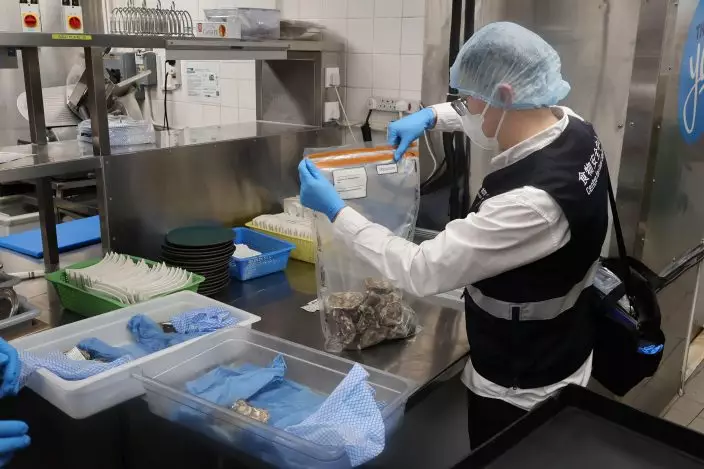
FEHD continues to actively follow up on food poisoning cases related to consumption of raw oysters and steps up inspections of food premises selling raw oysters  Source: HKSAR Government Press Releases

FEHD continues to actively follow up on food poisoning cases related to consumption of raw oysters and steps up inspections of food premises selling raw oysters Source: HKSAR Government Press Releases

FEHD continues to actively follow up on food poisoning cases related to consumption of raw oysters and steps up inspections of food premises selling raw oysters  Source: HKSAR Government Press Releases
FEHD continues to actively follow up on food poisoning cases related to consumption of raw oysters and steps up inspections of food premises selling raw oysters Source: HKSAR Government Press Releases
FEHD combats unsatisfactory hygiene conditions and serious rodent infestations in fresh provision shops

A spokesman for the Food and Environmental Hygiene Department (FEHD) said today (February 10) that, the department has been placing great importance to food safety and environmental hygiene. It will not tolerate fresh provision shops (FPSs) that flout regulations, mishandle pig carcasses, and cause serious rodent infestations that threaten public health. The FEHD will step up blitz operations across districts to clamp down on violating FPSs.

The spokesman pointed out that, during recent late-night special operations along Lok Shan Road in To Kwa Wan and Kowloon City Road, the FEHD discovered that a FPS had poor hygiene condition and serious rodent infestation. To protect public health, the FEHD issued an immediate closure order on January 24 under the Public Health and Municipal Services Ordinance, requiring the shop to immediately cease operation, and carry out thorough cleansing and rodent control. The shop will only be allowed to reopen once the FEHD is satisfied with its hygiene condition. The shop requested the lifting of the closure order on February 6, but as its hygiene condition and rodent control measures remained unsatisfactory, the request was rejected by the FEHD, and the closure order remains in effect.

In addition, the FEHD has carried out special operations across all districts early this month, stepping up inspections of more than 250 licensed FPSs, and taking stringent enforcement actions against irregularities that increase the risk of rodent infestation, with a view to safeguarding food safety and public health. During the special operations, the FEHD staff initiated 47 prosecutions and issued 101 verbal warnings/advice against the FPSs concerned.

The spokesman said that the FEHD will continue to inspect FPSs regularly. To further combat the poor hygiene or serious rodent problems of shops, the department will step up late-night blitz operations across districts. If FPSs are found mishandling pig carcasses in ways that lead to rodent infestation, the FEHD will not hesitate to issue immediate closure orders and cancel their licences to protect public health.

Under the relevant regulation, every person engaged in any food business, including FPSs, shall not knowingly suffer or permit in any food premises, the presence of rats, mice or insects; and shall adopt appropriate measures to protect the food from risk of contamination or deterioration. Operators must at all times keep every part of food premises clean, properly maintained, and in good condition. Offenders are liable to prosecution and a maximum fine of $10,000 and imprisonment for three months. All meat delivered to licensed FPSs must be directly delivered into the licensed premises; otherwise, it constitutes a breach of licensing conditions and may result in immediate licence cancellation. Furthermore, if the condition of a premises poses an imminent health risk, the FEHD has the authority to issue closure orders and immediately close the premises.

Source: AI-found images

Source: AI-found images

Recommended Articles