Skip to Content Facebook Feature Image

King Charles III seeks 'moral high ground' with pledge to help police as Epstein scandal deepens

News

King Charles III seeks 'moral high ground' with pledge to help police as Epstein scandal deepens
News

News

King Charles III seeks 'moral high ground' with pledge to help police as Epstein scandal deepens

2026-02-11 06:06 Last Updated At:06:10

LONDON (AP) — In an earlier era, Britain’s royal family might have tried to bury the scandal surrounding Andrew Mountbatten-Windsor’s friendship with Jeffrey Epstein. Not during the reign of King Charles III.

Since October, the king has stripped his younger brother of the right to be called prince, forced him to move out of the royal estate he occupied for more than 20 years and issued a public statement supporting the women and girls abused by Epstein.

Then came Monday’s unprecedented announcement that Buckingham Palace was ready to cooperate in the event of a police inquiry into Mountbatten-Windsor’s links to Epstein.

Charles was forced to act after the U.S. Justice Department released millions of pages of Epstein documents that revealed the details of his relationship with Mountbatten-Windsor and torpedoed the former prince’s claims that he severed ties with the financier after his 2008 conviction for soliciting a minor for prostitution.

Fifty or 100 years ago, “you can imagine the gentlemen’s agreements" that would have sought to "bury this kind of story,” said Ed Owens, author of “After Elizabeth: Can the Monarchy Save Itself?”

“But, thankfully, we live in a more democratic age where people are rightly held accountable for their actions. In taking the moral high ground — and that is what the king is doing here — the monarchy is signaling very clearly that it recognizes that public opinion demands that justice be served and that it is willing to comply with the police inquiry.”

The King's latest step was triggered by allegations that Mountbatten-Windsor sent Epstein confidential reports from a 2010 tour of Southeast Asia, which he undertook as Britain’s envoy for international trade. The correspondence was uncovered by reporters combing through the Justice Department files.

The Thames Valley Police, an agency that covers areas west of London, including Mountbatten-Windsor’s former home, said Monday that it was “assessing” the reports. The police statement quickly brought a response from the palace.

“The King has made clear, in words and through unprecedented actions, his profound concern at allegations which continue to come to light in respect of Mr. Mountbatten-Windsor’s conduct," the palace said in a statement. “While the specific claims in question are for Mr. Mountbatten-Windsor to address, if we are approached by Thames Valley Police we stand ready to support them as you would expect.’’

Mountbatten-Windsor has denied any wrongdoing in his relationship with Epstein.

The palace’s announcement was splashed across British newspapers on Tuesday, with The Sun tabloid filling its front page with the headline “King: We’ll Help Cops on Andy.”

The palace’s commitment to cooperate with police is just the latest in a series of actions designed to isolate Mountbatten-Windsor and shield the rest of the royal family from the scandal, said Craig Prescott, an expert on constitutional law and the monarchy at Royal Holloway, University of London.

While the revelations about Mountbatten-Windsor have tarnished the family’s reputation, support for the monarchy remains firm, Prescott said.

“As long as it’s contained to Prince Andrew, then I think the monarchy’s relatively safe,” he said of the scandal.

Britain’s royal family has struggled to respond to Mountbatten-Windsor’s behavior since 2010, when Virginia Giuffre alleged that Epstein had flown her to Britain to have sex with the man who was then a prince of the realm. Giuffre, who was just 17 at the time, died by suicide last year.

But under the late Queen Elizabeth II, who sought to preserve the royal mystique with the philosophy of “never complain, never explain,” the palace was largely silent.

That became untenable in 2019, when Mountbatten-Windsor gave a disastrous interview to the BBC. Instead of silencing his critics, the interview only fueled the scandal after the royal gave implausible explanations for his behavior and failed to show sympathy for Epstein’s victims.

Soon after the interview, Elizabeth forced her second son to give up his royal duties and his work with charities across the country.

But the man who was reputed to be the queen’s favorite child remained Prince Andrew until last fall.

Then in October the publication of an unflattering book about the prince’s sense of entitlement and the looming release of the Justice Department files prompted the king to strip his brother of his remaining royal titles, including the right to be called a prince.

Charles also ordered his brother to vacate Royal Lodge, a 30-room mansion near Windsor Castle that is owned by the crown and managed for the benefit of taxpayers.

Mountbatten-Windsor left his longtime home last week months ahead of schedule. He is now living on the Sandringham Estate in eastern England, which is privately owned by the king.

The fallout from the scandal remains a “massive problem” for the monarchy's future, Owens said.

The king’s decision to cooperate with a potential investigation means the palace may turn over documents and allow staff, or even members of the royal family, to be interviewed by police.

“This is going to lead to more unwanted headlines,” Owens said. “But this is how you exorcise the demon of Jeffrey Epstein.”
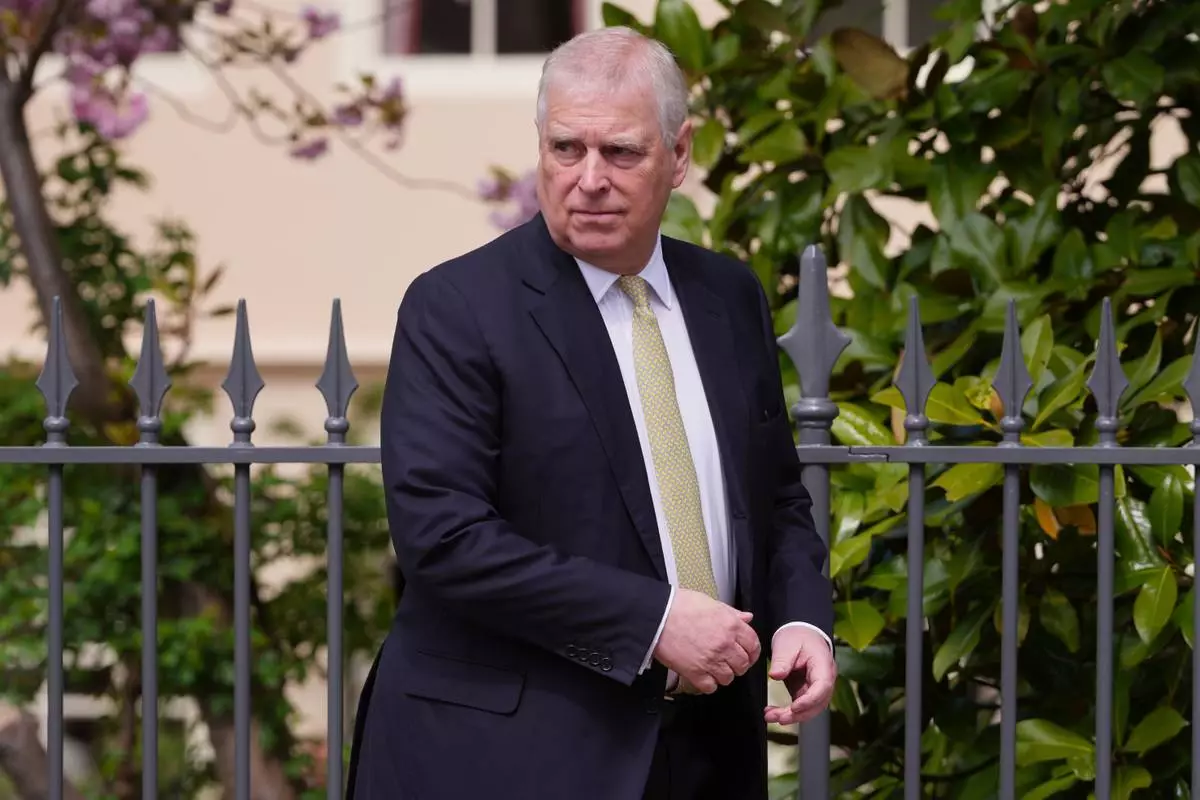
FILE - Britain’s Andrew Mountbatten-Windsor, formerly known as Prince Andrew, looks round as he leaves after attending the Easter Matins Service at St. George's Chapel, Windsor Castle, England, April 20, 2025. (AP Photo/Kirsty Wigglesworth, File)
FILE - Britain’s Andrew Mountbatten-Windsor, formerly known as Prince Andrew, looks round as he leaves after attending the Easter Matins Service at St. George's Chapel, Windsor Castle, England, April 20, 2025. (AP Photo/Kirsty Wigglesworth, File)

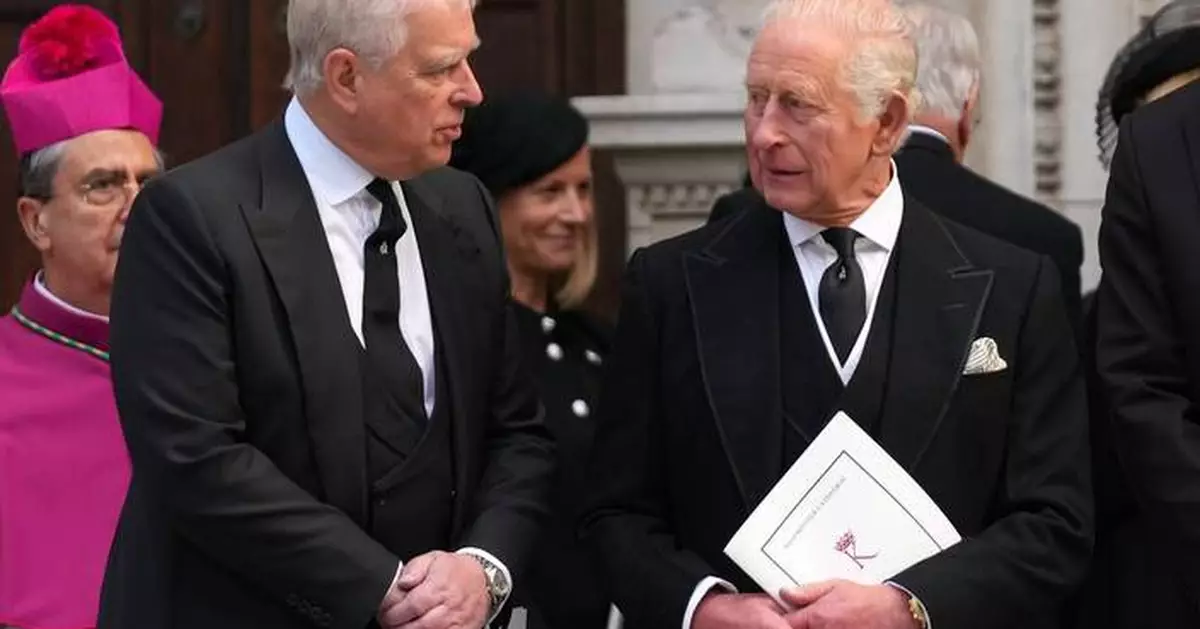
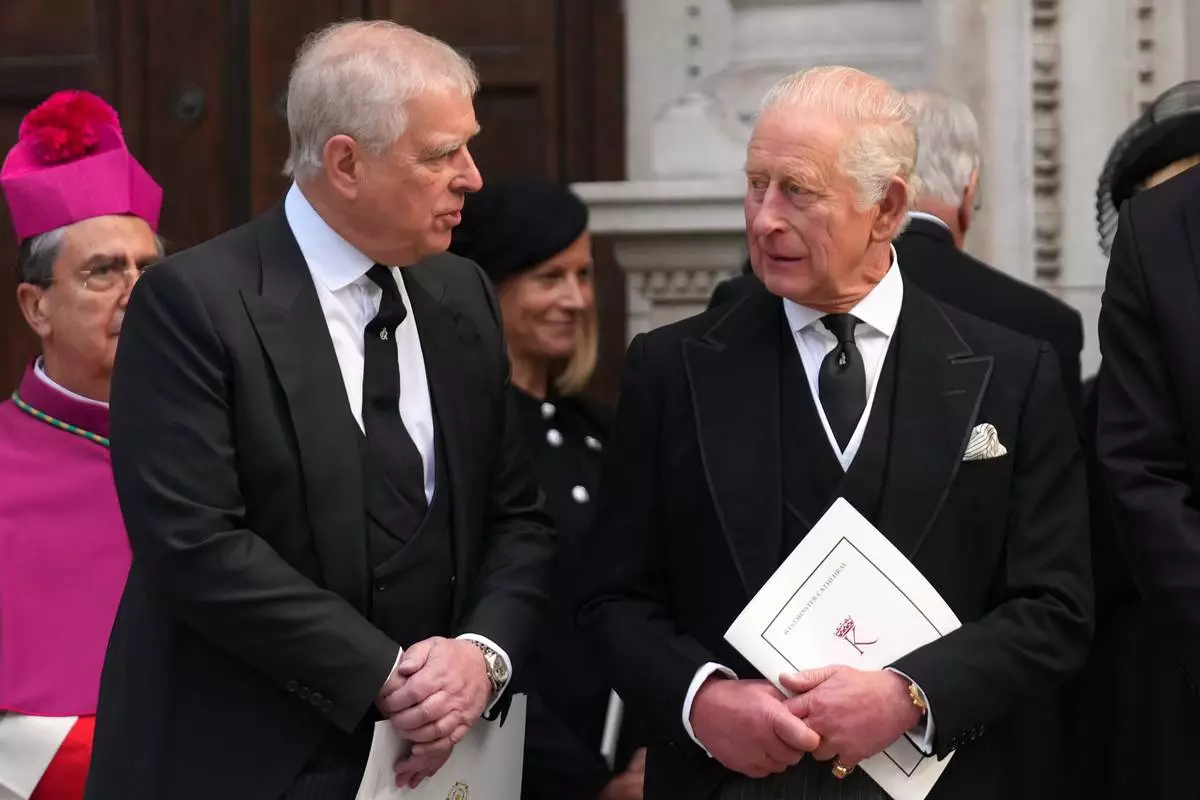
FILE - Britain's Prince Andrew, left, and Britain's King Charles III leave after the Requiem Mass service for the Duchess of Kent at Westminster Cathedral in London, Sept. 16, 2025. (AP Photo/Joanna Chan, File)


FILE - Britain's Prince Andrew, left, and Britain's King Charles III leave after the Requiem Mass service for the Duchess of Kent at Westminster Cathedral in London, Sept. 16, 2025. (AP Photo/Joanna Chan, File)

WASHINGTON (AP) — Congressional leaders said Tuesday that a deal was still possible with the White House on Homeland Security Department funding before it expires this weekend. But the two sides were still far apart as Democrats demanded new restrictions on President Donald Trump’s immigration crackdown.

After federal agents fatally shot two protesters in Minneapolis last month, Democrats say U.S. Immigration and Customs Enforcement needs to be “dramatically” reined in and are prepared to let Homeland Security shut down if their demands aren't met. On Tuesday, Senate Democratic Leader Chuck Schumer and House Democratic Leader Hakeem Jeffries said they had rejected a White House counteroffer that “included neither details nor legislative text” and does not address “the concerns Americans have about ICE’s lawless conduct.”

“We simply want ICE to follow the same standards that most law enforcement agencies across America already follow,” Schumer said Tuesday. “Democrats await the next answer from our Republican counterparts.”

The Democrats’ rejection of the Republican counteroffer comes as time is running short, with a shutdown of the Homeland Security Department threatening to begin Saturday. Among the Democrats’ demands are a requirement for judicial warrants, better identification of DHS officers, new use-of-force standards and a stop to racial profiling.

Finding agreement on the charged, partisan issue of immigration enforcement will be exceedingly difficult. But even as lawmakers in both parties were skeptical, a White House official said that the administration was having constructive talks with both Republicans and Democrats. The official, granted anonymity to speak about ongoing deliberations, stressed that Trump wanted the government to remain open and for Homeland Security services to be funded.

Senate leaders also expressed some optimism.

“There’s no reason we can’t do this” by the end of the week, Senate Democratic Leader Chuck Schumer said after meeting with his caucus on Tuesday.

Senate Majority Leader John Thune, R-S.D., said there have been “some really productive conversations.”

Schumer and Jeffries have said they want immigration officers to remove their masks, to show identification and to better coordinate with local authorities. They have also demanded a stricter use-of-force policy for the federal officers, legal safeguards at detention centers and a prohibition on tracking protesters with body-worn cameras.

Among other asks, Democrats say Congress should end indiscriminate arrests, “improve warrant procedures and standards,” ensure the law is clear that officers cannot enter private property without a judicial warrant and require that before a person can be detained, it’s verified that the person is not a U.S. citizen.

Democrats made the demands for new restrictions on ICE and other federal law enforcement after ICU nurse Alex Pretti was shot and killed by a U.S. Border Patrol officer in Minneapolis on Jan. 24, and some Republicans suggested that new restrictions were necessary. Renee Good was shot by ICE agents on Jan. 7.

Many Democrats said they won’t vote for another penny of Homeland Security funding until enforcement is radically scaled back.

“Dramatic changes are needed at the Department of Homeland Security before a DHS funding bill moves forward,” Jeffries said. “Period. Full stop.”

Jeffries said Tuesday that the White House’s offer “walked away from” their proposals for better identification of ICE agents, for more judicial warrants and for a prohibition on excessive use of force. Republicans also rejected their demand for an end to racial or ethnic profiling, Jeffries said.

“The White House is not serious at this moment in dramatically reforming ICE,” Jeffries said.

Republican lawmakers have also pushed back on the requests. Oklahoma Sen. Markwayne Mullin, a close ally of Trump, said Tuesday that he’s willing to discuss more body cameras and better training — both of which are already in the Homeland spending bill — but that he would reject the Democrats’ most central demands.

“They start talking about judicial warrants? No. They start talking about demasking them? No, not doing that. They want them to have a photo ID with their name on it? Absolutely not,” Mullin said.

Republicans have said ICE agents should be allowed to wear masks because they are more frequently targeted than other law enforcement officials.

“People are doxing them and targeting them,” said House Speaker Mike Johnson, R-La., on Monday. “We’ve got to talk about things that are reasonable and achievable.”

Some Republicans also have demands of their own, including the addition of legislation that would require proof of citizenship before Americans register to vote and restrictions on cities that they say do not do enough to crack down on illegal immigration.

At a House hearing on Tuesday, the acting director of ICE, Todd Lyons, said his agency is “only getting started” and would not be intimidated as his officers carry out Trump's mass deportation agenda.

Congress is trying to renegotiate the DHS spending bill after Trump agreed to a Democratic request that it be separated out from a larger spending measure that became law last week and congressional Republicans followed his lead. That package extended Homeland Security funding at current levels only through Feb. 13, creating a brief window for action as the two parties discuss new restrictions on ICE and other federal officers.

But even as he agreed to separate the funding, Trump has not publicly responded to the Democrats’ specific asks or suggested any areas of potential compromise.

White House press secretary Karoline Leavitt said late last week that the Trump administration is willing to discuss some items on the Democrats’ list, but “others don’t seem like they are grounded in any common sense, and they are nonstarters for this administration.”

Thune said Tuesday that “there are certain red lines that I think both sides have, things they are not going to negotiate on, but there are some things they are going to negotiate on, and that's where I think the potential deal space is here.”

It was, so far, unclear what those issues were.

“We are very committed to making sure that federal law enforcement officers are able to do their jobs and to be safe doing them,” Thune said of Republicans.

In addition to ICE and U.S. Customs and Border Protection, the homeland security bill includes funding for the Federal Emergency Management Agency and the Transportation Security Administration, among other agencies. If DHS shuts down, Thune said last week, “there’s a very good chance we could see more travel problems” similar to the 43-day government closure last year.

Thune has said Republicans will try to pass a two- to four-week extension of the Homeland Security funding while negotiations continue.

Many Democrats are unlikely to vote for another extension. But Republicans could potentially win enough votes in both chambers from Democrats if they feel hopeful about negotiations.

“The ball is in the Republicans’ court,” Jeffries said Monday.

Associated Press writers Matt Brown, Joey Cappelletti and Lisa Mascaro contributed to this report.

Senate Minority Leader Chuck Schumer, D-N.Y., center, speaks during a news conference as House Minority Leader Hakeem Jeffries, D-N.Y. listens, at the Capitol in Washington, Wednesday, Feb. 4, 2026. (AP Photo/J. Scott Applewhite)

Senate Minority Leader Chuck Schumer, D-N.Y., center, speaks during a news conference as House Minority Leader Hakeem Jeffries, D-N.Y. listens, at the Capitol in Washington, Wednesday, Feb. 4, 2026. (AP Photo/J. Scott Applewhite)

Recommended Articles