|
― Demand for solo travel expands both domestically and internationally, with domestic solo travel interest up 17% year on year ―
TOKYO, Feb. 11, 2026 /PRNewswire/ -- Digital travel platform Agoda has released the latest search data on "solo travel" among Japanese travelers. According to accommodation search data from Agoda, interest in solo travel among Japanese travelers increased by 11% year on year for international travel and by 17% for domestic travel, revealing that demand for traveling alone is steadily expanding both within Japan and abroad.
The data compares search activity by Japanese solo travelers from January 1 to December 31, 2025, with the same period in the previous year (2024).
- Popular Overseas Travel Destinations Among Japanese Solo Travelers
For international travel, the cities that attracted the most interest from Japanese solo travelers are as follows:
- Seoul
- Bangkok
- Taipei
- Hong Kong
- Honolulu
All of these cities share the advantages of convenient access from Japan, a strong sense of safety, and well-developed transportation infrastructure, making them popular choices as easy and reassuring destinations for first-time solo overseas travelers.
Among them, Seoul stands out as a particularly popular destination for solo travelers, especially for trips focused on beauty and wellness. In addition, the ability to efficiently enjoy a wide range of experiences—such as dining, shopping, and sightseeing - even during short stays is also believed to be a key factor driving its appeal among Japanese solo travelers.
- Domestic Solo Travel Interest Also Expands, Especially in Regional Cities
For domestic travel, interest in solo travel increased by 17% year on year, surpassing the growth seen in international travel.
The cities with the highest search volumes among Japanese solo travelers were major urban centers such as Tokyo, Osaka, Fukuoka, Sapporo, and Yokohama.
Meanwhile, the following regional cities emerged as destinations with particularly high growth in demand for solo travel.
- Chiba (up 67% year on year)
- Takamatsu (up 62% year on year)
- Okayama (up 46% year on year)
- Izumisano (up 41% year on year)
- Saitama (up 40% year on year)
Many of these cities are characterized by convenient access to major airports or the presence of an airport, suggesting that they are being chosen not only for domestic trips but also as gateways for solo travel abroad.
In particular, Takamatsu and Okayama stand out for their strong balance of convenience and tourism resources despite being regional cities and have garnered especially high popularity among Japanese solo travelers.
These findings reflect a growing interest in regional cities that allow travelers to avoid crowds and enjoy trips at their own pace, as well as the needs of solo travelers who place importance on flexible itineraries centered around airports.
Tadashi Ikai, Senior Country Director for Japan at Agoda shared, "In Japan, solo travel is becoming established not as a special travel style, but as an everyday choice. Domestically, interest is growing in regional cities, while internationally, travelers are interested in destinations that are easy to access and offer a sense of safety and comfort during their stay. Agoda will continue to provide accommodation options and travel products that cater to the diverse needs of solo travelers."
Travelers can seamlessly search and book more than 6 million accommodations, 130,000+ flight routes, and 300,000+ activities through Agoda's platform. Attractive accommodation deals can be easily found via the Agoda mobile app or official website (Agoda.com).
― Demand for solo travel expands both domestically and internationally, with domestic solo travel interest up 17% year on year ―
TOKYO, Feb. 11, 2026 /PRNewswire/ -- Digital travel platform Agoda has released the latest search data on "solo travel" among Japanese travelers. According to accommodation search data from Agoda, interest in solo travel among Japanese travelers increased by 11% year on year for international travel and by 17% for domestic travel, revealing that demand for traveling alone is steadily expanding both within Japan and abroad.
The data compares search activity by Japanese solo travelers from January 1 to December 31, 2025, with the same period in the previous year (2024).
- Popular Overseas Travel Destinations Among Japanese Solo Travelers
For international travel, the cities that attracted the most interest from Japanese solo travelers are as follows:
All of these cities share the advantages of convenient access from Japan, a strong sense of safety, and well-developed transportation infrastructure, making them popular choices as easy and reassuring destinations for first-time solo overseas travelers.
Among them, Seoul stands out as a particularly popular destination for solo travelers, especially for trips focused on beauty and wellness. In addition, the ability to efficiently enjoy a wide range of experiences—such as dining, shopping, and sightseeing - even during short stays is also believed to be a key factor driving its appeal among Japanese solo travelers.
- Domestic Solo Travel Interest Also Expands, Especially in Regional Cities
For domestic travel, interest in solo travel increased by 17% year on year, surpassing the growth seen in international travel.
The cities with the highest search volumes among Japanese solo travelers were major urban centers such as Tokyo, Osaka, Fukuoka, Sapporo, and Yokohama.
Meanwhile, the following regional cities emerged as destinations with particularly high growth in demand for solo travel.
- Chiba (up 67% year on year)
- Takamatsu (up 62% year on year)
- Okayama (up 46% year on year)
- Izumisano (up 41% year on year)
- Saitama (up 40% year on year)
Many of these cities are characterized by convenient access to major airports or the presence of an airport, suggesting that they are being chosen not only for domestic trips but also as gateways for solo travel abroad.
In particular, Takamatsu and Okayama stand out for their strong balance of convenience and tourism resources despite being regional cities and have garnered especially high popularity among Japanese solo travelers.
These findings reflect a growing interest in regional cities that allow travelers to avoid crowds and enjoy trips at their own pace, as well as the needs of solo travelers who place importance on flexible itineraries centered around airports.
Tadashi Ikai, Senior Country Director for Japan at Agoda shared, "In Japan, solo travel is becoming established not as a special travel style, but as an everyday choice. Domestically, interest is growing in regional cities, while internationally, travelers are interested in destinations that are easy to access and offer a sense of safety and comfort during their stay. Agoda will continue to provide accommodation options and travel products that cater to the diverse needs of solo travelers."
Travelers can seamlessly search and book more than 6 million accommodations, 130,000+ flight routes, and 300,000+ activities through Agoda's platform. Attractive accommodation deals can be easily found via the Agoda mobile app or official website (Agoda.com).
** The press release content is from PR Newswire. Bastille Post is not involved in its creation. **
Agoda Announces Japanese "Solo Travel" Trends
|
Announced alongside M Series Smart Assist Module launch on Kickstarter
NEW YORK, April 4, 2026 /PRNewswire/ -- Yarbo, a company focused on intelligent yard robotics, today announced the Yarbo Open Platform, a long-term initiative currently under development and planned for release in early 2027. Designed to expand Yarbo's modular yard robot system across both software and hardware, the platform is intended to support deeper customization, broader smart home connectivity, and new forms of user and developer-driven functionality over time. The announcement coincides with the launch of the Smart Assist Module (SAM) for the M Series on Kickstarter.
The Open Platform is not available today. Instead, it reflects Yarbo's roadmap for how its ecosystem may evolve over time, including a three-layer software architecture built around an Open API, SDK, and no-code Automation Editor, as well as a hardware expansion framework designed to support future user-built and developer-built modules.
A Structured Approach to Software Integration and Automation
The Yarbo Open Platform is structured to accommodate different levels of technical expertise, from everyday users to experienced developers. It is designed to provide multiple entry points into the Yarbo ecosystem, enabling both software-driven automation and hardware-level expansion.
On the software side, the platform consists of three layers:
- Yarbo Open API — intended to enable connectivity between Yarbo devices and external platforms, allowing them to participate in broader home automation scenarios.
- Yarbo SDK — a set of development tools, including code libraries and documentation, designed for developers building custom features or integrations.
- Yarbo Automation Editor — a visual, drag-and-drop interface within the Yarbo app that allows users to create automation workflows without writing code.
Together, these components are intended to make automation accessible to a wide range of users, while also supporting more advanced development use cases.
The platform is also designed to support compatibility with widely used smart home ecosystems, including Home Assistant, Google Home, and Amazon Alexa, enabling users to incorporate Yarbo into existing connected home setups.
Extending Capability Through Hardware
In addition to software capabilities, the Open Platform introduces a hardware expansion approach designed to extend Yarbo's functionality beyond its existing modules.
At the center of this is CoreBridge, a standardized hardware interface currently in development that is intended to provide access to Yarbo's mechanical mounting points, power system, and data connections. It is designed to support third-party development and user-built extensions, allowing new types of functionality beyond pre-defined modules.
One example of this extensibility is an electromagnet-based module, which can be attached via CoreBridge to enable Yarbo to latch onto and move objects such as garbage bins. In a potential use scenario, this could enable automated movement of a bin to the curb on collection day and its return afterward.
This combination of software and hardware openness reflects an effort to expand the role of outdoor robotics beyond fixed-function devices.
Smart Assist Module Launch on Kickstarter
Alongside the Open Platform announcement, Yarbo is launching the Smart Assist Module (SAM) for the M Series on Kickstarter.
The module introduces two primary features designed to expand how users interact with their yard robot in everyday use:
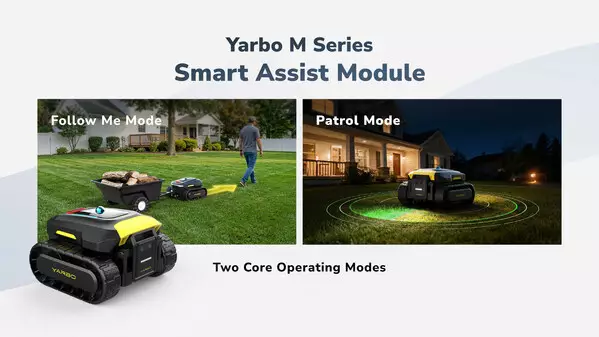
- Follow Me Mode — enabling Yarbo to move alongside the user while carrying tools or materials, reducing the need for manual transport during yard work.
- Patrol Mode — allowing Yarbo to move along customizable routes around the property, with features such as remote live view, app-based alerts, and optional audio notifications via its built-in speaker, providing an added layer of awareness and convenience for users managing outdoor spaces.
The Smart Assist Module is positioned as part of Yarbo's broader effort to extend the practical use cases of its modular system.
Looking Ahead
The Yarbo Open Platform is planned for release in early 2027 and is being developed to support both the Y Series and M Series. By introducing a framework that combines software integration, developer tools, and hardware extensibility, Yarbo aims to enable a broader range of applications while allowing users to define how the system evolves over time.
Further details will be shared as development progresses.
About Yarbo
Yarbo is defining a new category of outdoor robotics with its Modular Yard Robot. Known for its automated snow blower robots, Yarbo introduced a modular system designed for year-round use. Powered by a single intelligent core unit, the system supports interchangeable modules for mowing, leaf blowing, snow clearing, and more—creating a more efficient approach to outdoor maintenance for homeowners.
Announced alongside M Series Smart Assist Module launch on Kickstarter
NEW YORK, April 4, 2026 /PRNewswire/ -- Yarbo, a company focused on intelligent yard robotics, today announced the Yarbo Open Platform, a long-term initiative currently under development and planned for release in early 2027. Designed to expand Yarbo's modular yard robot system across both software and hardware, the platform is intended to support deeper customization, broader smart home connectivity, and new forms of user and developer-driven functionality over time. The announcement coincides with the launch of the Smart Assist Module (SAM) for the M Series on Kickstarter.
The Open Platform is not available today. Instead, it reflects Yarbo's roadmap for how its ecosystem may evolve over time, including a three-layer software architecture built around an Open API, SDK, and no-code Automation Editor, as well as a hardware expansion framework designed to support future user-built and developer-built modules.
A Structured Approach to Software Integration and Automation
The Yarbo Open Platform is structured to accommodate different levels of technical expertise, from everyday users to experienced developers. It is designed to provide multiple entry points into the Yarbo ecosystem, enabling both software-driven automation and hardware-level expansion.
On the software side, the platform consists of three layers:
- Yarbo Open API — intended to enable connectivity between Yarbo devices and external platforms, allowing them to participate in broader home automation scenarios.
- Yarbo SDK — a set of development tools, including code libraries and documentation, designed for developers building custom features or integrations.
- Yarbo Automation Editor — a visual, drag-and-drop interface within the Yarbo app that allows users to create automation workflows without writing code.
Together, these components are intended to make automation accessible to a wide range of users, while also supporting more advanced development use cases.
The platform is also designed to support compatibility with widely used smart home ecosystems, including Home Assistant, Google Home, and Amazon Alexa, enabling users to incorporate Yarbo into existing connected home setups.
Extending Capability Through Hardware
In addition to software capabilities, the Open Platform introduces a hardware expansion approach designed to extend Yarbo's functionality beyond its existing modules.
At the center of this is CoreBridge, a standardized hardware interface currently in development that is intended to provide access to Yarbo's mechanical mounting points, power system, and data connections. It is designed to support third-party development and user-built extensions, allowing new types of functionality beyond pre-defined modules.
One example of this extensibility is an electromagnet-based module, which can be attached via CoreBridge to enable Yarbo to latch onto and move objects such as garbage bins. In a potential use scenario, this could enable automated movement of a bin to the curb on collection day and its return afterward.
This combination of software and hardware openness reflects an effort to expand the role of outdoor robotics beyond fixed-function devices.
Smart Assist Module Launch on Kickstarter
Alongside the Open Platform announcement, Yarbo is launching the Smart Assist Module (SAM) for the M Series on Kickstarter.
The module introduces two primary features designed to expand how users interact with their yard robot in everyday use:
- Follow Me Mode — enabling Yarbo to move alongside the user while carrying tools or materials, reducing the need for manual transport during yard work.
- Patrol Mode — allowing Yarbo to move along customizable routes around the property, with features such as remote live view, app-based alerts, and optional audio notifications via its built-in speaker, providing an added layer of awareness and convenience for users managing outdoor spaces.
The Smart Assist Module is positioned as part of Yarbo's broader effort to extend the practical use cases of its modular system.
Looking Ahead
The Yarbo Open Platform is planned for release in early 2027 and is being developed to support both the Y Series and M Series. By introducing a framework that combines software integration, developer tools, and hardware extensibility, Yarbo aims to enable a broader range of applications while allowing users to define how the system evolves over time.
Further details will be shared as development progresses.
About Yarbo
Yarbo is defining a new category of outdoor robotics with its Modular Yard Robot. Known for its automated snow blower robots, Yarbo introduced a modular system designed for year-round use. Powered by a single intelligent core unit, the system supports interchangeable modules for mowing, leaf blowing, snow clearing, and more—creating a more efficient approach to outdoor maintenance for homeowners.
** This press release is distributed by PR Newswire through automated distribution system, for which the client assumes full responsibility. **
Yarbo Introduces Open Platform Strategy, Opening Its Robotics System to Developers and Smart Home Ecosystems

Yarbo Introduces Open Platform Strategy, Opening Its Robotics System to Developers and Smart Home Ecosystems