China conducted successfully a series of flight tests for its next-generation crewed lunar exploration systems on Wednesday, moving a step closer to its goal of landing astronauts on the moon before 2030, according to the China Manned Space Engineering Office.
The flight tests were carried out at the Wenchang Space Launch Site in south China's Hainan Province, and included a low-altitude demonstration of the Long March-10 rocket and a high-speed abort test of the Mengzhou crewed spacecraft under maximum aerodynamic pressure. Both systems performed as designed. These test plans were previously outlined by the China Manned Space Agency last October.
The test followed a series of earlier milestones, including tethered ignition tests for the Long March-10 rocket, a zero-altitude abort flight test for the Mengzhou spacecraft, and integrated landing and takeoff verification for the Lanyue lunar lander.
They mark another major developmental flight test, representing an important milestone in China's crewed lunar exploration program.
The mission featured several firsts and highlights, including a new rocket model, a new crewed spacecraft, a newly built launch pad, and new at-sea recovery missions for both the rocket and the spacecraft.
The rocket and spacecraft used in the test were both in initial prototype configurations. The rocket adopted a single-stage core configuration and had previously completed two tethered ignition tests, while the spacecraft's return capsule had earlier undergone a zero-altitude abort flight test.
To support this mission, all test articles were modified in accordance with reusability requirements and procedures. The Wenchang Space Launch Site advanced construction while operating to ensure the test proceeded as scheduled, and the landing zone system conducted targeted training and drills to address technical challenges associated with the spacecraft's first at-sea splashdown recovery.
The ground test command center issued the ignition command at 11:00 (Beijing Time) on Wednesday morning.
The rocket lifted off and reached conditions corresponding to the spacecraft's maximum dynamic pressure abort regime.
Upon receiving the abort command from the rocket, the spacecraft successfully executed separation and abort procedures. The rocket's first-stage body and the spacecraft's return capsule then splashed down safely and under control in the sea.
The test marked the Long March-10 rocket's first ignition flight in its initial prototype configuration, China's first maximum dynamic pressure abort test of a crewed spacecraft, the country's first at-sea splashdown recovery of both a crewed spacecraft return capsule and a rocket first stage, and the first ignition flight mission from Wenchang's newly constructed launch pad.
The successful test verified the rocket's ascent and recovery performance, as well as the spacecraft's maximum dynamic pressure abort and recovery functions. It also validated interface compatibility across multiple engineering systems, providing valuable flight data and engineering experience for future crewed lunar exploration missions.
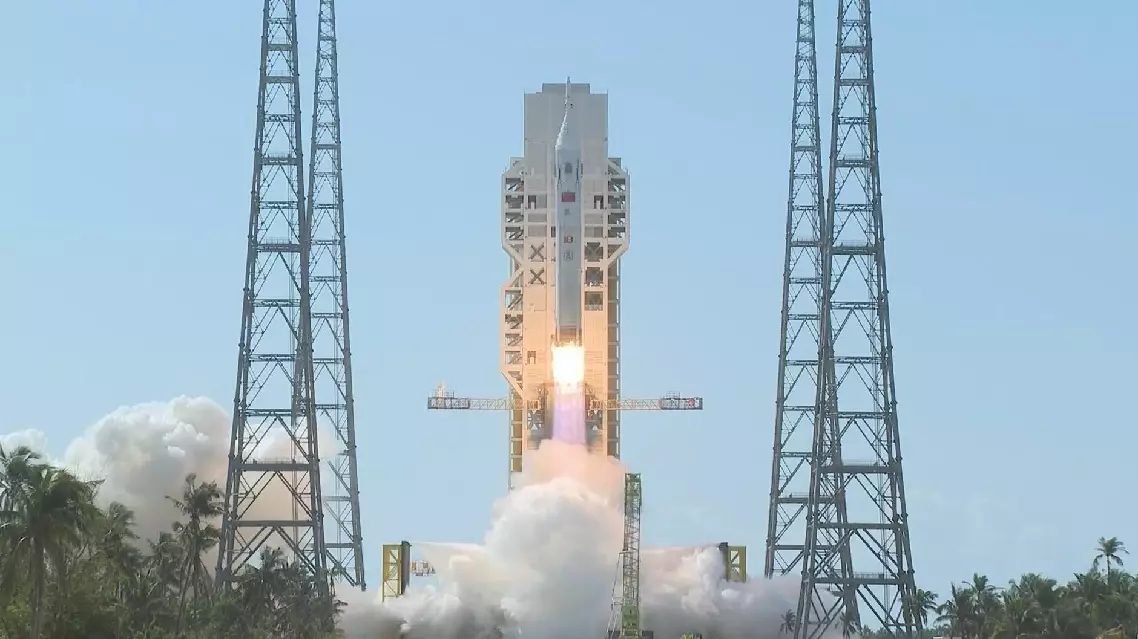
China conducts crucial Long March-10 rocket flight test for manned lunar landing before 2030
China conducts crucial Long March-10 rocket flight test for manned lunar landing before 2030