Skip to Content Facebook Feature Image

QuiX Quantum and Artilux Establish Strategic Collaboration to Advance Energy-Efficient Photonic Quantum Computing

Business

QuiX Quantum and Artilux Establish Strategic Collaboration to Advance Energy-Efficient Photonic Quantum Computing
Business

Business

QuiX Quantum and Artilux Establish Strategic Collaboration to Advance Energy-Efficient Photonic Quantum Computing

2026-02-11 19:17 Last Updated At:19:35

Enabling scalable, data-center compatible quantum systems for real-world deployment

ENSCHEDE, Netherlands and HSINCHU, Feb. 11, 2026 /PRNewswire/ -- QuiX Quantum, a leading provider of photonic quantum computing hardware, and Artilux, a developer of advanced semiconductor-based photonic detector technologies, today announced the signing of a Memorandum of Understanding (MoU).

This agreement builds on the companies' complementary strengths in photonic system design and their positions within the broader semiconductor ecosystem. The collaboration is aimed at strengthening hardware integration, improving manufacturability, and lowering operational energy requirements in photonic quantum computing systems.

Building quantum hardware for practical environments
As quantum computing matures into real-world applications, operating efficiently beyond specialized laboratory environments is becoming increasingly critical. The collaboration focuses on integrating advanced detector components more closely within photonic quantum hardware, enabling meaningful reductions in infrastructure demands. This direction contributes to quantum computing hardware that is increasingly compatible with modern data-center environments and designed with deployability and total cost of ownership in mind.

Integration, scalability, and energy efficiency
By combining Artilux's expertise on germanium silicon (GeSi) photonic technology with QuiX Quantum's system-level photonic quantum computing development, the collaboration seeks to simplify system architecture and reduce detector-level cooling requirements and support infrastructure. This approach improves overall manufacturability and supports QuiX Quantum's objective of delivering high-performance photonic quantum computing hardware in Data Centers and HPC infrastructure, enabling scaling with industry needs.

Executive Quotes:

Dr.-Ing. Stefan Hengesbach, CEO, QuiX Quantum
"We are thrilled to partner with Artilux as this collaboration supports our long-term strategy of building scalable and most energy-efficient photonic quantum computers. This allows us to improve manufacturability, uptime and reduce operational complexity while further expanding practical deployment."

Erik Chen, CEO, Artilux
"We are excited to collaborate with QuiX Quantum on leveraging our detector technologies to advance and support more energy-efficient and scalable quantum hardware. Partnerships like this help accelerate progress in next-generation photonic computing and underscores our growing role in global deep-tech innovation across multiple industrial sectors."

Bas Pulles, Representative of Netherlands Office Taipei
"We are pleased to witness the signing of this agreement between two technology pioneers; this agreement exemplifies how international cooperation can accelerate breakthrough technologies and create long-term economic and technological value for both regions."

About Artilux
Founded in 2014, Artilux has been at the forefront of a new era in semiconductor and photonic innovation, pioneering GeSi (germanium silicon) technology that bridges the gap between the electronic and photonic worlds. Building on a proven track record of photonic innovations that address the growing demand for high data throughput and low power consumption, Artilux's dedicated team continuously pushes the boundaries of technology—transforming fundamental scientific breakthroughs into real-world solutions spanning communications, sensing, imaging, and computing. Artilux's vision is to redefine the interaction between light and intelligence, creating a seamlessly connected world where photonics and electronics converge to power the next generation of sensing, communication, and computing.

About QuiX Quantum
QuiX Quantum is a leading provider of photonic quantum computing hardware, driving innovation with proven quality in the development of its Universal Quantum Computer. The first system, already sold and contracted for delivery, underscores the impact of QuiX Quantum's market-leading hardware and renowned quality. This strong technological foundation positions the company to build the most powerful quantum computers. With offices across Europe, QuiX Quantum continues to push the boundaries of quantum technology while serving a growing global customer base.


** The press release content is from PR Newswire. Bastille Post is not involved in its creation. **

QuiX Quantum and Artilux Establish Strategic Collaboration to Advance Energy-Efficient Photonic Quantum Computing

QuiX Quantum and Artilux Establish Strategic Collaboration to Advance Energy-Efficient Photonic Quantum Computing

SHANGHAI, April 3, 2026 /PRNewswire/ -- As AI becomes essential in K–12 education, many teachers face a practical question: How to teach AI through hands-on, project-based learning without advanced coding skills?

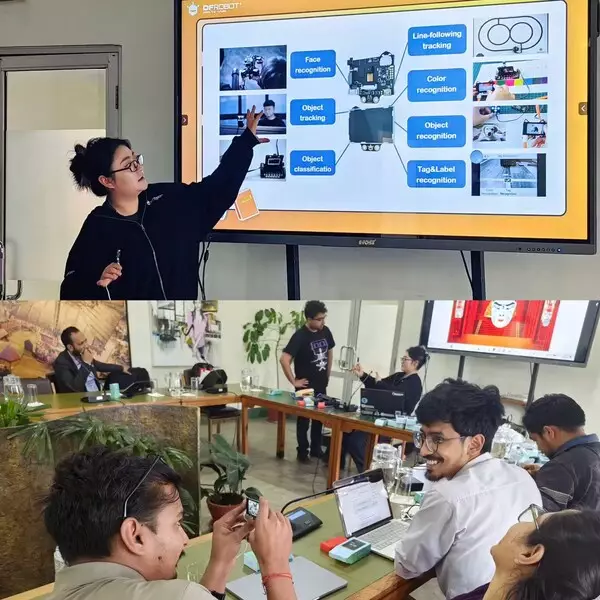
A recent workshop in Kathmandu University offers a clear answer. Conducted by DFRobot, an innovator in STEAM education, the three-hour workshop at the School of Engineering brought together teachers and department heads from across disciplines. Participants completed two hands-on AI projects while exploring how to translate these experiences into their own classroom teaching.

From Awareness to Classroom Practice

According to the Computer Science Teachers Association, while most educators support AI in the curriculum, many lack confidence in teaching it effectively. This workshop directly addressed that gap—moving from awareness to practical implementation.

Learning AI Through Hands-On Building

The training adopted a face-to-face, project-based approach, combining technical learning with pedagogy. It focused on deploying AI capabilities—such as speech and vision—on edge devices, connecting abstract concepts to interactive classroom applications.

Using UNIHIKER K10 hardware and Mind+ graphical programming software, participants completed two progressive projects:

Voice Interaction

Using the UNIHIKER K10 and the Mind+ graphical programming platform software, the workshop introduced voice-based human–machine interaction as an accessible entry point into AI learning. Teachers began by creating a simple voice-controlled system with commands such as "turn on the light," experiencing a fundamental AI interaction loop: wake → recognize → execute.

Building on this foundation, they extended the system to control on-screen movement through voice directions, transforming a basic function into a more engaging and interactive experience. Rather than focusing on complex programming, the training emphasized how simple voice commands can be translated into practical classroom applications.

Through this process, teachers gained a clear understanding of real-time voice interaction and its classroom potential.

Vision Interaction

The workshop introduced the HUSKYLENS AI vision sensor and its face recognition capabilities, helping teachers understand how machines perceive the world through visual data. Trainers explained the core workflow of face recognition—including detection, alignment, encoding, and matching—providing a clear technical framework for classroom application. Building on this foundation, teachers connected HUSKYLENS with the Mind+ programming environment and implemented real-time recognition tasks. Extending this approach, they developed a "Smart Pet" system by integrating HUSKYLENS with the UNIHIKER K10. The system could recognize different types of cats—such as Orange Tabby, Striped Tabby, and Siamese—and respond with corresponding interactive states.

Through this hands-on process, teachers gained a clear understanding of computer vision concepts and how visual input can drive interactive systems, enabling more engaging and project-based learning in the classroom.

A Model That Can Be Applied in AI Classrooms

The workshop highlights a practical approach to AI education that can be replicated across schools:
Accessible: Entry-level coding is all that's needed — suitable for K–12 learners.
Adaptable: Projects can be transformed into games, smart systems, or classroom tools
Structured: Aligned with project-based learning and real-world problem-solving

As part of the assessment, each teacher was asked to outline how the projects could be adapted for their own classrooms—highlighting a core objective of the training: not just using tools, but enabling curriculum design and effective knowledge transfer.

More importantly, it emphasized a critical shift—from understanding AI to applying it. By experiencing the full creation process, teachers gained the confidence to bring AI into their own classrooms.

** This press release is distributed by PR Newswire through automated distribution system, for which the client assumes full responsibility. **

How to Teach AI in the Classroom: A Hands-On Teacher Training Workshop at Kathmandu University

How to Teach AI in the Classroom: A Hands-On Teacher Training Workshop at Kathmandu University

Recommended Articles