NEW YORK--(BUSINESS WIRE)--Feb 11, 2026--
DDC Enterprise Limited (NYSEAMERICAN: DDC) (“DDC” or the “Company”), a global Asian food platform and digital asset treasury company, today announced the acquisition of 100 Bitcoin (“BTC”). This latest purchase marks the fifth consecutive week of BTC acquisitions and brings the Company’s total Bitcoin holdings to 1988.
This press release features multimedia. View the full release here: https://www.businesswire.com/news/home/20260211709632/en/
The transaction was executed following a recent pullback in BTC prices. The Company’s activity remains guided by its established treasury parameters, with an emphasis on position sizing, liquidity, and balance sheet strength rather than short-term price dynamics.
Bitcoin Purchase Highlights
“Our long-term execution framework is deliberately designed to be insensitive to day-to-day market sentiment,” said Norma Chu, Founder, Chairwoman, and Chief Executive Officer of DDC. “We apply clear guardrails and oversight to our Bitcoin activity so that each transaction fits within a broader, durable capital structure plan.”
The Company’s treasury strategy remains centered on disciplined execution, governance-led decision-making, and transparency in capital allocation. DDC maintains its view of Bitcoin as a scarce, long-duration asset that can enhance treasury resilience against fiat currency debasement and support balance sheet diversification across macroeconomic environments.
About DDC Enterprise Limited
DDC Enterprise Limited (NYSEAMERICAN: DDC) is participating proactively in the corporate Bitcoin treasury evolution while maintaining its foundation as a leading global Asian food platform. The Company has strategically positioned Bitcoin as a core reserve asset while continuing to expand its portfolio of culinary brands. DDC is at the forefront of public companies integrating Bitcoin into their financial architecture. For more information, visit www.ddc.xyz.
Caution Regarding Forward-Looking Statements
Certain statements in this announcement are forward-looking statements. Investors can identify these forward-looking statements by words or phrases such as “may,” “will,” “expect,” “anticipate,” “aim,” “estimate,” “intend,” “plan,” “believe,” “is/are likely to,” “potential,” “continue” or other similar expressions. Examples of forward-looking statements include those related to business prospects, accumulation of Bitcoin, the Company and its management’s view of market conditions and outlook, and the Company’s goals, strategy and future activity. These statements are subject to uncertainties and risks including, but not limited to, the risk factors discussed in the Risk Factors and in Management’s Discussion and Analysis of Financial Condition and Results of Operations sections of our Forms 20-F, 6-K and other reports filed with the Securities and Exchange Commission (“SEC”) and available at www.sec.gov. It is also inherent in forward-looking statements for there to be risks, uncertainties and other factors beyond the Company’s ability to predict or control. Although the Company believes that the expectations expressed in these forward-looking statements are reasonable, it cannot assure you that such expectations will turn out to be correct, and the Company cautions investors that actual results may differ materially from the anticipated results and encourages investors to review other factors that may affect its future results in the Company’s filings with the SEC. Additional factors are discussed in the Company’s filings with the SEC, which are available for review at www.sec.gov. The Company undertakes no obligation to update or revise publicly any forward-looking statements to reflect subsequent occurring events or circumstances, or changes in its expectations that arise after the date hereof, except as may be required by law.

DDC Now Holds 1,988 BTC
President Donald Trump tried to put some teeth into his latest attempt to save college sports.
The threat of cutting funding to cash-starved schools that don’t comply is real, even if the stricter rules that come out of the executive order he signed Friday could take a while to figure out.
In the order signed hours before the women’s Final Four tipped off one of the biggest weekends in college sports Trump went after eligibility rules, transfers and the spiraling costs associated with an industry that now pays its players millions of dollars per year.
He called on federal agencies to ensure schools are following the rules and threatened to choke off federal grants and funding, a similar approach his administration has taken to force universities around the country to alter policies involving diversity, equity and inclusion, transgender rights and even the kinds of classes they offer.
In some ways, forcing those changes might seem like child’s play once college sports figures this out. The NCAA, the newly created College Sports Commission, the four power conferences, dozens more smaller ones and hundreds of educational institutions all have a say here: It’s a big reason Congress, which Trump instructed to act quickly, has been stuck for more than a year on this.
Trump’s order was his second since one last July and it was a laundry list of proposed fixes, many of which lawmakers and college leaders have been pushing for since the approval of a $2.8 billion settlement changed the face of games that were once played by pure amateurs.
He called for “clear, consistent and fair eligibility limits, including a five-year participation window," and wants to limit athletes to one transfer with one more available once they get a four-year degree.
At a college sports roundtable last month, Trump said he anticipated any order he signed would trigger litigation. Athletes have largely won the freedom to transfer almost at will via the portal along with the ability to be paid by schools that are now doling out more than $20 million a year to their athletes.
As much as the changes he directs, Trump’s call for the Education Department, the Federal Trade Commission and the attorney general’s office to evaluate “whether violations of such rules render a university unfit for Federal grants and contracts” stands out as a way to force change.
Several universities across the country have made policy changes to comply with federal orders and avoid funding-related showdowns with the government. Yet big-named schools like Penn State and Florida State are facing huge debts.
“I haven’t read it, obviously, but I certainly appreciate his interest in the issue," NCAA President Charlie Baker said at the women's Final Four in Phoenix. "And from what I saw, some of the social media traffic, it’s pretty clear that he made clear that we need congressional action to sort of seal the deal on a number of these things, which is good, because we do.”
ACC Commissioner Jim Phillips praised the president's order, saying “there continues to be significant momentum to preserve the athletic and academic opportunities for the next generation of student-athletes and we appreciate the ongoing efforts.”
Attorney Mit Winter, who follows college sports law, said the order is likely to set up a situation where the NCAA and schools have to decide whether to follow a federal court order or an executive order.
“Federal court orders prohibit the NCAA from making athletes sit out a season if they transfer more than once and prohibit the NCAA from enforcing rules that limit collectives from being involved in recruiting,” he said. "The EO appears to direct the NCAA to create rules that would likely violate both of these court orders. Will the NCAA create rules that do that? And if they do, will schools follow them?
"Either way, we’re likely going to see litigation challenging the EO by athletes and third parties.”
Winter added that the order also appears to urge schools to pay new revenue share amounts.
“Most schools are paying 90-95% of their rev-share funds to men's basketball and football players,” he said. "And those funds are already promised via contracts signed with those athletes. Will the order purport to make schools not adhere to those contracts?”
AP Sports Writers Maura Carey, David Brandt and Eric Olson contributed.
Get poll alerts and updates on the AP Top 25 throughout the season. Sign up here. AP college football: https://apnews.com/hub/ap-top-25-college-football-poll and https://apnews.com/hub/college-football
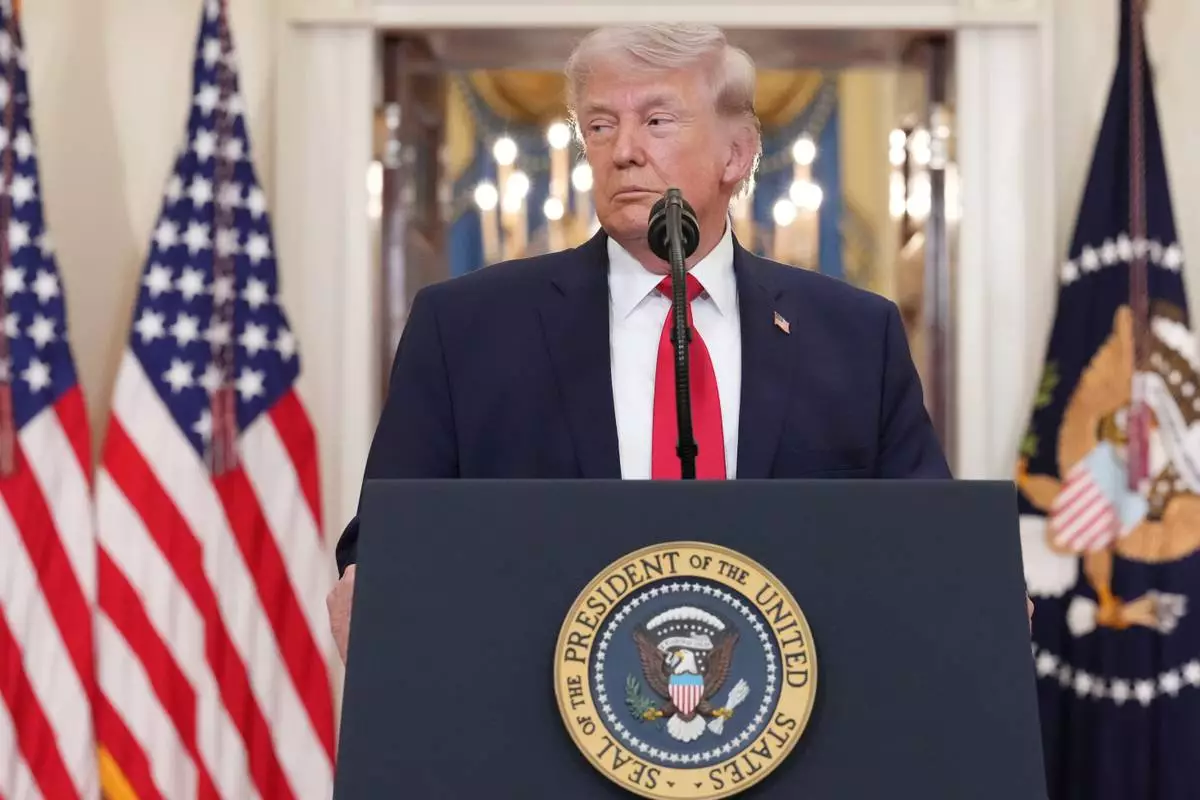
President Donald Trump pauses as he finishes speaking about the Iran war from the Cross Hall of the White House on Wednesday, April 1, 2026, in Washington. (AP Photo/Alex Brandon, Pool)