BRUSSELS (AP) — NATO on Wednesday launched a new military effort dubbed Arctic Sentry aimed at improving security in the High North, a month after U.S. President Donald Trump ramped up tensions in the alliance with his threats to annex Greenland.
Initially, Arctic Sentry will be the NATO label for national military exercises in the region, such as Denmark’s Arctic Endurance — which angered Trump so much that he threatened to slap tariffs on allies taking part — and Norway’s Cold Response drills.
Arctic Sentry is not a military operation. It does not involve the permanent or long-term deployment of troops to the region under a NATO banner.
“What is really new about it is that for the first time now we will bring everything we do in the Arctic together under one command,” NATO Secretary-General Mark Rutte told reporters in Brussels. He said it would help the alliance to “assess which (security) gaps there are which we have to fill.”
“In the face of Russia’s increased military activity and China’s growing interest in the High North, it was crucial that we do more,” Rutte added.
Arctic security has been on NATO’s agenda in recent years — seven allies lie in the region, along with Russia — but pressure to act accelerated as Trump’s determination to “get” Greenland fueled tensions among the allies.
NATO’s role in this series of military activities, which will be coordinated through its U.S. headquarters in Norfolk, Virginia, is aimed at countering Russian and Chinese influence in the High North, which includes Greenland.
NATO’s Supreme Allied Commander Europe, U.S. Air Force Gen. Alexus Grynkewich, said in a statement that “Arctic Sentry underscores the alliance’s commitment to safeguard its members and maintain stability in one of the world’s most strategically significant and environmentally challenging areas.”
As part of the effort, the United Kingdom has announced that the number of British troops deployed to Norway will double over three years from 1,000 to 2,000. Some will be involved in Exercise Lion Protector, already planned for September.
Details are sketchy, but other NATO activities will be added to Arctic Sentry once broader security needs are assessed and as the national military exercises end.
France, Germany and Denmark have said they will take part but have not said how many troops would be involved.
NATO’s primary role is to defend the territory of its 32 member states. The specter of the alliance’s most powerful country threatening to annex part of another ally, Denmark, has deeply shaken the rest of the alliance. Greenland is a semiautonomous territory in the Danish realm.
European allies hope that Arctic Sentry and ongoing talks between the Trump administration, Denmark and Greenland will allow NATO to move on from the dispute and focus on Europe's real security priority, Russia's war on Ukraine.

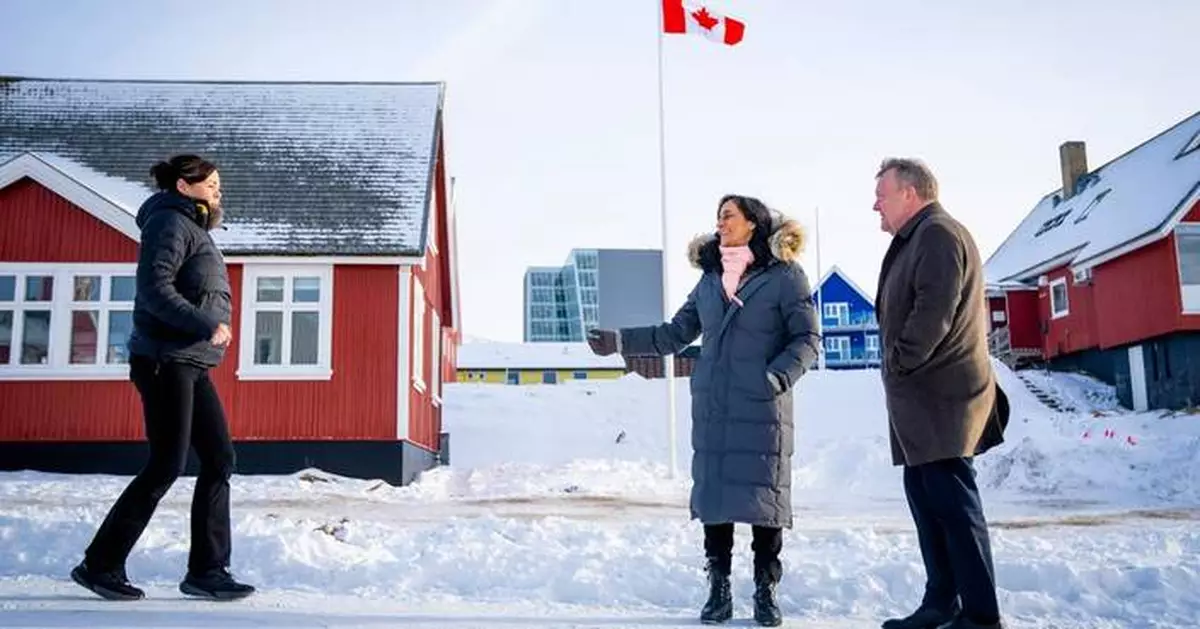
Greenland's Minister for Foreign Affairs Vivian Motzfeldt, left, Canada's Foreign Minister Anita Anand, and Danish Foreign Minister Lars Loekke Rasmussen, right, meet in front of the newly opened Canadian consulate in Nuuk, Saturday, Feb. 7, 2026. (Ida Marie Odgaard/Ritzau Scanpix via AP)
NEW YORK (AP) — Aaron Judge turned to the Bleacher Creatures during their first-inning Roll Call at the New York Yankees' home opener Friday, bent a knee and flexed with both arms in honor of Brett Gardner.
“Still hoping he gets a chance to come back here and share his knowledge with the boys a little bit,” Judge said after his go-ahead, two-run homer in the first inning started the Yankees to an 8-2 win over the Miami Marlins. “He was a big part of this team, his long tenure here as a Yankee, so I always like paying him a little credit. He's tuned into the game and watching.”
Gardner spent his entire big league career with the Yankees from 2008-21, and Judge made his major league debut with New York in 2016. Judge started flexing for Roll Call when playing center field, Gardner's old position. Judge roomed with Gardner in 2017.
“He was a leader. He was a professional. He was a prankster. He was everything that you look for in a guy to lead the team,” Judge said, speaking slowly and choosing his words carefully. “He took me in at a young age when I first got here and he treated me just like everybody else and showed me respect. He taught me a lot of things. It kind of teaches you how to lead a clubhouse. He had a big influence on me not only on the field but inside this clubhouse, just the way he played the game and the way he held everybody to a standard. Very few guys are made like Brett Gardner.”
Gardner has been in the Yankees' thoughts even more since March 2024, when his youngest son died at age 14 during a family vacation in Costa Rica. Authorities determined carbon monoxide poisoning was the cause of death.
Judge, the team captain, wanted the Yankees to arrive in style after opening 5-1 on their West Coast trip.
“That's Cap, again, setting the tone,” said Ben Rice, who homered and drove in three runs. “Sent us a text late last night saying: `Hey, suits tomorrow.' So everybody was fired up and we were happy to continue that momentum out on the field.”
Trent Grisham reached leading off with the first of 11 walks by Marlins pitchers and Judge drove a slider into the left-field seats against Eury Pérez for a 2-1 lead.
Judge, who had three RBIs, hit a record 20 first-inning home runs last year, when he finished with 53. Three of Judge’s five hits this season have been home runs.
Coming off his third AL MVP award and first batting title, Judge is off to a slow start with a .185 average.
He gave his teammates a scare in the second inning when he was hit below the right wrist by a 98.9 mph fastball from Pérez, one pitch after Grisham's bases-loaded walk.
“I’ve broken my wrist like that, so that’s always the main concern,” Judge said.
Judge missed 45 games after he was hit by a pitch from Kansas City’s Jakob Junis on July 26, 2018.
“Felt like he was probably OK but I tend to jump up a little quicker when it’s to him," Yankees manager Aaron Boone said.
AP MLB: https://apnews.com/mlb

New York Yankees' Aaron Judge (99) hits a two-run home run during the first inning of the Yankees' home-opener baseball game against the Miami Marlins, Friday, April 3, 2026, in New York. (AP Photo/Yuki Iwamura)

New York Yankees right fielder Aaron Judge (99) walks back to dugout during the fifth inning of a home-opener baseball game against the Miami Marlins, Friday, April 3, 2026, in New York. (AP Photo/Yuki Iwamura)
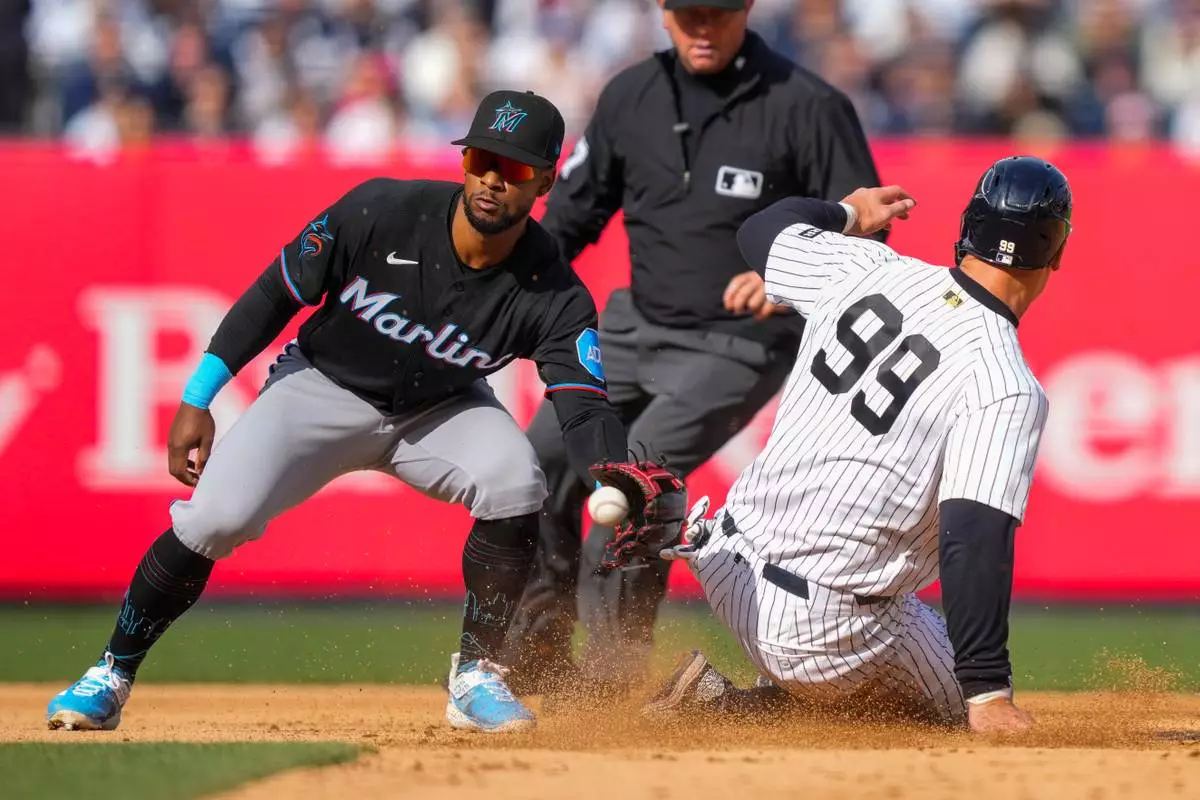
New York Yankees' Aaron Judge (99) successfully steals second base during the eighth inning of a home-opener baseball game against the Miami Marlins, Friday, April 3, 2026, in New York. (AP Photo/Yuki Iwamura)
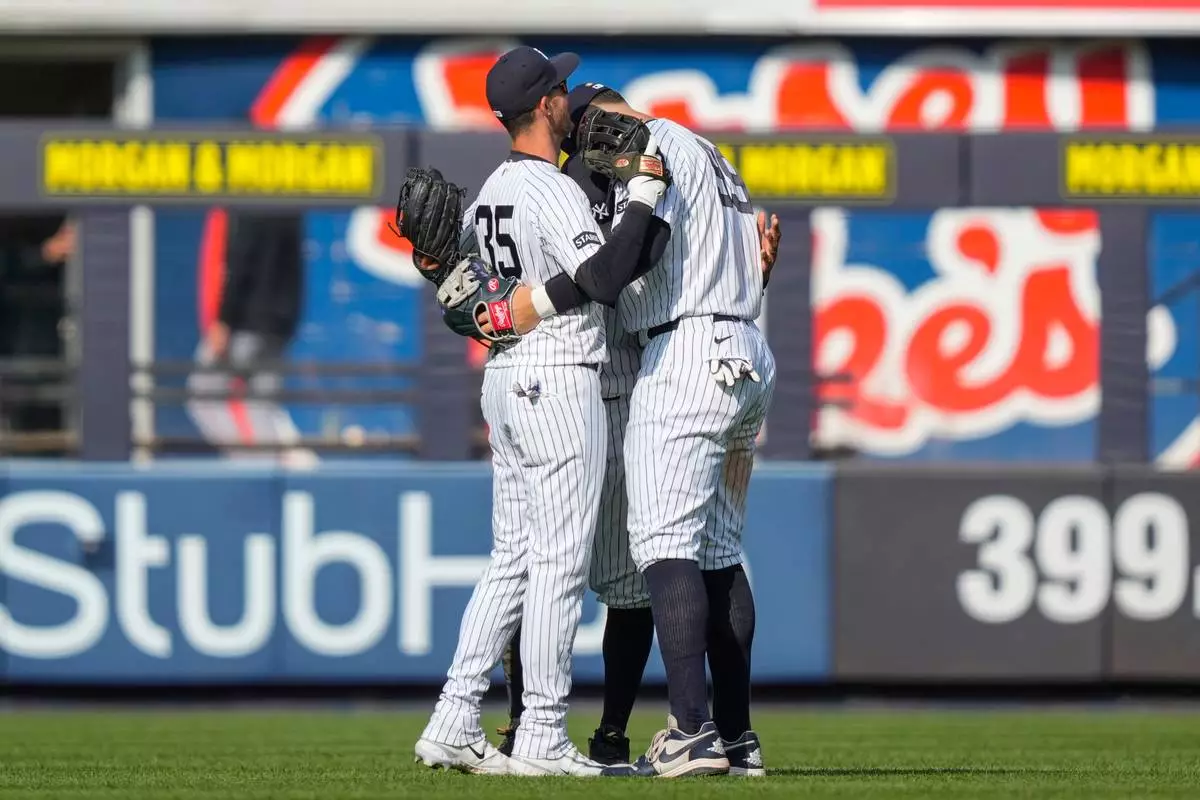
New York Yankees outfielders Cody Bellinger (35), Trent Grisham (12) and Aaron Judge (99) embrace each other after wining a home-opener baseball game against the Miami Marlins, Friday, April 3, 2026, in New York. (AP Photo/Yuki Iwamura)

New York Yankees' Aaron Judge (99) celebrates after hitting a two-run home run during the first inning of the Yankees' home-opener baseball game against the Miami Marlins, Friday, April 3, 2026, in New York. (AP Photo/Yuki Iwamura)