|
PANAMA CITY, Feb. 11, 2026 /PRNewswire/ -- In 2025, amid heightened volatility and widening dispersion across sectors, HTX delivered a strategy that is both measurable and repeatable: smart listings are defined by timing, judgment, and risk discipline working together to create realizable returns for users.
HTX Outperformed on Securable Returns
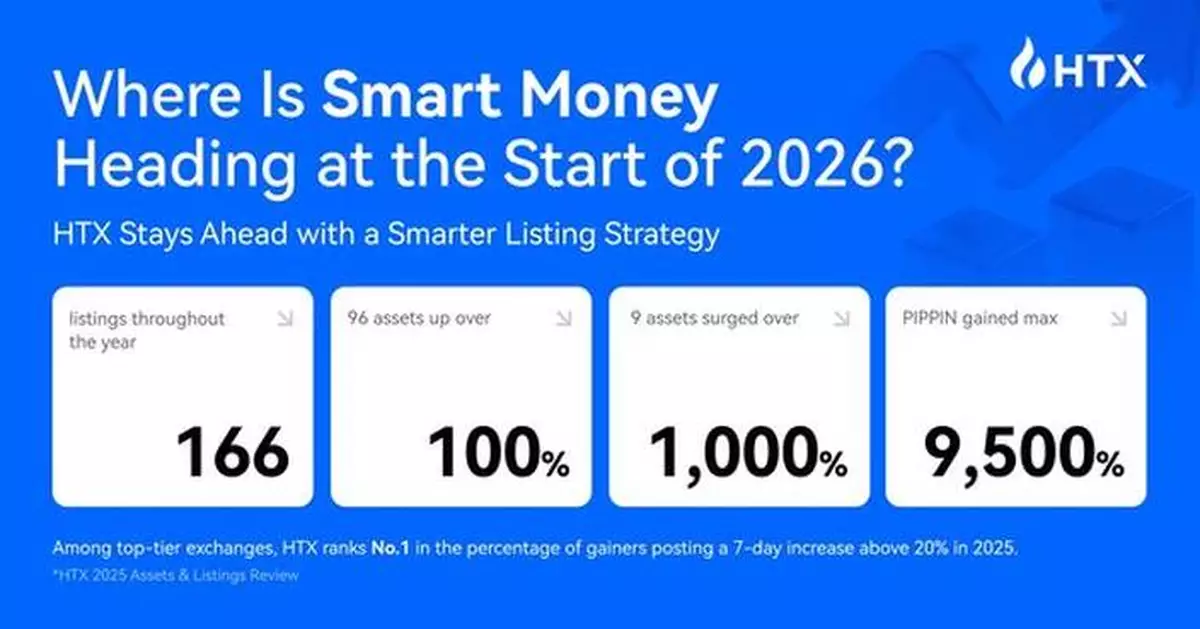
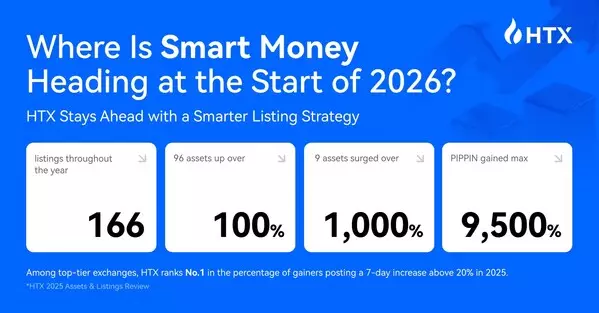
A review of HTX's newly listed assets in 2025 shows the platform listed 166 new assets over the year, spanning AI, memecoin, Layer1/Layer2, RWA, stablecoins, and DeFi. 96 assets recorded post-listing gains exceeding 100%, while 9 surged more than 1,000%. The top performer, PIPPIN, achieved a peak increase of 9,500%.
HTX's competitive edge lies not in headline returns, but in the time window available to ordinary users to access those assets.
In 2025, 17.47% of new listings on HTX achieved gains of more than 20% within seven days of listing, ranking No.1 among peer top-tier exchanges.
Time as Alpha: Why Early Participation Matters
One thing has remained constant at HTX in listing: in the crypto space, time itself is a source of return.
AI: Advancing Timeline by Entire Cycle
In early 2025, AI Agent and DeFAI narratives began to emerge. Between January 18 and January 28, just eleven days, HTX listed 11 AI-related projects, including NEUR, BUZZ, AVAAI, PIPPIN, ARC, GAMEBASE, AI16Z, GRIFFAIN, ELIZAOS, SWARMS, and DEGENAI. Nearly all were initial listings or extremely early-stage listings.
While the broader market was still debating whether AI would become a primary narrative, HTX had already completed a structural deployment. This allowed users to position ahead of consensus formation, rather than chasing momentum at peak sentiment.
Beating Market Is About Positioning, Not Prediction
Throughout the year, 18 assets were listed on HTX ahead of other major exchanges, including PLUME, BANK, BIGTIME, USD1, and TRUMP. When the market consensus was formed, HTX users were already positioned with existing holdings
This advantage was particularly evident in the following BSC ecosystem assets:
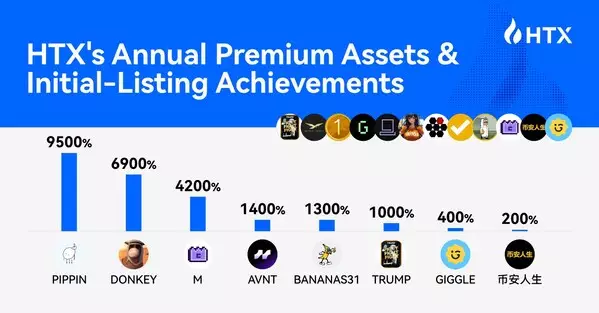
- DONKEY was listed before widespread discussion in the market, later surging 6,811%
- M benefited from early structural positioning and continuous marketing after listing, delivering a maximum increase of 4,186%
- ASTER, first listed on HTX among CEXs, it rose 340% before broader recognition
- Binance Life, marking HTX one of the earliest CEXs to support the Chinese memecoins, it was listed before narrative expansion and achieved a 438% surge
These were not arbitrary listings in their early stages. Each was supported by sustained monitoring of on-chain data, community activity, and capital flows.
Smart Timing Also Means Knowing When Not to List
A disciplined listing strategy does not equate to being first at all costs. Sometimes, waiting or delaying a launch is more responsible for users. Certain projects may not be suitable for participation on their debut day, yet remain valuable once the timing is right.
For instance, many VC-backed tokens face heavy selling pressure during initial unlock periods. By anticipating the convergence of high supply and shorting sentiment, HTX often chooses to list only after the market has completed its hand-over and confirmed the project's resilience. The subsequent price rallies often validate the wisdom of this strategic delay.
Deconstructing HTX Listing Strategy
Looking back at 2025, the principle of "listing whatever is trending," as highlighted by Justin Sun, Advisor to HTX, formed the foundational logic of the platform's asset strategy, which has consistently evolved around three core questions:.
Firstly, is it early enough? True momentum often emerges before consensus. HTX advances the timeline by tracking on-chain data, community engagement, and capital structure ahead of narrative breakouts.
Secondly, is the judgment accurate? Among trending assets, HTX prioritizes sustainability over noise, filtering out structurally imbalanced or purely emotional trades.
Thirdly, is the strategy user-centric? The purpose of listing is not traffic, but realizable participation for users. Through early positioning, staged observation, and risk filtering, hot narratives are converted into actionable opportunities.
HTX's listing strategy speaks for itself. As 2026 unfolds, HTX is partnering with its global users to navigate volatility and capture long-term upside across market cycles.
About HTX
Founded in 2013, HTX (formerly Huobi) has evolved from a virtual asset exchange into a comprehensive ecosystem of blockchain businesses that span digital asset trading, financial derivatives, research, investments, incubation, and other businesses.
As a world-leading gateway to Web3, HTX harbors global capabilities that enable it to provide users with safe and reliable services. Adhering to the growth strategy of "Global Expansion, Thriving Ecosystem, Wealth Effect, Security & Compliance," HTX is dedicated to providing quality services and values to virtual asset enthusiasts worldwide.
To learn more about HTX, please visit https://www.htx.com/ or HTX Square , and follow HTX on X, Telegram, and Discord.
PANAMA CITY, Feb. 11, 2026 /PRNewswire/ -- In 2025, amid heightened volatility and widening dispersion across sectors, HTX delivered a strategy that is both measurable and repeatable: smart listings are defined by timing, judgment, and risk discipline working together to create realizable returns for users.
HTX Outperformed on Securable Returns
A review of HTX's newly listed assets in 2025 shows the platform listed 166 new assets over the year, spanning AI, memecoin, Layer1/Layer2, RWA, stablecoins, and DeFi. 96 assets recorded post-listing gains exceeding 100%, while 9 surged more than 1,000%. The top performer, PIPPIN, achieved a peak increase of 9,500%.
HTX's competitive edge lies not in headline returns, but in the time window available to ordinary users to access those assets.
In 2025, 17.47% of new listings on HTX achieved gains of more than 20% within seven days of listing, ranking No.1 among peer top-tier exchanges.
Time as Alpha: Why Early Participation Matters
One thing has remained constant at HTX in listing: in the crypto space, time itself is a source of return.
AI: Advancing Timeline by Entire Cycle
In early 2025, AI Agent and DeFAI narratives began to emerge. Between January 18 and January 28, just eleven days, HTX listed 11 AI-related projects, including NEUR, BUZZ, AVAAI, PIPPIN, ARC, GAMEBASE, AI16Z, GRIFFAIN, ELIZAOS, SWARMS, and DEGENAI. Nearly all were initial listings or extremely early-stage listings.
While the broader market was still debating whether AI would become a primary narrative, HTX had already completed a structural deployment. This allowed users to position ahead of consensus formation, rather than chasing momentum at peak sentiment.
Beating Market Is About Positioning, Not Prediction
Throughout the year, 18 assets were listed on HTX ahead of other major exchanges, including PLUME, BANK, BIGTIME, USD1, and TRUMP. When the market consensus was formed, HTX users were already positioned with existing holdings
This advantage was particularly evident in the following BSC ecosystem assets:
- DONKEY was listed before widespread discussion in the market, later surging 6,811%
- M benefited from early structural positioning and continuous marketing after listing, delivering a maximum increase of 4,186%
- ASTER, first listed on HTX among CEXs, it rose 340% before broader recognition
- Binance Life, marking HTX one of the earliest CEXs to support the Chinese memecoins, it was listed before narrative expansion and achieved a 438% surge
These were not arbitrary listings in their early stages. Each was supported by sustained monitoring of on-chain data, community activity, and capital flows.
Smart Timing Also Means Knowing When Not to List
A disciplined listing strategy does not equate to being first at all costs. Sometimes, waiting or delaying a launch is more responsible for users. Certain projects may not be suitable for participation on their debut day, yet remain valuable once the timing is right.
For instance, many VC-backed tokens face heavy selling pressure during initial unlock periods. By anticipating the convergence of high supply and shorting sentiment, HTX often chooses to list only after the market has completed its hand-over and confirmed the project's resilience. The subsequent price rallies often validate the wisdom of this strategic delay.
Deconstructing HTX Listing Strategy
Looking back at 2025, the principle of "listing whatever is trending," as highlighted by Justin Sun, Advisor to HTX, formed the foundational logic of the platform's asset strategy, which has consistently evolved around three core questions:.
Firstly, is it early enough? True momentum often emerges before consensus. HTX advances the timeline by tracking on-chain data, community engagement, and capital structure ahead of narrative breakouts.
Secondly, is the judgment accurate? Among trending assets, HTX prioritizes sustainability over noise, filtering out structurally imbalanced or purely emotional trades.
Thirdly, is the strategy user-centric? The purpose of listing is not traffic, but realizable participation for users. Through early positioning, staged observation, and risk filtering, hot narratives are converted into actionable opportunities.
HTX's listing strategy speaks for itself. As 2026 unfolds, HTX is partnering with its global users to navigate volatility and capture long-term upside across market cycles.
About HTX
Founded in 2013, HTX (formerly Huobi) has evolved from a virtual asset exchange into a comprehensive ecosystem of blockchain businesses that span digital asset trading, financial derivatives, research, investments, incubation, and other businesses.
As a world-leading gateway to Web3, HTX harbors global capabilities that enable it to provide users with safe and reliable services. Adhering to the growth strategy of "Global Expansion, Thriving Ecosystem, Wealth Effect, Security & Compliance," HTX is dedicated to providing quality services and values to virtual asset enthusiasts worldwide.
To learn more about HTX, please visit https://www.htx.com/ or HTX Square , and follow HTX on X, Telegram, and Discord.
** The press release content is from PR Newswire. Bastille Post is not involved in its creation. **
HTX Outperforms Industry Peers at the Start of 2026, Leveraging Disciplined Listing Strategies to Capture "Smart Money" Inflows
HTX Outperforms Industry Peers at the Start of 2026, Leveraging Disciplined Listing Strategies to Capture "Smart Money" Inflows
SHANGHAI, April 3, 2026 /PRNewswire/ -- As AI becomes essential in K–12 education, many teachers face a practical question: How to teach AI through hands-on, project-based learning without advanced coding skills?
A recent workshop in Kathmandu University offers a clear answer. Conducted by DFRobot, an innovator in STEAM education, the three-hour workshop at the School of Engineering brought together teachers and department heads from across disciplines. Participants completed two hands-on AI projects while exploring how to translate these experiences into their own classroom teaching.
From Awareness to Classroom Practice
According to the Computer Science Teachers Association, while most educators support AI in the curriculum, many lack confidence in teaching it effectively. This workshop directly addressed that gap—moving from awareness to practical implementation.
Learning AI Through Hands-On Building
The training adopted a face-to-face, project-based approach, combining technical learning with pedagogy. It focused on deploying AI capabilities—such as speech and vision—on edge devices, connecting abstract concepts to interactive classroom applications.
Using UNIHIKER K10 hardware and Mind+ graphical programming software, participants completed two progressive projects:
Voice Interaction
Using the UNIHIKER K10 and the Mind+ graphical programming platform software, the workshop introduced voice-based human–machine interaction as an accessible entry point into AI learning. Teachers began by creating a simple voice-controlled system with commands such as "turn on the light," experiencing a fundamental AI interaction loop: wake → recognize → execute.
Building on this foundation, they extended the system to control on-screen movement through voice directions, transforming a basic function into a more engaging and interactive experience. Rather than focusing on complex programming, the training emphasized how simple voice commands can be translated into practical classroom applications.
Through this process, teachers gained a clear understanding of real-time voice interaction and its classroom potential.
Vision Interaction
The workshop introduced the HUSKYLENS AI vision sensor and its face recognition capabilities, helping teachers understand how machines perceive the world through visual data. Trainers explained the core workflow of face recognition—including detection, alignment, encoding, and matching—providing a clear technical framework for classroom application. Building on this foundation, teachers connected HUSKYLENS with the Mind+ programming environment and implemented real-time recognition tasks. Extending this approach, they developed a "Smart Pet" system by integrating HUSKYLENS with the UNIHIKER K10. The system could recognize different types of cats—such as Orange Tabby, Striped Tabby, and Siamese—and respond with corresponding interactive states.
Through this hands-on process, teachers gained a clear understanding of computer vision concepts and how visual input can drive interactive systems, enabling more engaging and project-based learning in the classroom.
A Model That Can Be Applied in AI Classrooms
The workshop highlights a practical approach to AI education that can be replicated across schools:
Accessible: Entry-level coding is all that's needed — suitable for K–12 learners.
Adaptable: Projects can be transformed into games, smart systems, or classroom tools
Structured: Aligned with project-based learning and real-world problem-solving
As part of the assessment, each teacher was asked to outline how the projects could be adapted for their own classrooms—highlighting a core objective of the training: not just using tools, but enabling curriculum design and effective knowledge transfer.
More importantly, it emphasized a critical shift—from understanding AI to applying it. By experiencing the full creation process, teachers gained the confidence to bring AI into their own classrooms.
** This press release is distributed by PR Newswire through automated distribution system, for which the client assumes full responsibility. **
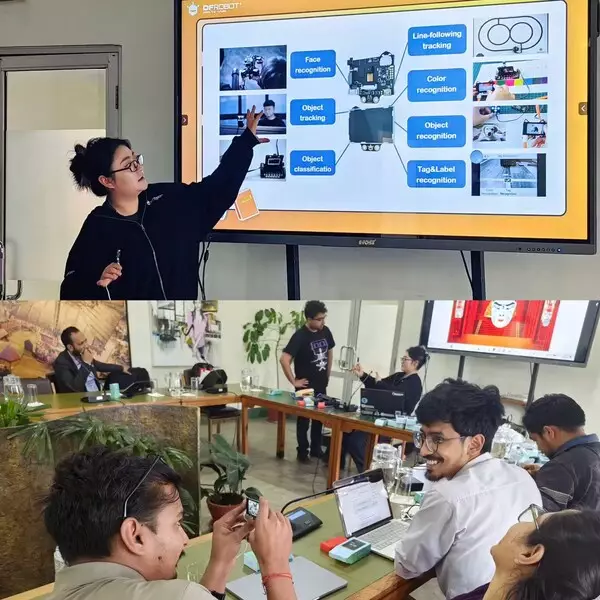
How to Teach AI in the Classroom: A Hands-On Teacher Training Workshop at Kathmandu University