Skip to Content Facebook Feature Image

Member of Trump's Religious Liberty Commission ousted in dispute over antisemitism

News

Member of Trump's Religious Liberty Commission ousted in dispute over antisemitism
News

News

Member of Trump's Religious Liberty Commission ousted in dispute over antisemitism

2026-02-12 09:26 Last Updated At:09:30

A member of the federal Religious Liberty Commission has been ousted after a hearing this week that featured tense exchanges on the definition of antisemitism. The ousted member, Carrie Prejean Boller, had defended prominent commentator Candace Owens, who routinely shares antisemitic conspiracy theories.

Prejean Boller, a model turned conservative activist, denied that Owens had ever said anything antisemitic, quoted a Bible verse that attributed the death of Jesus to Jews and pushed back on the idea that some people mask antisemitism in their criticism of Israel.

“No member of the commission has the right to hijack a hearing for their own personal and political agenda on any issue,” said Texas Lt. Gov. Dan Patrick, chair of the commission, in a statement Wednesday. “This is clearly, without question, what happened Monday in our hearing on antisemitism in America. This was my decision.”

Prejean Boller challenged Patrick’s authority to remove her, saying only President Donald Trump has that power. In a post on the social media site X, she said Patrick's actions “reflect a Zionist political agenda.”

The hearing took place as the commission, created by Trump last year, is the subject of a new federal lawsuit this week from progressive religious groups. The suit says the panel fails to represent diverse views and religions and consists almost entirely of conservative Christian members.

Prejean Boller's removal came amid a wider, increasingly contentious debate over whether the right should give a platform to commentators espousing antisemitic views.

It followed a hearing Monday in Washington that was focused on antisemitism. It featured multiple witnesses, including first-hand accounts of students and others who said universities failed to protect Jewish students amid pro-Palestinian protests during the Israel-Hamas war in Gaza.

Prejean Boller had sharp exchanges with witnesses during the hearing. Seth Dillon, CEO of the conservative satirical site The Babylon Bee, which routinely lampoons progressives, was there to testify that conservatives need to push back against a growing antisemitic movement on the right.

Prejean Boller challenged him, questioning whether critics of Israel should be considered antisemitic. Dillon said no, but that context matters. There are “people who try to conceal their antisemitism under the guise of merely criticizing Israel," he said.

Prejean Boller also questioned whether social media sites should be pressured to ban quotations of a Bible verse that attributes the death of Jesus to Jews. And she disputed Dillon's criticisms of Owens, saying she had never heard her say anything antisemitic.

“You should look up more of her statements,” Dillon said, citing such things as Owens saying her critics were “of the synagogue of Satan.”

Prejean Boller, the 2009 Miss California, drew criticism during the Miss USA contest that same year when she said she believed marriage should only be between a man and a woman. She became politically active in subsequent years, supporting Trump's presidential runs and criticizing such things as COVID-19 restrictions.

The hearing was the latest of several by the commission, which has featured testimony accusing the administration of former President Joe Biden of allegedly repressing religious freedom in different ways. The commission is preparing to deliver a report to Trump this spring.

Also this week, various faith groups filed a lawsuit in U.S. District Court in New York, challenging the makeup of the commission.

The lawsuit was filed by the progressive Interfaith Alliance as well as Muslim, Hindu and Sikh organizations.

It argued that the 1972 Federal Advisory Committee Act requires that any advisory committees be fairly balanced among competing viewpoints.

The lawsuit says the commissioners, “consisting of almost exclusively Christians with one Orthodox Jewish Rabbi, represent the narrow perspective that America was founded as a 'Judeo-Christian' nation and must be guided by Biblical principles.”

It said this excludes people of other faiths and no religions, as well as those in the Judeo-Christian tradition who "are committed to religious freedom and pluralism, and reject Christian nationalism."

Associated Press religion coverage receives support through the AP’s collaboration with The Conversation US, with funding from Lilly Endowment Inc. The AP is solely responsible for this content.
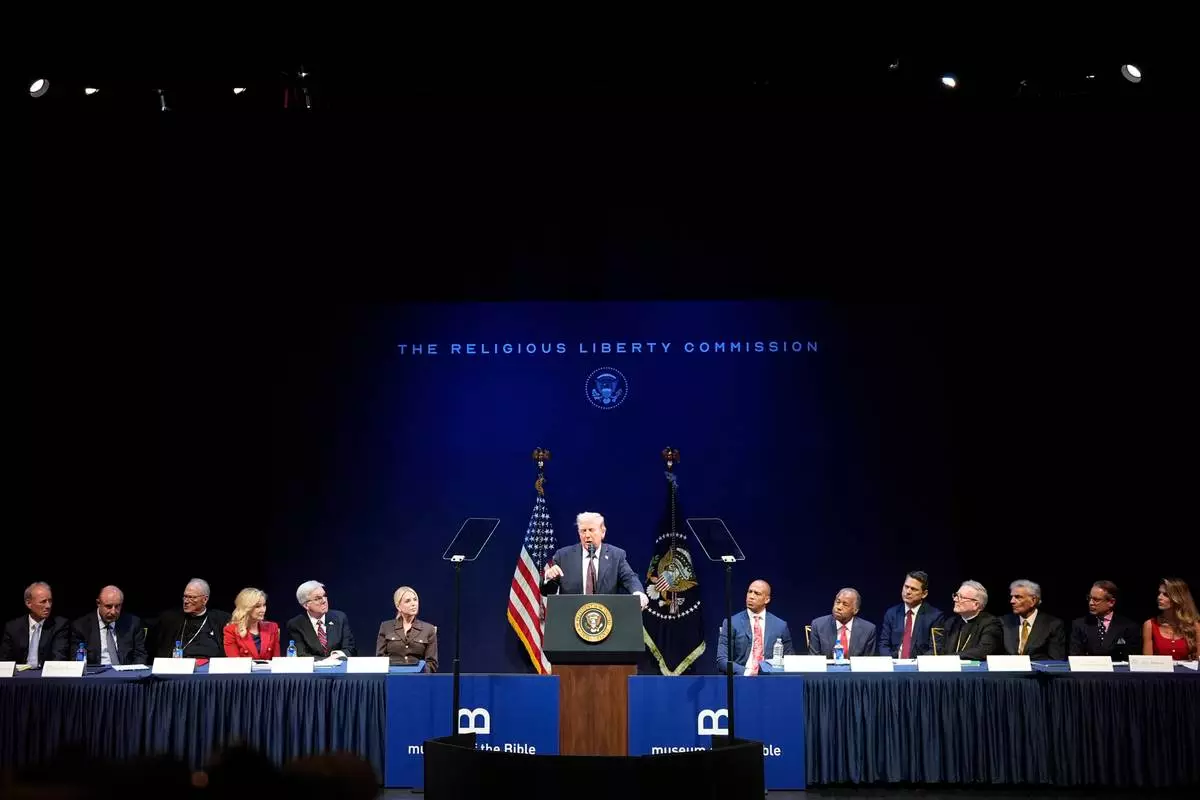
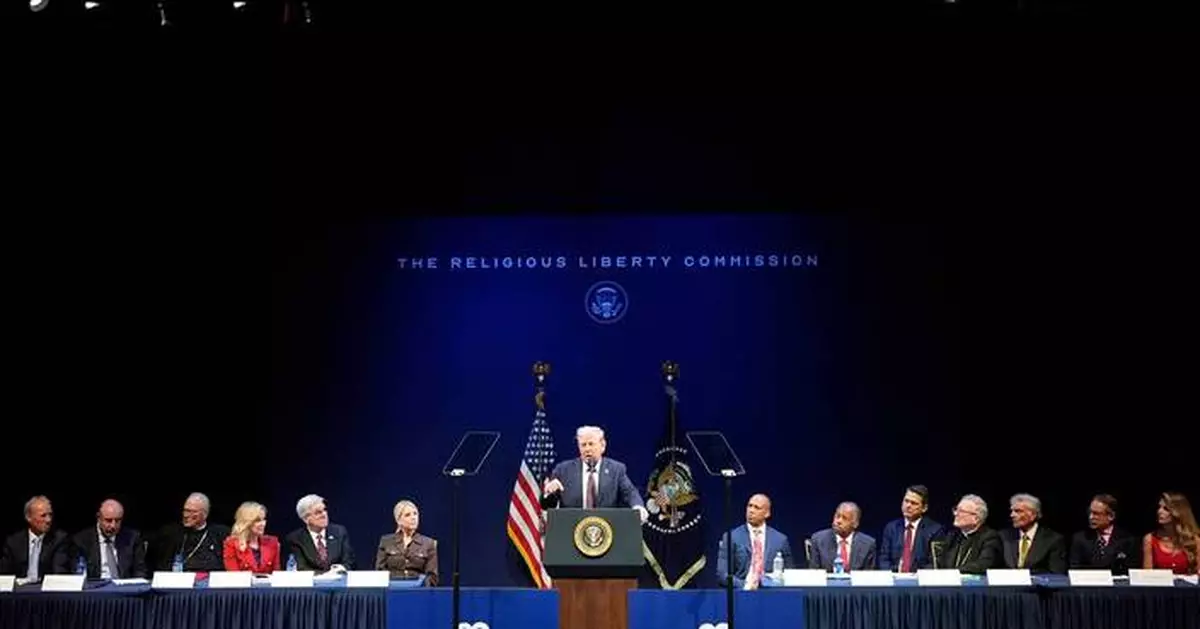
FILE - President Donald Trump speaks at a hearing of the Religious Liberty Commission at the Museum of the Bible, Sept. 8, 2025, in Washington. (AP Photo/Alex Brandon, File)
FILE - President Donald Trump speaks at a hearing of the Religious Liberty Commission at the Museum of the Bible, Sept. 8, 2025, in Washington. (AP Photo/Alex Brandon, File)
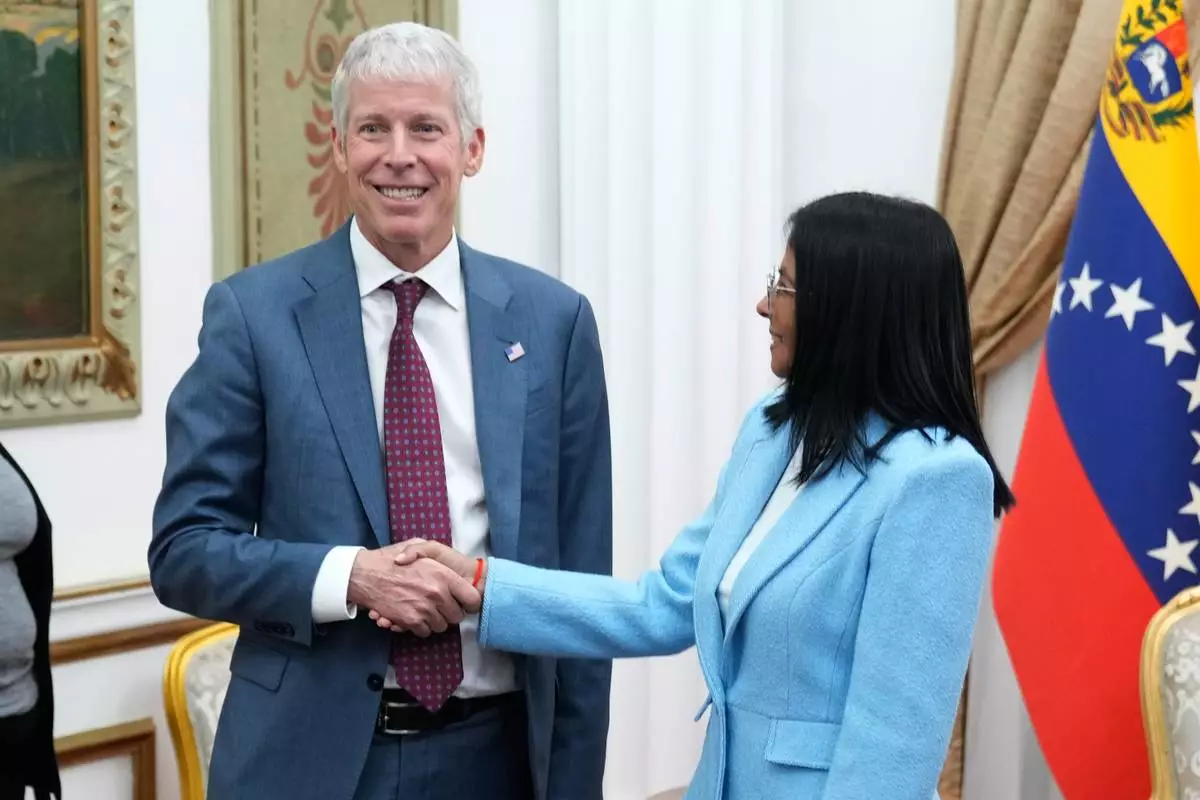
CARACAS, Venezuela (AP) — United States Energy Secretary Chris Wright arrived Wednesday in Venezuela for a firsthand assessment of the country's oil industry, a visit that further asserts the U.S. government's self-appointed role in turning around Venezuela’s dilapidated energy sector.

Wright met Venezuela's acting President Delcy Rodríguez at the Miraflores presidential palace in the capital, Caracas. He is expected to meet with government officials, oil executives and others during a three-day visit to the South American country.

Wright’s visit comes as the administration of U.S. President Donald Trump continues to lift sanctions to allow foreign companies to operate in Venezuela and help rebuild the nation’s most important industry. It follows last month’s enactment of a Venezuelan law that opened the nation’s oil sector to private investment, reversing a tenet of the self-proclaimed socialist movement that has ruled the country for more than two decades.

“I bring today a message from President Trump,” Wright told reporters as he stood next to Rodríguez with flags from both countries behind them. “He is passionately committed to absolutely transforming the relationship between the United States and Venezuela, part of a broader agenda to make the Americas great again, to bring our countries closer together, to bring commerce, peace, prosperity, jobs, opportunity to the people of Venezuela.”

Rodríguez was sworn into her new role after the brazen Jan. 3 seizure of then-President Nicolás Maduro in a U.S. military attack in Caracas. She proposed the overhaul of the country’s energy law after Trump said his administration would take control of Venezuela’s oil exports and revitalize the ailing industry by luring foreign investment.

Rodríguez on Wednesday acknowledged that Venezuela’s relationship with the U.S. has had “highs and lows” but said both countries are now working on a mutually benefiting “energy agenda.”

“Let diplomatic dialogue ... and energy dialogue be the appropriate and suitable channels for the U.S. and Venezuela to maturely determine how to move forward,” she said.

Rodríguez’s government expects the changes to the country's oil law to serve as assurances for major U.S. oil companies that have so far hesitated about returning to the volatile country. Some of those companies lost investments when the ruling party enacted the existing law two decades ago to favor Venezuela’s state-run oil company, PDVSA.

The new law now grants private companies control over oil production and sales, ending PDVSA's monopoly over those activities as well as pricing. It also allows for independent arbitration of disputes, removing a mandate for disagreements to be settled only in Venezuelan courts, which are controlled by the ruling party.

Foreign investors view the involvement of independent arbitrators as crucial to guard against future expropriation.

Wright told reporters the reform “is a meaningful step in the right direction” but “probably not far and clear enough to encourage the kind of large capital flows" the U.S. would like to see in Venezuela.

Wright planned to visit oil fields Thursday.

Follow AP’s coverage of Latin America and the Caribbean at https://apnews.com/hub/latin-america

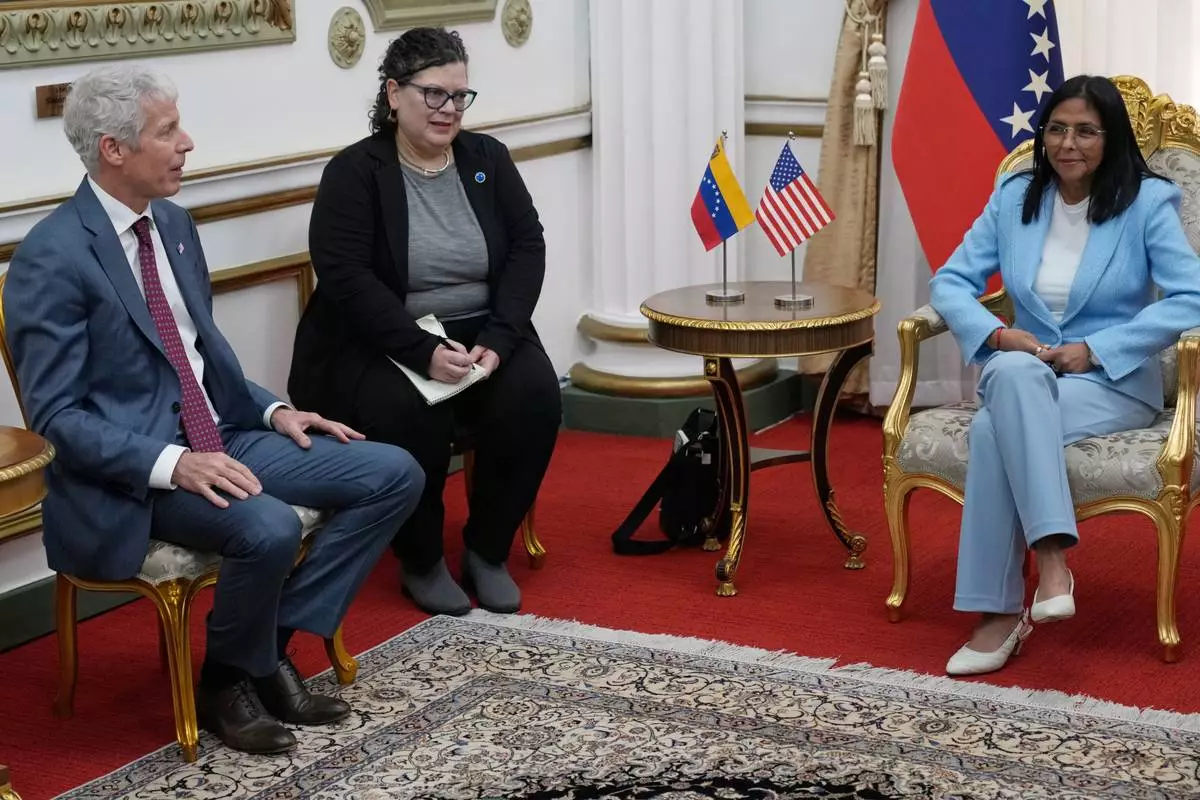
Venezuelan acting President Delcy Rodriguez, right, meets with U.S. Energy Secretary Chris Wright, left, at Miraflores presidential palace in Caracas, Venezuela, Wednesday, Feb. 11, 2026. (AP Photo/Ariana Cubillos)

Venezuelan acting President Delcy Rodriguez, right, meets with U.S. Energy Secretary Chris Wright, left, at Miraflores presidential palace in Caracas, Venezuela, Wednesday, Feb. 11, 2026. (AP Photo/Ariana Cubillos)

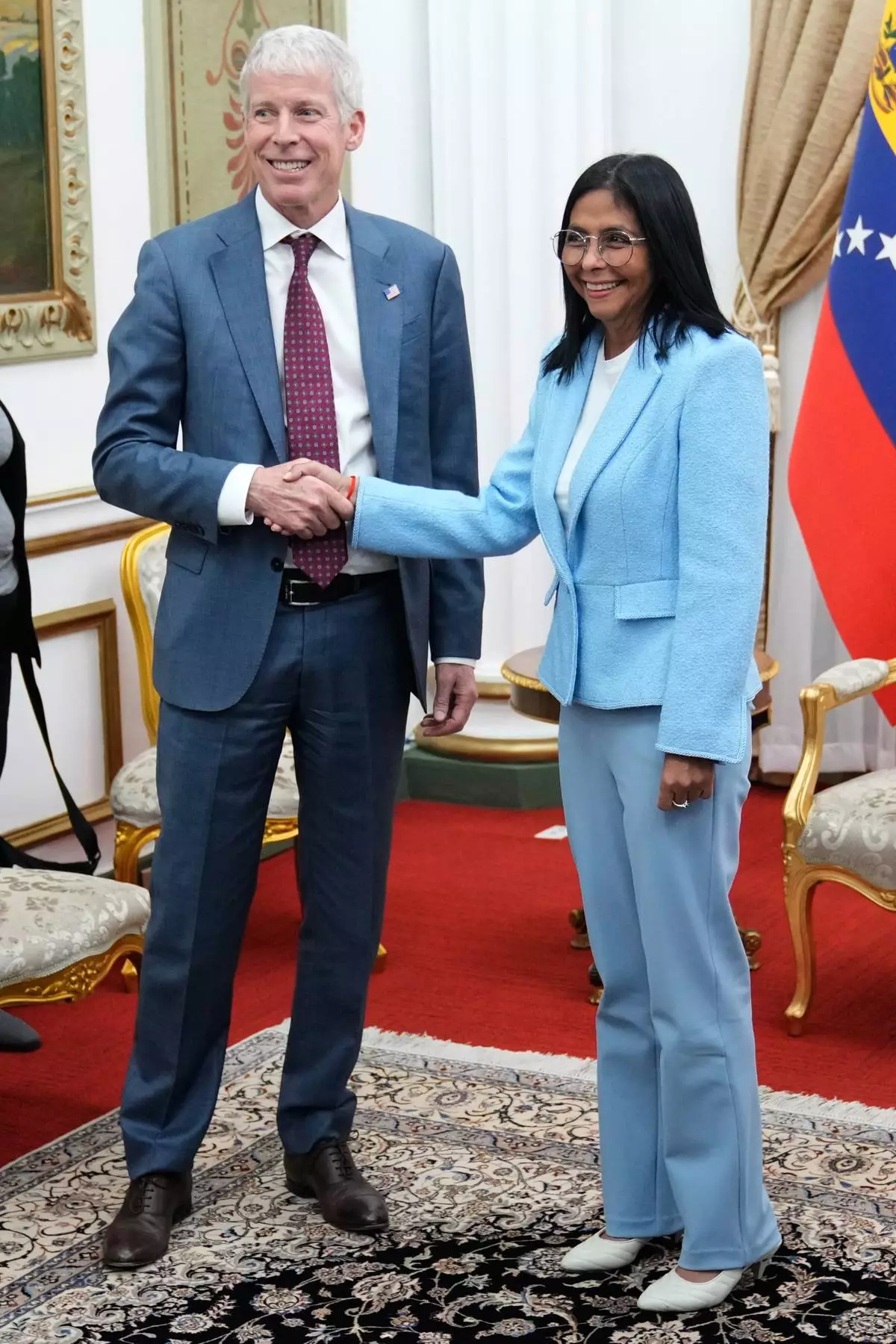
Venezuelan acting President Delcy Rodriguez greets U.S. Energy Secretary Chris Wright at Miraflores presidential palace in Caracas, Venezuela, Wednesday, Feb. 11, 2026. (AP Photo/Ariana Cubillos)

Venezuelan acting President Delcy Rodriguez greets U.S. Energy Secretary Chris Wright at Miraflores presidential palace in Caracas, Venezuela, Wednesday, Feb. 11, 2026. (AP Photo/Ariana Cubillos)

Venezuelan acting President Delcy Rodriguez greets U.S. Energy Secretary Chris Wright at Miraflores presidential palace in Caracas, Venezuela, Wednesday, Feb. 11, 2026. (AP Photo/Ariana Cubillos)

Venezuelan acting President Delcy Rodriguez greets U.S. Energy Secretary Chris Wright at Miraflores presidential palace in Caracas, Venezuela, Wednesday, Feb. 11, 2026. (AP Photo/Ariana Cubillos)

FILE - Energy Secretary Chris Wright speaks as White House chief of staff Susie Wiles listens during a meeting with President Donald Trump and oil executives in the East Room of the White House, Friday, Jan. 9, 2026, in Washington. (AP Photo/Evan Vucci, File)

FILE - Energy Secretary Chris Wright speaks as White House chief of staff Susie Wiles listens during a meeting with President Donald Trump and oil executives in the East Room of the White House, Friday, Jan. 9, 2026, in Washington. (AP Photo/Evan Vucci, File)

Recommended Articles