Chinese scientists have been using artificial intelligence in rice seed breeding to accelerate the pace at which research results are applied in agriculture.
In China's southern island province of Hainan, rice-breeding experts and artificial intelligence engineers have been working side by side to tackle one of the most intractable problems in agriculture: enabling successful hybridization by overcoming the timing difference of flowering between two types of rice.
Zhang Guangheng, a researcher at the China National Rice Research Institute of the Chinese Academy of Agricultural Sciences who has spent nearly 30 years working on rice seed breeding, has run into such pollination obstacle recently. His goal is to cross indica and japonica rice to produce a higher-quality variety. However, the two strains flower at different times, which makes pollination difficult.
Zhang Guangheng's team used to rely on manpower to calculate the flowering timing of two different rice varieties, but he found it difficult to calculate them accurately, often missing the critical window for successful cross-breeding.
"We have about 40 to 50 graduate students and doctoral students. They monitored the rice plant from 8:00 until 14:00 every day. It's very tiring, but the data we get was basically not good enough," said Zhang Guangheng.
To overcome the challenge, he turned to Zhang Jianhua, head of the Nanfan technology team of the Chinese Academy of Agricultural Sciences who leads an AI team that is conducting smart agriculture research at the Nanfan seed breading base in Sanya, Hainan.
The AI team has been stationed at the base since 2021. They provide customized AI solutions for seed breeders -- from remote IoT monitoring to AR glasses for pest and disease identification -- accumulating rich practical experience.
To help with seed breeding, Zhang Jianhua's team repeatedly photographed rice during its flowering stage, and trained large language models to tell the difference between flowers that are open -- ready for pollination -- and those that are not. Once the algorithms matured, they deployed drones for the first round of field testing.
However, the results were disappointing -- flying too high reduced clarity, while flying too low caused wind disturbance to the rice leaves.
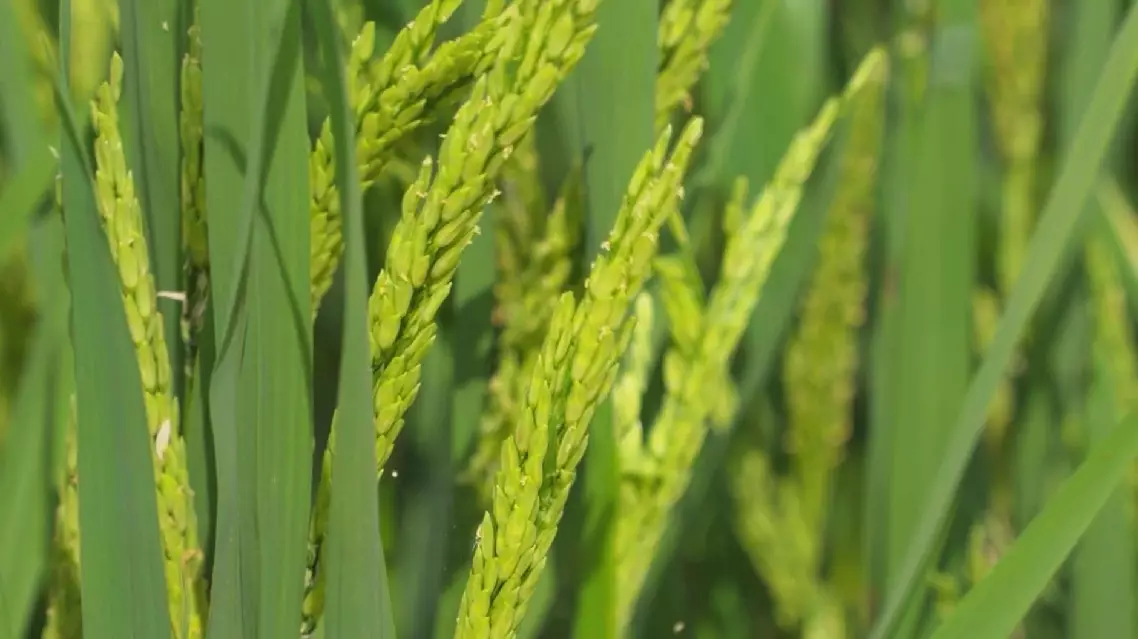
"Rice flowers are tiny, only a little thicker than a strand of hair, so detecting whether they are open for pollination requires extremely high precision," said Zhang Jianhua.
After the failure of the first round of drone trials, the team turned to robots. They modified robots and increased their power, but once deployed in the paddy fields, the robots quickly became stuck in the mud.
To address the problem, Zhang Jianhua assembled a cross-disciplinary team of mechanical engineers, mechanics specialists, and algorithm experts to troubleshoot and find solutions.
Currently, the team is working with manufacturers to design special wheels suited for muddy paddy fields and to refine walking control algorithms, aiming to have robots operating smoothly before the rice flowering season in March.
"With artificial intelligence, I'm certain we can identify the genes that control flowering time. We are fully confident," said Zhang Guangheng.
The integration of modern technology with traditional agriculture is a microcosm of the development in the Nanfan seed breeding base, where every new variety and every technological breakthrough are born from relentless exploration and perseverance.
The base is now accelerating the research-industry collaboration, aiming to move laboratory breakthroughs more quickly into the fields.
"We want to use these facilities and our research base to attract more scientific researchers from both China and abroad. Particularly, we must strengthen in-depth innovation in seed industry research institutions and enterprises. While producing more and better seeds, we want these seeds to go out of the laboratory and serve the whole country. We are not only breeding seeds -- we are breeding the future," said Chen Weiwei, deputy director of the Yazhou Bay Science and Technology City administration.
Chinese scientists use AI in rice seed breeding