Skip to Content Facebook Feature Image

MLB Commissioner Rob Manfred optimistic major leaguers will play in 2028 Los Angeles Olympics

Sport

MLB Commissioner Rob Manfred optimistic major leaguers will play in 2028 Los Angeles Olympics
Sport

Sport

MLB Commissioner Rob Manfred optimistic major leaguers will play in 2028 Los Angeles Olympics

2026-02-13 05:25 Last Updated At:05:40

PALM BEACH, Fla. (AP) — Baseball Commissioner Rob Manfred is optimistic that major leaguers will play in the 2028 Los Angeles Olympics.

Manfred, speaking following an owners meeting Thursday, said there are still issues to resolve with the Major League Baseball Players Association before those Olympic aspirations are a reality, but “I think we’re a lot closer to there than we were the last time we talked about it,” he said.

The six-nation baseball tournament will be played from July 13-19 at Dodger Stadium. MLB is planning for an extended All-Star break between July 9 and July 21, with the All-Star Game likely at San Francisco on July 11.

An agreement with the union is needed.

“I sense a lot of momentum towards playing in LA in 2028,” Manfred said. “I think we are going to get over those issues. I think people have come to appreciate that the Olympics on U.S. soil is a unique marketing opportunity for the game. I think we had a lot of players interested in doing it and, you know, I feel pretty good about the idea (that) we’ll get there.”

In addition, an agreement is needed on insurance to cover player contracts for time with Olympic teams.

The United States will have an automatic berth in the both the baseball and softball tournaments and the top two other nations from the Americas in next month’s World Baseball Classic will earn berths.

MLB did not allow players on 40-man rosters to participate in the 2021 Tokyo Olympics, when Nippon Professional Baseball interrupted its season and Japan beat the U.S. 2-0 in the gold medal game.

Manfred was also asked if the involvement of Casey Wasserman, the prominent businessman and talent agent who has recently lost clients because of his appearance in recently released government files on Jeffrey Epstein, would deter the league from participating in the Olympics. He declined to comment on Wasserman, who is the chairman of the Los Angeles games, saying, “Look, our dealings are not with Casey. Our dealings are with the institution of the Olympics.”

The addition of star outfielder Kyle Tucker by the Los Angeles Dodgers to what already was among the highest payrolls again sparked debate over whether management will propose a salary cap in collective bargaining this year.

Manfred said there hasn't been much movement in salary cap talks.

Tucker, the right fielder who is considered one of the best players in baseball, is the latest accomplished veteran brought in by the Dodgers, who have three of the top eight current contracts by average annual value. Los Angeles also signed top closer Edwin Díaz to bolster its bullpen.

“Look, I think great teams are always good for baseball,” he said. “I think with respect to this particular great team, it added to what we have been hearing from fans in a lot of markets for a long time about the competitiveness of the game. But great teams are always good baseball.”

Bargaining is likely to start this spring on a labor contract to succeed the deal that expires Dec. 1.

“We’re in the preparation process,” Manfred said. “We haven’t agreed on a calendar with the MLBPA and it does take two to tango, as they say, but historically after opening day we kind of get started.”

Manfred said there likely isn't a way around insurance issues that have come up for MLB-contracted players planning to play in next month's World Baseball Classic. Several stars, including Puerto Rico's Francisco Lindor and Carlos Correa, were left off their countries' rosters because the WBC insurer wouldn't cover them.

“We like that, when they say they want to play, obviously,” Manfred said. “But then to have a problem with the insurance and the guy being unable to play, we recognize that. I’m just not sure that there is a way around it.”

The tournament is co-owned by Major League Baseball and the Major League Baseball Players Association. Insurance is provided by National Financial Partners.

“In order to get clubs comfortable with the idea that guys should play earlier in games they otherwise would not play, we had to protect them financially,” Manfred said.

Owners approved a rules change requiring first- and third-base coaches to remain in the marked coaching boxes. Coaches have frequently moved toward home plate, in a better position to better relay signs from the defensive team that may pick up.

MLB will produce and distribute local television broadcasts of at least 14 teams this season following financial problems of Main Street Sports Group's FanDuel Sports Network.

“The RSN situation has an impact on our revenue growth because the decline there is a drag on what is otherwise a growing industry,” Manfred said. “It is true that the smaller markets have been hit harder than the larger markets, which impacts revenue sharing. Having said both of those, I think longer term, our content is inherently valuable. We deliver tons of eyeballs, and I think when we have an opportunity to get to market in 2028, we’re going to be just fine.”

Manfred said the 14 teams are “probably making a little less than they made under their old contracts.”

“The key word there is old,” he added. “The reason those contracts aren’t there anymore was they were not economic given the cord-cutting that’s going on.”

Teams approved two changes in controlling owners: Cincinnati Reds CEO Phil Castellini succeeds his father Minnesota Twins board member Tom Pohlad takes over from takes over from his younger brother Bob.

Manfred said of the San Diego Padres' sale process: “There is robust interest in what is viewed as a really appealing asset.”

Milwaukee chairman Mark Attanasio and Baltimore control owner David Rubenstein were voted to the eight-man executive council, replacing Arizona managing general partner Ken Kendrick and Seattle chairman John Stanton. The council also includes San Francisco chairman Greg Johnson and Cleveland chairman Paul Dolan (whose terms expire in 2027) and Miami chairman Bruce Sherman and Los Angeles Angels owner Arte Moreno (2028) and New York Mets chairman Steve Cohen and Athletics managing partner John Fisher (2029).

MLB approved extensions of its contract with Anheuser-Busch Cos. Inc. and of the deals for Comcast Corp. and Cox Communications Inc. to carry the Extra Innings package of out-of-market TV broadcasts.

AP MLB: https://apnews.com/hub/mlb
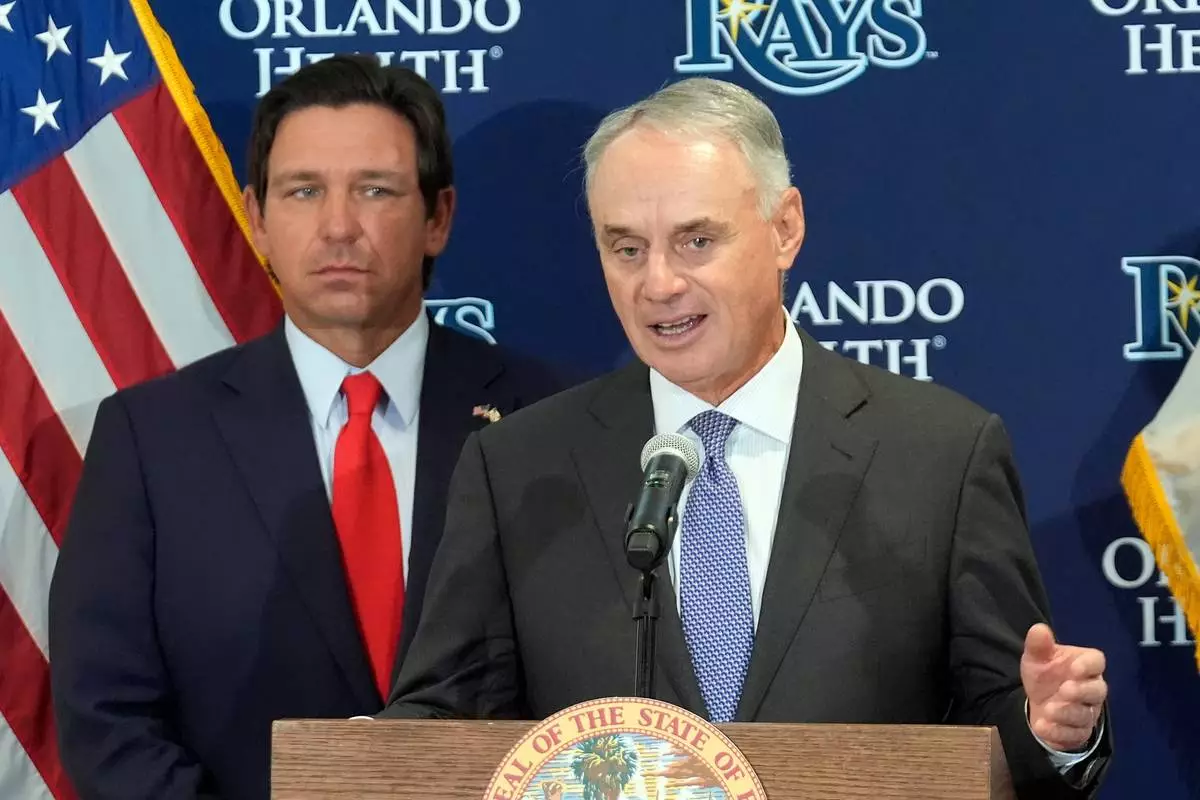
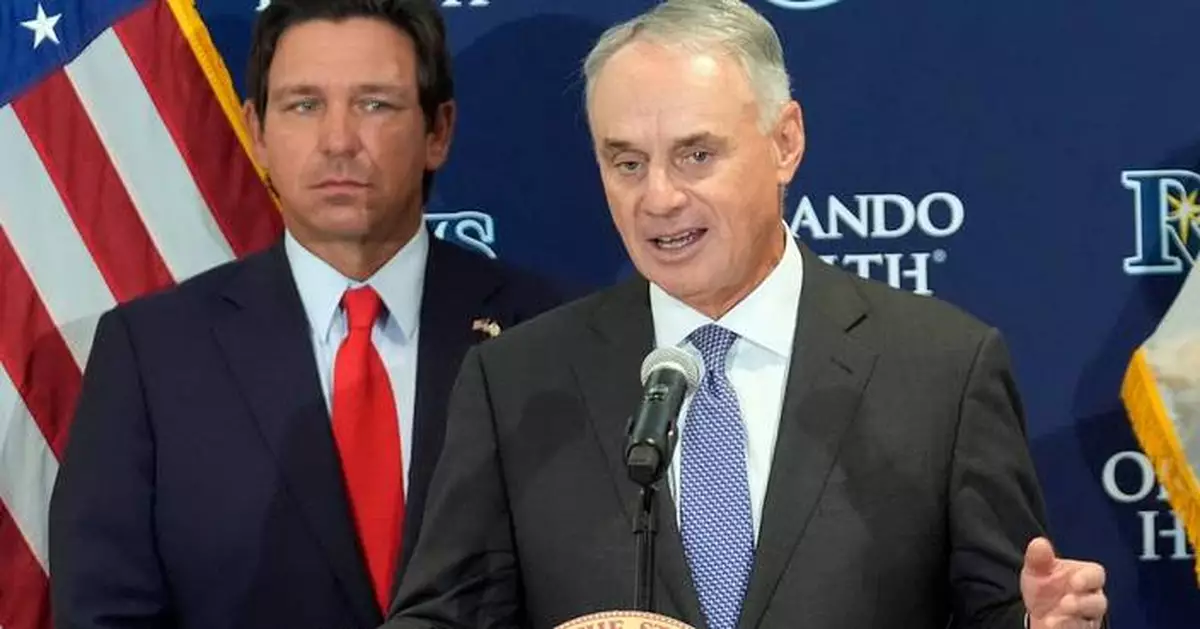
Major League Baseball commissioner Rob Manfred, right, speaks during a new baseball stadium news conference as Florida Gov. Ron DeSantis looks, Tuesday, Feb. 3, 2026, at Hillsborough College in Tampa, Fla. (AP Photo/Chris O'Meara)
Major League Baseball commissioner Rob Manfred, right, speaks during a new baseball stadium news conference as Florida Gov. Ron DeSantis looks, Tuesday, Feb. 3, 2026, at Hillsborough College in Tampa, Fla. (AP Photo/Chris O'Meara)

The Virginia Supreme Court ruled Thursday that a U.S. Marine and his wife will keep an Afghan orphan they brought home in defiance of a U.S. government decision to reunite her with her Afghan family. The decision likely ends a bitter, yearslong legal battle over the girl's fate.

In 2020, a judge in Fluvanna County, Virginia, granted Joshua and Stephanie Mast an adoption of the child, who was then 7,000 miles away in Afghanistan living with a family the Afghan government decided were her relatives.

Four justices on the Virginia Supreme Court on Thursday signed onto an opinion reversing two lower courts’ rulings that found the adoption was so flawed it was void from the moment it was issued.

The justices wrote that a Virginia law that cements adoption orders after six months bars the child’s Afghan relatives from challenging the court, no matter how flawed its orders and even if the adoption was obtained by fraud.

Three justices issued a scathing dissent, calling what happened in this court “wrong,” “cancerous” and “like a house built on a rotten foundation.”

An attorney for the Masts declined to comment, citing an order from the circuit court not to discuss the details of the case publicly. Lawyers representing the Afghan family said they were not yet prepared to comment.

The child was injured on the battlefield in Afghanistan in September 2019 when U.S. soldiers raided a rural compound. The child’s parents and siblings were killed. Soldiers brought her to a hospital at an American military base.

The raid was targeting terrorists who had come into Afghanistan from a neighboring country; some believed she was not Afghan and tried to make a case for bringing her to the U.S. But the State Department, under President Donald Trump’s first administration, insisted the U.S. was obligated under international law to work with the Afghan government and the International Committee of the Red Cross to unite the child with her closest surviving relatives.

The Afghan government determined she was Afghan and vetted a man who claimed to be her uncle. The U.S. government agreed and brought her to the family. The uncle chose to give her to his son and his new wife, who raised her for 18 months in Afghanistan.

Meanwhile, Mast and his wife convinced courts in rural Fluvanna County, Virginia, to grant them custody and then a series of adoption orders, continuing to claim she was the “stateless” daughter of foreign fighters.

Judge Richard Moore granted them a final adoption in December 2020. When the six-month statute of limitations ran out, the child was still in Afghanistan living with her relatives, who testified they had no idea a judge was giving the girl to another family. Mast contacted them through intermediaries and tried to get them to send the girl to the U.S. for medical treatment but they refused to let her go alone.

When the U.S. military withdrew from Afghanistan and the Taliban took over, the family agreed to leave and Mast worked his military contacts to get them on an evacuation flight. Mast then took the baby from them at a refugee resettlement center in Virginia, and they haven’t seen her since.

The AP agreed not to name the Afghan couple because they fear their families in Afghanistan might face retaliation from the Taliban. The circuit court issued a protective order shielding their identities.

The Afghans challenged the adoption, claiming the court had no authority over a foreign child and the adoption orders were based on Mast repeatedly misleading the judge.

The Virginia Supreme Court on Thursday wrote that the law prohibiting challenges to an adoption after six months is designed to create permanency, so a child is not bounced from one home to another. The only way to undercut it is to argue that a parent’s constitutional rights were violated.

The lower courts had found that the Afghan couple had a right to challenge the adoption because they were the girl’s “de facto” parents when they came to the United States.

Four of the Supreme Court judges — D. Arthur Kelsey, Stephen R. McCullough, Teresa M. Chafin, Wesley G. Russell Jr. — disagreed.

“We find no legal merit” in the argument that “that they were ‘de facto’ parents of the child and that no American court could constitutionally sever that relationship,” they wrote. They pointed to Fluvanna County Circuit Court Judge Richard Moore’s findings that the Afghan couple “are not and never were parents” of the child, because they had no order from an Afghan court and had not proven any biological relationship to her.

The Afghans had refused DNA testing, saying it could not reliably prove a familial connection between opposite-gender half-cousins. They insisted that it didn't matter, because Afghanistan claimed the girl as its citizen and got to determine her next-of-kin.

The Supreme Court leaned heavily on a 38-page document written by Judge Moore, who granted the adoption, then presided over a dozen hearings after the Afghans challenged it. He wrote that he trusted the Masts more than the Afghans, and believed that the Masts’ motivations were noble while the Afghans were misrepresenting their relationship to the child.

The Supreme Court also dismissed the federal government’s long insistence that Trump’s first administration had made a foreign policy decision to unite her with her Afghan relatives, and a court in Virginia has no authority to undo it. The government submitted filings in court predicting dire outcomes if the baby was allowed to remain with the Marine: it could be viewed as “endorsing an act of international child abduction,” threaten international security pacts and be used as propaganda by Islamic extremists — potentially endangering U.S soldiers overseas.

But the Justice Department in Trump’s second administration abruptly changed course.

The Supreme Court noted in its opinion that the Justice Department had been granted permission to make arguments in the case, but withdrew its request to do so on the morning of oral arguments last year, saying it “has now had an opportunity to reevaluate its position in this case.”

The Supreme Court returned repeatedly to Moore’s finding that giving the girl to the family “was not a decision the United States initiated, but rather consented to or acquiesced in.”

The three judges who dissented were unsparing in their criticism of both the Masts and the circuit court that granted him the adoption.

“A dispassionate review of this case reveals a scenario suffused with arrogance and privilege. Worse, it appears to have worked,” begins the dissent, written by Justice Thomas P. Mann, and signed by Chief Justice Cleo E. Powell and LeRoy F. Millette, Jr.

A Virginia court never had the right to give the child to the Masts, the dissent said.

They castigated the Masts for “brazenly” misleading the courts during their quest to adopt the girl.

“We must recognize what an adoption really is: the severance and termination of the rights naturally flowing to an otherwise legitimate claimant to parental authority. Of course, the process must be impeccable. An evolved society could not sanction anything less than that. And here, it was less,” Mann wrote. “If this process was represented by a straight line, (the Masts) went above it, under it, around it, and then blasted right through it until there was no line at all — just fragments collapsing into a cavity.”

FILE - Marine Maj. Joshua Mast and his wife, Stephanie, arrive at Circuit Court, Thursday, March 30, 2023, in Charlottesville, Va. (AP Photo/Cliff Owen, File)

FILE - Marine Maj. Joshua Mast and his wife, Stephanie, arrive at Circuit Court, Thursday, March 30, 2023, in Charlottesville, Va. (AP Photo/Cliff Owen, File)

FILE - U.S. Marine Corp Major Joshua Mast, center, talks with his attorneys during a break in the hearing of an ongoing custody battle over an Afghan orphan, March 30, 2023, at the Circuit Courthouse in Charlottesville, Va. (AP Photo/Cliff Owen, File)

FILE - U.S. Marine Corp Major Joshua Mast, center, talks with his attorneys during a break in the hearing of an ongoing custody battle over an Afghan orphan, March 30, 2023, at the Circuit Courthouse in Charlottesville, Va. (AP Photo/Cliff Owen, File)

FILE - Marine Maj. Joshua Mast and his wife, Stephanie, arrive at Circuit Court, Thursday, March 30, 2023 in Charlottesville, Va. (AP Photo/Cliff Owen, File)

FILE - Marine Maj. Joshua Mast and his wife, Stephanie, arrive at Circuit Court, Thursday, March 30, 2023 in Charlottesville, Va. (AP Photo/Cliff Owen, File)

Recommended Articles