Argentina's economic woes have only worsened in the new year as data showed prices rose for the fifth straight month in January, dealing a further blow to President Javier Milei's pledge to tame the country's historic inflation issue.
The increases come even as the government delayed using a new calculation method to determine the official inflation index, which analysts say underestimates the true scale of real price rises.
But whatever the figures say, the impact is undeniably being felt by businesses and consumers across the country.
In the capital Buenos Aires, a fair-trade cooperative has been buying directly from small-scale farmers in an effort to keep quality food at more affordable prices. However, the persistently high inflation is putting a serious strain on such cooperatives as costs begin to spiral out of control.
"To give you an idea, last week we received four lists with prices for products -- all had increases. I'm not talking about small increases. It was 6 percent, 12 percent, even 14 percent. The bottom line is that prices never stop going up, and that's a real struggle for us," said Lorena Gonzalez Lahuerta, a staff member at one cooperative store.
Argentina's annual inflation is down from the alarming triple-digit figures of just a few years ago, but the current increase in prices continues to be a highly sensitive issue for the libertarian President Milei.
Official data showed that monthly inflation rose 2.9 percent in January, meaning annual inflation now sits at 32.4 percent, while residents report mounting food, tax, and service costs.
The government's delay in the adoption of an updated price index to calculate inflation led to the well-regarded statistics institute director stepping down last week, and it has raised questions over just how severe the real inflation rate may be.
"This indicator is used not only to adjust pensions, salaries, and rents, but also for the permanent household survey and calculating poverty. So, for example, if the inflation figure were artificially understated, we would also be underestimating the poverty figure," said Fabio Penalva, Union Secretary of ATE INDEC, which specifically represents workers at the National Institute of Statistics and Censuses (INDEC).
Combating inflation is the backbone of President Milei's economic policy, however, local elections last year added to the uncertainty in the markets and among Argentines.
"Here, when Argentinians get nervous, they start buying dollars. And when you buy dollars, dollars go up, and when the dollar goes up, inflation goes up. That's what explains the inflation from the last months of the previous year, October, November, December," said Ivan Cachanosky, an economist.
Amid these struggles, Milei is pushing forward with his ambitious austerity program. The government's controversial labor reform passed on Wednesday night as protests took place outside Congress, showing how public frustration is mounting over Argentina's perennial problem with inflation.
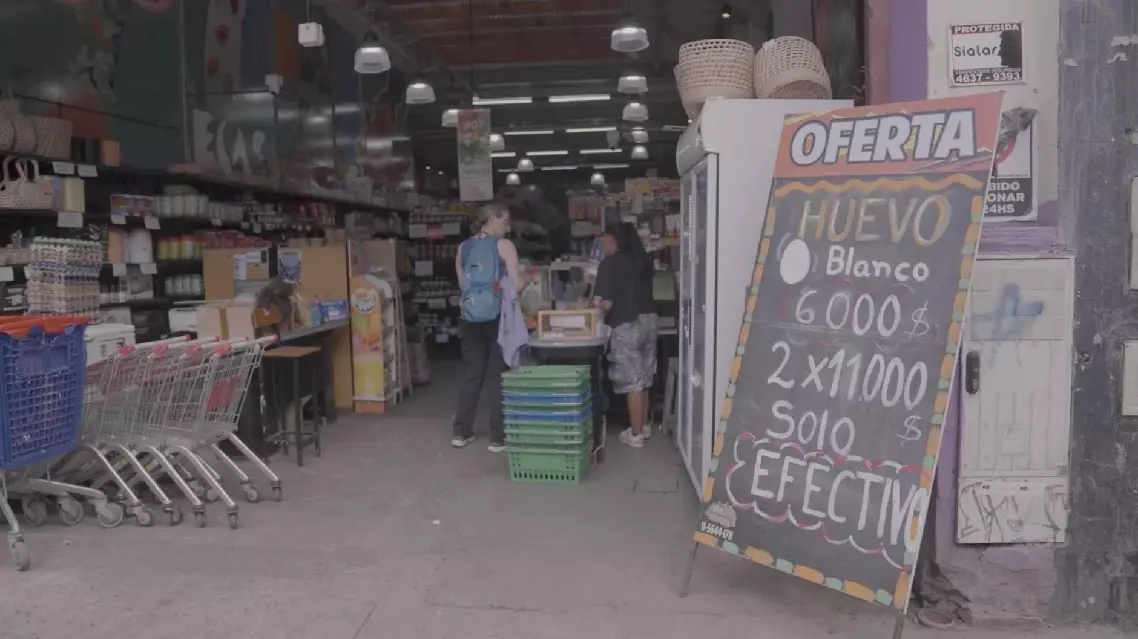
Argentina's economic woes continue as inflation rises for fifth straight month