Skip to Content Facebook Feature Image

Mikaela Shiffrin's giant slalom at Milan Cortina ended without a medal but plenty of optimism

News

Mikaela Shiffrin's giant slalom at Milan Cortina ended without a medal but plenty of optimism
News

News

Mikaela Shiffrin's giant slalom at Milan Cortina ended without a medal but plenty of optimism

2026-02-16 01:32 Last Updated At:01:40

CORTINA D'AMPEZZO, Italy (AP) — Mikaela Shiffrin stood at the start gate atop the giant slalom course at sun-splashed Tofane and made a promise to herself.

“I’m going to do this whole thing here,” she said.

More Images
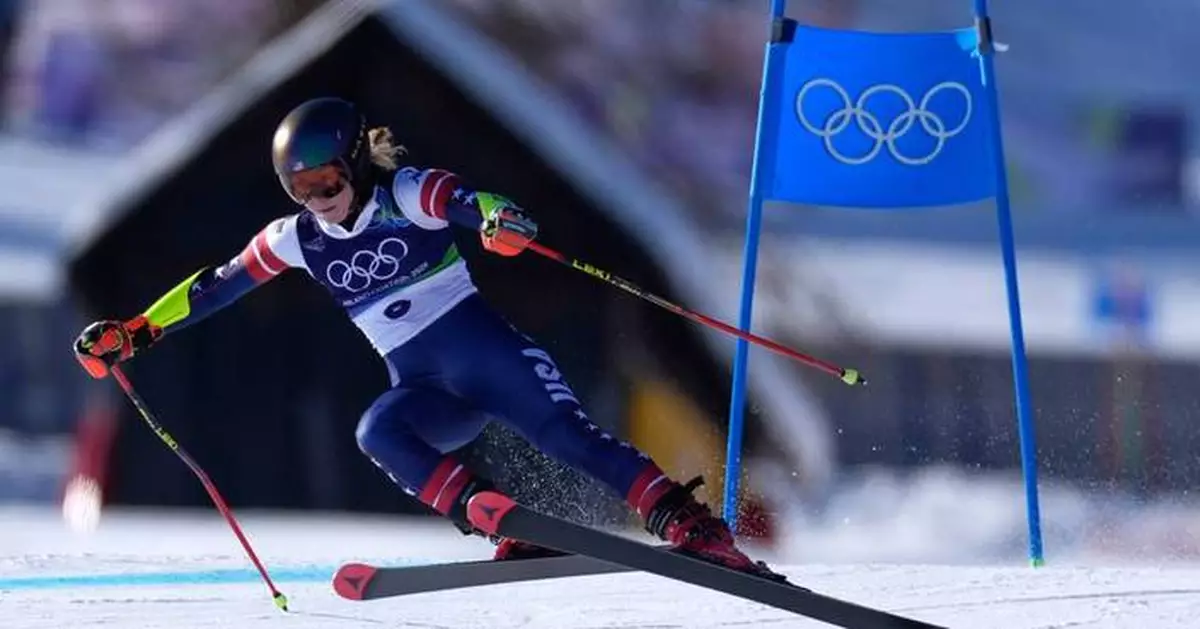
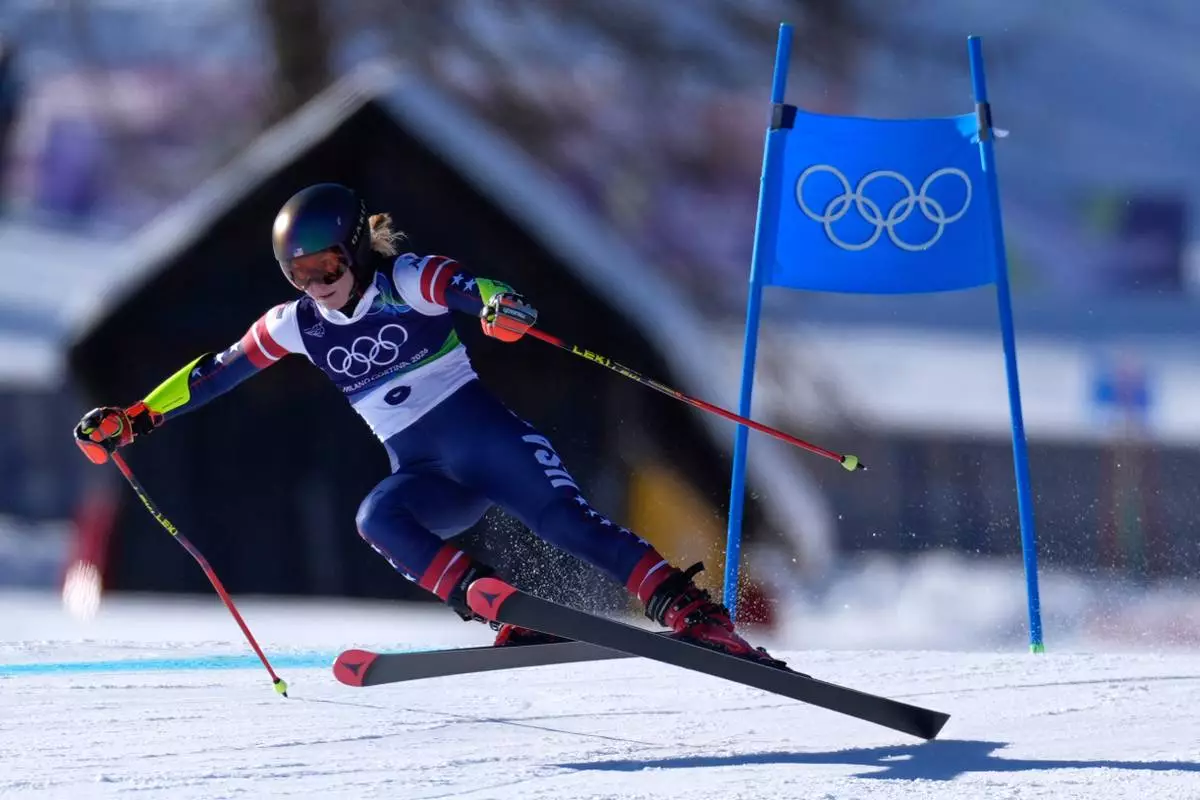
United States' Mikaela Shiffrin speeds down the course, during an alpine ski, women's giant slalom race, at the 2026 Winter Olympics, in Cortina d'Ampezzo, Italy, Sunday, Feb. 15, 2026. (AP Photo/Robert F. Bukaty)
United States' Mikaela Shiffrin speeds down the course, during an alpine ski, women's giant slalom race, at the 2026 Winter Olympics, in Cortina d'Ampezzo, Italy, Sunday, Feb. 15, 2026. (AP Photo/Robert F. Bukaty)

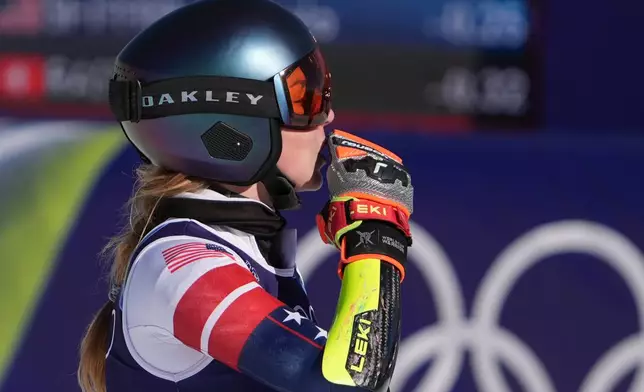
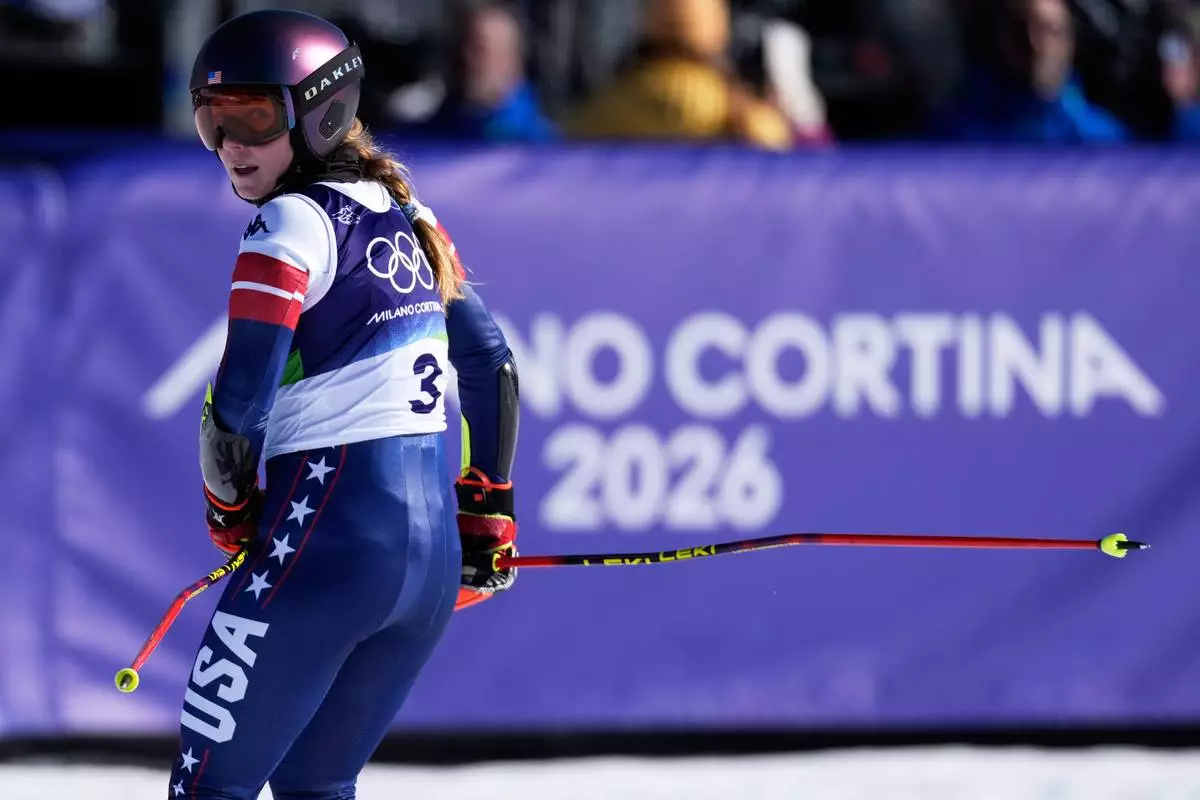
United States' Mikaela Shiffrin at the finish area of an alpine ski, women's giant slalom race, at the 2026 Winter Olympics, in Cortina d'Ampezzo, Italy, Sunday, Feb. 15, 2026. (AP Photo/Jacquelyn Martin)
United States' Mikaela Shiffrin at the finish area of an alpine ski, women's giant slalom race, at the 2026 Winter Olympics, in Cortina d'Ampezzo, Italy, Sunday, Feb. 15, 2026. (AP Photo/Jacquelyn Martin)

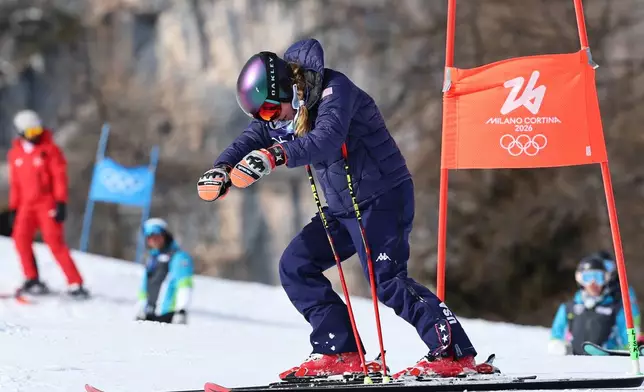
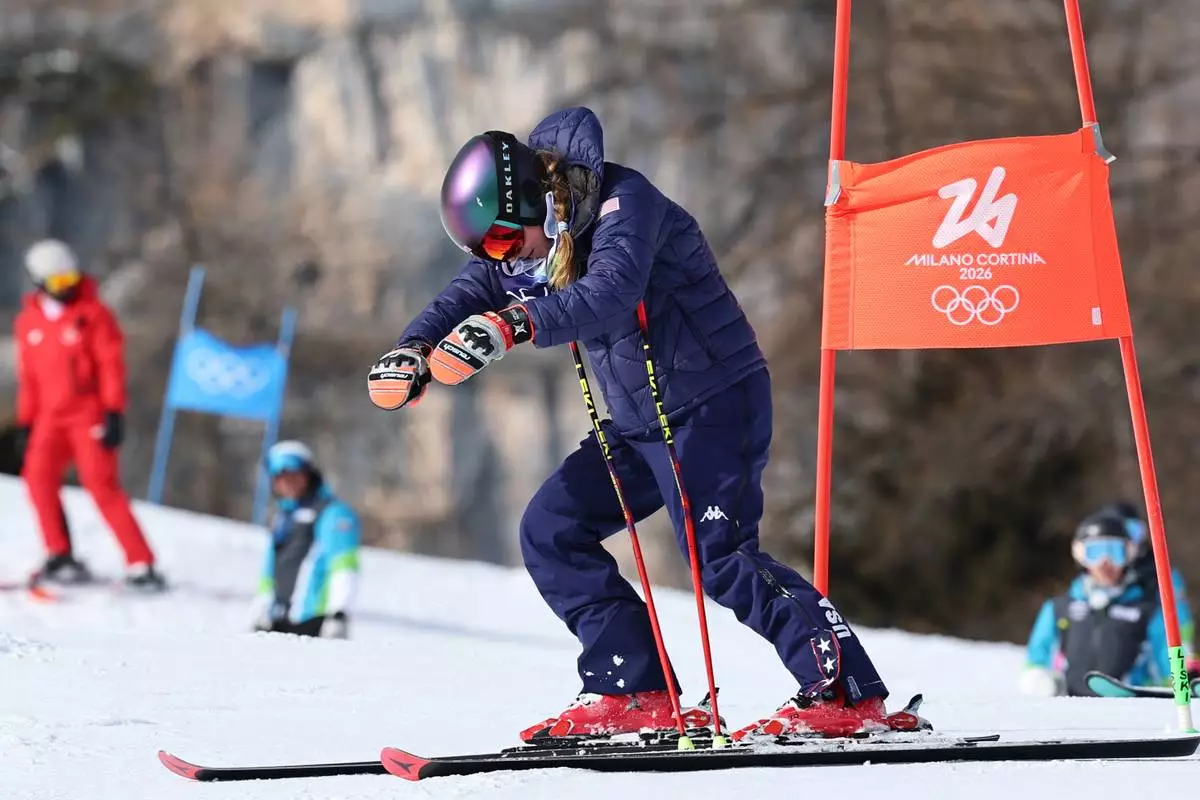
United States' Mikaela Shiffrin visualizes the course ahead of the second run of an alpine ski, women's giant slalom race, at the 2026 Winter Olympics, in Cortina d'Ampezzo, Italy, Sunday, Feb. 15, 2026. (AP Photo/Marco Trovati)
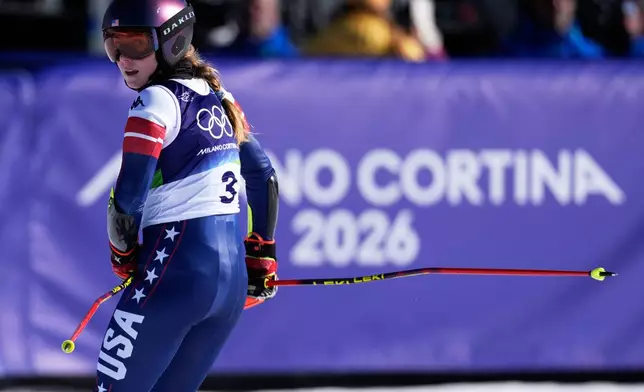
United States' Mikaela Shiffrin visualizes the course ahead of the second run of an alpine ski, women's giant slalom race, at the 2026 Winter Olympics, in Cortina d'Ampezzo, Italy, Sunday, Feb. 15, 2026. (AP Photo/Marco Trovati)

United States' Mikaela Shiffrin at the finish area during an alpine ski, women's giant slalom race, at the 2026 Winter Olympics, in Cortina d'Ampezzo, Italy, Sunday, Feb. 15, 2026. (AP Photo/Robert F. Bukaty)
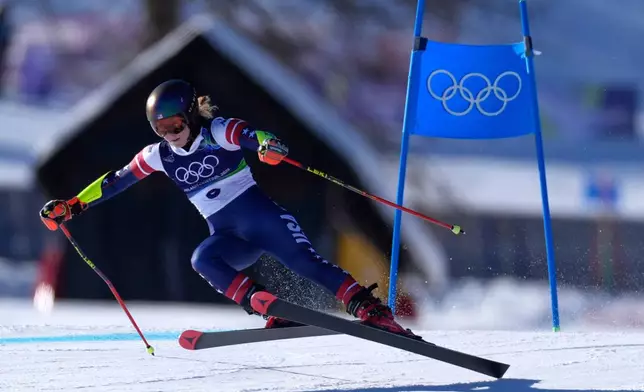
United States' Mikaela Shiffrin at the finish area during an alpine ski, women's giant slalom race, at the 2026 Winter Olympics, in Cortina d'Ampezzo, Italy, Sunday, Feb. 15, 2026. (AP Photo/Robert F. Bukaty)

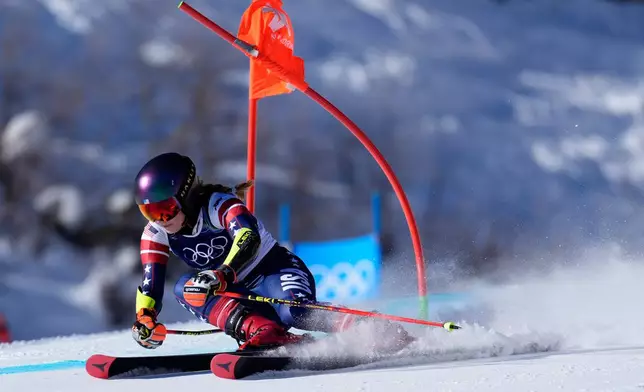
United States' Mikaela Shiffrin speeds down the course, during an alpine ski, women's giant slalom race, at the 2026 Winter Olympics, in Cortina d'Ampezzo, Italy, Sunday, Feb. 15, 2026. (AP Photo/Robert F. Bukaty)

United States' Mikaela Shiffrin speeds down the course, during an alpine ski, women's giant slalom race, at the 2026 Winter Olympics, in Cortina d'Ampezzo, Italy, Sunday, Feb. 15, 2026. (AP Photo/Robert F. Bukaty)

Considering the path the American star has taken to reach the Milan Cortina Olympics, and to this event in particular, that was enough.

So while the leaderboard near the finish line during Sunday's GS needed to flip to the second page before Shiffrin's name appeared in 11th, the most decorated skier in the history of the sport didn't view her finish as a disappointment.

Disappointment is washing out, which she did four years ago in Beijing. Disappointment is wondering if the speed that once came so easily would ever return while recovering from a harrowing crash during a World Cup start in Killington, Vermont, in late 2024 that left her abdomen punctured and her confidence shaken.

What happened during what Shiffrin called “the greatest show of GS skiing we've had in a really long time” was not disappointment. If anything, it was the opposite.

Yes, Shiffrin finished outside the top 10. The way the snow felt underneath her skis and the razor-thin margin that separated the silver medalists from the chasing pack — there was no catching Italy's Federica Brignone on this day — offered evidence she's trending in the right direction heading into slalom, her best event, on Wednesday.

“To be here now like within touch of the fastest women, that’s huge for me,” Shiffrin said. “So I’m proud of that.”

The gap between Shiffrin and co-runners-up Sara Hector of Sweden and Thea Louise Stjernesund was an impossibly tight 0.3 seconds in a discipline that requires skiers to make two runs.

When Shiffrin won gold in the GS in Pyeongchang eight years ago, the gap between silver and 11th was around 1.4 seconds. Four years ago in Beijing, it was nearly 2 seconds. Three weeks ago at a World Cup event in Czechia, where Shiffrin earned her first podium in the GS in two years, it was over 3 1/2 seconds.

On Sunday, Shiffrin was right there. A turn here. A turn there. On a course that was a little flatter and a little less technically demanding than what Shiffrin and the rest of the best skiers in the world usually see — one almost explicitly designed to create a safe and ultracompetitive race — the difference between a medal and the middle was nearly imperceptible.

Shiffrin promised to “learn” after slogging down through the slalom in the women's combined last week, when her skis couldn't seem to “go.” Perhaps too aware of the perception of an Olympic slump — the Games are the only place she hasn't won in the last eight years — she did her best to refocus and block out the noise.

In her mind, she did just that. She could feel herself taking power from the course. As “Killing in the Name” by Rage Against the Machine blasted over the speakers during her second run, Shiffrin felt like she was in the moment and not in her head.

“It felt good to push, which was amazing,” she said, later adding: “It felt really good to ski high intensity.”

Shiffrin's intensity feels as if it is slowly but steadily ramping up. She wore bib No. 3, a nod to the fact she's back in the top 7 in the world in the GS, something she considered a “challenging task” when the season began. It's become doable, but Shiffrin has learned progress isn't linear.

While she continues to dominate slalom — in which she's already clinched her ninth World Cup series title with two races to go — GS is another matter. Sure, Shiffrin's 22 career GS victories are a record. But she hasn't won a GS race since late 2023.

Her climb back up the GS rankings has been fueled by consistency. The “lights-out speed” she knows is required to finish atop the podium doesn't come quite as easily as it did when she was at the peak of her powers. That's fine.

“The task ahead of me for the coming months (and) in the coming years is to try to bring that kind of intensity and fire and to continue to work with the team to find those hundredths (of a second) that it takes to actually win races,” she said.

That didn't happen under the snowcapped peaks of the Dolomites on Sunday. Maybe on another course, one with a more difficult setup that would allow her to lean in to her experience, things may have played out differently.

It's not a conversation Shiffrin seems particularly interested in having. The layout allowed for competitive racing. And she pointed to the medal stand — where the 35-year-old Brignone won her second gold in four days and Hector added silver to go with the gold she captured in Beijing in 2022 — as proof the results were not fluky.

“It wasn’t like somebody won who wasn’t supposed to win,” Shiffrin said.

Brignone emerged as a deserving champion. Behind her, however, was chaos. Shiffrin doesn't think that's a bad thing.

“(We were all) close and that’s how that’s how high the competition level, is I think,” she said. “That’s a beautiful show of our sport on an Olympic stage.”

AP Winter Olympics: https://apnews.com/hub/milan-cortina-2026-winter-olympics
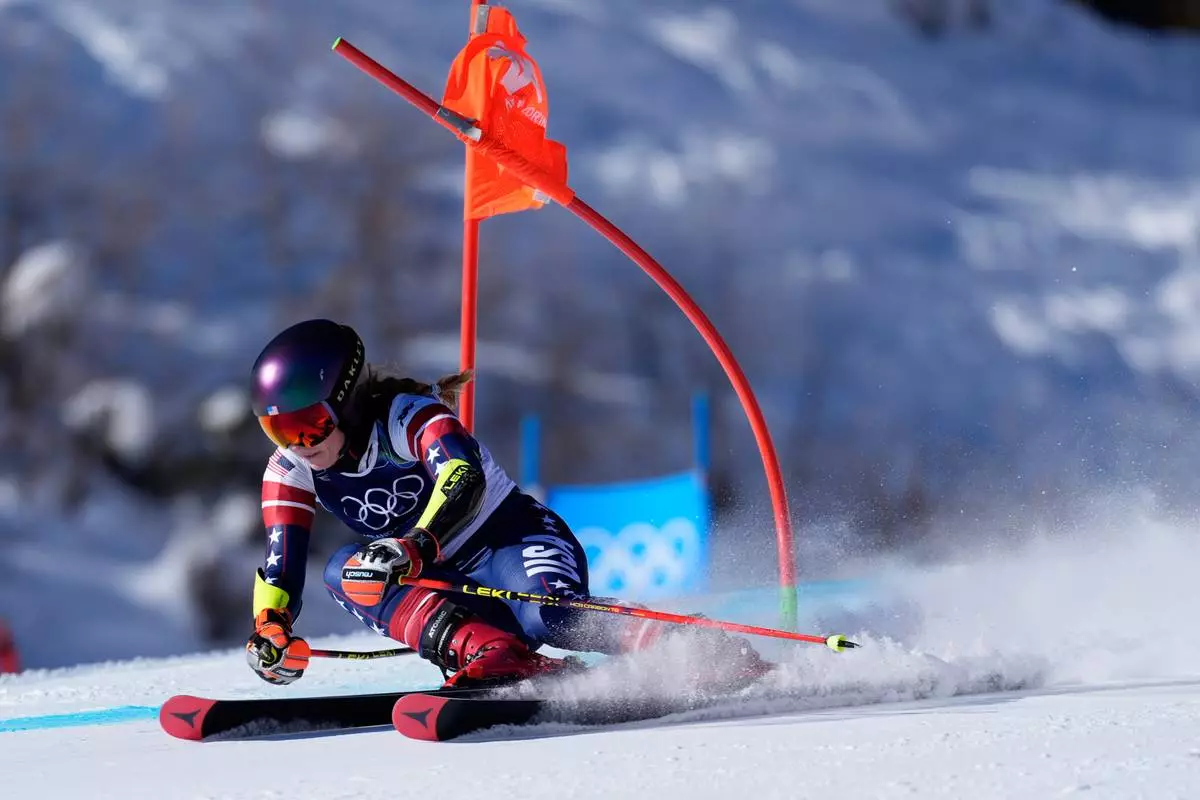
United States' Mikaela Shiffrin speeds down the course, during an alpine ski, women's giant slalom race, at the 2026 Winter Olympics, in Cortina d'Ampezzo, Italy, Sunday, Feb. 15, 2026. (AP Photo/Robert F. Bukaty)
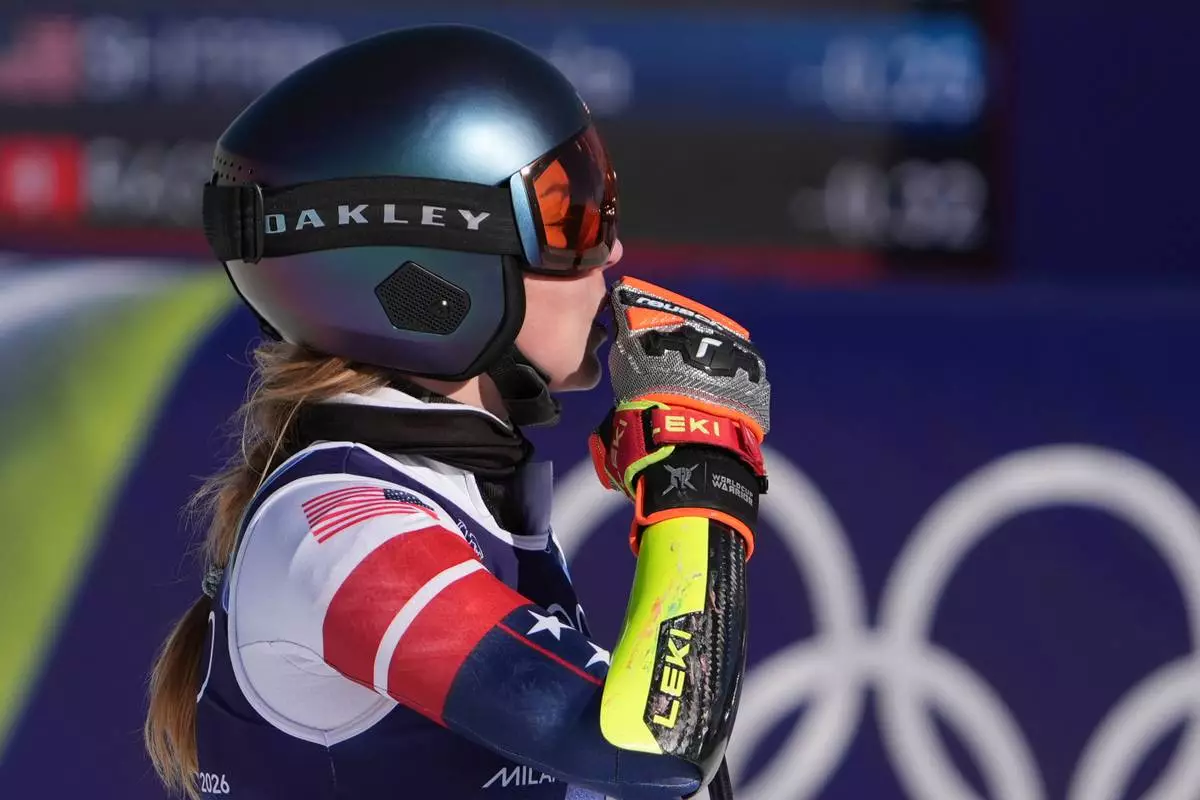
United States' Mikaela Shiffrin speeds down the course, during an alpine ski, women's giant slalom race, at the 2026 Winter Olympics, in Cortina d'Ampezzo, Italy, Sunday, Feb. 15, 2026. (AP Photo/Robert F. Bukaty)

United States' Mikaela Shiffrin at the finish area of an alpine ski, women's giant slalom race, at the 2026 Winter Olympics, in Cortina d'Ampezzo, Italy, Sunday, Feb. 15, 2026. (AP Photo/Jacquelyn Martin)
United States' Mikaela Shiffrin at the finish area of an alpine ski, women's giant slalom race, at the 2026 Winter Olympics, in Cortina d'Ampezzo, Italy, Sunday, Feb. 15, 2026. (AP Photo/Jacquelyn Martin)

United States' Mikaela Shiffrin visualizes the course ahead of the second run of an alpine ski, women's giant slalom race, at the 2026 Winter Olympics, in Cortina d'Ampezzo, Italy, Sunday, Feb. 15, 2026. (AP Photo/Marco Trovati)
United States' Mikaela Shiffrin visualizes the course ahead of the second run of an alpine ski, women's giant slalom race, at the 2026 Winter Olympics, in Cortina d'Ampezzo, Italy, Sunday, Feb. 15, 2026. (AP Photo/Marco Trovati)

United States' Mikaela Shiffrin at the finish area during an alpine ski, women's giant slalom race, at the 2026 Winter Olympics, in Cortina d'Ampezzo, Italy, Sunday, Feb. 15, 2026. (AP Photo/Robert F. Bukaty)
United States' Mikaela Shiffrin at the finish area during an alpine ski, women's giant slalom race, at the 2026 Winter Olympics, in Cortina d'Ampezzo, Italy, Sunday, Feb. 15, 2026. (AP Photo/Robert F. Bukaty)


United States' Mikaela Shiffrin speeds down the course, during an alpine ski, women's giant slalom race, at the 2026 Winter Olympics, in Cortina d'Ampezzo, Italy, Sunday, Feb. 15, 2026. (AP Photo/Robert F. Bukaty)

United States' Mikaela Shiffrin speeds down the course, during an alpine ski, women's giant slalom race, at the 2026 Winter Olympics, in Cortina d'Ampezzo, Italy, Sunday, Feb. 15, 2026. (AP Photo/Robert F. Bukaty)

CORTINA D’AMPEZZO, Italy (AP) — Controversy is swirling in curling at the Winter Olympics.

The Canadian men's and women's teams, as well as the British men's team, have been accused of the same infraction: double-touching the curling stone after it is released.

It comes as Canada, a historic curling powerhouse, finds its ego bruised. Its mixed doubles team didn't even play for a medal, and its women's team cannot afford to lose more matches if it hopes to advance.

Here's a look at the whole controversy and why it matters:

On Friday, Oskar Eriksson of Sweden accused Canada's Marc Kennedy of breaking the rules by touching the rock again after initially releasing it down the sheet of ice. Kennedy responded with an expletive-laden outburst.

That was before video appearing to show a clear double-touch by Kennedy circulated on social media, taken by Swedish public broadcaster SVT. Still, he maintained his innocence. The Canadians won the match, 8-6.

Late Saturday, an umpire accused acclaimed Canadian skip Rachel Homan of the same infraction in a game against Switzerland. The umpire stopped play and the stone was removed from play. Homan looked shocked and denied the allegation.

Again, video spread on social media appearing to show her double-touch. The Canadians lost to the Swiss, 8-7.

Then, on Monday, in the ninth end of Britain’s round-robin game against Germany, officials said Bobby Lammie of Scotland had touched a stone after releasing it.

After the uproar, World Curling clarified that double-tapping is not allowed, issuing a statement: “During forward motion, touching the granite of the stone is not allowed. This will result in the stone being removed from play.”

Asked about the footage, Kennedy said: “If somebody said to you, ‘Hey, do you double-touch all the time?’ I honestly, in that split second of a moment, I couldn’t even tell you if I do or not.”

He then suggested the whole thing might have been “premeditated planning to try to catch us.”

“They’ve come up with a plan to catch teams in the act,” Kennedy said.

Homan, meanwhile, postulated that she was being unfairly targeted because of the controversy on the men’s side.

“I don’t understand the call. I’ll never understand it. We’ve never done that,” she said. “It has nothing to do with us.”

As fierce as the competition can be, curling has a quiet camaraderie even though there have been scandals (see: Broomgate, a sweeping-related headache that World Curling believes it solved last June). So it sticks out when there are allegations of cheating.

Canada is also the top nation in curling, easily its biggest market and where the biggest non-Olympic competitions tend to take place. The Canadians are taking it personally that their integrity is coming under attack in front of a global audience at the Olympics, which touts the values of respect and friendship.

The athletes playing for Canada and Sweden used to be close off the ice — huge rivals, sure, but admiring of each other’s skills. Now there’s clear animosity between the teams, which is intriguing for the casual viewer but a blow to the curling community.

Canada’s curlers are where they don’t want to be in the middle of a Winter Olympics: on the back foot, not just questioning their technique — “We’ll make some adjustments, release-wise, if we have to,” Kennedy said — but also scrambling to be in the mix for medals at the end of the week.

Kennedy had the worst shot success of Canada’s four players in its only game Saturday. Canada lost 9-5 to Switzerland, a team it was expected to beat.

All eyes are on both teams now. The Canadian men would not face Sweden again before the semifinals, should both teams make it, and that would be must-see TV whether you’re a curling fan or not.

AP Olympics: https://apnews.com/hub/milan-cortina-2026-winter-olympics

Canada's Ben Hebert, and Sweden's Oskar Eriksson in action during the men's curling round robin session, at the 2026 Winter Olympics, in Cortina d'Ampezzo, Italy, Friday, Feb. 13, 2026. (AP Photo/Misper Apawu)

Canada's Ben Hebert, and Sweden's Oskar Eriksson in action during the men's curling round robin session, at the 2026 Winter Olympics, in Cortina d'Ampezzo, Italy, Friday, Feb. 13, 2026. (AP Photo/Misper Apawu)

Canada's Rachel Homan and Switzerland's Silvana Tirinzoni compete during the women's curling round robin session at the 2026 Winter Olympics, in Cortina d'Ampezzo, Italy, Saturday, Feb.14, 2026. (AP Photo/Fatima Shbair)

Canada's Rachel Homan and Switzerland's Silvana Tirinzoni compete during the women's curling round robin session at the 2026 Winter Olympics, in Cortina d'Ampezzo, Italy, Saturday, Feb.14, 2026. (AP Photo/Fatima Shbair)

Canada's Rachel Homan in action during the women's curling round robin session against Switzerland at the 2026 Winter Olympics, in Cortina d'Ampezzo, Italy, Saturday, Feb. 14, 2026. (AP Photo/Fatima Shbair)

Canada's Rachel Homan in action during the women's curling round robin session against Switzerland at the 2026 Winter Olympics, in Cortina d'Ampezzo, Italy, Saturday, Feb. 14, 2026. (AP Photo/Fatima Shbair)

Recommended Articles