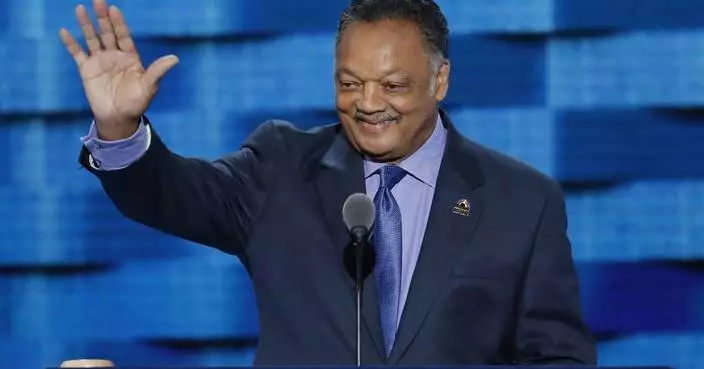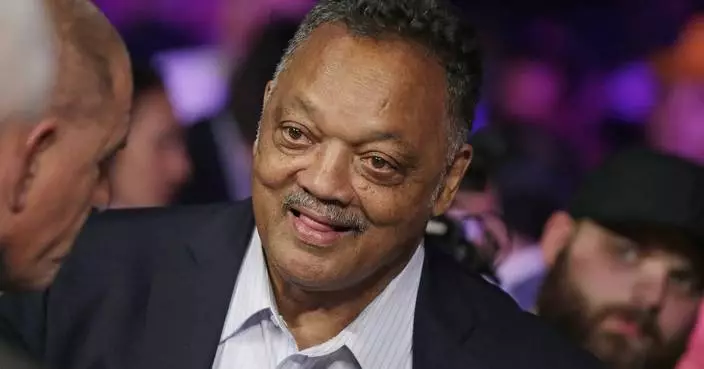
CHICAGO (AP) — The Rev. Jesse Jackson was profiled by The Associated Press when he was a 41-year-old civil rights activist preparing his historic 1984 campaign for the presidency. The AP is republishing that story, by the late AP writer Sharon Cohen, as it appeared on Aug. 7, 1983.
He sees himself on the lonely, dusty road of the prophets — a man ordained by the spirit and sent forth like Jesus, Gandhi or the Rev. Martin Luther King Jr. to show others the way out of the wilderness.
“I’m very much driven by my religion to rise,” he says. “There’s a push that comes from religious duty. Gandhi couldn’t stop. Martin couldn’t stop. Jesus couldn’t stop.”
Nor, to hear him tell it, can the Rev. Jesse L. Jackson.
“I’m in the prophetic ministry,” he says. “It’s the kind of ministry ancient prophets engaged in when they challenged the conduct of kings and queens.”
Jesse Louis Jackson — 41-year-old son of the South, child of civil rights and a prospective 1984 black presidential candidate — is a man driven, almost obsessed with his self-appointed mission.
Wherever Jackson goes, his message is hope. His style is rhyme. He is a master of the slogan.
“If you are behind in a race, you CAN’T run equally,” he tells church audiences. “The race does not go to the fast or to the strong but to those who hold out.”
“If you pickle your brains with liquor, you CAN’T hold out. If you shoot cocaine in your membrane, you CAN’T hold out. If you put dope in your veins, rather than hope in your brains, you CAN’T hold out.”
His speeches mesmerize. Soon the audience is chanting, “Preach, brother. Preach it.” He does.
“We’re not the result of accidents, we’re the result of providence. We’re not here because we’re lucky. We’re here because we’re blessed.”
After his sermons, crowds flock to him, snapping pictures, begging for autographs and asking him to kiss babies. He turns no one away.
“My gift is a gift of the spirit,” he says.
It is a gift manifest in many forms in the evolution of this complex man from a brash, impetuous lieutenant of King into a magnetic — if controversial — political force in his own right.
In the ’60s, he battled for equal rights, picketing restaurants and marching for open housing.
In the ’70s came stress on self-respect and economic justice. Push-Excel, a bootstraps program urging students to study hard. The beginning of corporate agreements guaranteeing blacks fair participation.
Today, it’s leadership. A drive for voter registration across the South. More blacks in public office. And, ultimately, a black president, maybe Jesse Jackson.
“It’s not enough to get in the mainstream and swim,” Jackson says. “You must get in the mainstream and redirect its course.”
For years, and in highly visible ways, Jackson has tried to contribute his share, often to the dismay and irritation of others.
He has assailed dirty lyrics in disco music, mediated local labor disputes and led boycotts of national corporations.
He’s advocated the rights of Haitians, Palestinians and Poles.
He visited Panama to see whether the canal treaty was a good deal and spoke in South Africa to 20,000 blacks about apartheid.
American Jews were appalled when he embraced Yasser Arafat, leader of the Palestine Liberation Organization. Legislators applauded when he addressed Alabama’s Legislature — the first black to do so this century.
For the past few months, and maybe longer, Jackson has been weighing a bid for the presidency through the Democratic primaries and has sounded more and more like a candidate, to mixed reaction from other black leaders who, for various reasons, are skeptical of the political wisdom of a black candidacy at this time.
One poll has shown him to be more popular than some of the announced candidates. “God did not limit genius to white males,” says Jackson. “He distributed it all over town.”
Jackson has never run for political office. His only formal constituency is Chicago-based Operation PUSH (People United to Serve Humanity), but in reality he is the organization. Jackson founded the group in 1971, originally named the less-humble People United to Save Humanity, after splitting from the Southern Christian Leadership Conference. He has been president ever since at a current annual salary of $40,000.
When friends and foes alike discuss Jackson, they invariably speak of the same traits — his ego, his drive, his grand ideas, his weakness as an organizer, and his adroit courting of the media.
“He seems himself on a messianic mission,” says half-brother Noah Robinson. “What is it that motivates a person to grow? For Jesse, it’s his ego. God bless him for having that ego.”
“I always describe a visionary as someone who looks at cloudy skies and does not see the clouds, but sees the sun,” says Gary, Ind., Mayor Richard Hatcher, a friend and PUSH chairman of the board. “He’s able to do that.”
Mary Frances Berry, a member of the U.S. Civil Rights Commission, added though that “Jesse’s not really an organization man. His strong suit is not really running an organization.”
“The most pungent criticism is that he is constantly announcing campaigns and crusades that evaporate after the TV set is turned off,” says Don Rose, a political strategist who worked with Jackson in the 1960s civil rights movement.
Jackson, says Hatcher, “seems to have the ability to elicit from people either a very strong feeling of support ... or a very strong feeling of dislike, and sometimes a feeling that borders almost on hatred.”
Indeed, several national black leaders accuse Jackson of being an opportunist who exploits issues and seizes credit for the work of others. But virtually none has opposed him openly.
No one disputes that Jackson can cut an impressive figure. He’s an athletic 6-foot-2, in well-tailored conservative suits that long ago replaced the splashy dashikis he wore in the ’60s, along with a bold Afro.
He’s retained his Baptist preacher’s eloquence, doesn’t smoke or drink, yet, unbending, displays a humor that leads his friends to suggest that Jackson could have made a dazzling comedian.
Perennially on the go, he takes time to quiz teachers on his son’s classroom performance. Jesse Jr., 18, eldest of his five children, attends a private Episcopalian school in Washington, D.C. “He wants us to be an example of what he preaches,″ says Jesse Jr.
While Jackson preaches on many things, one theme has been as consistent in his message as in his life, an unrelenting drive to succeed.
“When you do less than your best, it’s a SIN,” he tells audiences. “To be black in America, you have to be superior to be equal.”
Jackson was born Oct. 8, 1941, in Greenville, S.C., and graduated from North Carolina A&T, where he earned a bachelor’s degree in sociology and economics, and met Jacqueline Davis, whom he married in 1962.
After college, Jackson entered the Chicago Theological Seminary, and joined King in civil rights protests.
In 1967, King appointed him as director of Operation Breadbasket, economic arm of the SCLC. Four years later, after King’s assassination, he founded Operation PUSH.
Jackson was with King that day in 1968 when he was shot down in Memphis, Tenn. He wore a shirt said to be soaked with the slain civil rights leader’s blood to a Chicago City Council meeting the following day.
As PUSH president, Jackson has been an urban version of Dale Carnegie, pushing and praising, cajoling and criticizing blacks to work hard, excel in school, and demand their share of power.
Jackson’s Operation PUSH claims to have signed more than $1 billion in trade agreements with Burger King, Coca-Cola, Heublein, and Seven-Up that provide for more distributorships and more advertising in black-audience publications.
Not all his efforts have won friends.
When PUSH announced a boycott of Anheuser-Busch beer last year, some blacks in St. Louis, where the company is based, assailed him for picking on the wrong company.
Others say Jackson’s programs don’t help enough people.
Another Jackson brainchild, PUSH-EXCEL — Push for Excellence, a program started in 1976 urging daily study hours, teacher dedication and student discipline — has run into other problems.
Seven reports completed this year by Department of Education auditors want to disallow PUSH-EXCEL’s use of $736,000. They said the funds apparently were spent on items not eligible under the organization’s federal grants and contracts.
In addition, officials said, about $1 million in spending has been questioned because it was not documented adequately. The money is part of about $6 million awarded to PUSH-EXCEL over three or four years.
The audits don’t allege criminal violations. Jackson says PUSH гepresentatives are working with auditors to resolve the matter.
As Jackson ventured into presidential issues like the re-industrialization of America, jobs, or the defense budget, some critics questioned his qualifications for speaking out on such national issues.
Jackson bristles at that notion.
“I wasn’t trained in auto mechanics and brick masonry,” he says. “I had a liberal arts education ... So if on a given day Mr. Reagan can speak about agricultural policy and trade policy and international affairs and art and culture and science, who’s to suggest I should be less able to speak to a broad range of issues?”
Jackson says the success of his Southern registration drive, finances and organization will help determine whether he runs for the Democratic nomination. If he doesn’t, he says, some black should.
The Democrats, he says, “have in many ways made us like the Harlem Globetrotters. We can provide the thrills and excitement, but not participate in the other room where policy decisions are made.”
While friends and black leaders are divided on a Jackson candidacy, some see benefits from broaching the possibility.
“He’s made the party more cognizant of black voters,″ says Georgia state Sen. Julian Bond. ”It has made race — in a positive way — an agenda item in the campaign for the Democratic nomination.”
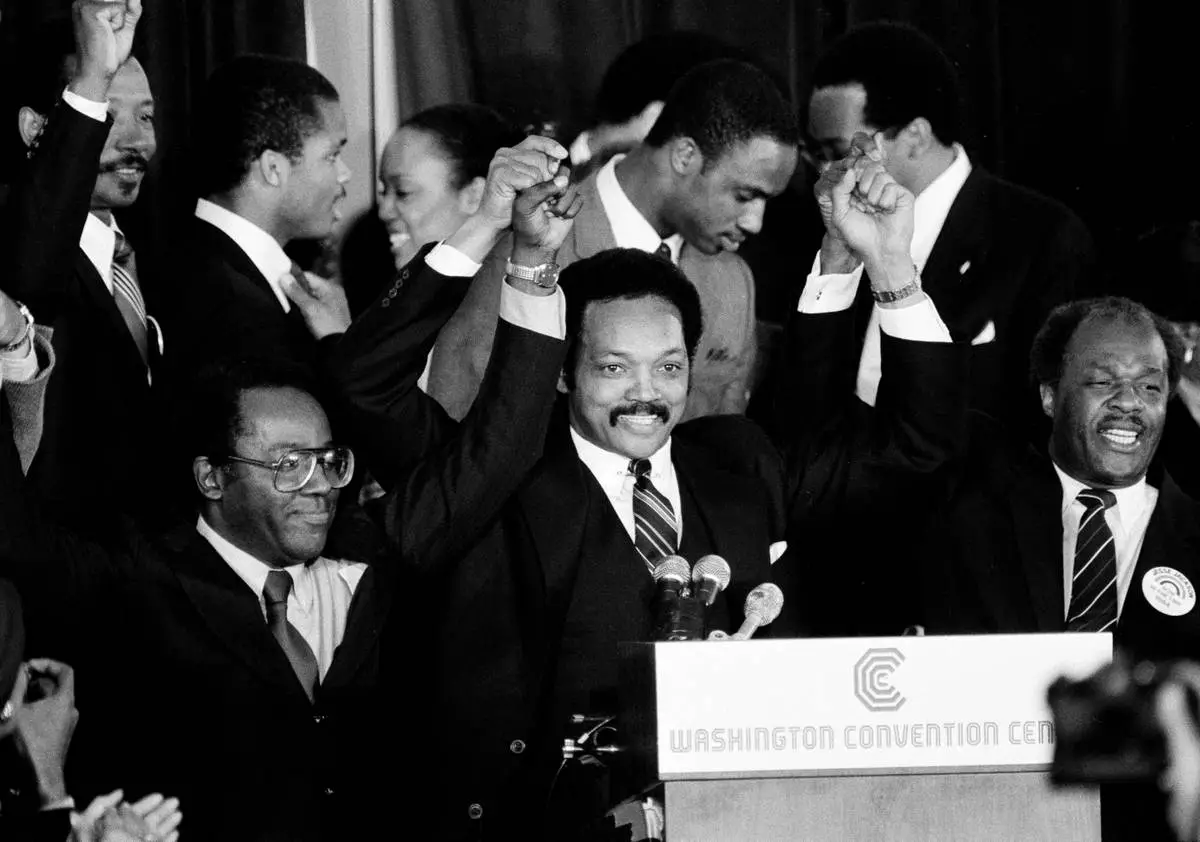
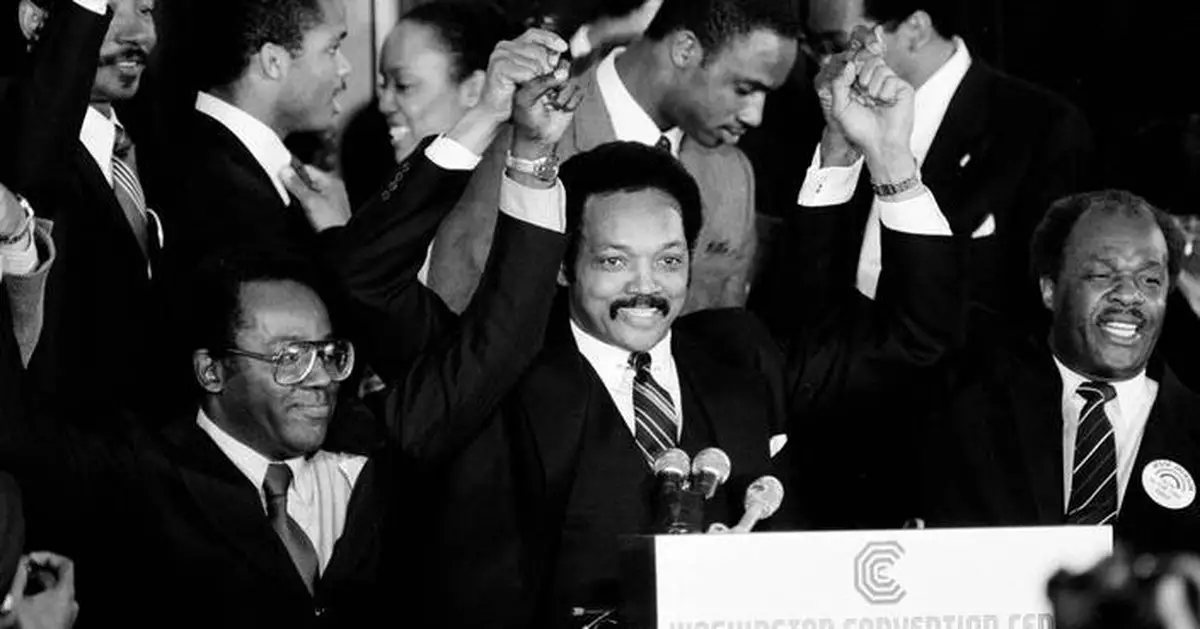
FILE - Jesse Jackson holds his hands up after announcing he will seek the Democratic nomination for president, with his campaign chairman Mayor Richard Hatcher, left, of Gary Ind., and Mayor Marion Barry of Washington, D.C., in Washington, Nov. 3, 1983. (AP Photo/Scott Stewart, File)