WASHINGTON (AP) — Tariffs paid by midsize U.S. businesses tripled over the course of past year, new research tied to one of America’s leading banks showed on Thursday — more evidence that President Donald Trump 's push to charge higher taxes on imports is causing economic disruption.
The additional taxes have meant that companies that employ a combined 48 million people in the U.S. — the kinds of businesses that Trump had promised to revive — have had to find ways to absorb the new expense, by passing it along to customers in the form of higher prices, employing fewer workers or accepting lower profits.
“That’s a big change in their cost of doing business,” said Chi Mac, business research director of the JPMorganChase Institute, which published the analysis Thursday. “We also see some indications that they may be shifting away from transacting with China and maybe toward some other regions in Asia.”
The research does not say how the additional costs are flowing through the economy, but it indicates that tariffs are being paid by U.S. companies. The study is part of a growing body of economic analyses that counter the administration's claims that foreigners pay the tariffs.
The JPMorganChase Institute report used payments data to look at businesses that might lack the pricing power of large multinational companies to offset tariffs, but may be small enough to quickly change supply chains to minimize exposure to the tax increases. The companies tended to have revenues between $10 million and $1 billion with fewer than 500 employees, a category known as “middle market.”
The analysis suggests that the Trump administration’s goal of becoming less directly reliant on Chinese manufacturers has been occurring. Payments to China by these companies were 20% below their October 2024 levels, but it’s unclear whether that means China is simply routing its goods through other countries or if supply chains have moved.
The authors of the analysis emphasized in an interview that companies are still adjusting to the tariffs and said they plan to continue studying the issue.
The White House did not immediately respond to questions about the analysis, which showed that U.S. companies are paying tariffs that the president had previously claimed would be paid by foreign entities.
Trump imposed a series of tariffs last year for the ostensible goal of reducing the U.S. trade imbalance with other countries, so that America was not longer importing more than it exports. But trade data published Thursday by the Census Bureau showed that the trade deficit climbed last year by $25.5 billion to $1.24 trillion. The president on Wednesday posted on social media that he expected there would be a trade surplus “during this year.”
The Trump administration has been adamant that the tariffs are a boon for the economy, businesses, and workers. Kevin Hassett, director of the White House National Economic Council, lashed out on Wednesday at research by the New York Federal Reserve showing that nearly 90% of the burden for Trump's tariffs fell on U.S. companies and consumers.
“The paper is an embarrassment,” Hassett told CNBC. “It’s, I think, the worst paper I’ve ever seen in the history of the Federal Reserve system. The people associated with this paper should presumably be disciplined.”
Trump increased the average tariff rate to 13% from 2.6% last year, according to the New York Fed researchers. He declared that tariffs on some items such as steel, kitchen cabinets and bathroom vanities were in the national security interest of the country. He also declared an economic emergency to bypass Congress and impose a baseline tax on goods from much of the world in April 2025 at an event he called “Liberation Day.”
The high rates provoked a financial market panic, prompting Trump to walk back his rates and then engage in talks with multiple countries that led to a set of new trade frameworks. The Supreme Court is expected to rule soon on whether Trump surpassed his legal authority by declaring an economic emergency.
Trump was elected in 2024 on his promise to tame inflation, but his tariffs have contributed to voter frustration over affordability. While inflation has not spiked during Trump's term thus far, hiring slowed sharply and a team of academic economists estimate that consumer prices were roughly 0.8 percentage points higher than they would otherwise be.
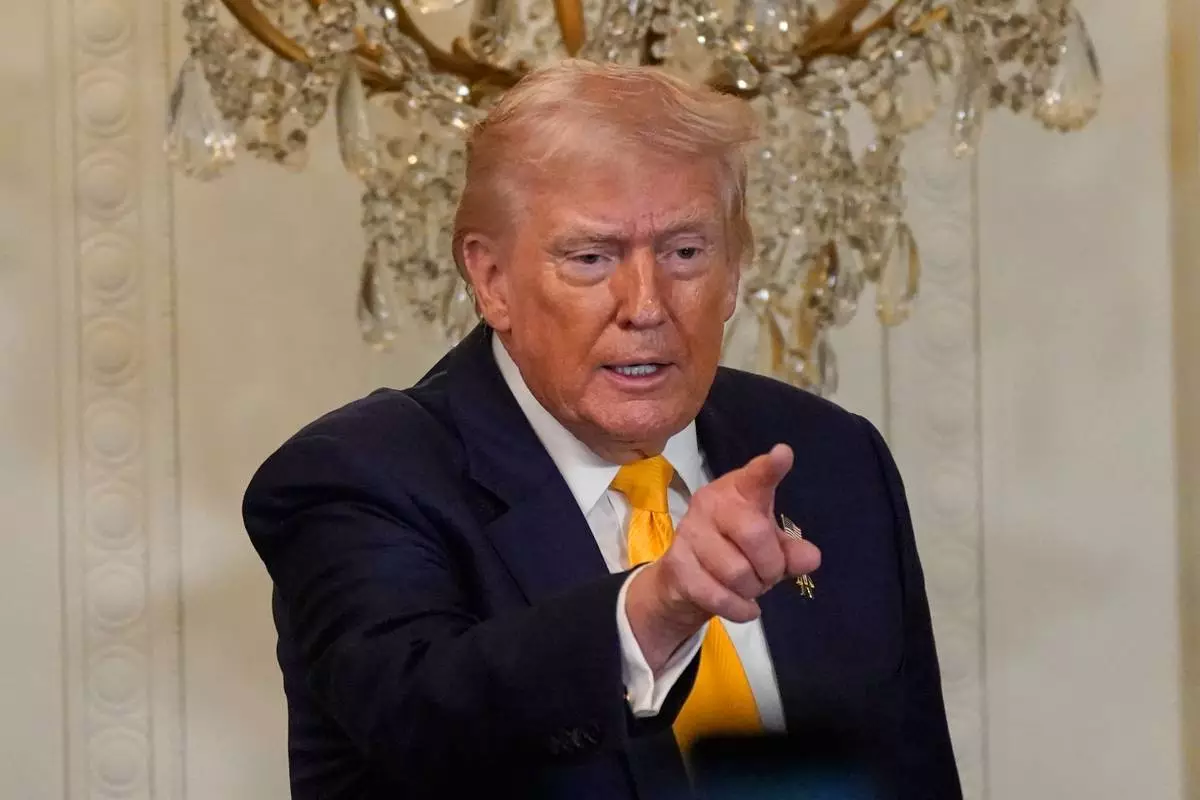
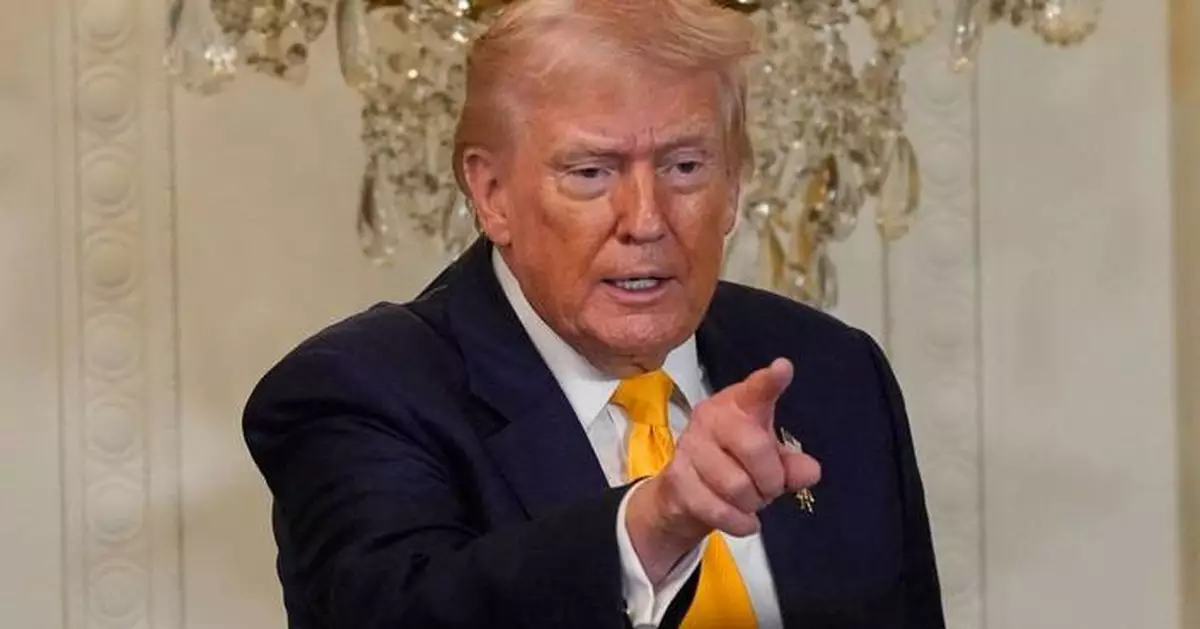
President Donald Trump gestures during a Black History Month event in the East Room of the White House, Wednesday, Feb. 18, 2026, in Washington. (AP Photo/Nathan Howard)
MINNEAPOLIS (AP) — The Trump administration has issued a sweeping new order that could lead to the arrest of tens of thousands of refugees who are lawfully in the United States but do not yet have permanent residency, overturning years of legal and immigration safeguards.
A memo filed by the Department of Homeland Security ahead of a Thursday federal court hearing in Minnesota says refugees applying for green cards must return to federal custody one year after they were admitted to the U.S. for review of their applications.
DHS “may maintain custody for the duration of the inspection and examination process,” said the memo, which was filed Wednesday.
Advocacy and resettlement groups slammed the order, which will likely face legal challenges and could sow confusion and fear among the nearly 200,000 refugees who came to the United States during the Biden administration.
The order, first reported on by The Washington Post, is the latest in a series of immigration restrictions by the Trump administration, which has upended longstanding policies toward refugees, including dramatically reducing the numbers of those admitted into the country. A memo obtained by The Associated Press late last year said the administration was planning a review of all refugees admitted to the U.S. during the Biden administration.
The administration has cited national security and economic concerns for its changed policies. Experts say refugees let into the country already undergo extensive vetting.
The order came hours before U.S. District Judge John Tunheim was to hear arguments Thursday on whether he should extend a temporary order that protects Minnesota refugees who are lawfully in the U.S. from being arrested and deported. Tunheim's order currently applies only in Minnesota.
Immigration advocates quickly pushed back against the new policy, with HIAS, an international Jewish nonprofit serving refugees and asylum-seekers, calling it “a transparent effort to detain and potentially deport thousands of people who are legally present in this country, people the U.S. government itself welcomed.”
“They were promised safety and the chance to rebuild their lives. Instead, DHS is now threatening them with arrest and indefinite detention," Beth Oppenheim, the group's CEO, said in a statement.
Tunheim blocked the government from targeting the Minnesota refugees last month, saying the plaintiffs in the case were likely to prevail on their claims “that their arrest and detention, and the policy that purports to justify them, are unlawful.” His Jan. 28 temporary restraining order will expire Feb. 25 unless he grants a more permanent preliminary injunction.
The judge rejected the government’s claim that it had the legal right to arrest and detain refugees who haven’t obtained their green cards within a year of arriving in the U.S. He said that would be illogical and nonsensical, given that refugees can’t apply for permanent residency until they’ve been in the U.S. for a year.
Refugee rights groups sued the federal government in January after the Department of Homeland Security and U.S. Citizenship and Immigration Services in mid-December launched Operation PARRIS, an acronym for Post-Admission Refugee Reverification and Integrity Strengthening.
It was billed as a “sweeping initiative” to reexamine the cases of 5,600 Minnesota refugees who had not yet been granted permanent resident status, also known as green cards. The agencies cited fraud in public programs in Minnesota as justification.
Operation PARRIS was part of the Trump administration's broader immigration crackdown that targeted Minnesota, including the surge of thousands of federal officers into the state. Homeland Security said it was its largest immigration enforcement operation ever. It also sparked mass protests after federal agents shot and killed Renee Good and Alex Pretti. White House border czar Tom Homan announced last week the surge was ending, though a small federal presence would remain.
The lawsuit alleges that ICE officers went door to door under Operation PARRIS arresting refugees and sending them to detention centers in Texas, without access to attorneys. Some were later released on the streets of Texas and left to find their own way back to Minnesota, they said.
Tunheim noted in his order that refugees are extensively vetted by multiple agencies before being resettled in the U.S. He wrote that none arrested in the operation had been deemed a danger to the community or a flight risk, nor had any been charged with crimes that could be grounds for deportation.
The judge cited several cases involving plaintiffs named in the lawsuit, including one man identified only as U.H.A., a refugee with no criminal history. He was admitted into the U.S. in 2024 and was arrested by ICE while driving to work on Jan. 18 this year. “He was pulled over, ordered out of his car, handcuffed, and detained, without a warrant or apparent justification,” the judge wrote.
Tunheim stressed that the refugees impacted by his order were admitted into the U.S. because of persecution in their home countries. He prohibited further arrests under Operation PARRIS and ordered that all detainees still in custody from it be released and returned to Minnesota.
“They are not committing crimes on our streets, nor did they illegally cross the border. Refugees have a legal right to be in the United States, a right to work, a right to live peacefully — and importantly, a right not to be subjected to the terror of being arrested and detained without warrants or cause in their homes or on their way to religious services or to buy groceries,” he wrote.
“At its best, America serves as a haven of individual liberties in a world too often full of tyranny and cruelty. We abandon that ideal when we subject our neighbors to fear and chaos,” he continued.
In a follow-up order Feb. 9, Tunheim rejected a government motion to lift the temporary restraining order.
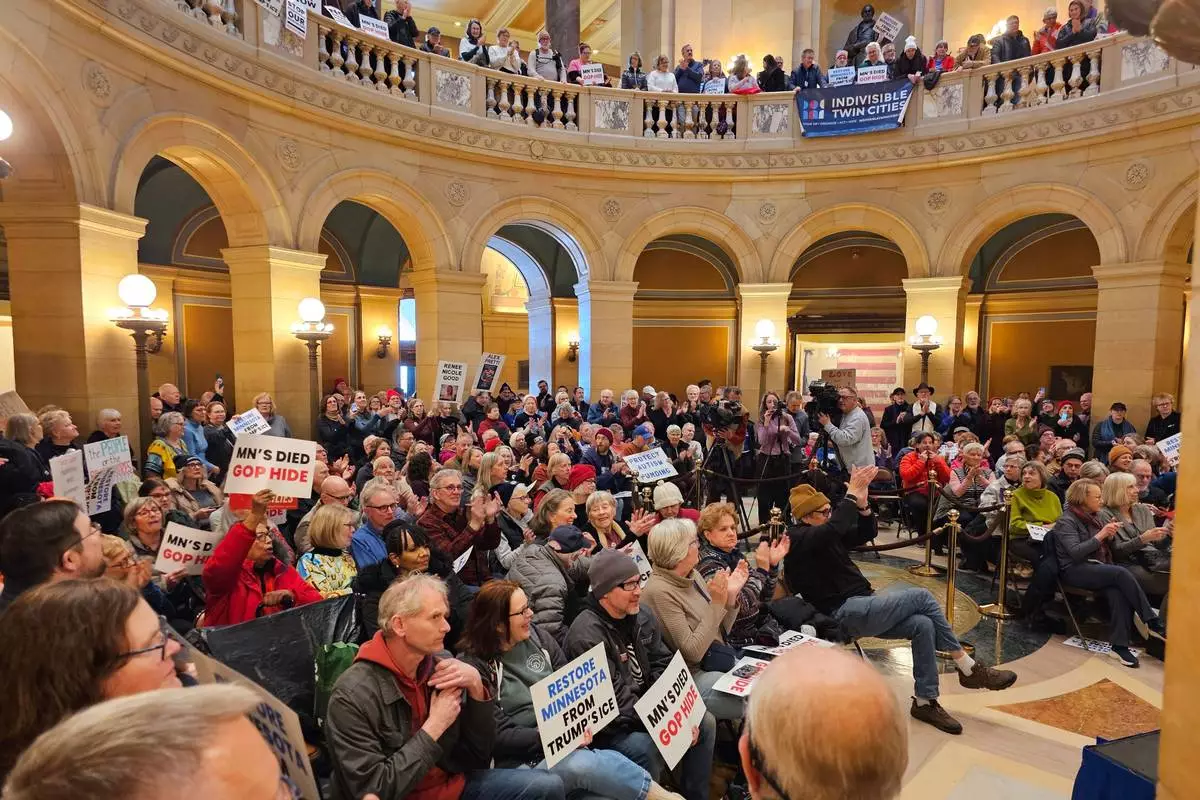
Hundreds of people attend a rally in the rotunda of the Minnesota State Capitol in St. Paul, Minn., Wednesday, Feb. 18, 2026, to urge leaders to support economic recovery in the wake of the Trump administration's immigration crackdown in the state. (AP Photo/Steve Karnowski)
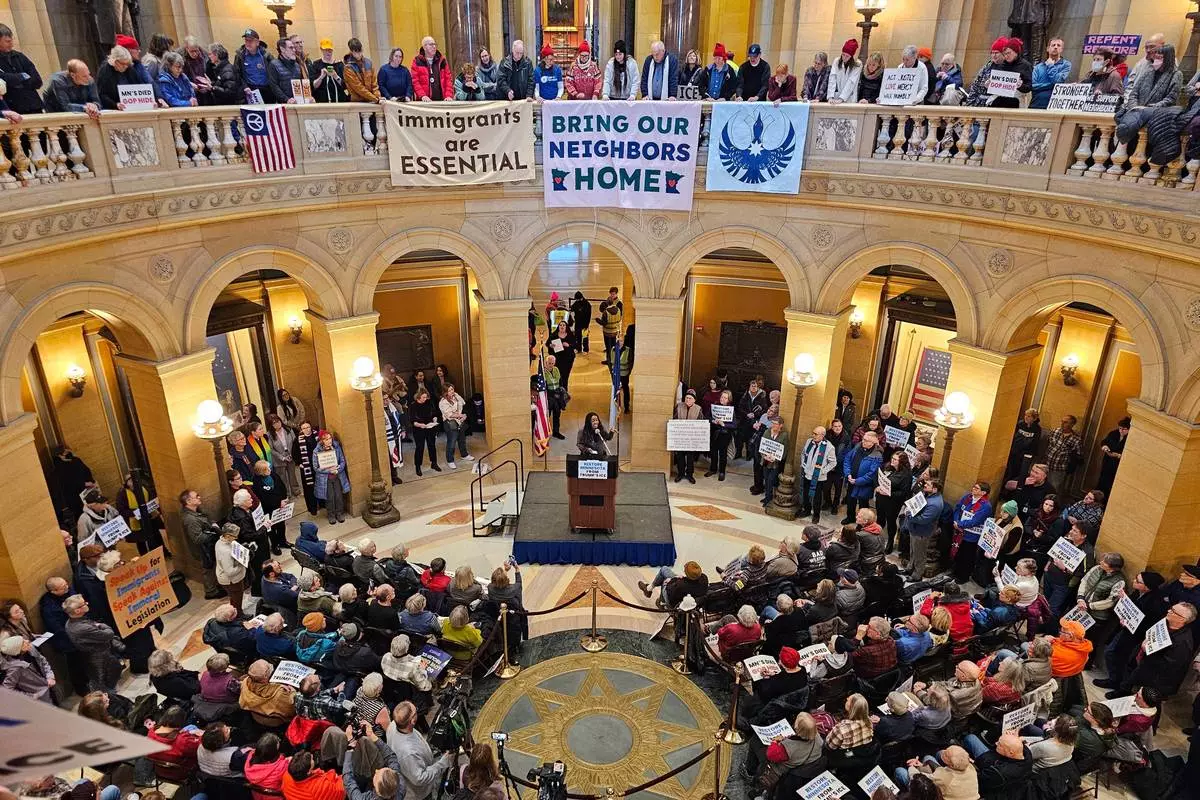
Hundreds of people attend a rally in the rotunda of the Minnesota State Capitol in St. Paul, Minn., Wednesday, Feb. 18, 2026, to urge leaders to support economic recovery in the wake of the Trump administration's immigration crackdown in the state. (AP Photo/Steve Karnowski)