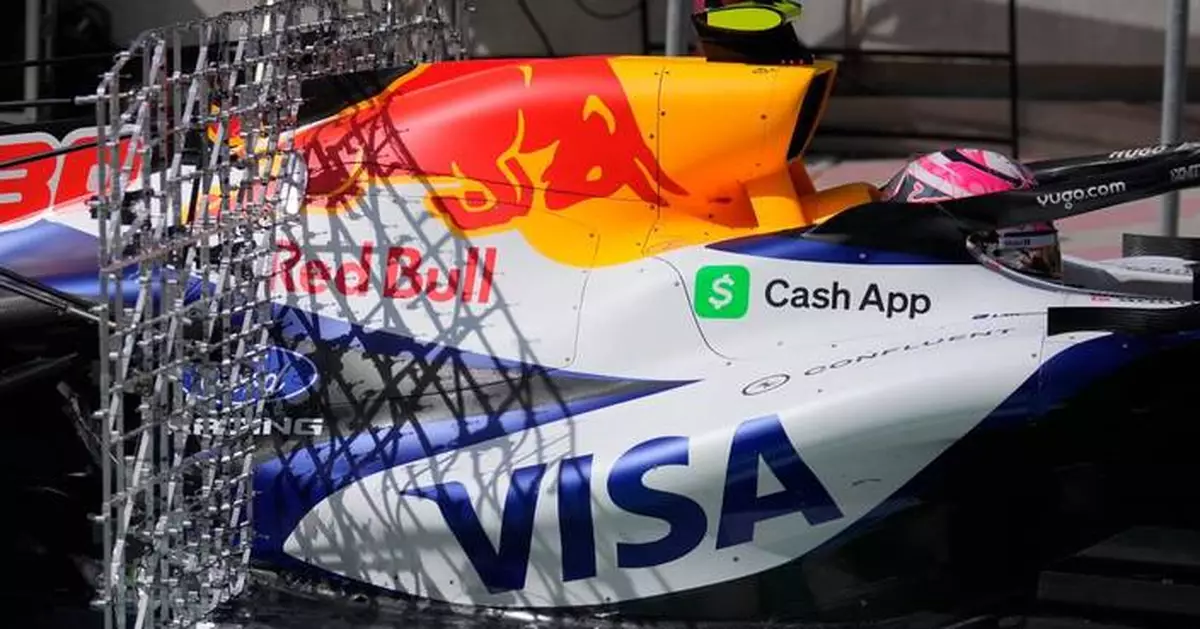
Visa entered Formula 1 in 2024 with Red Bull Racing its first new global sports sponsorship agreement in 15 years. But it was a bumpy launch as its entry came with a name mocked as one of the worst in motorsports history.
Didn't matter to Visa, which on Thursday announced a four-year contract extension through 2030 that expands its partnership with Red Bull Racing and Visa Cash App Racing Bulls.
Some fans call it VCARB, others call it Racing Bulls, and some even say Visa Cash App.
“When people embrace what you’re doing, people will find a way to talk about your name in positive light,” Frank Cooper, chief marketing officer of VISA, told The Associated Press. "Names become affectionate names once people find some kind of close connection to the company, the drivers, the team, and so people have gotten comfortable with it.
“I don’t know anyone has settled on ‘This is exactly what we’re going to call it every single time’ because sometimes people will say the car, sometimes they’ll say Racing Bulls, it’s a little bit all over the place. But I’m comfortable with that because: one, they’re talking about it, and two, the initial response of ‘How do I even say this? What does it mean?’ That’s all gone."
The extension with Red Bull shows how far the partnership has grown over Visa's first two seasons in F1. The new deal encompasses new branding rights, enhanced hospitality options and immersive experiential opportunities across both Red Bull and Racing Bulls.
“In a short space of time, Oracle Red Bull Racing and Visa have fostered a partnership built on collaborative effort and mutual success," said Paul Gandolfi, chief commercial officer of Red Bull Racing. "With Red Bull, we sit at the epicenter of sport, entertainment and lifestyle, meaning we are strategically positioned to bring globally recognized industry leaders like Visa, into the sport as we embark on a new era of Formula 1.”
Visa will continue as the title partner of Red Bull's second team, the two-car effort for Liam Lawson and rookie Arvid Lindblad, as well as the title partner for Racing Bulls' all-female Formula 1 Academy program.
But it also comes with a more prominent branding on the Red Bull cars of four-time world champion Max Verstappen and Isack Hadjar, who was promoted from Racing Bulls at the end last year. Visa's logo will on the front wing of the new RB22 for 2026.
Visa has also secured exclusive rights within the retail banking category, alongside expanded pass‑through rights.
Essentially, Visa is backing all the cars across all Red Bull teams in F1 and F1 Academy.
Cooper said the contract extension gives Visa more access to the team, its drivers, the paddock and hospitality areas.
"We looked at it from the fan perspective of what do the fans want? What does a client want? Those are the things they want. They want to be close to the access," said Cooper. "They want to feel like they’re part of it. The way we think about it is, being a traditional sponsor means just simply being adjacent to the property that you paid some money for. You get a logo. You’re adjacent to it, you hope to get a halo effect from that adjacency.
“We decided that's fine for those who want to do it that way, but we think we can do more. Our approach is to try to add value to the fan experience and add value to the driver.”
Cooper said he learned from the popularity of the F1 docudrama “Drive To Survive” series that fans want to see the human side of the global racing series and that mindset helped develop one of Visa's more popular campaigns. Visa last year did a #TakeYourDriverToWorkDay event in which Hadjar and Lawson traded the cars for cubicles and participated in onboarding sessions at Visa’s London office.
The two drivers struggled through everyday office rituals in a campaign that was featured across social media and resonated with fans. The series felt a bit like the sitcom “The Office.”
Cooper expects to see more of that as Visa is in the middle of a monstrous year of activation: Visa is key sponsors of the Super Bowl, the Olympics, the upcoming World Cup and Red Bull's F1 team. Visa will also play a prominent role in the Red Bull Showrun Tour that starts in the United States this Saturday with a public exhibition event transforming San Francisco’s Marina Boulevard into an F1‑style demonstration course.
Visa also plans to add a musical element to its F1 activation this summer. Red Bull in 2022 — before Visa came aboard — hosted Bad Bunny at the Miami Grand Prix.
“One thing that has been true for decades is that athletes want to be around musicians and musicians want to be close to athletes,” Cooper said. “The opportunity to cross-pollinate across various cultural pillars and create new experiences is there for us.”
AP auto racing: https://apnews.com/hub/auto-racing
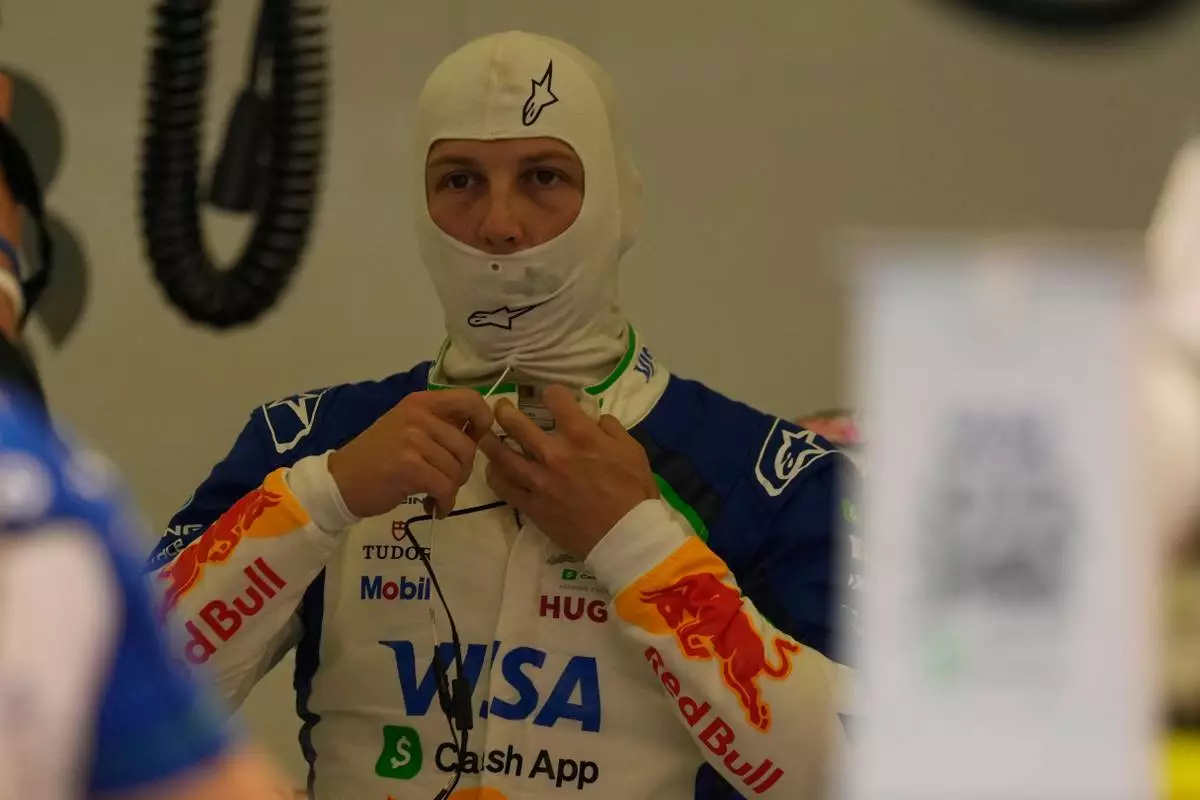
Racing Bulls driver Liam Lawson of New Zealand prepares for a Formula One pre-season test at the Bahrain International Circuit in Sakhir, Bahrain, Thursday, Feb. 12, 2026. (AP Photo/Altaf Qadri)

Racing Bulls driver Liam Lawson of New Zealand steers his car on the third day of Formula One pre-season test at the Bahrain International Circuit in Sakhir, Bahrain, Friday, Feb. 13, 2026. (AP Photo/Altaf Qadri)
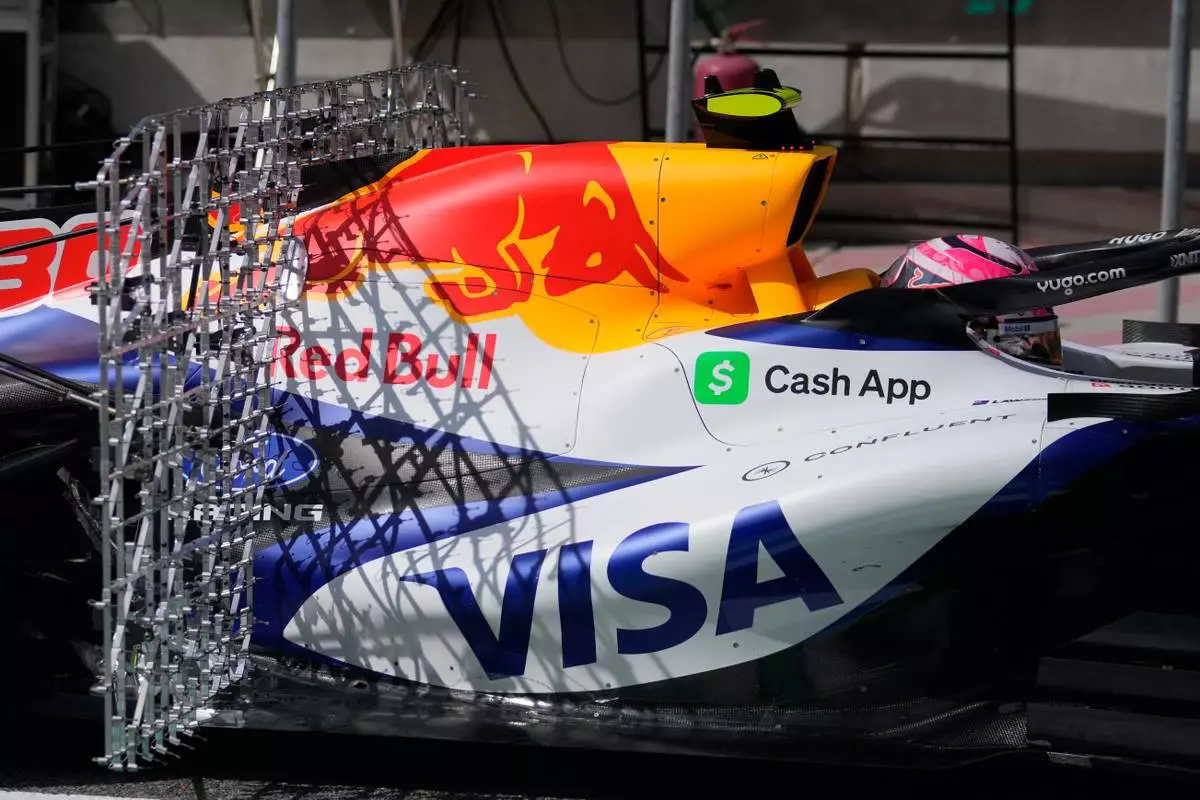
Racing Bulls driver Liam Lawson of New Zealand steers his car during a Formula One pre-season test at the Bahrain International Circuit in Sakhir, Bahrain, Thursday, Feb. 12, 2026. (AP Photo/Altaf Qadri)
JEFFERSON CITY, Mo. (AP) — Missouri is poised to hold its November election with congressional districts passed after the last census, after the U.S. Supreme Court on Thursday again rejected a new map backed by President Donald Trump that Republicans hoped could help them win an additional seat in the pivotal midterms.
The Supreme Court's decision marked a defining moment in a pitched legal battle that has lasted nearly a year and caused confusion for voters. Citing the court's latest action, Missouri's chief election official directed local authorities to use U.S. House districts passed in 2022, as the state’s highest court had ordered.
Trump wanted courts to allow the use of his preferred map, which lawmakers approved last year at his urging.
The decision means Missouri could run the November general election with different U.S. House districts than were used in the August primary — an extremely rare situation that could switch the candidate choices for more than a million potential voters, or nearly 1 in 4 voters statewide, according to an Associated Press estimate.
No Supreme Court justices publicly dissented from the brief order. It did not detail the court’s legal reasoning, as is typical in emergency appeals.
The White House did not immediately respond to a request for comment on the U.S. Supreme Court decision.
Earlier Thursday, Missouri's top court convened a hearing on whether to hold Republican Secretary of State Denny Hoskins in contempt for not following its orders to use the districts passed after the last census. Hoskins had instead told local election authorities to use the new Trump-backed map, pointing to a competing order from a federal judge on Tuesday that forbade him from using anything other than the new districts.
Missouri Supreme Court judges, while questioning a state attorney representing Hoskins, repeatedly pressed for Hoskins to send out guidance Thursday to use the 2022 version of the congressional districts.
“We’re in a precarious situation,” Chief Justice W. Brent Powell said.
Hoskins later released a statement acknowledging the U.S. Supreme Court decision, saying “my Office is directing local election authorities to use the 2022 congressional map.”
The court then reconvened, finding Hoskins in contempt for violating its order not to use the Trump-backed map but then quickly declaring that he had corrected the problem with his latest order to use the 2022 map. The court imposed no consequences on Hoskins.
Outside the court, progressive activist Keith Rose stood in the rain protesting Hoskins’ legal maneuverings to try to use the Trump-backed map. Rose, who helped gather petition signatures to put the new map to a statewide vote, said he hopes the U.S. Supreme Court’s decision Thursday ends the uncertainty.
“We need some finality. We need to focus on the real issues that Missourians care about,” Rose said.
Candidates who won Missouri’s August primary already have been certified for the November ballot according to the number of the district they won. But those districts could substantially change shape.
The 5th Congressional District encompasses only the Kansas City area under the 2022 map that Republican lawmakers passed after the last census. Under the revised map backed by Trump, portions are shed to neighboring districts and the remainder is stretched into rural Republican areas. About 59% of the potential voters are new to the district under that version, according to an AP estimate.
Some other states that have switched congressional districts after their primaries have redone their primary votes. Alabama held a new primary in August under revised districts when the U.S. Supreme Court allowed a change to occur after voting in the original May primary.
In Missouri’s case, however, no court has suggested redoing the primary.
Missouri’s battle over its congressional districts has spanned more than a year and spawned confusion over which districts will be in place for voters.
It was the second Republican-led state, after Texas, to enact new districts after Trump urged Republicans last year to redraw House districts to their advantage ahead of the midterm elections.
The revised districts target a Kansas City-based seat held by Democratic Rep. Emanuel Cleaver of Kansas City, aiming to help Republicans win seven of the state’s eight House seats in the midterm elections.
Redistricting opponents collected hundreds of thousands of petition signatures seeking to force a statewide vote on the new districts. They submitted the signatures in December. But Hoskins waited until August — on the same day as Missouri’s primary — to reject the petition. Hoskins asserted that a referendum petition could not be used for congressional redistricting.
The delay allowed Missouri to use the new districts in its August primary. Cleaver was unopposed for the Democratic nomination. State Sen. Rick Brattin won the Republican primary for the right to challenge Cleaver. Brattin was among those suing in federal court to try to prevent the state from reverting to the prior districts.
Republican U.S. Rep. Bob Onder, who was also among those suing, said Thursday: “This isn’t over.” He noted that the 8th U.S. Circuit Court of Appeals will hear arguments on the merits of his case.
Republican state officials have argued that it would violate voters’ federal rights to switch districts before the general election.
But the Missouri Supreme Court last week ordered Hoskins to put the redistricting referendum on the November ballot, which he did. It also ruled that the new districts never became law and instead were suspended retroactively to the December petition submission. The court barred Hoskins from using the new map and said the old map — passed by Republican lawmakers in 2022 after the last census — must be used in the November election.
The state then appealed to the U.S. Supreme Court to block the state court decision. Justice Brett Kavanaugh rejected the request.
The group People Not Politicians Missouri, which sponsored the redistricting referendum, applauded the Supreme Court decisions that left the state court ruling in place.
“The law is the law, the Missouri constitution is clear as was the Missouri Supreme Court,” said Executive Director Richard von Glahn. “The courts have settled this, now it’s up to Missouri voters to finish the job and vote NO on Proposition A.”
Whitehurst reported from Washington. Associated Press journalist Hannah Recht in Washington contributed.
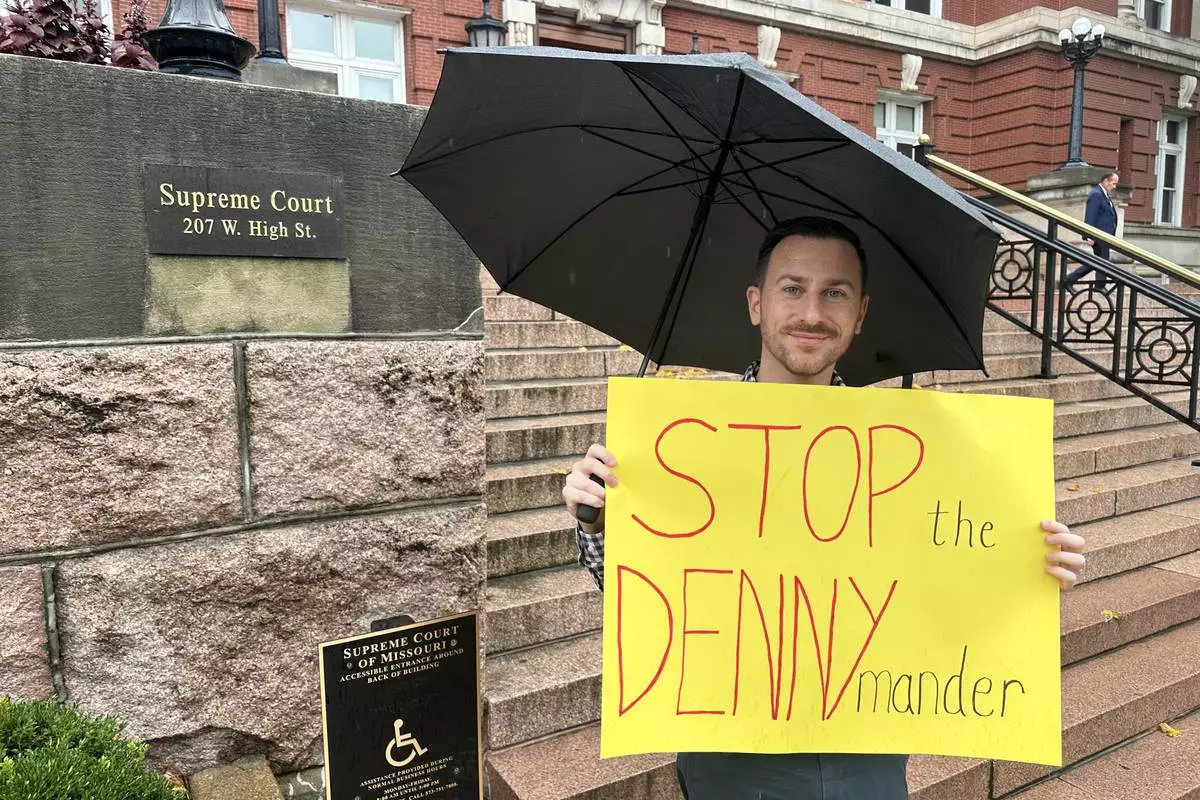
This photo taken with a smartphone shows Keith Rose holding a sign opposed to new Missouri congressional districts supported by Secretary of State Denny Hoskins outside the Missouri Supreme Court in Jefferson City, Mo., Thursday, Sept. 10, 2026. (AP Photo/David A. Lieb)
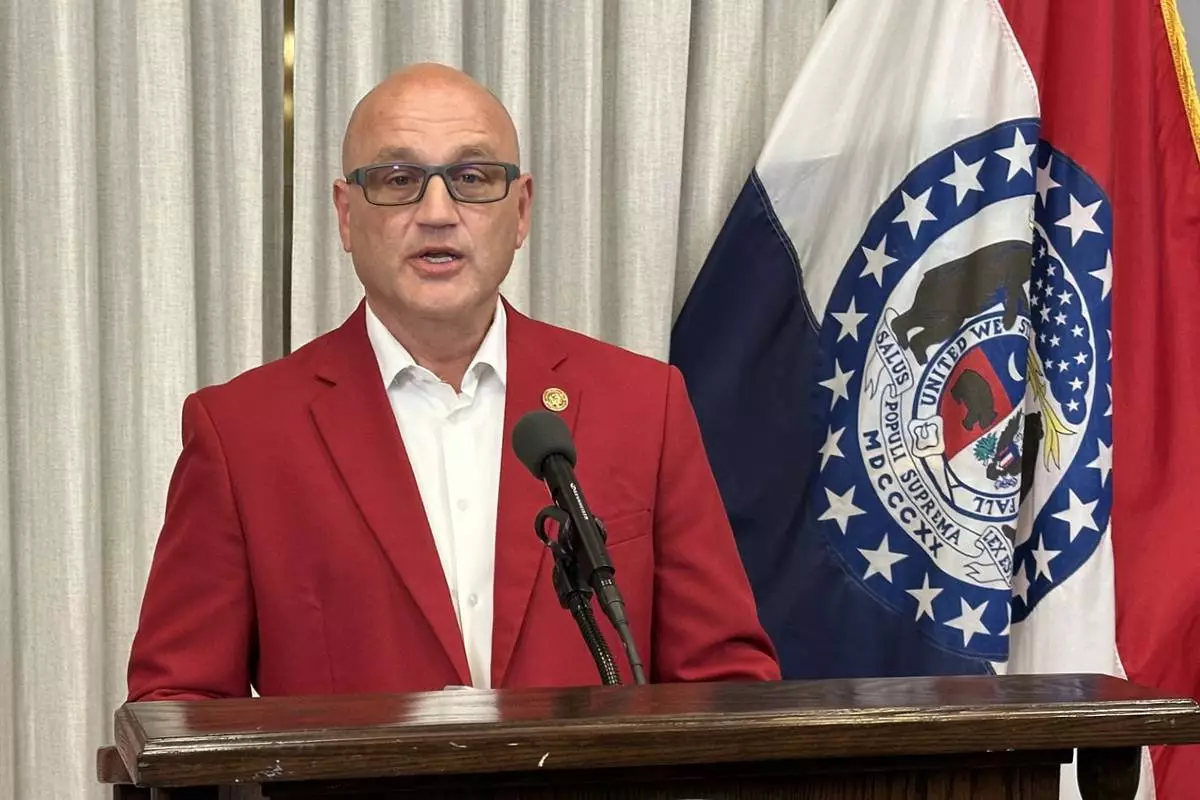
FILE - Missouri Secretary of State Denny Hoskins talks to reporters Tuesday, Aug. 4, 2026, at his office in the state Capitol in Jefferson City, Mo. (AP Photo/David A. Lieb, File)
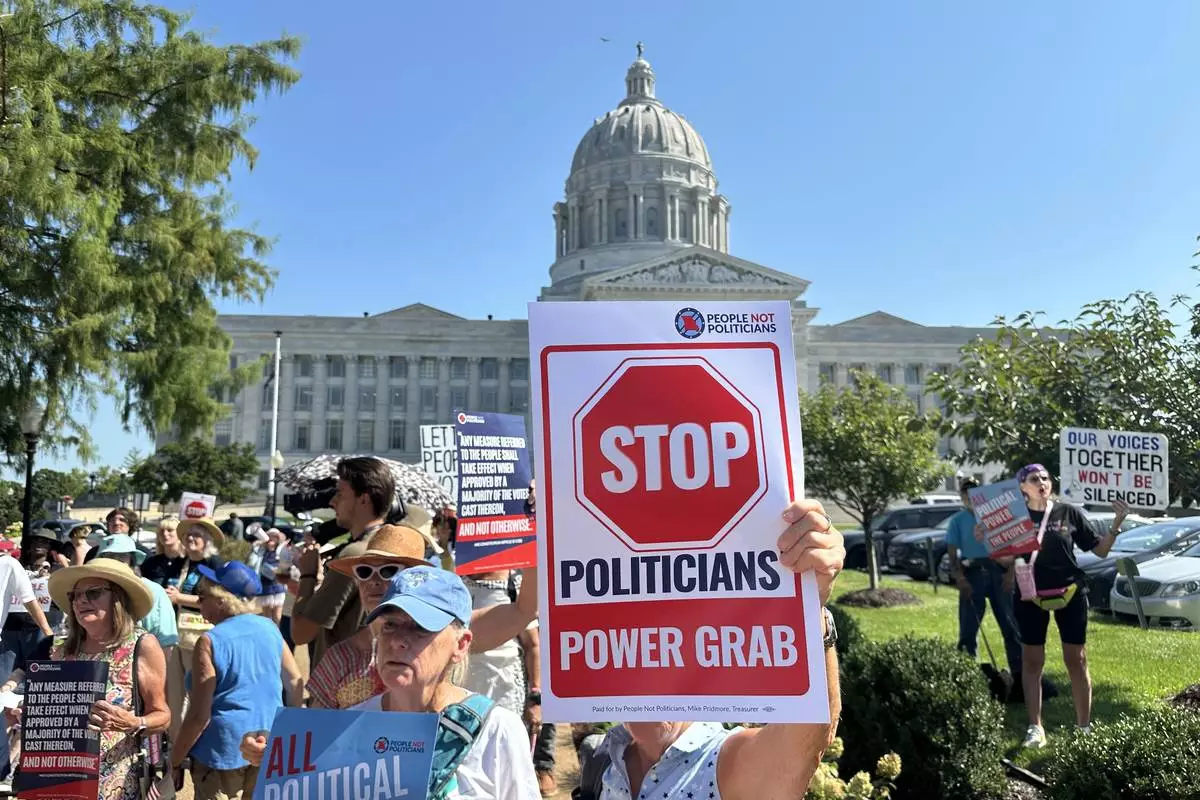
In this photo taken with a smartphone, people opposed to a congressional redistricting plan rally outside the Missouri Capitol in Jefferson City, Mo., Wednesday, Sept. 2, 2026. (AP Photo/David A. Lieb)