MUKHMAS, West Bank (AP) — Israeli settlers in the occupied West Bank shot and killed a Palestinian-American during an attack on a village, the Palestinian Health Ministry and a witness said Thursday.
Raed Abu Ali, a resident of the village of Mukhmas, said a group of settlers came to the community Wednesday afternoon and tried to attack a farmer, prompting clashes after residents intervened. Israeli forces later arrived, and during the violence armed settlers killed 19-year-old Nasrallah Abu Siyam and injured several others.
Abu Ali said that the army shot tear gas, sound grenades and live ammunition. Israel's military acknowledged using what it called “riot dispersal methods” after receiving reports of Palestinians throwing rocks but denied that its forces fired during the clashes.
“When the settlers saw the army, they were encouraged and started shooting live bullets,” Abu Ali said. He added that they clubbed those injured with sticks after they had fallen to the ground.
The Palestinian Ministry of Health confirmed Abu Siyam's death from critical wounds sustained Wednesday afternoon near the village east of Ramallah.
Abu Siyam’s killing is the latest in a surge in violence by extremist settlers in the West Bank, which killed 240 people last year, according to the United Nations Office for the Coordination of Humanitarian Affairs. Seventeen Israelis were killed over the same period. The Palestinian Authority’s Wall and Settlement Resistance Commission said Abu Siyam was the first Palestinian killed by settlers in 2026.
Mukhmas and its surrounding area — most of which lies under Israeli civil and military administration — have become a hotspot for settler attacks, including arson and assaults, as well as the construction of outposts that Israeli law considers illegal.
The Israeli military said late Wednesday that unnamed suspects shot at Palestinians, who were later evacuated for medical treatment. It did not say whether any were arrested.
Abu Siyam's mother told The Associated Press that he was an American citizen, making him the second Palestinian-American to be killed by Israeli settlers in less than a year.
The U.S. Embassy did not respond to questions on Thursday.
Palestinians and rights groups say authorities routinely fail to prosecute settlers or hold them accountable for violence. Under National Security Minister Itamar Ben-Gvir, investigations into settler attacks have plummeted, according to the Israeli rights group Yesh Din.
The U.N. human rights office on Thursday accused Israel of war crimes and said practices that displace Palestinians in the occupied West Bank “raise concerns over ethnic cleansing.”
The Office of the High Commissioner for Human Rights, citing findings collected November 2024 to October 2025, said Israel was engaged in “concerted and accelerating effort to consolidate annexation” while maintaining a system “to maintain oppression and domination of Palestinians.”
It said Israeli military operations in the northern West Bank “employed means and methods designed for warfare” including lethal airstrikes and forcibly transferring civilians from their homes. It also said Israel “forbade” residents from returning to their homes in northern West Bank refugee camps. The operation, which Israel said was aimed against militants, has displaced tens of thousands of Palestinians.
The report also accused Palestinian security forces of using unnecessary lethal force in the same areas, killing at least eight people, and noted that the Palestinian Authority had engaged in “intimidation, detention and ill-treatment of journalists, human rights defenders and other individuals deemed critical of its rule.”
Neither Israel’s Foreign Ministry nor the Palestinian Authority responded to requests for comment. Israel has repeatedly accused the U.N. rights office of anti-Israel bias.
Last year, the U.N. human rights monitor warned of what it called “an unfolding genocide in Gaza” with “conditions of life increasingly incompatible with (Palestinians’) continued existence.”
The Committee to Protect Journalists said that dozens of Palestinian journalists who were detained in Israel during the war in Gaza experienced terrible conditions, including physical assaults, forced stress positions, sensory deprivation, sexual violence and medical neglect.
CPJ has documented the detention of at least 94 Palestinian journalists and one media worker during the war in Gaza. It covers 32 journalists and one media worker from Gaza, 60 from the West Bank, and two from Israel. Thirty of the journalists are still in custody, CPJ said.
The report found that half of the journalists detained were never charged with a crime and were held under Israel’s administrative detention system, which allows for suspects deemed a security risk to be held for six months and can be renewed indefinitely.
Israel’s prison services did not immediately respond to a request for comment about the report, but had rejected a similar report in January about conditions for Palestinian prisoners as “false allegations,” contending it operates lawfully, is subject to oversight and reviews complaints.
The vast destruction across Gaza will take at least seven years just to remove the rubble, according to the United Nations Development Program.
Alexander De Croo, the former Belgian prime minister who just returned from Gaza, said that the UNDP had removed just 0.5% of the rubble and people in Gaza are experiencing “the worst living conditions that I have ever seen.”
De Croo said 90% of Gaza’s 2.2 million people live in “very, very rudimentary tents” in the middle of the rubble, which poses health dangers and a danger from exploding weapons.
He said UNDP has been able to build 500 improved housing units, and has 4,000 more that are ready, but estimates the true need is 200,000 to 300,000 units. The units are meant to be used temporarily while reconstruction takes place. He called on Israel to expand access for goods and items needed for reconstruction and the private sector to begin development.
Find more of AP’s coverage at https://apnews.com/hub/israel-hamas-war
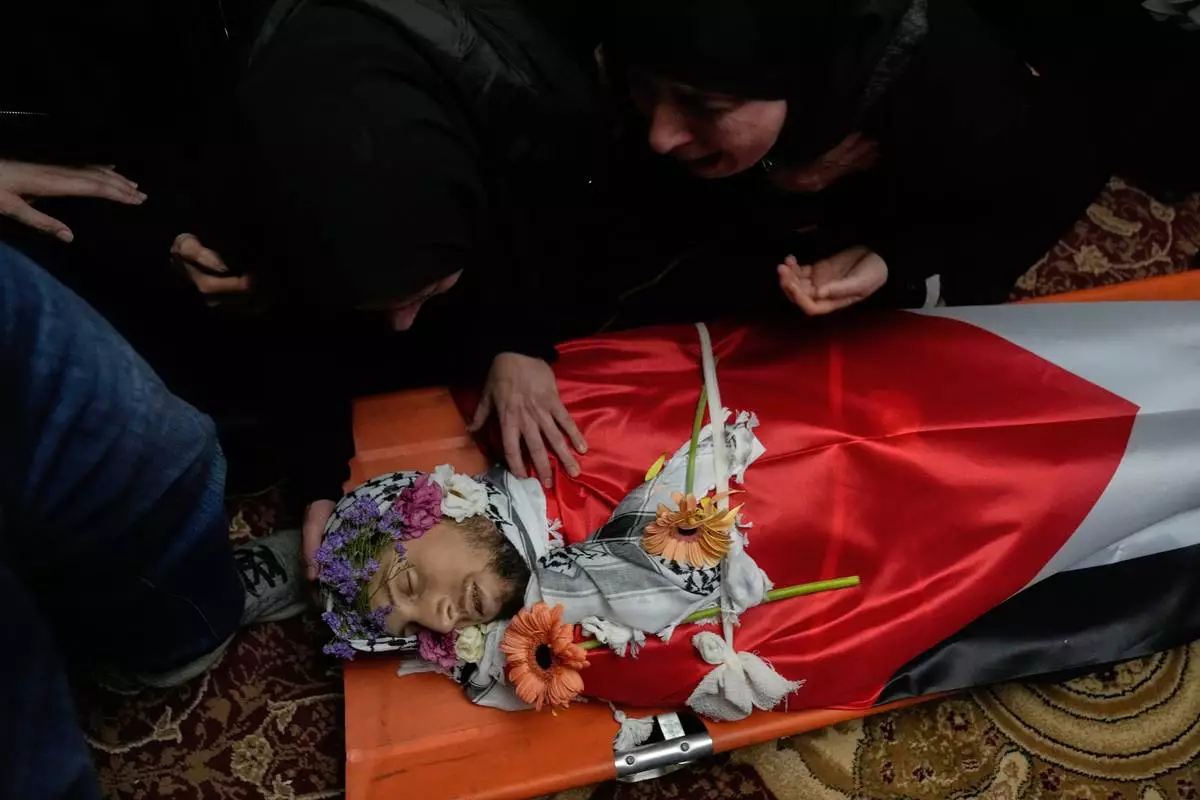
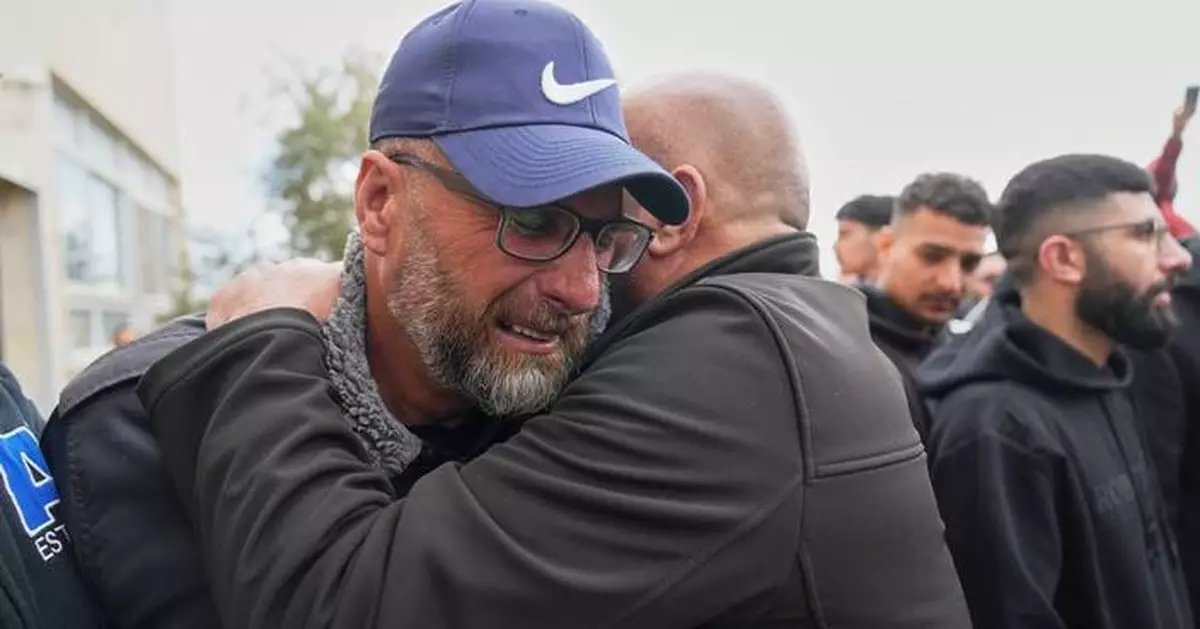
Mourners take the last look at the body of Palestinian-American Nasrallah Muhammad Jamal Abu Siyam, 19, who according to the Palestinian Health Ministry was shot by settlers on Wednesday night, during his funeral in the West Bank village of Mukhmas, east of Ramallah, Thursday, Feb. 19, 2026. (AP Photo/Nasser Nasser)
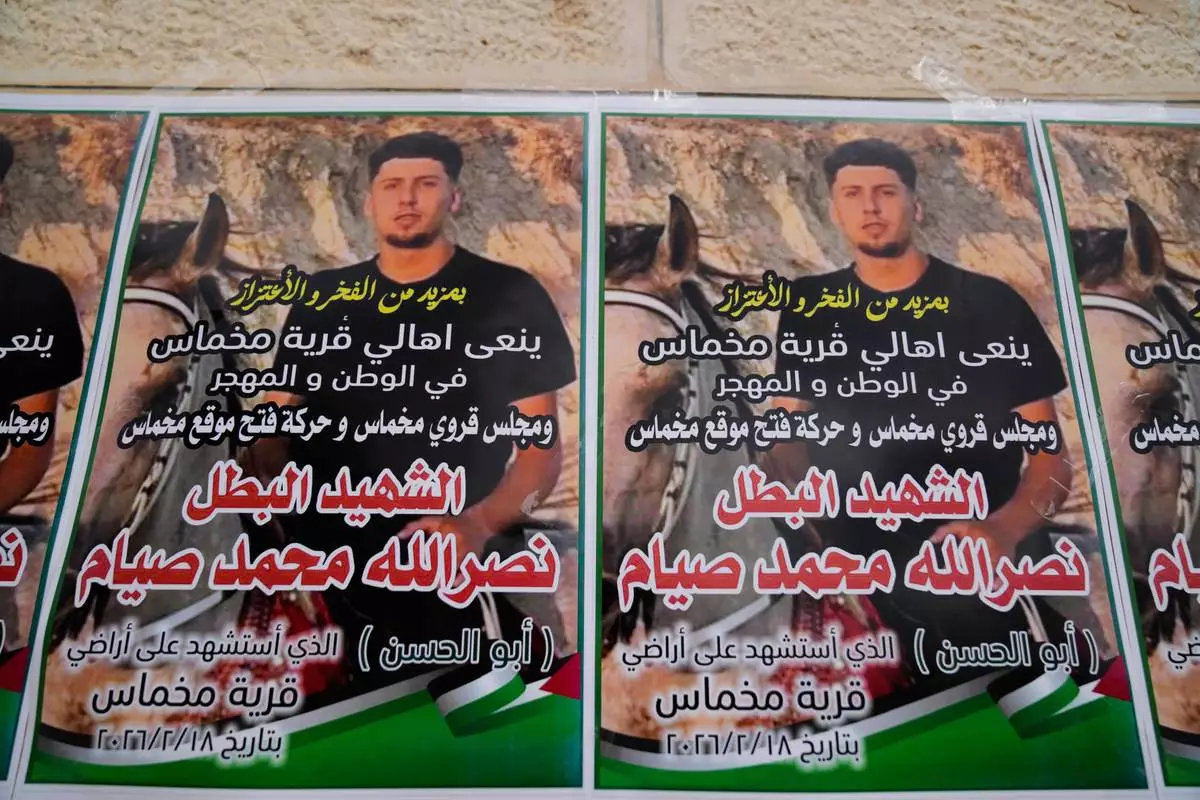
Posters with the name and picture of Palestinian-American Nasrallah Muhammad Jamal Abu Siyam, 19, who according to the Palestinian Health Ministry was shot by settlers on Wednesday night, are seen during his funeral in the West Bank village of Mukhmas, east of Ramallah, Thursday, Feb. 19, 2026. (AP Photo/Nasser Nasser)
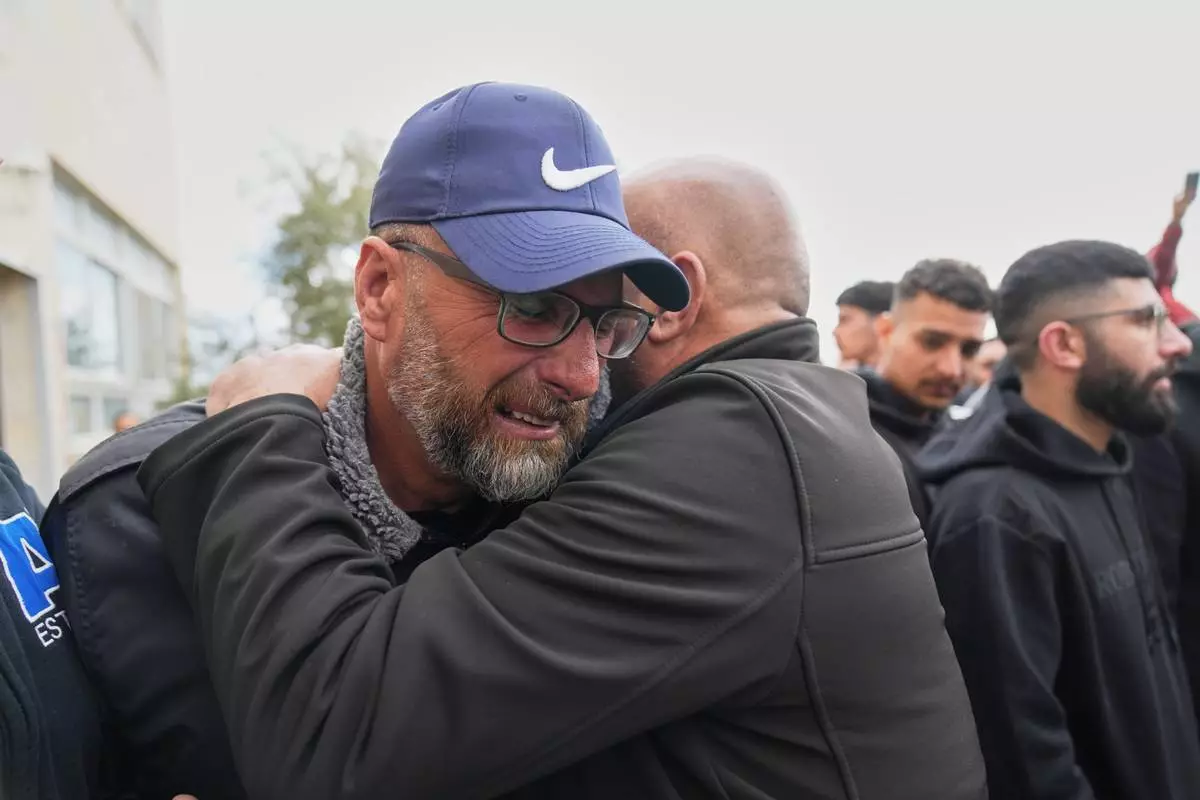
Mourners give condolences to Mohammad Abu Siyam, the father of Palestinian-American Nasrallah Abu Siyam, 19, who according to the Palestinian Health Ministry was shot by settlers on Wednesday night, during his funeral in the West Bank village of Mukhmas, east of Ramallah, Thursday, Feb. 19, 2026. (AP Photo/Nasser Nasser)
President Donald Trump announced Thursday at the inaugural Board of Peace meeting that nine members have agreed to pledge a combined $7 billion toward a Gaza relief package, while five countries have agreed to deploy troops to take part in an international stabilization force to the war-battered Palestinian territory.
But $7 billion is only a fraction of the estimated $70 billion needed to rebuild Gaza, where a shaky ceasefire deal looms over Trump’s ambitions for his board to rival the United Nations in solving world conflicts.
Trump also announced the U.S. was pledging $10 billion for the Board of Peace but didn’t specify what the money will be used for.
Instead, the president is turning his focus to domestic issues: In an hour, he’ll arrive in Georgia for a trip designed to help boost Republicans’ political standing heading into the midterms.
The Latest:
The Trump administration last week made a $160 million partial payment of its past dues to the United Nations regular budget, U.N. spokesperson Stephane Dujarric told the Associated Press.
The payment comes as Trump adjourned his first meeting Thursday of the Board of Peace, a new initiative many see as his attempt to replace the U.N. Security Council’s role in preventing and ending conflict around the world.
U.N. Secretary-General Antonio Guterres had warned earlier this month that the world body faces “imminent financial collapse” unless its financial rules are overhauled or all 193 member nations pay their dues, a message clearly directed at the United States.
The U.S. owes $2.196 billion to the U.N.’s regular operating budget, including $767 million for this year, according to a U.N. official. The U.S. also owes $1.8 billion for the separate budget for the U.N.’s far-flung peacekeeping operations, and that also will rise.
It wasn’t only heads of state who offered major contributions to Trump’s Board of Peace.
FIFA president Giovanni Infantino outlined a new plan by the world’s governing body of football — “soccer” for those who live in the U.S. — to bring new sports opportunities to war-torn Gaza.
“We don’t have to rebuild houses or schools or hospitals or roads,” Infantino said. “We also have to rebuild and build people, emotion, hope and trust. And this is what football, my sport, is about.”
Specifically, FIFA pledged to spend $50 million for a national football stadium in Gaza to hold between 20,000 and 25,000 spectators in addition to a FIFA academy at a cost of $15 million. The organization also vowed to build 50 “FIFA arena mini pitches” and five full-sized pitches at a total cost of $7.5 million.
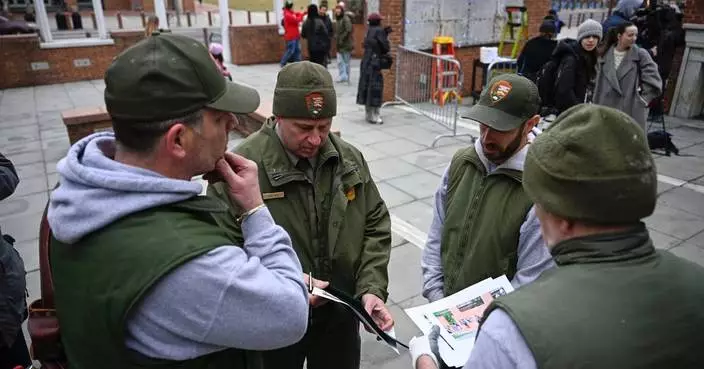
Workers are restoring an exhibit depicting the history of the nine people once enslaved in Philadelphia amid a legal fight between the city and the Trump Administration.
Mayor Cherelle Parker visited the site Thursday morning and saw the work being done, spokesperson Joe Grace said.
A federal judge had set a Friday deadline for the Interior Department to restore the exhibit on the people enslaved by George Washington at the former President’s House on Independence Mall.
Senior U.S. District Judge Cynthia Rufe issued the deadline Wednesday even as the Justice Department appeals her order to reinstate the exhibit.
In the last of several statements made about the United Nations, Trump ended his inaugural meeting Thursday by hinting that the U.S. -- the world body’s largest donor -- will be making more changes to the institution, including to the appearance of its headquarters in New York.
Many world leaders and diplomats have been worried that Trump’s new initiative was an attempt to eclipse the U.N. Security Council. But Trump attempted to assuage those concerns, saying that the U.S. will “work again with the United Nations and, bring it back to health.”
He added that his administration plans to “fix up even the building.”
“I like to see beautiful buildings. I like to see buildings fixed up physically, not look like they are in disrepair,” Trump said. “We don’t like that. So we’re going to do a job with the United Nations.”
Billionaire investor Marc Rowan, a member of the Board of Peace’s executive committee, said reconstruction would begin in Gaza’s southern city of Rafah.
He said 100,000 homes for 500,000 people, about a quarter of Gaza’s population, were initially planned, along with $5 billion of infrastructure. He said “over time,” 400,000 new homes for Gaza’s entire population were planned, with $30 billion in infrastructure projects.
He gave no timeline for when construction would begin.
“This is not a problem of money or collateral,” he said. “This is a problem of peace.”
In an hourslong meeting, leaders from various countries, including Peru, Bahrain and Pakistan, spent most of their speaking time praising Trump and what they called his “unprecedented” ability to end conflicts around the world.
Pakistan called him the “savior of South Asia,” while others said that years of U.S. foreign policy efforts by his predecessor failed to do what Trump has done in the last year.
The glowing remarks that went around from each corner of the globe resembled the same format and tone of Trump’s Cabinet meetings, which involve less policy substance and more adulation for the Republican president.
Israeli Prime Minister Benjamin Netanyahu reiterated his pledge that Gaza will not be rebuilt until Hamas disarms.
“We agreed with our friends in the United States: There will be no reconstruction of the Gaza Strip before the demilitarization of the Gaza Strip,” he said in a speech to graduating officers at an army base in southern Israel.
“Soon, Hamas will face a dilemma: disarm the easy way — or disarm the hard way. But it will be disarmed, and Gaza will no longer threaten Israel.”
Iran held annual military drills with Russia on Thursday as a second American aircraft carrier drew closer to the Middle East, with both the United States and Iran signaling they are prepared for war if talks on Tehran’s nuclear program fizzle out.
Trump said he hopes to reach a deal with Iran, but the talks have been deadlocked for years, and Iran has refused to discuss wider U.S. and Israeli demands that it scale back its missile program and sever ties to armed groups. Indirect talks held in recent weeks made little visible progress, and one or both sides could be buying time for final war preparations.
Iran’s theocracy is more vulnerable than ever, following 12 days of Israeli and U.S. strikes on its nuclear sites and military last year, as well as mass protests in January that were violently suppressed. But it is still capable of striking Israel and U.S. bases, and has warned that any attack would trigger a regional war.
▶ Read more
Despite repeatedly underscoring the importance of preventing and ending conflict, Trump made several pointed remarks during his Board of Peace meeting directed at Iran as the U.S. has amassed a significant military in the region.
The Republican president stood in front of many of the same regional allies who have pressured the U.S. in the last few weeks to not take military action against Iran and once again warned its longtime adversary to come to the table with an acceptable deal or face the consequences.
“We have to make a meaningful deal. Otherwise bad things happen,” Trump said.
The inaugural meeting of Trump’s Board of Peace comes perhaps ironically at a time of high tension between the United States and Iran and one of the largest U.S. military buildups in the Middle East in decades, with one aircraft carrier group in the region already and another on the way.
The military moves have coincided with the series of threats Trump has made to Iran if it does not accede to his demands to denuclearize, give up ballistic missiles and halt funding extremist proxy groups.
Maj. Gen. Jasper Jeffers, the leader of the newly-created International Stabilization Force, announced that Indonesia, Morocco, Kazakhstan, Kosovo and Albania have all pledged troops to the effort. In addition, Egypt and Jordan, which border the Gaza Strip, have agreed to train the police and security forces.
“With these first steps, we help bring the security that Gaza needs for a future of prosperity and enduring peace,” Jeffers said.
The U.S. Commission of Fine Arts unanimously approved Trump’s proposal, despite raising concerns at the panel’s January meeting. Some commissioners had questioned the lead architect about its “immense” design and scale, roughly twice the size of the White House itself.
Trump’s demolition of the East Wing prompted a public outcry when it began without the independent reviews, congressional approval and public comment typical for even relatively minor modifications to historic buildings in Washington.
The National Trust for Historic Preservation has sued in federal court to halt construction. And the project is scheduled for additional discussion at a March 5 meeting of the National Capital Planning Commission, now led by one of Trump’s top aides.
The vice president nodded to domestic politics heading into the midterm elections in his brief statement to the board.
“The reason that we’re here today is yes to save lives and yes to promote peace, but this creates incredible prosperity for the American people,” Vance said.
He said the countries represented on the board represent “trillions of dollars of investment” in the U.S., and support millions of American jobs by buying goods made in America.
The direct line between the Board of Peace and the U.S. economy is not completely clear. Trump’s trade war has strained economic relations with several major U.S. allies.
The Republican president repeated his concerns and criticism of the United Nations during his Board of Peace meeting, saying the UN should have been more involved in conflict-solving than it has been.
But, Trump also said that the U.S. is going “to be working with the United Nations very close.”
“Someday I won’t be here. The United Nations will be, I think, is going to be much stronger,” he said. “The Board of Peace is gonna almost be looking over the United Nations, and making sure it runs properly.”
Trump also announced the U.S. is pledging $10 billion for the Board of Peace, but didn’t specify what the money will be used for.
“The Board of Peace is showing how a better future can be built, starting right here in this room,” Trump said.
Kazakhstan, Azerbaijan, UAE, Morocco, Bahrain, Qatar, Saudi Arabia, Uzbekistan and Kuwait are the countries that are making pledges, Trump said.
“But every dollar spent is an investment in stability and the hope of new and harmonious (region),” said Trump in thanking the donors.
The amount, while significant, represents a fraction of the estimated $70 billion needed to rebuild the Palestinian territory decimated after two years of war.
Shouting out all of the various conflicts he says he solved, Trump mentioned that Iran is “a hot spot right now.” He said his envoys have had “very interesting” meetings with Iranian officials.
His positive comments come as the two adversaries have leaned into gunboat diplomacy in recent weeks, with nuclear talks between the nations hanging in the balance, Tehran holding drills with Russia and the Americans bringing another aircraft carrier closer to the Mideast.
“It’s proven to be, over the years, not easy to make a meaningful deal with Iran, and we have to make a meaningful deal. Otherwise bad things happen,” Trump said.
Trump is fueling the rivalry between the two members of his administration considered the front-runners to replace him as the GOP’s next presidential nominee: Secretary of State Marco Rubio and Vice President JD Vance.
Trump described Vance as “a fantastic man” and a “fantastic talent” before running through the highlights of the vice president’s education and marriage and noting that Vance “gets a little bit tough on occasion.”
The president then pivoted to Rubio, calling his leadership style “the opposite extreme. ... Marco does it with a velvet glove, but it’s a kill.”
Trump then praised Rubio’s performance at the Munich Security Conference this week, joking that if he did his job any better he’d be fired for outshining him.
Much can change in the two years before voters pick the GOP’s 2028 presidential nominee. The Constitution bars Trump from seeking a third term.
A week after Trump blasted him as a RINO, short for Republican In Name Only, Oklahoma Gov. Kevin Stitt struck a conciliatory tone toward the White House.
“Politics is tough,” Stitt said Thursday at an event sponsored by Politico at the outset of the National Governors Association’s annual meeting. “Politics has a way of just beating you down over time so I can’t imagine being president of the United States. He’s got a tough job to do.”
Stitt is the president of the NGA this year. The group, made up of governors from both parties, is typically one of the few bipartisan organizations to convene in Washington each year.
But this year’s meeting has been defined by tensions as Trump has refused to invite two Democratic governors to a business meeting at the White House. Trump said Stitt mischaracterized his position.
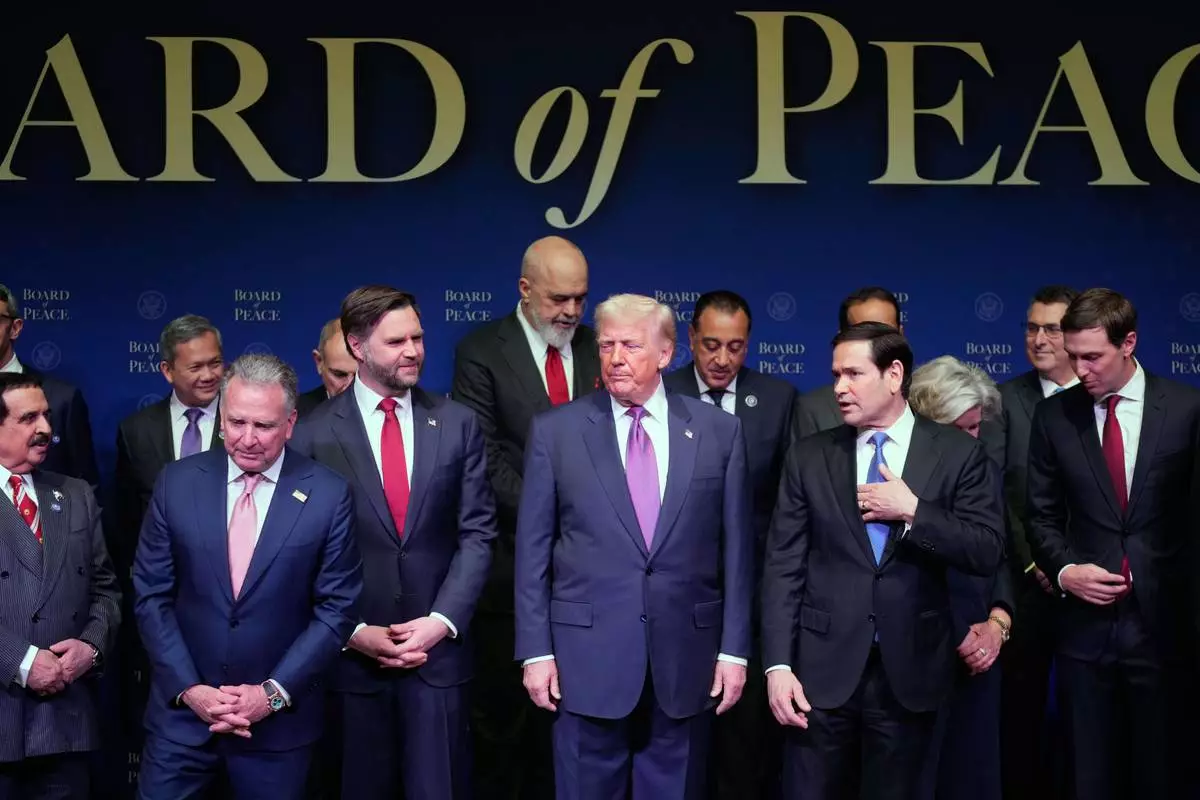
President Donald Trump, center, with Vice President JD Vance to his left, and Secretary of State Marco Rubio to his right, arrives for a Board of Peace meeting at the U.S. Institute of Peace, Thursday, Feb. 19, 2026, in Washington. (AP Photo/Mark Schiefelbein)
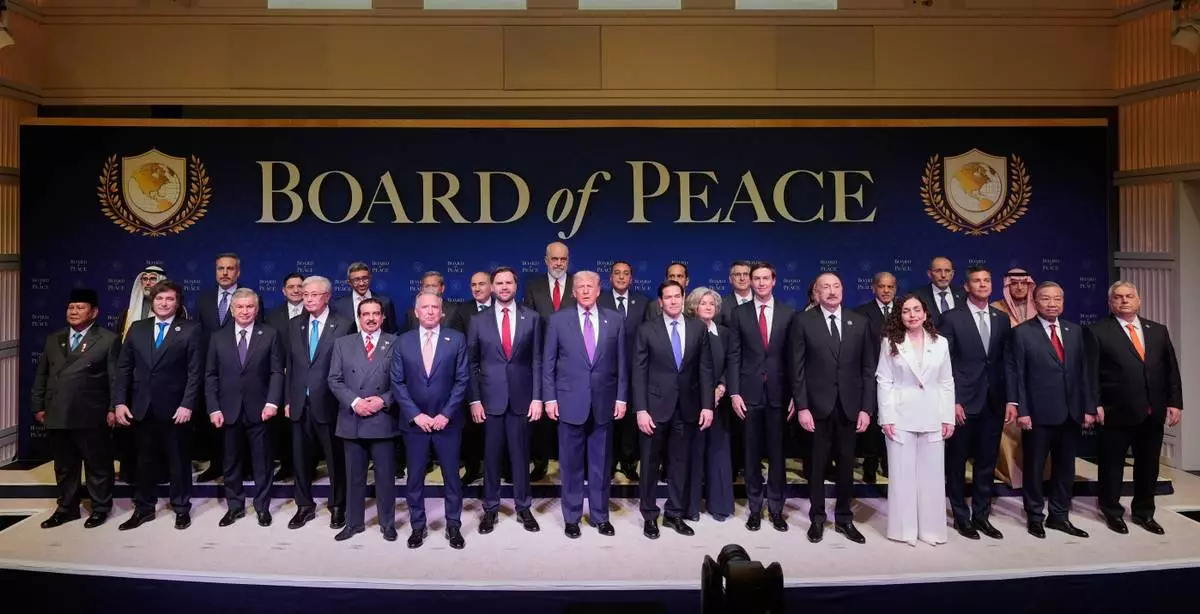
President Donald Trump stands with other World leaders before a Board of Peace meeting at the U.S. Institute of Peace, Thursday, Feb. 19, 2026, in Washington. (AP Photo/Mark Schiefelbein)
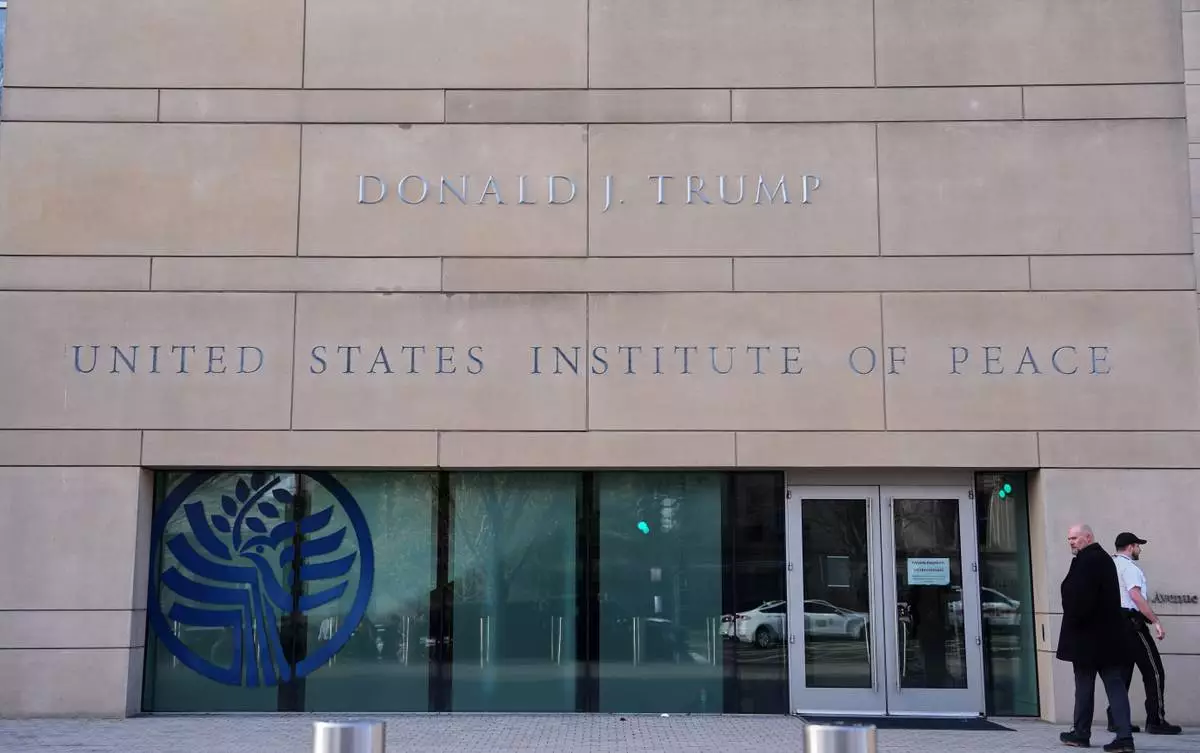
FILE - President Donald Trump's name is seen on the U.S. Institute of Peace building, Dec. 4, 2025, in Washington. (AP Photo/Evan Vucci, File)