Skip to Content Facebook Feature Image

Japan's traditional kimonos are being repurposed in creative and sustainable ways

ENT

Japan's traditional kimonos are being repurposed in creative and sustainable ways
ENT

ENT

Japan's traditional kimonos are being repurposed in creative and sustainable ways

2026-02-20 16:37 Last Updated At:16:41

TOKYO (AP) — The kimono, that elaborate, delicate wrap-around garment worn by geisha and samurai from centuries back, is getting a vibrant remake, appreciated these days for a virtue that’s more relevant than ever: sustainability.

A genuine silk kimono, which literally means “worn thing,” lasts a hundred years or more. In a Japanese family, it’s handed down over generations like heirloom jewelry, artworks and military medals.

More Images
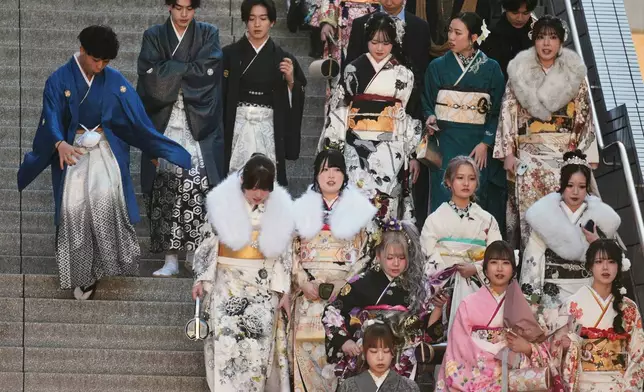
FILE - Young adults arrive at a venue to celebrate the Coming-of-Age Day, a centuries-old tradition and national holiday marking the milestone from childhood to adulthood, Jan. 12, 2026, in Yokohama near Tokyo. (AP Photo/Eugene Hoshiko, File)
FILE - Young adults arrive at a venue to celebrate the Coming-of-Age Day, a centuries-old tradition and national holiday marking the milestone from childhood to adulthood, Jan. 12, 2026, in Yokohama near Tokyo. (AP Photo/Eugene Hoshiko, File)

Nao Shimizu, Representative Director of Kimono Sunao Co., Ltd., left, demonstrates various ways of tying an obi on assistant Emiko Terai during a kimono presentation in Tokyo Tuesday, Nov. 11, 2025. (AP Photo/Eugene Hoshiko)
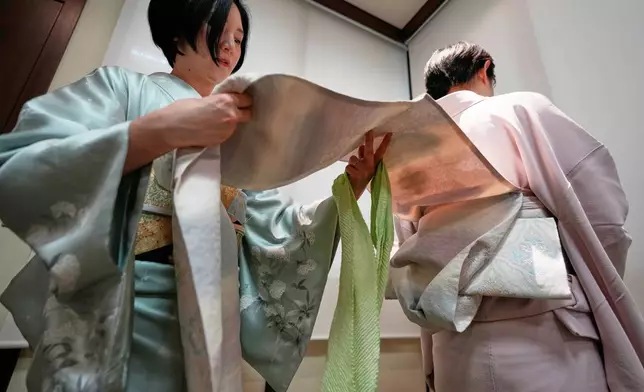
Nao Shimizu, Representative Director of Kimono Sunao Co., Ltd., left, demonstrates various ways of tying an obi on assistant Emiko Terai during a kimono presentation in Tokyo Tuesday, Nov. 11, 2025. (AP Photo/Eugene Hoshiko)

Nao Shimizu, Representative Director of Kimono Sunao Co., Ltd., left, demonstrates various ways of tying an obi on Emiko Terai during a kimono presentation in Tokyo on Tuesday, Nov. 11, 2025. (AP Photo/Eugene Hoshiko)
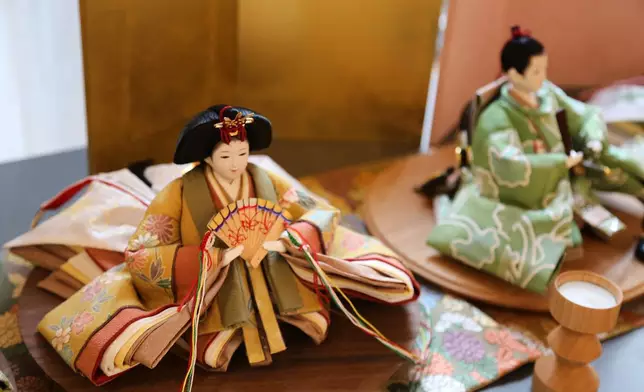
Nao Shimizu, Representative Director of Kimono Sunao Co., Ltd., left, demonstrates various ways of tying an obi on Emiko Terai during a kimono presentation in Tokyo on Tuesday, Nov. 11, 2025. (AP Photo/Eugene Hoshiko)

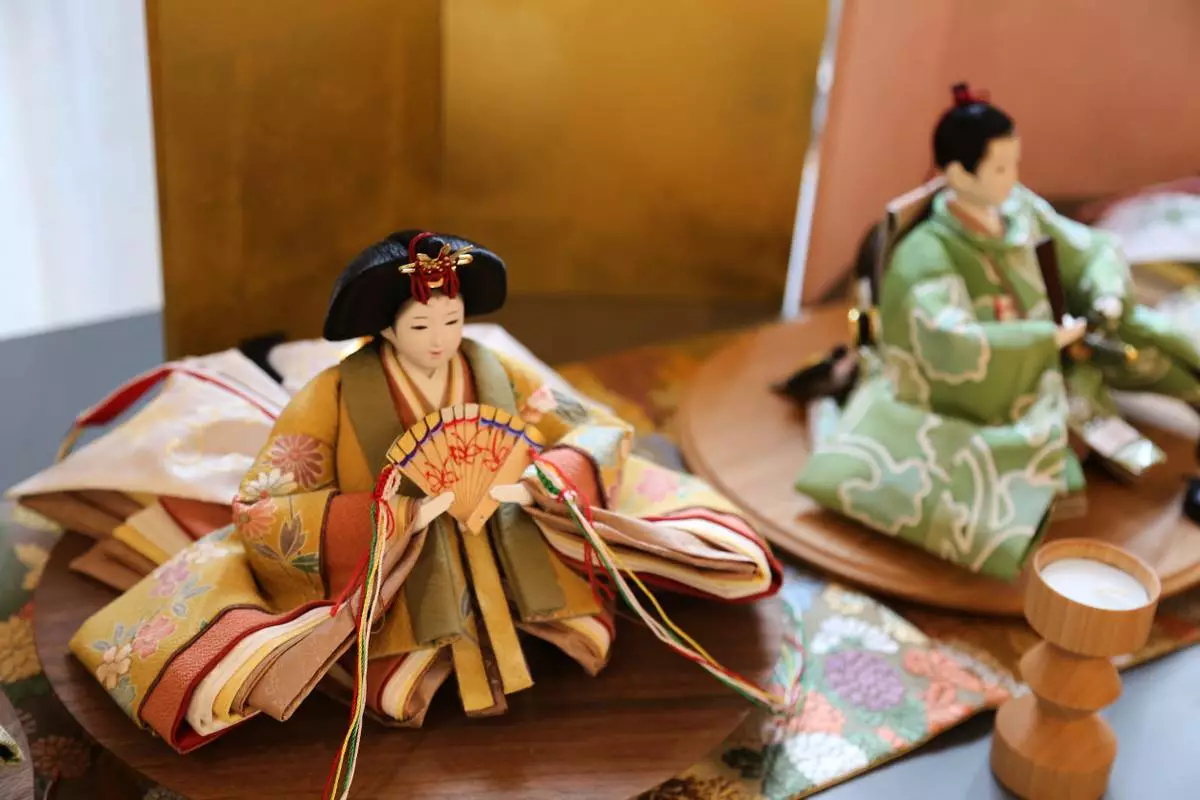
Dolls dressed in miniature kimonos made by designer Tomoko Ohkata from recycled kimonos are pictured in Tokyo, on Jan. 15, 2026. (AP Photo/Yuri Kageyama)
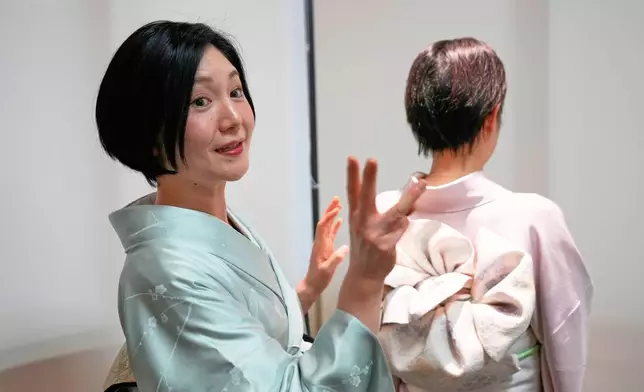
Dolls dressed in miniature kimonos made by designer Tomoko Ohkata from recycled kimonos are pictured in Tokyo, on Jan. 15, 2026. (AP Photo/Yuri Kageyama)

Nao Shimizu, Representative Director of Kimono Sunao Co., Ltd., left, demonstrates various ways of tying an obi on dressing assistant Emiko Terai during a kimono presentation in Tokyo on Tuesday, Nov. 11, 2025. (AP Photo/Eugene Hoshiko)
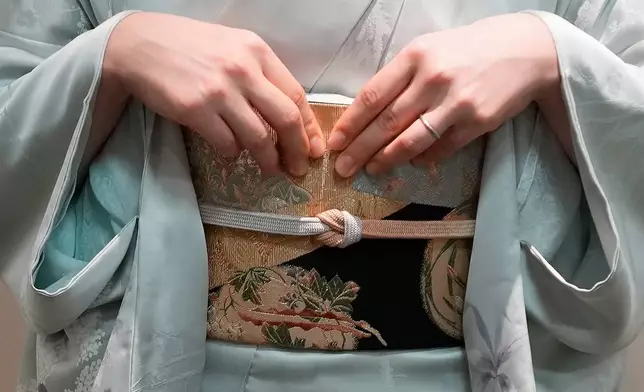
Nao Shimizu, Representative Director of Kimono Sunao Co., Ltd., left, demonstrates various ways of tying an obi on dressing assistant Emiko Terai during a kimono presentation in Tokyo on Tuesday, Nov. 11, 2025. (AP Photo/Eugene Hoshiko)

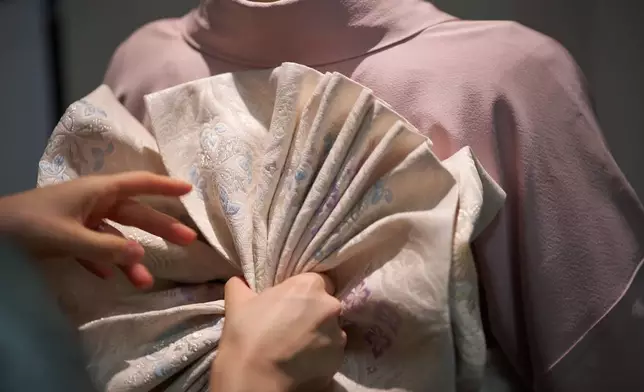
A woman displays a kimono in Tokyo Tuesday, Nov. 11, 2025. (AP Photo/Eugene Hoshiko)
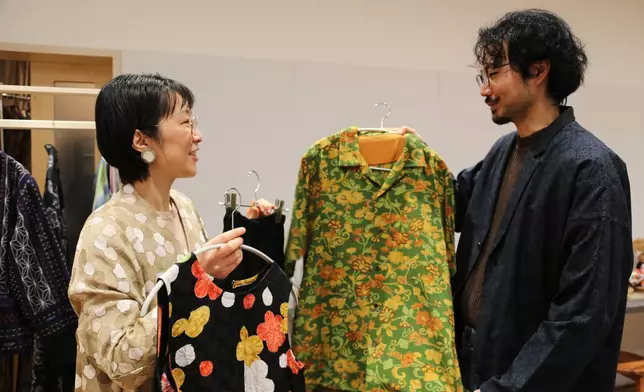
A woman displays a kimono in Tokyo Tuesday, Nov. 11, 2025. (AP Photo/Eugene Hoshiko)

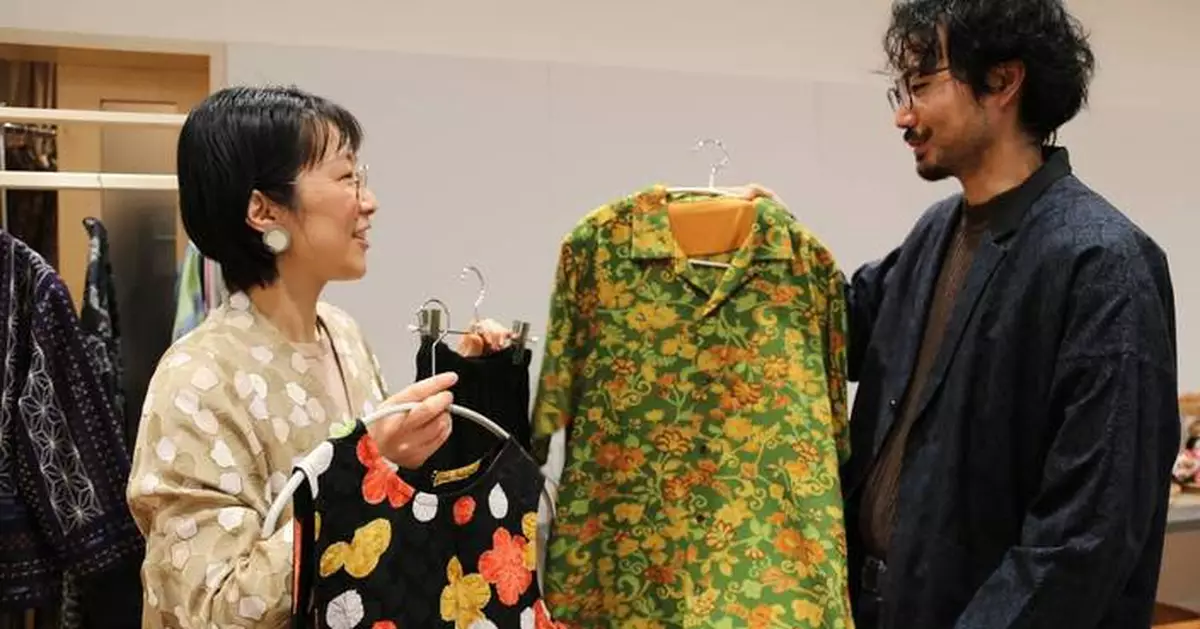
Designer Tomoko Ohkata, left, and her assistant Koki Unami hold Ohkata's designs made from old kimono, in Tokyo, on Jan. 15, 2026. (AP Photo/Yuri Kageyama)

Designer Tomoko Ohkata, left, and her assistant Koki Unami hold Ohkata's designs made from old kimono, in Tokyo, on Jan. 15, 2026. (AP Photo/Yuri Kageyama)

It never goes out of style.

The design of the kimono and accompanying “obi” sash has remained basically the same since the 17th century Edo period depicted in Akira Kurosawa samurai movies.

But today, some people are taking a different creative approach, refashioning the traditional kimono, and also taking apart and resewing them as jackets, dresses and pants.

“I noticed that a lot of beautiful kimono is just sleeping in people’s closets. That’s such a waste,” said Mari Kubo, who heads a kimono-remake business called K’Forward, pronounced “K dash forward.”

Hers is among a recent surge in such services, which also turn old kimono into tote bags and dolls.

The most popular among Kubo’s products are “tomesode,” a type of formal kimono that is black with colorful, embroidered flowers, birds or foliage at the bottom.

She also creates matching sets, or what she calls “set-ups.” A tomesode is turned into a jacket with its long, flowing sleeves intact, and its intricate patterns placed at the center in the back. She then takes a kimono with a matching pattern to create a skirt or pants to go with the top. Sometimes, an obi is used at the collar to add a pop of color.

Kubo said many of her customers are young people who want to enjoy a kimono without the fuss.

A remade kimono at K’Forward can cost as much as 160,000 yen ($1,000) for a “furisode,” a colorful kimono with long sleeves meant for young unmarried women, while a black tomesode goes for about 25,000 yen ($160).

What Tomoko Ohkata loves most about the products she designs using old kimonos is that she doesn’t have to live with a guilty conscience, and instead feels she is helping solve an ecological problem.

“I feel the answer was right there, being handed down from our ancestors,” she said.

Recycling venues in Japan get thousands of old kimonos a day as people find them stashed away in closets by parents and grandparents. These days, Japanese generally wear kimonos just for special occasions like weddings. Many women prefer to wear a Western-style white wedding dress rather than the kimono, or they wear both.

Many of Ohkata’s clientele are people who have found a kimono at home and want to give it new life. They care about the story behind the kimono, she added.

Her small store in downtown Tokyo displays various dolls, including a figure of an emperor paired with his wife, who are traditionally brought out for display in Japanese homes for the Girls’ Day festival every March 3. Her dolls, however, are exquisitely dressed in recycled kimonos, tailored in tiny sizes to fit the dolls. They sell for 245,000 yen ($1,600) a pair.

The original old-style kimono is also getting rediscovered.

“Unlike the dress, you can arrange it,” says Nao Shimizu, who heads a school in Japan’s ancient capital of Kyoto that teaches people how to wear a kimono and how to carry oneself while wearing it.

“In half a year, you can learn how to do it all by yourself,” she said, briskly demonstrating several ways to tie the obi to express different moods, from playful to understated.

Besides its durability, said Shimizu, that versatility also makes the kimono sustainable.

Younger Japanese are taking a more relaxed view, wearing a kimono with boots, for instance, she laughed. Traditionally, kimono is worn with sandals called “zori.”

Although it requires some skill to put on a kimono in the traditional way, one can take lessons from teachers like Shimizu, like learning a musical instrument. Professional help is also available at beauty parlors, hotels and some shops.

Most Japanese might wear a kimono just a few times in their lives. But wearing one is a memorable experience.

Sumie Kaneko, a singer who plays the traditional Japanese instruments koto and shamisen, often performs wearing flashy dresses made of recycled kimonos. The idea of sustainability is deeply rooted in Japanese culture, she says, noting that the ivory and animal hide used in her musical instruments are now hard to obtain.

She calls it “the recycling of life.”

“The performer breathes new life into them,” says the New York-based Kaneko.

“In the same way, a past moment — and those patterns and colors that were once loved — can come back to life.”

Yuri Kageyama is on Threads: https://www.threads.com/@yurikageyama

This story has been corrected in the “Reuse and recycle” section to note that the male doll depicts an emperor, not a samurai.
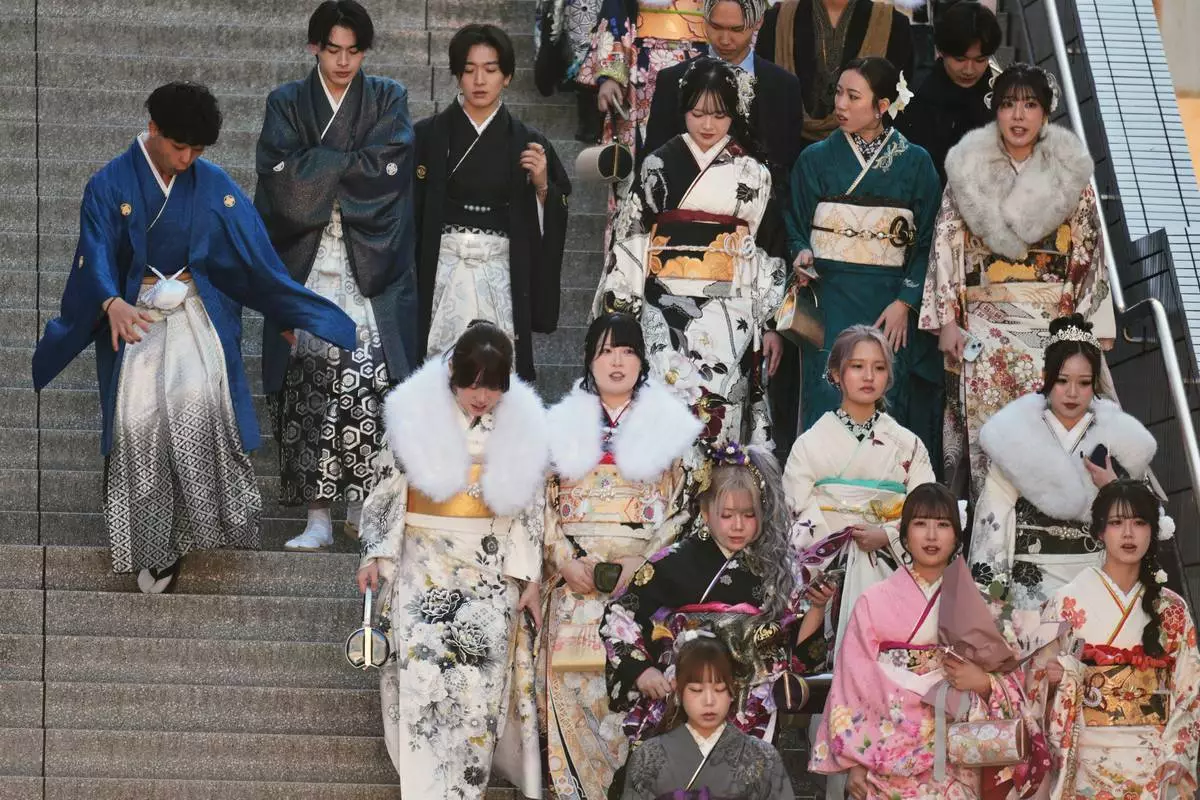
FILE - Young adults arrive at a venue to celebrate the Coming-of-Age Day, a centuries-old tradition and national holiday marking the milestone from childhood to adulthood, Jan. 12, 2026, in Yokohama near Tokyo. (AP Photo/Eugene Hoshiko, File)
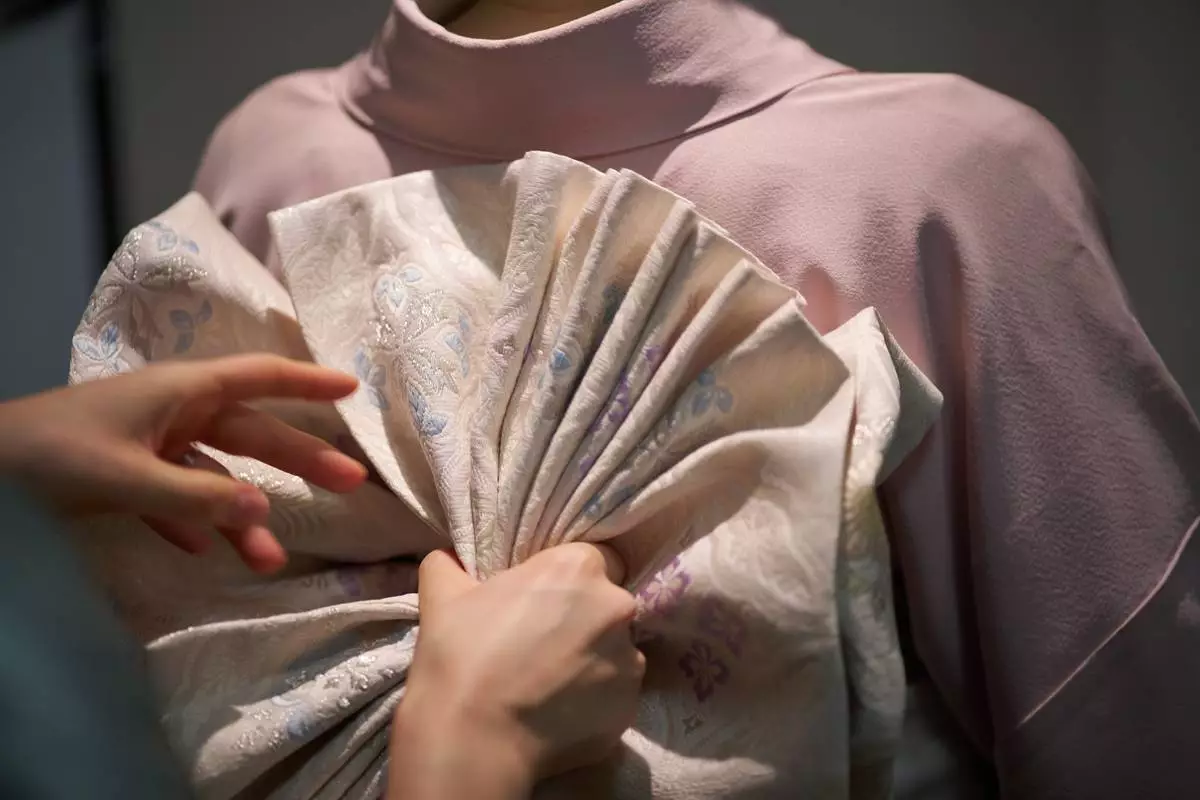
FILE - Young adults arrive at a venue to celebrate the Coming-of-Age Day, a centuries-old tradition and national holiday marking the milestone from childhood to adulthood, Jan. 12, 2026, in Yokohama near Tokyo. (AP Photo/Eugene Hoshiko, File)

Nao Shimizu, Representative Director of Kimono Sunao Co., Ltd., left, demonstrates various ways of tying an obi on assistant Emiko Terai during a kimono presentation in Tokyo Tuesday, Nov. 11, 2025. (AP Photo/Eugene Hoshiko)
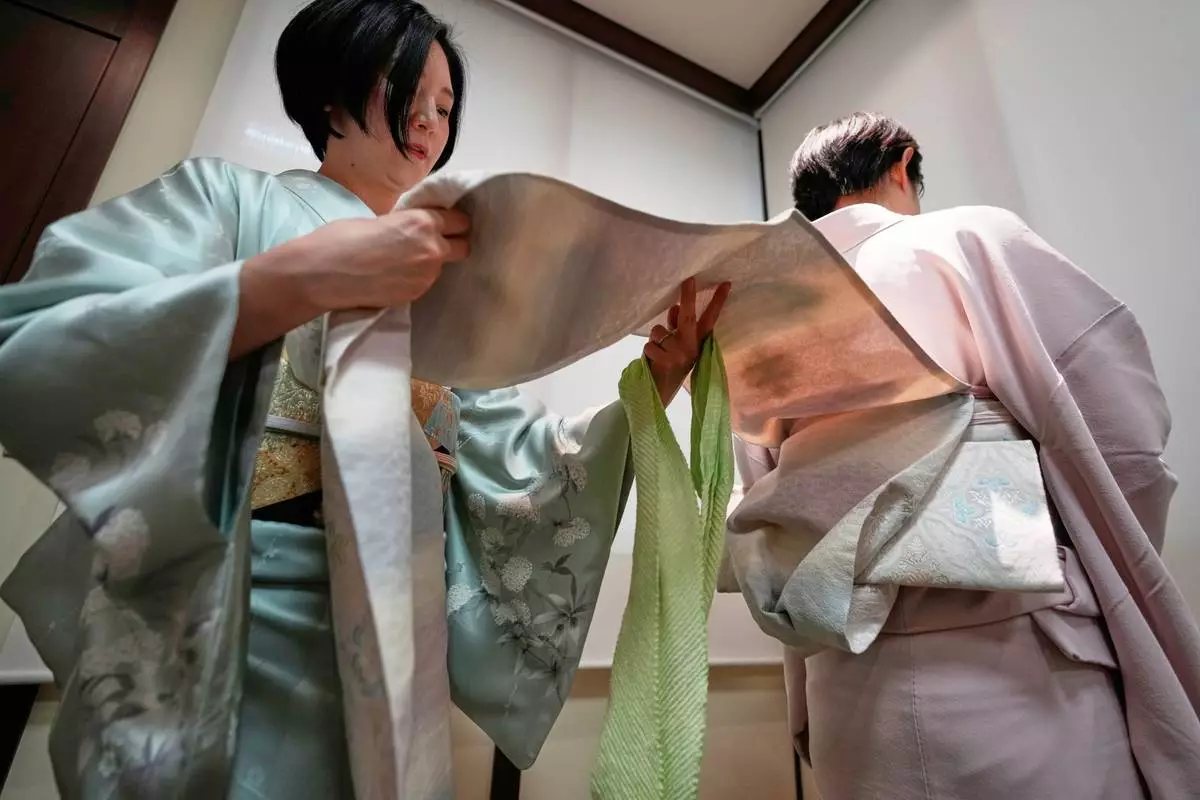
Nao Shimizu, Representative Director of Kimono Sunao Co., Ltd., left, demonstrates various ways of tying an obi on assistant Emiko Terai during a kimono presentation in Tokyo Tuesday, Nov. 11, 2025. (AP Photo/Eugene Hoshiko)

Nao Shimizu, Representative Director of Kimono Sunao Co., Ltd., left, demonstrates various ways of tying an obi on Emiko Terai during a kimono presentation in Tokyo on Tuesday, Nov. 11, 2025. (AP Photo/Eugene Hoshiko)
Nao Shimizu, Representative Director of Kimono Sunao Co., Ltd., left, demonstrates various ways of tying an obi on Emiko Terai during a kimono presentation in Tokyo on Tuesday, Nov. 11, 2025. (AP Photo/Eugene Hoshiko)

Dolls dressed in miniature kimonos made by designer Tomoko Ohkata from recycled kimonos are pictured in Tokyo, on Jan. 15, 2026. (AP Photo/Yuri Kageyama)

Dolls dressed in miniature kimonos made by designer Tomoko Ohkata from recycled kimonos are pictured in Tokyo, on Jan. 15, 2026. (AP Photo/Yuri Kageyama)

Nao Shimizu, Representative Director of Kimono Sunao Co., Ltd., left, demonstrates various ways of tying an obi on dressing assistant Emiko Terai during a kimono presentation in Tokyo on Tuesday, Nov. 11, 2025. (AP Photo/Eugene Hoshiko)
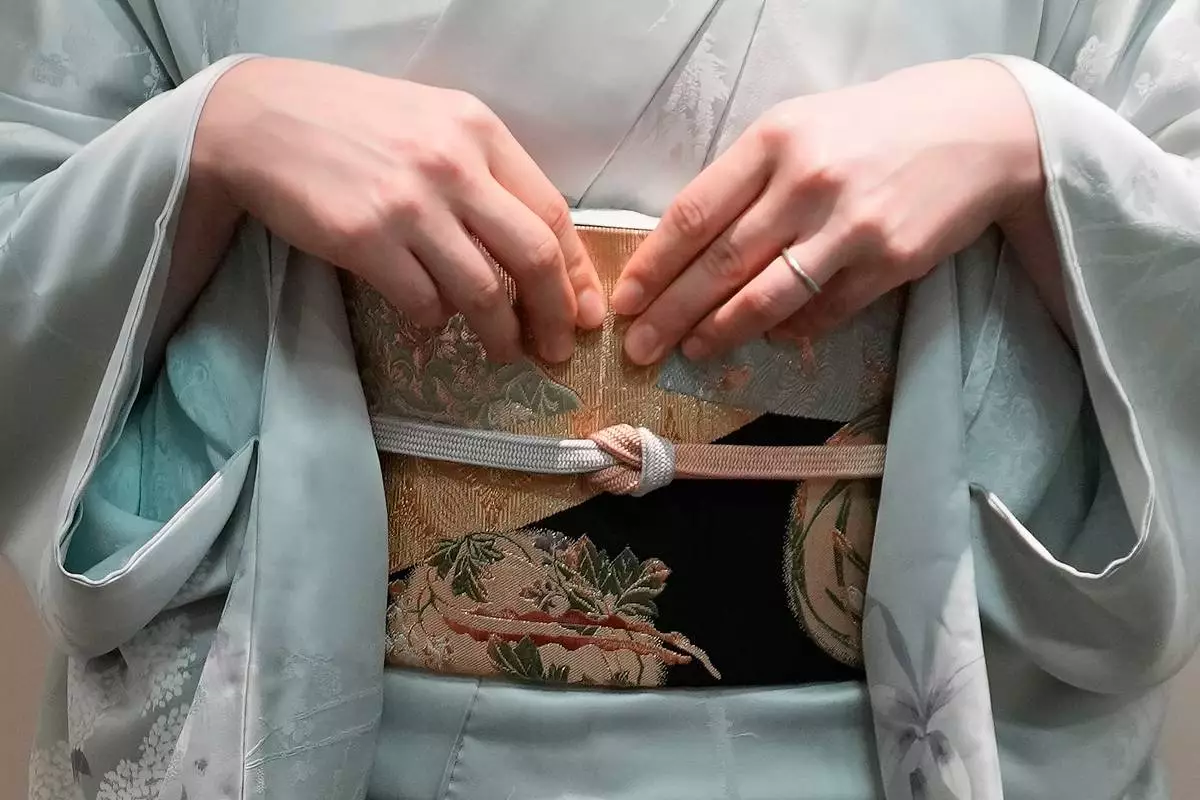
Nao Shimizu, Representative Director of Kimono Sunao Co., Ltd., left, demonstrates various ways of tying an obi on dressing assistant Emiko Terai during a kimono presentation in Tokyo on Tuesday, Nov. 11, 2025. (AP Photo/Eugene Hoshiko)

A woman displays a kimono in Tokyo Tuesday, Nov. 11, 2025. (AP Photo/Eugene Hoshiko)
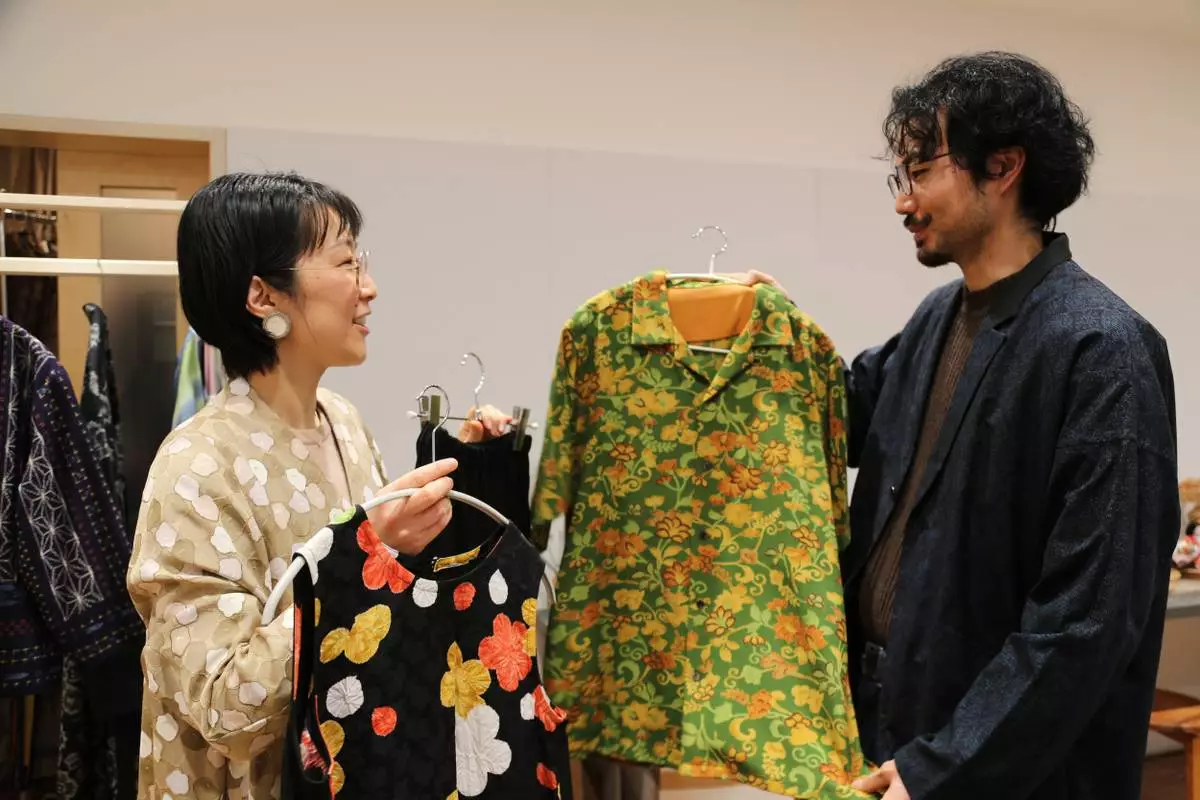
A woman displays a kimono in Tokyo Tuesday, Nov. 11, 2025. (AP Photo/Eugene Hoshiko)

Designer Tomoko Ohkata, left, and her assistant Koki Unami hold Ohkata's designs made from old kimono, in Tokyo, on Jan. 15, 2026. (AP Photo/Yuri Kageyama)


Designer Tomoko Ohkata, left, and her assistant Koki Unami hold Ohkata's designs made from old kimono, in Tokyo, on Jan. 15, 2026. (AP Photo/Yuri Kageyama)

MILAN (AP) — Hilary Knight is in her last Olympics, wrapping up a stretch as the face of women's hockey in the United States. Laila Edwards is in her first and could very well be Knight's successor.

The present and future of the sport combined on a spectacular tying goal late in the gold-medal game against Canada. Knight tipped Edwards' shot in with just over two minutes left in regulation, and Megan Keller's overtime goal sent the U.S. home with gold in its beloved 36-year-old captain's swan song at the Games.

"Couldn’t script it any better than that," teammate Rory Guilday said. “It’s pretty amazing.”

It was a storybook ending for Knight, who proposed to American speedskater Brittany Bowe on Wednesday. She acknowledged being more nervous about getting engaged than playing hockey.

Against Canada in the final, the nerves built up as the game went on and the U.S. trailed with time ticking off the clock. Knight did not want to settle for silver in her Olympic finale, and when the play was decided on before the next faceoff she thought: “Yeah, this is our moment. Here we go.”

The puck went to Edwards, and Knight knew she needed to get in front of the net because the defenseman was either going to shoot for a tip or right into the net. Fearing she'd miss again, Edwards aimed at Knight's stick and the veteran star sent the puck spinning through her legs and into the net.

“I knew I took a lot of high shots that game and it wasn’t going my way," Edwards said. "I knew we had a lot of traffic there, and so I get it to the net and Hilary’s there and she’ll take care of it, which she did.”

Edwards called it unbelievable to play a role in Knight's final goal at the Olympics, her 15th to give her sole possession of the U.S. record.

“Just to even be a very small part of what Hilary’s accomplished, I’m so honored,” Edwards said. "And to learn from her every day, it’s just been such a blessing.”

Knight won her second Olympic gold medal to go with three silvers. In many sports, finishing second is a major accomplishment, but for the U.S. and Canada in women's hockey it means a devastating loss in a bitter rivalry.

When the puck went in the net past goaltender Ann-Renee Desbiens, Knight said to herself, “We’re going to win the game." Now Knight gets to skate off into the sunset a champion again.

“I’ve said this is my last Games," Knight said. “I’ve had a heck of a week personally. It’s been an incredible ride. I have to soak this all in.”

Edwards is, too, with her family in attendance, but she's just 22 and should have many more Olympics ahead of her. That's the part that excites Knight as she passes the torch to Edwards and the next generation of Americans.

“Laila is just such a special person and means so much to this group and I’m so excited that everybody got to see her unleash her talents on the world stage,” Knight said. “It’s only fitting that there’s more of that to come with her.”

AP Winter Olympics: https://apnews.com/hub/milan-cortina-2026-winter-olympics

United States' Kendall Coyne, left, and United States' Hilary Knight celebrate after victory ceremony for women's ice hockey at the 2026 Winter Olympics, in Milan, Italy, Thursday, Feb. 19, 2026. (AP Photo/Hassan Ammar)

United States' Kendall Coyne, left, and United States' Hilary Knight celebrate after victory ceremony for women's ice hockey at the 2026 Winter Olympics, in Milan, Italy, Thursday, Feb. 19, 2026. (AP Photo/Hassan Ammar)

United States' players celebrate after a women's ice hockey gold medal game between the United States and Canada at the 2026 Winter Olympics, in Milan, Italy, Thursday, Feb. 19, 2026. (AP Photo/Petr David Josek)

United States' players celebrate after a women's ice hockey gold medal game between the United States and Canada at the 2026 Winter Olympics, in Milan, Italy, Thursday, Feb. 19, 2026. (AP Photo/Petr David Josek)

United States' Hilary Knight, second from left, celebrates after scoring a goal against Canada during the third period of the women's ice hockey gold medal game at the 2026 Winter Olympics, in Milan, Italy, Thursday, Feb. 19, 2026. (AP Photo/Carolyn Kaster)

United States' Hilary Knight, second from left, celebrates after scoring a goal against Canada during the third period of the women's ice hockey gold medal game at the 2026 Winter Olympics, in Milan, Italy, Thursday, Feb. 19, 2026. (AP Photo/Carolyn Kaster)

United States' Hilary Knight (21) celebrates with Laila Edwards (10) after Knight deflected a shot by Edwards for a goal against Canada during the third period of the women's ice hockey gold medal game at the 2026 Winter Olympics, in Milan, Italy, Thursday, Feb. 19, 2026. (AP Photo/Carolyn Kaster)

United States' Hilary Knight (21) celebrates with Laila Edwards (10) after Knight deflected a shot by Edwards for a goal against Canada during the third period of the women's ice hockey gold medal game at the 2026 Winter Olympics, in Milan, Italy, Thursday, Feb. 19, 2026. (AP Photo/Carolyn Kaster)

United States' Hilary Knight (21) celebrates after scoring an equalizer during a women's ice hockey gold medal game between the United States and Canada at the 2026 Winter Olympics, in Milan, Italy, Thursday, Feb. 19, 2026. (AP Photo/Petr David Josek)

United States' Hilary Knight (21) celebrates after scoring an equalizer during a women's ice hockey gold medal game between the United States and Canada at the 2026 Winter Olympics, in Milan, Italy, Thursday, Feb. 19, 2026. (AP Photo/Petr David Josek)

Recommended Articles