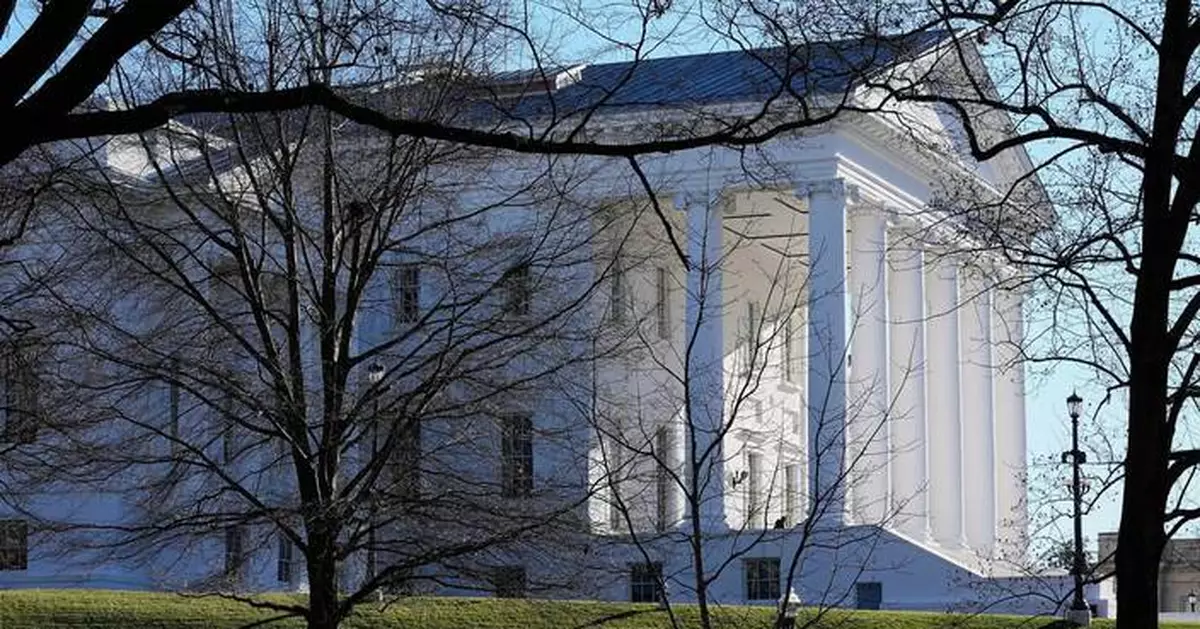
RICHMOND, Va. (AP) — Democrats passed a new congressional map through the Virginia legislature on Friday that aims to help their party win four more seats in the national redistricting battle. It's a flex of state Democrats' political power, however hurdles remain before they can benefit from friendlier U.S. House district boundaries in this year's midterm elections.
A judge in Tazewell, a conservative area in Southwest Virginia, has effectively blocked a voter referendum on the redrawn maps from happening on April 21 by granting a temporary restraining order, issued Thursday.
Democrats are appealing that decision and another by the same judge, who ruled last month that Democrats illegally rushed the planned voter referendum on their constitutional amendment to allow the remapping. The state's Supreme Court picked up the party's appeal of the earlier ruling.
The judge's order prohibits officials from preparing for the referendum through March 18. But early voting for it was slated to start March 6, meaning Democrats would have to get a favorable court ruling within two weeks to stick with that timeline.
If Democrats get to carry out a referendum, voters will choose whether to temporarily adopt new congressional districts and then return to Virginia's standard process after the 2030 census. Democrats wanted to publish the new map ahead of the April vote.
President Donald Trump launched an unusual mid-decade redistricting battle last year by pushing Republican officials in Texas to redraw districts to help his party win more seats. The goal was for the GOP to hold on to a narrow House majority in the face of political headwinds that typically favor the party out of power in midterms.
Instead, it created a burst of redistricting efforts nationwide. So far, Republicans believe they can win nine more House seats in Texas, Missouri, North Carolina and Ohio. Democrats think they can win six more seats in California and Utah, and are hoping to fully or partially make up the remaining three-seat margin in Virginia.
Democratic lawmakers in Virginia have sought to portray their redistricting push as a response to Trump's overreach.
“The president of the United States, who apparently only one half of this chamber knows how to stand up to, basically directed states to grab power,” Virginia's Democratic Senate Majority Leader Scott Surovell said in February. “To basically maintain his power indefinitely — to rig the game, rig the system.”
Republicans have sounded aghast. House Minority Leader Terry Kilgore described the remap as a way for liberals in northern Virginia's Arlington, Fairfax and Prince William counties to commandeer the rest of the state.
“In southwest Virginia, we have this saying ... They say, ‘Terry, you do a good job up there, but you know, Virginia stops at Roanoke,” Kilgore previously said, referring to how some people across Virginia's Appalachian region feel unrepresented in state politics. “That’s not going to be the same saying anymore, because Virginia is now going to stop just a little bit west of Prince William County.”
Virginia is currently represented in the U.S. House by six Democrats and five Republicans who ran in districts imposed by a court after a bipartisan legislative commission failed to agree on a map after the 2020 census.
Legislation that would put the Democrats' more gerrymandered map into effect if voters approve the referendum now awaits the signature of Democratic Gov. Abigail Spanberger, who has indicated that she would support it.
“Virginia has the opportunity and responsibility to be responsive in the face of efforts across the country to change maps,” Spanberger said as she approved the referendum.
Democratic candidates are already lining up in anticipation. “Dopesick” author Beth Macy and former U.S. Rep. Tom Perriello launched campaigns in red areas that would be moved into districts with more registered Democrats.
Virginia Del. Dan Helmer and former federal prosecutor J.P. Cooney, who helped investigate Trump and was fired by him, have launched campaigns in a formerly rural district that would now mostly include voters just outside the nation's capital. And former Democratic congresswoman Elaine Luria is mounting a comeback against Republican Rep. Jen Kiggans, who ousted her in 2022, in a competitive district that the map has made slightly more favorable to Democrats.
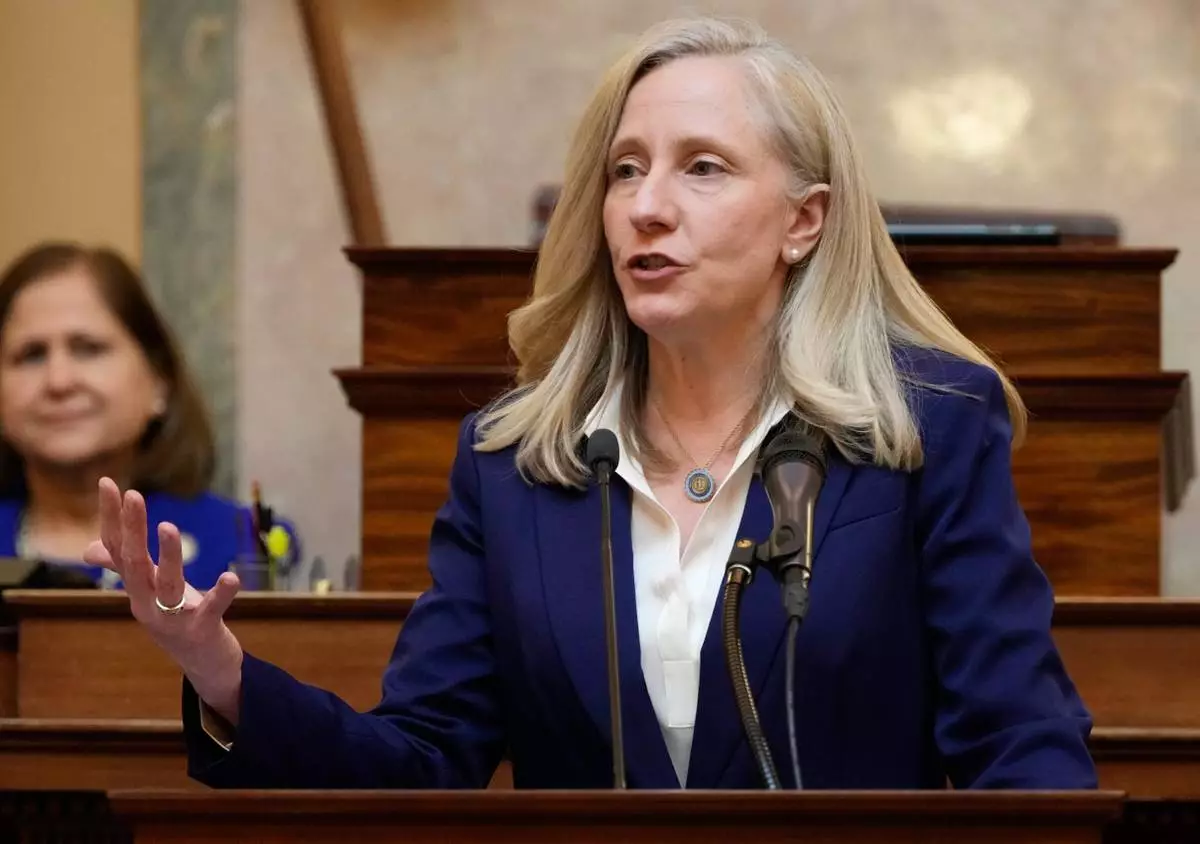
FILE - Virginia Gov. Abigail Spanberger delivers her State of the Commonwealth address before a joint session of the Virignia General Assembly at the Capitol, Jan. 19, 2026, in Richmond, Va. (AP Photo/Steve Helber, File)
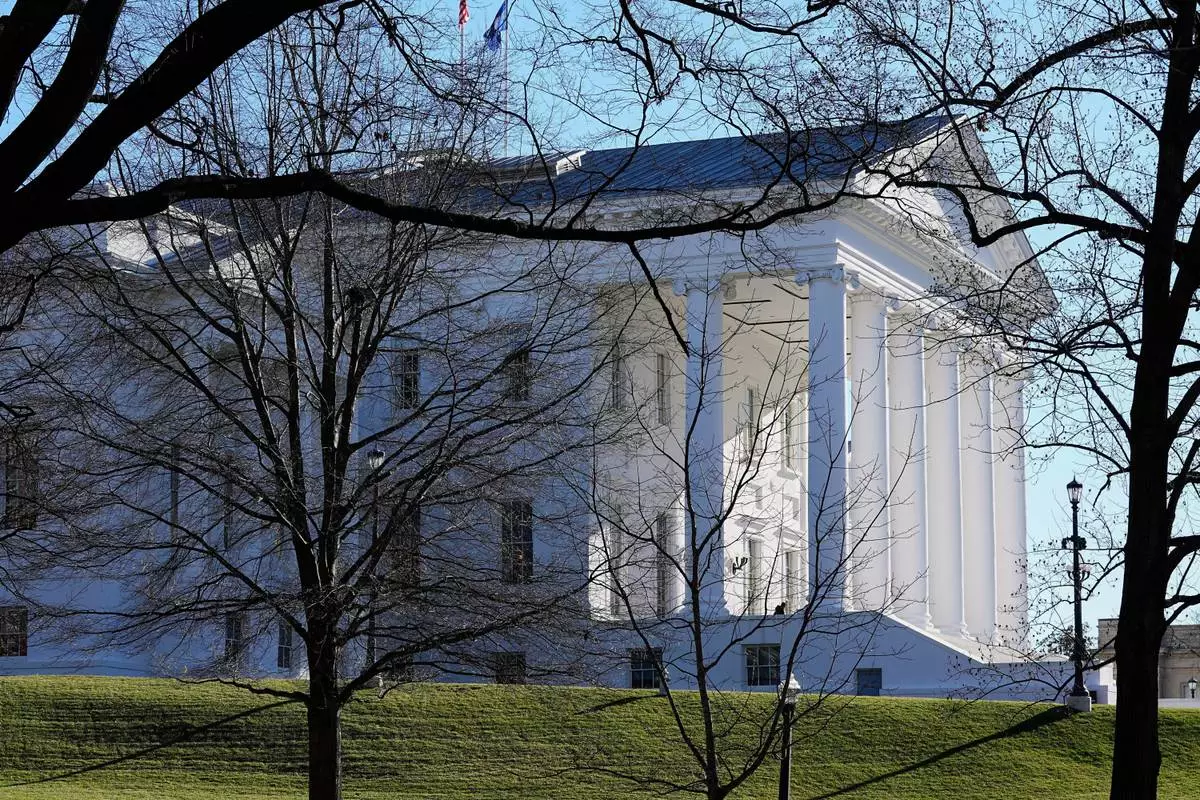
FILE - The state and U.S. flags fly over the Virginia State Capitol at the start of the 2024 session of the Virginia General Assembly in Richmond, Va., on Jan. 10, 2024. (AP Photo/Steve Helber, File)
WASHINGTON (AP) — President Donald Trump paid a price for going it alone on tariffs — with the Supreme Court on Friday delivering a rare rebuke by ruling he lacked the power to declare an economic emergency and launch sweeping new taxes on imports.
Trump had made tariffs the bedrock of his economic pitch to voters going into the midterm elections, even describing tariffs as his “favorite word in the dictionary.” He promised that factories would relocate from overseas and bring jobs with them, and he warned that losing the tariffs could plunge the U.S. into a deep recession.
But Friday’s ruling will most likely prolong political and economic chaos over international trade through the election year.
Trump called the decision “a disgrace” after he was handed a note informing him of the Supreme Court decision during a private meeting with several governors, according to two people with knowledge of the president's reaction who spoke on the condition of anonymity. Another person, who was briefed on the conversation, disclosed that Trump said he has “to do something about these courts.”
The meeting with the governors ended shortly after Trump learned of the decision.
Trump is expected to address the ruling publicly during an afternoon press conference.
Republican strategist Doug Heye said it was immediately clear that the president “is not going to be happy" about the decision.
“We’re starting to hear about how this is a massive blow, a massive repudiation," he said.
However, Heye said Trump will try to find another way to pursue his trade agenda.
“Are they going to be able to figure out how to use this as an opportunity or not?" he asked. "There are too many questions.”
The White House plans to use alternative laws to preserve his tariffs, but those policies will only prolong the debate and keep alive an issue that is largely unpopular with voters.
About 6 in 10 Americans said Trump had gone too far on imposing new tariffs on other countries, according to an AP-NORC poll from January.
Even more worrisome for a president elected on the promise of fixing Americans’ concerns about affordability, 76% said in a poll conducted last April that Trump’s tariff policies would increase the cost of consumer goods in the U.S.
Trump’s aggressive use of tariffs had left many Republican lawmakers uneasy, publicly and privately, forcing them to defend what were essentially tax increases on the American public and businesses.
At various points during Trump’s second term, at least seven senators from the president's party have voiced their concerns. Earlier this month, six House Republicans joined with Democrats to vote for a resolution against Trump’s tariffs on Canada.
Indeed, free trade had long been a central plank of the Republican Party before Trump's rise to power.
Sen. Mitch McConnell, R-Kentucky, described Trump's assertion that he can bypass Congress to implement tariffs as “illegal” in a statement praising the Supreme Court's decision.
“Congress’ role in trade policy, as I have warned repeatedly, is not an inconvenience to avoid,” the former top Senate Republican said. “If the executive would like to enact trade policies that impact American producers and consumers, its path forward is crystal clear: convince their representatives under Article 1” of the Constitution.
Former Vice President Mike Pence, who served during Trump's first term, cheered the ruling as a victory for the public, the separation of powers enshrined in the Constitution and free trade.
“American families and American businesses pay American tariffs — not foreign countries,” Pence wrote on social media. “With this decision, American families and businesses can breathe a sigh of relief.”
Democrats were quick to seize on the opportunity given to them by the Supreme Court, with Rep. Suzan DelBene, D-Wash., saying that Trump “is not a king” and his “tariffs were always illegal.”
“Republicans in Congress could have easily ended this economic crisis by standing up for their communities," said DelBene, chair of the Democratic Congressional Campaign Committee. “Instead, they chose to bend the knee to Trump while families, small businesses, and farmers suffered from higher prices.”
The ruling essentially allows Trump's critics to say that he broke the law and that middle class families suffered as a result.
But Trump has claimed that his tariffs were the difference between national prosperity and deep poverty, a pitch he made on Thursday night to voters in the swing state of Georgia.
The president used the word “tariff” 28 times in his speech Thursday at a Georgia steel company, Coosa Steel, which credited the import taxes as making its products more competitive with goods from China.
“Without tariffs, this country would be in such trouble right now,” Trump charged.
Trump also complained that he had to justify his use of tariffs to the Supreme Court.
“I have to wait for this decision. I’ve been waiting forever, forever, and the language is clear that I have the right to do it as president,” he said. “I have the right to put tariffs on for national security purposes, countries that have been ripping us off for years.”
By a 6-3 vote, the high court said no.
The president has consistently misrepresented his tariffs, claiming despite evidence to the contrary that foreign governments would pay them and that the revenues would be sufficient to pay down the national debt and give taxpayers a dividend check.
New research tied to one of America’s leading banks found on Thursday that tariffs paid by midsize U.S. businesses tripled over the course of the past year.
The additional taxes have meant that companies that employ a combined 48 million people in the U.S. — the kinds of businesses that Trump had promised to revive — have had to find ways to absorb the new expense, by passing it along to customers in the form of higher prices, employing fewer workers or accepting lower profits.
Trump’s tariffs — not all of which were overturned — were expected to generate $3 trillion in revenues over 10 years, according to the Congressional Budget Office. That sum is large, but it would insufficient to cover the costs of the projected deficits.
The Supreme Court has not ruled on how any refund process would work.
Associated Press writer Steven Sloan contributed.
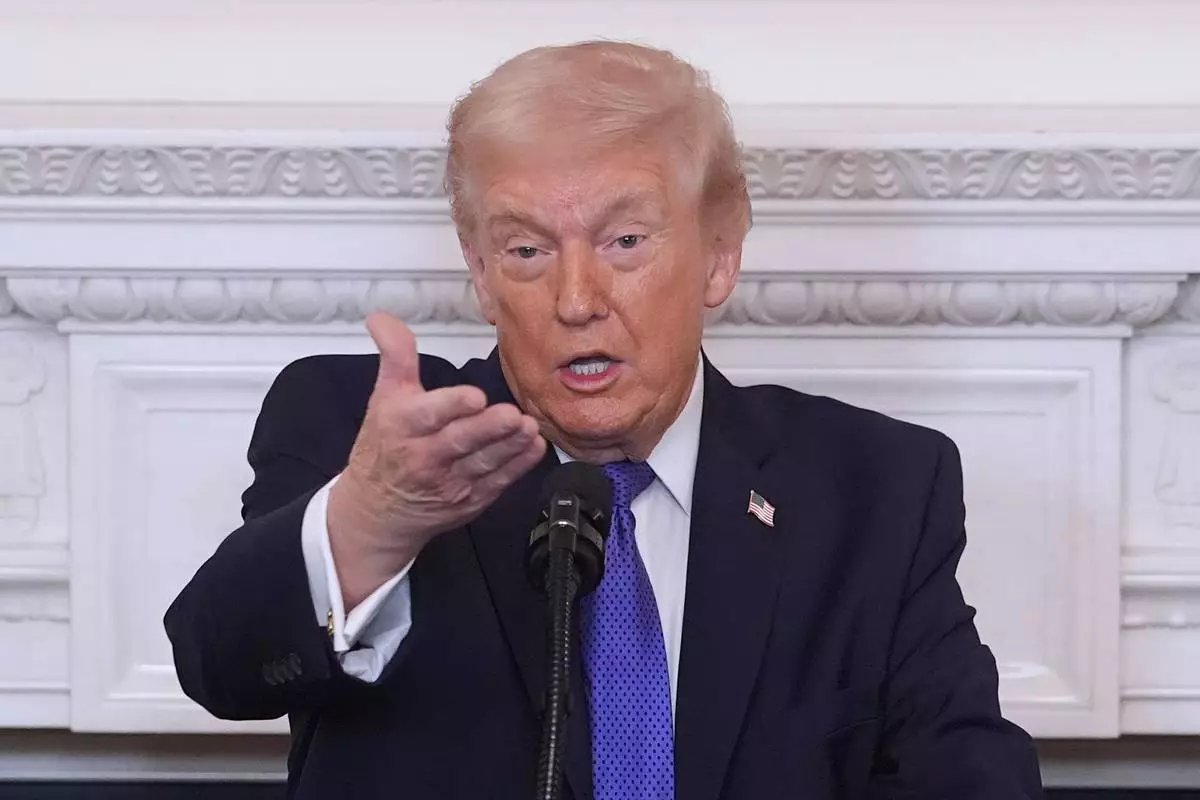
President Donald Trump speaks during a breakfast with the National Governors Association in the State Dining Room of the White House, Friday, Feb. 20, 2026, in Washington. (AP Photo/Evan Vucci)