More than 100,000 passenger trips had been made across the Taiwan Strait as of Friday through one of the "mini three links" routes between east China's Fujian Province and China's Taiwan region since the start of this year's Spring Festival travel rush period on Feb 2, according to the Xiamen Gaoqi Border Inspection Station.
The figure demonstrates the increasing cross-Strait exchanges through the Xiamen-Kinmen passenger ferry route and three other similar routes that facilitate the "mini three links," referring to small-scale trade, shipping and postal services between Fujian province, Kinmen Island and the Matsu Island group.
The other three passenger ferry routes are between Quanzhou City and Kinmen, Mawei District of Fuzhou City and Matsu, and Lianjiang County of Fuzhou and Matsu.
During the ongoing Spring Festival holiday, Xiamen's Wutong Ferry Terminal, a key hub that serves as the primary cross-Strait connection, has been holding various activities to welcome the surging number of holidaymakers from Taiwan.
On Tuesday, the first day of the Chinese New Year, staff members at the terminal, with some of them dressed as the auspicious Chinese mythological figure "God of Wealth," handed out Spring Festival gift bags to the ferry passengers, presented them with red scarves, and arranged stalls featuring intangible Chinese cultural heritage, while a group of artists played erhu, a traditional Chinese musical instrument.
"My kid got very excited when seeing the 'God of Wealth' just now. We didn't expect such a grand welcome with so many people greeting us today," said a mother from Taiwan.
"We're here to visit our relatives and friends. Xiaman and Kinmen belong to one family. Coming back to Xiamen is just like returning home for us. It feels so great," said another passenger from Taiwan.
According to the Xiamen Municipal Bureau of Culture and Tourism, many more similar events and activities will be held at the Wutong Ferry Terminal and elsewhere across Xiamen during this year's official Spring Festival holiday season, which lasts nine days through next Monday.
"During this year's Spring Festival holiday, we have prepared to hold over 1,500 wonderful cultural and tourism activities for everyone. We are also looking forward to seeing our compatriots from Taiwan coming to Xiamen to spend a happy Chinese New Year," said Peng Jun, who heads the Taiwan, Hong Kong and Macao Affairs Office of the Xiamen Municipal Bureau of Culture and Tourism.
This year's Spring Festival travel rush period lasts 40 days through March 13.
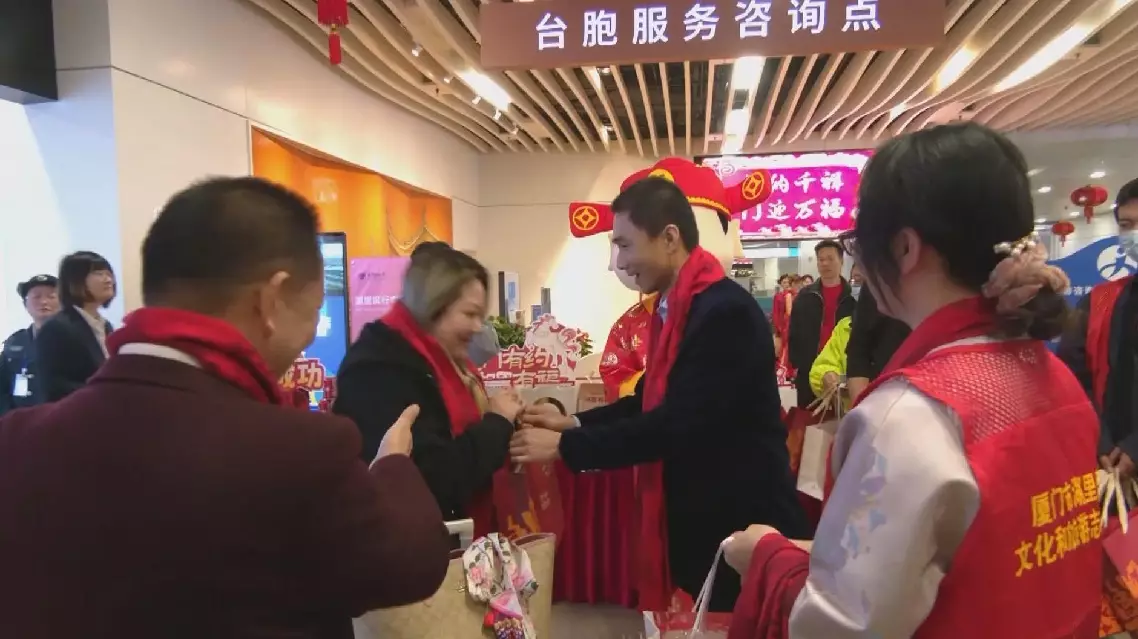
Xiamen-Kinmen "mini-three-links" route records over 100,000 cross-Strait passenger trips from Feb 2 to 20