From booking movie tickets and making restaurant reservations to sending new year greetings on the cellphone screen, artificial intelligence (AI) platforms have played an increasingly significant role in transforming the ways of how people spend the ongoing Chinese New Year holiday with the launch of a variety of functions for different scenarios. An AI team at a technology company based in south China's tech hub of Shenzhen managed to optimize its software functions before the current Chinese New Year holiday that started with the Spring Festival, upgrading the AI model to make online social activities during the Spring Festival more engaging and immersive.
"The Spring Festival is the most important traditional festival in China. We chose to present new ways to play in various social scenarios during this period, hoping to use AI to make social interactions more diverse and colorful for users during the Spring Festival," said Chi Hang, a member of Tencent's Yuanbao AI project.
For this year's Spring Festival, many AI companies launched new functions, such as AI-based booking for movie tickets and restaurant reservations. Users simply need to inform the relevant AI platform of the number of people, time, distance, and other requirements to receive a tailor-made plan.
Some companies also introduced functions for social contact, such as AI video and audio calls.
"This app has launched some new functions for the Chinese New Year, such as singing songs together. I think it's quite interesting," said Zhang Tong, a user from east China's Shandong Province.
According to data from multiple platforms, the usage rate of AI large models has been continuously increasing during this year's Spring Festival.
From Feb. 16 to 19, the cumulative usage of various AI large models exceeded 10 billion times. Among the users, 130 million people used AI for the first time to place orders, including nearly 4 million individuals who were over 60 years old, and over 40 percent of users were born in or after 2000.
According to data from the AI content-generation platform Qwen, the usage rate of AI large models has been continuously increasing during this year's Spring Festival holiday.
As of Thursday, the third day of the Year of the Horse, the number of orders for purchasing tickets through AI platforms increased by 22 times compared to the previous month, while the volume of AI bookings for transportation tickets, such as flights, rose by more than seven times.
In the film sector, the number of orders for purchasing movie tickets using AI increased by 372 times month on month, with orders from third-or fourth-tier markets soaring by 782 times.
During the holiday, the growth rate in county-level areas was significantly higher than in first-tier cities. Among all AI orders, more than 50 percent originated from county-level areas.
"The Spring Festival holiday is a peak period of app use by people. By choosing to launch new products during this time, enterprises can achieve more efficient and comprehensive product rollouts on a larger scale and quickly bridge the 'last mile' from technology to daily life," said Zhong Xinlong, associate researcher with the Future Industry Research Center (Artificial Intelligence Research Center) of China Center for Information Industry Development (CCID).
The official nine-day Chinese New Year holiday season began on Feb. 15, while the Spring Festival itself, China's most important annual celebration marked by family reunions, festive foods, and new year wishes, fell on Feb. 17 this year.
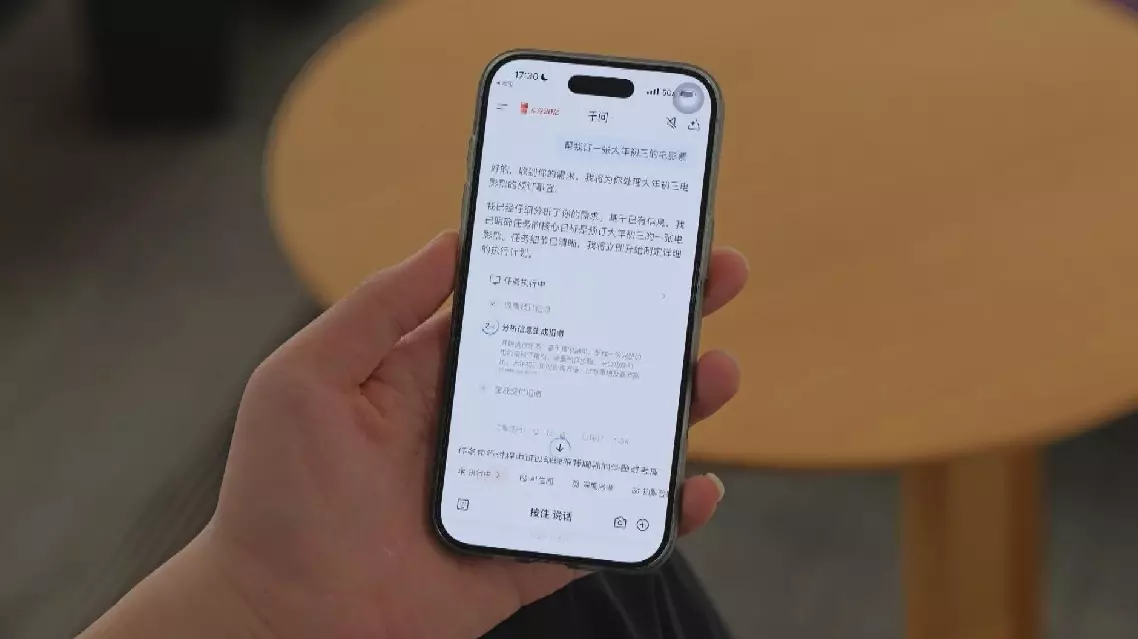
AI plays increasingly significant role in transforming ways of how people celebrate Chinese New Year