The ongoing Spring Festival holiday, the longest in recent years as it is extended to nine days this year, has seen bustling markets and surging spending, a good harvest both for China and the world, said a China Media Group commentary published on Sunday.
An adapted English version of the commentary is as follows:
In the southern island province of Hainan, duty-free sales reached 970 million yuan (nearly 140 million U.S. dollars) in the first four days of the holiday, up 15.8 percent from a year ago.
Noting that a strong domestic demand potential has been demonstrated during the Spring Festival, one of the peak consumption seasons of the year in China, Nestle China CEO Kais Marzouki said they will better meet consumers' increasingly upgraded quality demands during the festival by continuously deepening innovation based on local needs.
This year marks the beginning of China's 15th Five-Year Plan for national socioeconomic development in the 2026-2030 period. The official nine-day Spring Festival holiday is not only a happy time for people to purchase "nian huo," or New Year goods, visit relatives and friends and go outing in holiday making, but also an important window for the outside world to observe China's promotion of consumption and economic boost.
Chinese authorities have rolled out a series of policy measures to unlock consumption potential during the Spring Festival holiday.
Local governments have allocated 2.05 billion yuan (about 295.23 million U.S. dollars) in funds to directly benefit the public through consumption vouchers, subsidies and cash handouts during the nine-day holiday period starting Feb. 15, the day before the Chinese New Year's Eve.
The initiative, aimed at boosting festive spending, focuses on six key areas -- dining, accommodation, transportation, tourism, shopping and entertainment.
Specific measures include promoting festive dining and reunion banquets, offering discounts on home appliances and home renovation, increasing transport capacity, organizing cultural and tourism events, and rolling out shopping promotions in major commercial districts alongside cinema ticket discounts, according to the Ministry of Commerce (MOC).
To facilitate international tourists to experience traditional culture in China, local authorities issued multilingual maps of folk custom and launched one-stop traveling destination integrated with temple fairs, time-honored brands and intangible cultural heritage markets.
In addition, China has made it easier for international travelers to use their foreign credit cards by allowing them to link these cards directly to popular Chinese mobile payment platforms like Alipay and WeChat Pay.
A strong emphasis has been placed on expanding the consumer goods trade-in programs, facilitating inbound consumption and increasing financial support.
For example, China has front-loaded 62.5 billion yuan (about 9.04 billion U.S. dollars) of ultra-long-term special treasury bonds as the first batch of funds to support trade-ins of consumer goods this year, according to the National Development and Reform Commission, the country's top economic regulator.
In the first four days of the holiday break, average daily sales at major retail and catering businesses rose 8.6 percent from the corresponding period a year earlier, according to data from the Ministry of Commerce.
Traffic and revenue at 78 key shopping streets and districts in the first three days climbed 4.5 percent and 4.8 percent, respectively.
These policy measures have not only injected vigor and vitality into China's consumer market, but also enabled the rest of the world to enjoy the Chinese New Year holiday joyfully.
Flight bookings by foreign passengers for the holiday soared over 400 percent from the previous year, according to data from online travel service provider Fliggy on Jan. 30.
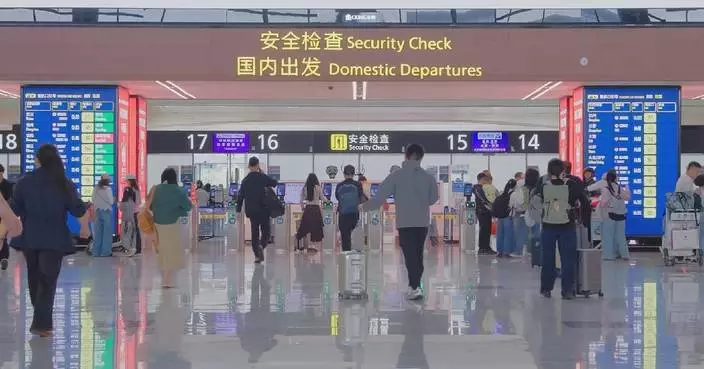
Take Shanghai, one of the main destinations for inbound tourism, as an example. During the Spring Festival holiday, the number of inbound and outbound passengers at the airport continued to rise, with an average of 113,000 inbound and outbound passenger trips per day. According to Beijing Customs, Beijing Capital International Airport Customs handled 7,966 departure tax-refund transactions in January, representing 469.81 percent year-on-year surge, with the refund amount reaching 12.5 million yuan (about 1.81 million U.S. dollars), up 43.68 percent on a yearly basis.
Foreign-funded enterprises have also benefited from the initiative, with many launching new products and sales promotion during the holiday.
George Magnus, a research associate at the University of Oxford's China Center, said the Spring Festival has undoubtedly brought a huge boost to retailers and consumer service providers. More importantly, as China opens its door wider and wider to the outside world and lowers its tariffs on imports, more global goods have become Chinese New Year's goods, and more Chinese products and services also benefit the world.
Chinese e-commerce giant JD.com on Feb. 10 officially launched its delivery brand JoyExpress in multiple European countries. Currently, it has achieved same-day and next-day delivery in major cities of countries such as Britain, Germany, the Netherlands and France.
Spain's state broadcaster RTVE commented that against the backdrop of a slow and uncertain global economic recovery, the Chinese Spring Festival is not only a good opportunity to boost global consumption, but also helps promote cross-border trade and the development of the service industry, becoming a catalyst for boosting the global economy.
From "traveling in China" to "shopping in China", the Spring Festival of the Year of the Horse has provided more opportunities for the rest of the world to perceive China in the new era.
Spring Festival spending boosts China's economy, becomes global harvest
Spring Festival spending boosts China's economy, becomes global harvest