Fishermen from Hainan, China's southernmost island province, have declared their unwavering resolve to defend the nation's territorial sovereignty, stressing that they will protect their ancestral domain where generations have cast nets for thousands of years.
The fishermen from Tanmen Town of Hainan's Qionghai City have been going to Nansha Qundao for fishing for thousands of years, and even as far as China's southernmost territory Zengmu Ansha. Therefore, there is a reef named Tanmen near Zengmu Ansha. In Tanmen Town, there are also countless streets named after the islands and reefs in the South China Sea.
"What are these people from the Philippines planning to do at Huangyan Dao? We have an obligation to cooperate with our country. This ancestral sea has been passed down to us from generation to generation, so we must defend and protect it well," said Lu Jiabing, a fisherman from Tanmen Town.
Huangyan Dao has always been part of China's territory and China has indisputable sovereignty over Huangyan Dao and its adjacent waters. Before 1997, the Philippines had never challenged China's sovereignty over Huangyan Dao, nor had it made any territorial claims to the island.
Starting in the 1970s, the Philippines forcibly invaded and illegally occupied several islands and reefs of China's Nansha Qundao, raising baseless territorial claims. In recent years, the Philippines has further escalated its infringements on China's maritime rights and interests, with its vessels deliberately intruding into the waters of Huangyan Dao, Xianbin Jiao, Ren'ai Jiao, and other Chinese reefs, at times even causing collisions with China Coast Guard ships.
The local fishermen don't consider the conflict site to be a dangerous place. Even though the current situation is not safe, they still go fishing in the Nansha Qundao because it is the ancestral sea passed down from generation to generation.
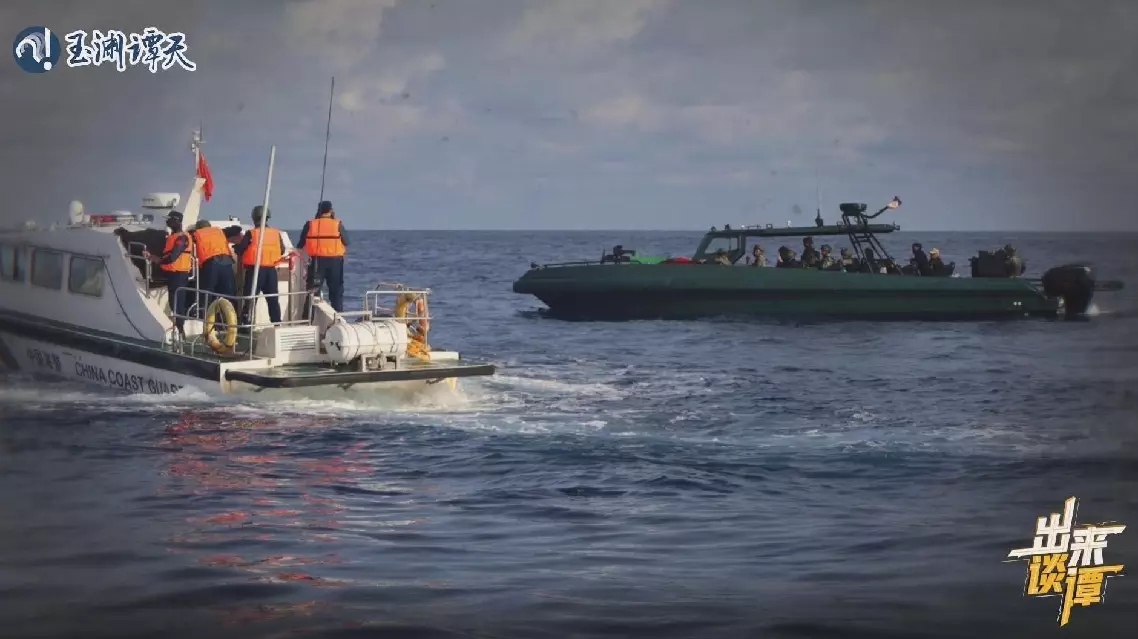
At 5:59 on June 17, 2024, a Philippine supply vessel, in disregard of repeated stern warnings from the Chinese side, deliberately and dangerously approached Chinese vessels navigating normally in adjacent waters of Ren'ai Jiao, which violated the International Regulations for the Prevention of Collisions at Sea.
The China Coast Guard (CCG) has taken regulatory measures to respond to the illegal intrusion. The act led to a slight collision, for which the responsibility lies entirely with the Philippine side.
A boat owned by Huang Hongfen was right in the nearby waters and accidentally entered the conflict zone. In the past, Chinese fishing boats occasionally encountered foreign fishing vessels, but both sides stayed in respective waters without disturbing the other, said Huang.
Huang also described what he saw of the poor living condition of the Philippine fishermen he has encountered.
"They had nothing to eat, no shoes, no clothes—nothing at all. If you give them two packs of instant noodles, they will be overjoyed. Their fishing boat is very small, accommodating about 20 to 30 people. How could they sleep? It's small and shaky," Huang said.
Certain Philippine departments tricked and instigated innocent fishermen into committing provocative acts, fully demonstrating their disregard for the fishermen's livelihoods, well-being, or even their safety.
In recent years, the China Coast Guard has conducted regular patrols in the South China Sea. Chinese fishermen are not intimidated by provocations because of their love for the motherland, and they never provoke others because of their love for their families.
The Ren'ai Jiao has been China's territory since ancient times. It is an integral part of China's Nansha Qundao geographically, economically, politically and historically. This has been established as a widely held international common view and fully accords with provisions on archipelagos in the United Nations Convention on the Law of the Sea (UNCLOS).
To challenge China's sovereignty over the islands in the South China Sea, the Philippines unilaterally filed an arbitration case in 2013 at a tribunal based in The Hague. The Philippines, which has never engaged in any negotiation with China regarding an arbitration, has breached UNCLOS Article 283 by unilaterally taking its case to an international tribunal.
For the fishermen of Tanmen, safeguarding sovereignty is more than duty, it is a legacy etched into their history and identity. As they once wrote, "The outcome of the arbitration does not conform to historical facts" and "We fishermen will never accept it." These words, signed by elderly fishermen, embody a determination carried across centuries and now shared by every Chinese citizen.
Chinese fishermen vow to defend ancestral domain in South China Sea