Skip to Content Facebook Feature Image

Hong Kong Implements New Railway Standards and Establishes Railway Checking Unit for Efficient Project Approval

HK

Hong Kong Implements New Railway Standards and Establishes Railway Checking Unit for Efficient Project Approval
HK

HK

Hong Kong Implements New Railway Standards and Establishes Railway Checking Unit for Efficient Project Approval

2026-02-23 18:25 Last Updated At:18:37

Promulgation of Hong Kong Railway Standards and establishment of Railway Checking Unit by Highways Department to optimise implementation of railway projects through multipronged approach

The Highways Department (HyD) promulgated the Hong Kong Railway Standards and also announced the official establishment of the Railway Checking Unit (RCU) today (February 23) to expedite implementation of new railway projects. The establishment ceremony was officiated by the Director of Highways, Mr Tony Yau, with numerous railway experts and representatives of relevant government departments in attendance.

In his address, Mr Yau remarked that, "The HyD is always committed to staying abreast of the times, optimising the implementation of railway projects and striving to construct railways in an efficient and robust manner. Capitalising on the opportunities brought by two cross-boundary railway projects, namely the Northern Link and the Hong Kong-Shenzhen Western Rail Link, we formulated the Hong Kong Railway Standards in collaboration with relevant government departments and railway experts. In addition to retaining the prevailing railway standards in Hong Kong, the Hong Kong Railway Standards have introduced suitable railway standards of the Nation and various places in the world (including European Norm (EN), Institute of Electrical and Electronics Engineers (IEEE)'s standards, International Electrotechnical Commission (IEC)'s standards and International Organization for Standardization (ISO)'s standards) with adaptation to local circumstances, as a result of detailed analyses and comparisons on the premise of ensuring railway safety, quality, and performancebased outcomes."

He continued, "The new Hong Kong Railway Standards could facilitate the use of a broader selection of advanced construction technologies, construction materials, equipment, and railway systems for railway projects, provide clear technical specifications as the approval basis of the supervisory authorities, and also facilitate the development and optimisation of work processes by the industry. This move helps to leverage and introduce the extensive experience and world-leading technologies in railway construction of our nation, as well as the recognised standards in other parts of the world, with a view to driving the new railway projects of Hong Kong with enhanced speed and efficiency, and striving for shorter construction times and lower costs."

Under the Hong Kong Railway Standards, the industry could flexibly apply suitable standards to different railway projects on account of their individual needs and characteristics, after holistic consideration of factors such as cost-effectiveness, technical requirements, supply chain conditions, site environment and labour and machinery resources. The Standards encourage the use of innovative construction machinery, technologies and materials (such as use of larger or more extensive use of standardised prefabrication technology, high-strength structural steel and ultra-high-performance concrete), as well as advanced equipment and construction specifications (such as the model selection, design, construction, and control of tunnel boring machines).

The benefits of Hong Kong Railway Standards can be summarised into four key highlights, namely:

(1) Keeping abreast of the times and embracing technology: promoting more unification and standardisation in different aspects of railway design, which would be conducive to introducing the latest construction technologies and advanced operating systems;

(2) Clear basis for expedited approval: providing a clear basis through introduction of more technical specifications for station design, construction equipment, rolling stock, construction methods, etc to help simplify and expedite approval processes;

(3) Diversified options and leveraging strengths: broadening options for construction materials, construction equipment and railway systems, which could enable better use of regional and local supply chains; and

(4) Optimising procedures for enhancing benefits: facilitate the industry in optimising construction procedures and enhance cost-effectiveness through provision of guidelines on construction procedures and recommendations on best practices.

The electronic copy of the Hong Kong Railway Standards has been uploaded to the HyD's website for public access

(www.hyd.gov.hk/en/technical_references/technical_document/railway_standards/index.html).

To effectively implement the Hong Kong Railways Standards, the HyD redeployed internal resources to set up the RCU, with professionals including building surveyors, structural engineers and civil engineers as members. The RCU is dedicated to handling the approval for the building plans of new railway projects, and an electronic centralised approval platform is also established to facilitate the convenient submission of documents and approvals of building plans, thereby enhancing administrative efficiency. The RCU will be responsible for the approvals relating to various new railway projects, including the Northern Link, the Hong Kong-Shenzhen Western Rail Link (Hung Shui Kiu-Qianhai) and new Smart and Green Mass Transit System projects.

The performance target of the RCU is to substantially reduce the processing time frame for first plan submissions from 60 days to 30 days, and that for amendment plan submissions from 30 days to 21 days, with key performance indicators for completing no less than 90 per cent of the approval decisions of the plan submissions within the aforementioned time frame. Meanwhile, the RCU also includes a monitoring and intervention mechanism. If the RCU encounters a major issue that could not be resolved within 15 days, the matter would be escalated to an officer at the Assistant Director level for handling, so that senior officers could intervene in a timely manner and explore viable solutions.
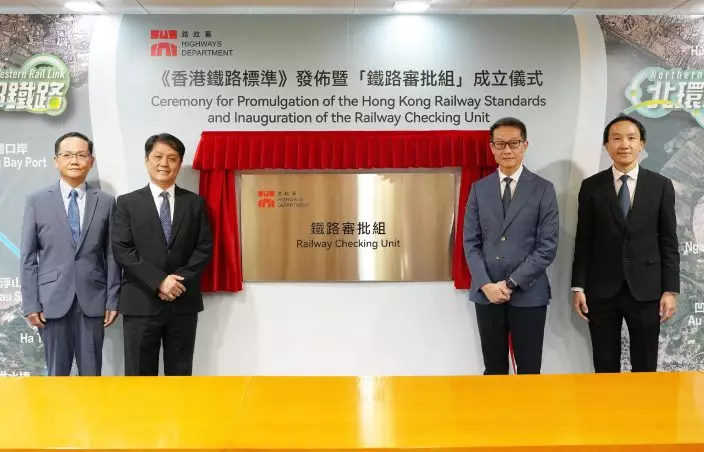
Photo shows the Director of Highways, Mr Tony Yau (second right); the Deputy Director of Highways, Mr Richard Ng (second left); the Commissioner for Northern Metropolis Railways, Mr Raymond Ip (first right); and Assistant Director/Railways of Electrical and Mechanical Services Department, Mr Chan Yiu-hon (first left), conducting the unveiling for the establishment of the Railway Checking Unit. Source: HKSAR Government Press Releases
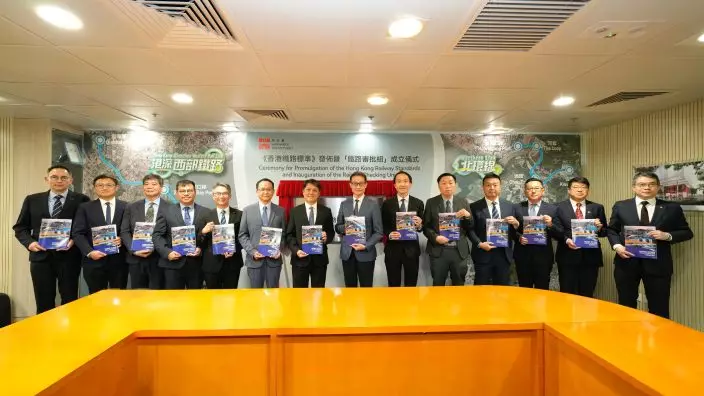
Photo shows the Director of Highways, Mr Tony Yau (second right); the Deputy Director of Highways, Mr Richard Ng (second left); the Commissioner for Northern Metropolis Railways, Mr Raymond Ip (first right); and Assistant Director/Railways of Electrical and Mechanical Services Department, Mr Chan Yiu-hon (first left), conducting the unveiling for the establishment of the Railway Checking Unit. Source: HKSAR Government Press Releases

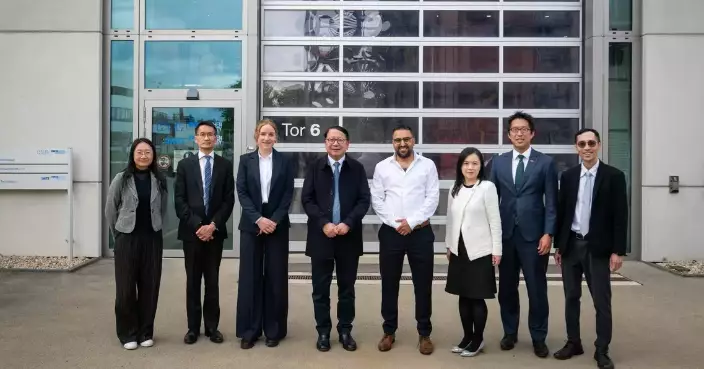
The pictured attendees include the Director of Highways, Mr Tony Yau (seventh right); the Deputy Director of Highways, Mr Richard Ng (seventh left); the Commissioner for Northern Metropolis Railways, Mr Raymond Ip (sixth right); representatives of Government departments (namely the Buildings Department, Civil Engineering and Development Department, Electrical and Mechanical Services Department, Fire Services Department, Hong Kong Police Force and Transport Department); and railway experts including Mr Perran Coak (first left), Mr Xu Chengyong (second right) of Beijing Urban Construction Design & Development Group Co., Limited; the Chairman of the Association of Hong Kong Railway Transport Professional, Mr Cheung Nin-sang (third left); the Executive Director of the Smart Transportation Alliance, Mr Gary Zhang (second left); and Mr Kelvin Wong (first right) of the MTR Corporation Limited. Source: HKSAR Government Press Releases
The pictured attendees include the Director of Highways, Mr Tony Yau (seventh right); the Deputy Director of Highways, Mr Richard Ng (seventh left); the Commissioner for Northern Metropolis Railways, Mr Raymond Ip (sixth right); representatives of Government departments (namely the Buildings Department, Civil Engineering and Development Department, Electrical and Mechanical Services Department, Fire Services Department, Hong Kong Police Force and Transport Department); and railway experts including Mr Perran Coak (first left), Mr Xu Chengyong (second right) of Beijing Urban Construction Design & Development Group Co., Limited; the Chairman of the Association of Hong Kong Railway Transport Professional, Mr Cheung Nin-sang (third left); the Executive Director of the Smart Transportation Alliance, Mr Gary Zhang (second left); and Mr Kelvin Wong (first right) of the MTR Corporation Limited. Source: HKSAR Government Press Releases

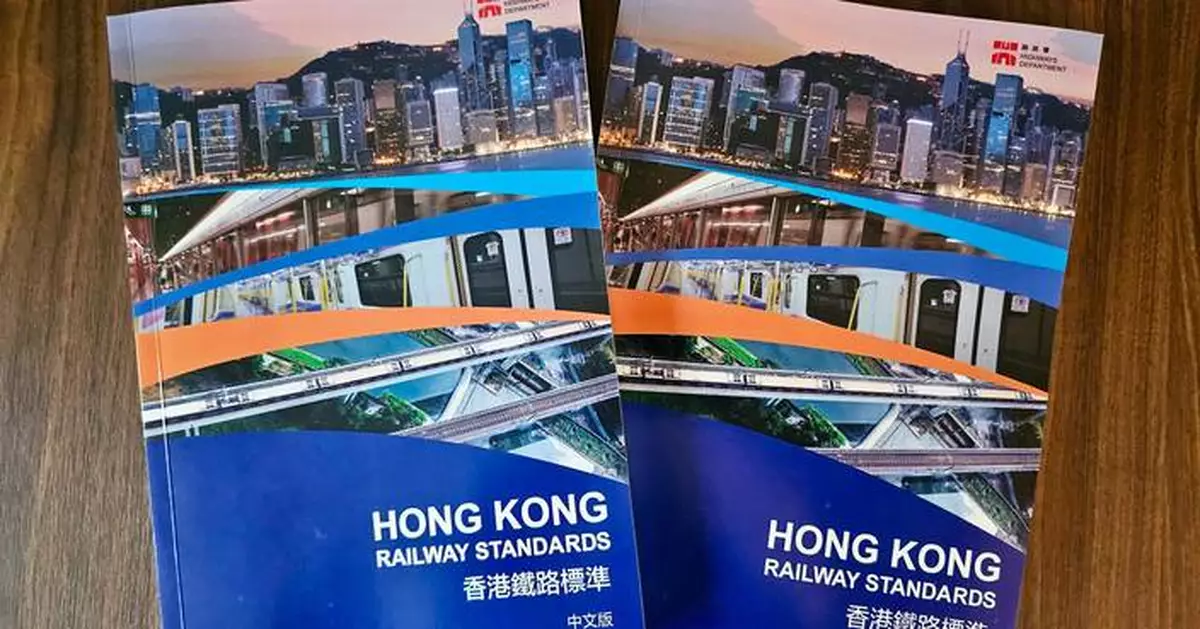
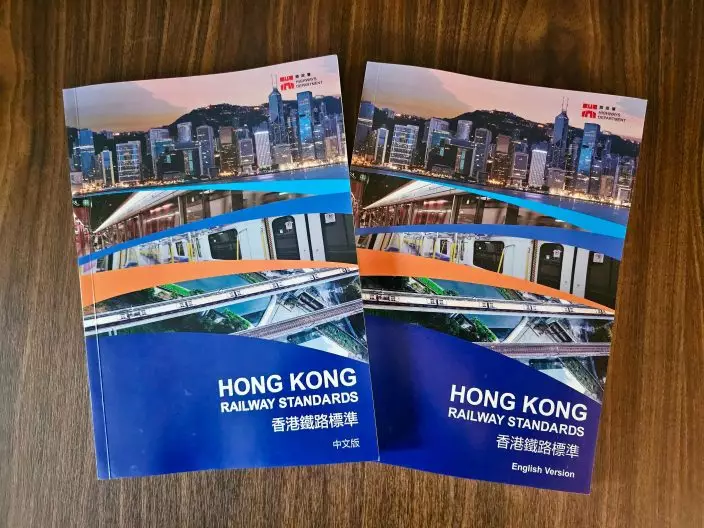
Photo shows the cover of Hong Kong Railway Standards. Source: HKSAR Government Press Releases

Photo shows the cover of Hong Kong Railway Standards. Source: HKSAR Government Press Releases
Court of Appeal delivers judgement on appeals of conspiracy to commit subversion case

The Court of Appeal of the High Court today (February 23) delivered its judgment on the appeals in a case of "conspiracy to commit subversion", dismissing the appeals against conviction or sentence lodged by 12 defendants. Furthermore, with regard to one defendant against whom the evidence was insufficient for the trial court to be sure of his participation in the conspiracy offence, the Court of Appeal upheld the trial court's verdict.

The Court of Appeal, in its judgment on the appeals in this case, rejected each of the grounds of appeal against conviction or sentence raised by the respective defendants. With regard to the appeals against conviction, the Court of Appeal noted that the relevant provisions of the Basic Law establish an executive-led system headed by the Chief Executive (CE), recognises that the CE, the Government, the Legislative Council (LegCo), and the Judiciary have different constitutional roles. Interaction and co-ordination between them is inevitable in areas where both the executive and legislative authority are required. As seen from the budgetary process, examining the merits of a budget by reference to fiscal considerations to see if it warrants approval must form the core of the LegCo's powers and functions under Article 73(2) of the Basic Law. The LegCo must exercise its powers and functions in accordance with, and not in contravention of, the provisions of the Basic Law. In particular, it cannot act in contravention of the fundamental provisions of the Basic Law which establish the constitutional order in the Hong Kong Special Administrative Region (HKSAR), and the LegCo members cannot contravene the constitutional duty to uphold the constitutional order in the HKSAR under the LegCo Oath. In this case, as envisaged and publicised by the first defendant Tai Yiu-ting and known to any participant who chose to join it, the "Project 35+" was a "constitutional mass destruction weapon" aiming to compel the CE to resign, to paralyse the Government and to force the Central People's Government to declare an end to the "one country, two systems" policy, which constituted an unlawful means of subverting the constitutional order of the HKSAR. Pursuing that aim in the pretext of examining budgets necessarily amounted to a breach of a LegCo member's duty to uphold the constitutional order in the HKSAR. The defendants agreed to join the "Project 35+" and participate in the relevant course of conduct with the intent to achieve the subversive consequences, and therefore constituted the offence of "conspiracy to commit subversion".

The Court of Appeal also considered that the trial court was entitled to make the impugned findings based on the totality of the evidence adduced. With all the evidence considered in context, the conclusions that each defendant was a party to the conspiracy could not be faulted. The Court of Appeal further held that there was no unfairness in the conduct of the trial proceedings.

Regarding the appeals against sentence, the Court of Appeal pointed out that the trial court's categorisation of all defendants who ran for the "primary election" as "actively participants" could not be faulted. The goal of the "Project 35+" was to cause havoc to the constitutional order in the HKSAR, by getting the concerned defendants elected. The Court of Appeal further pointed out that the defendants exploited the system in such a way intending to bring about potentially devastating consequences to the HKSAR. Therefore, "ignorance of the law" was not a valid mitigating factor in this case. All the discounts that had been given by the trial court under this head must be regarded as entirely gratuitous.

A spokesman for the HKSAR government said, "45 defendants have been convicted in this case. The trial court pointed out clearly in its reasons for verdict handed down earlier that by March and April 2020, the ultimate aim and purpose of the so-called 'Project 35+' had been very clear and made known to the public, which was to undermine, destroy or overthrow the existing political system and structure of the HKSAR established under the Basic Law and the 'one country, two systems' principle. The court pointed out that the defendants, led by Tai Yiu-ting, have invested a great deal of time and money in premeditating and planning the so-called 'primary election'. The other defendants all participated actively and made every effort to ensure the success of the 'Project 35+'. Had the plan been fully implemented, it would have given rise to profoundly far-reaching negative consequences, the severity of which would have been no less than the overthrow of the HKSAR Government."

"During the trial, it was revealed that the persons concerned put forward the '10 Steps to mutual destruction' which would bring Hong Kong society to a standstill through large-scale street riots and other means at the same time. Coupled with international political and economic sanctions, 'mutual destruction' would be achieved, causing suffering to members of the public. The severity of the crime in this case was supported by irrefutable evidence. The convicted individuals deserved their punishment. The Court of Appeal's dismissal of relevant appeals against conviction and sentence demonstrates that any person who intends to commit subversion and endanger national security will be punished in accordance with the law."

"As for the decision to uphold the verdict of a defendant against whom the evidence was insufficient for the trial court to be sure of his participation in the conspiracy, the Department of Justice will study the judgment carefully and consider whether to lodge an appeal."

The spokesman pointed out, "Hong Kong is a society underpinned by the rule of law. The Hong Kong National Security Law (HKNSL) and the Safeguarding National Security Ordinance (SNSO) clearly stipulate that the principle of the rule of law shall be adhered to in preventing, suppressing and imposing punishment for offences endangering national security. The court’s judgment in this appeal case shows that the Judiciary of the HKSAR exercises judicial power independently in accordance with the law, and everyone charged with a criminal offence will receive a fair trial strictly in accordance with laws applicable and as protected by the Basic Law and the Hong Kong Bill of Rights. The courts decide cases strictly in accordance with the evidence and all applicable laws. Cases will never be handled any differently owing to the profession, political beliefs or backgrounds of the persons involved. The prosecution has the burden to prove beyond reasonable doubt the commission of an offence before a defendant may be convicted by the court."

"Safeguarding national security is the inherent responsibility of every citizen. The HKSAR Government is resolutely determined to crack down on acts and activities that endanger national safety, ensuring that laws are observed and strictly enforced, so as to bring offenders to account. The HKSAR Government will, as always, resolutely, fully and faithfully implement the HKNSL, the SNSO and other relevant laws safeguarding national security in the HKSAR, to effectively prevent, suppress and impose punishment for acts and activities endangering national security in accordance with the law, while upholding the rights and freedoms of Hong Kong people in accordance with the law, to ensure the steadfast and successful implementation of the principle of 'one country, two systems'."

Source: AI-found images

Source: AI-found images

Recommended Articles