Skip to Content Facebook Feature Image

Chinese foreign trade companies continue uninterrupted operations during Spring Festival

China

China

China

Chinese foreign trade companies continue uninterrupted operations during Spring Festival

2026-02-23 17:41 Last Updated At:02-24 13:00

The Spring Festival, a usual traditional time of reunion for most Chinese, has become a pivotal moment for foreign trade professionals eager to secure orders. During the nine-day holiday until Feb 24, some industry representatives travel abroad for exhibitions, while others stay in factories to ensure timely deliveries, all in pursuit of a successful start to the Year of the Horse.

The Spring Festival, or the Chinese New Year, which fell on Feb 17 this year, is the most important traditional holiday for the Chinese people.

On the first day of the Chinese New Year, over 200 companies from China journeyed to the United States for exhibitions, marking one of the first waves of foreign trade teams actively seeking new opportunities in the new year.

A standout at an exhibition was a company from Changxing County, east China's Zhejiang Province, which showcased products that boast a 20 percent increase in efficiency and a 10 percent reduction in costs. The company was pleasantly surprised to attract numerous international clients.

"In just a few days, we not only closed many deals but also engaged with many interested clients," said Li Cheng, foreign trade manager of Zhejiang Huzhou Senfu Mechanical and Electrical Co., Ltd.

Domestic production facilities for overseas orders are also operating at full capacity during the holiday period. The global demand for artificial intelligence computing power continues to rise, driving an increased need for core electrical equipment such as transformers.

In Changzhou City, east China's Jiangsu Province, workers at a transformer factory are diligently working during the holiday period.

"Our orders exceed 3 billion yuan (about 434 million U.S. dollars), with export orders surpassing 2 billion yuan (about 289 million U.S. dollars). Our order backlog extends through the end of the year. To meet the project deadline and ensure timely delivery, we've continued some processes without stopping production during the Spring Festival," said Sun Lijun, executive deputy general manager of Jiangsu Huapeng Group Co., Ltd..

Data from China Unicom shows that the number of employees in national bonded zones increased rapidly starting on Feb 18, the second day of the Chinese New Year, with year-on-year growth of 6 percent. Provinces such as Henan, Guangdong, and Jiangsu are leading in both employee scale and growth rates within these zones.

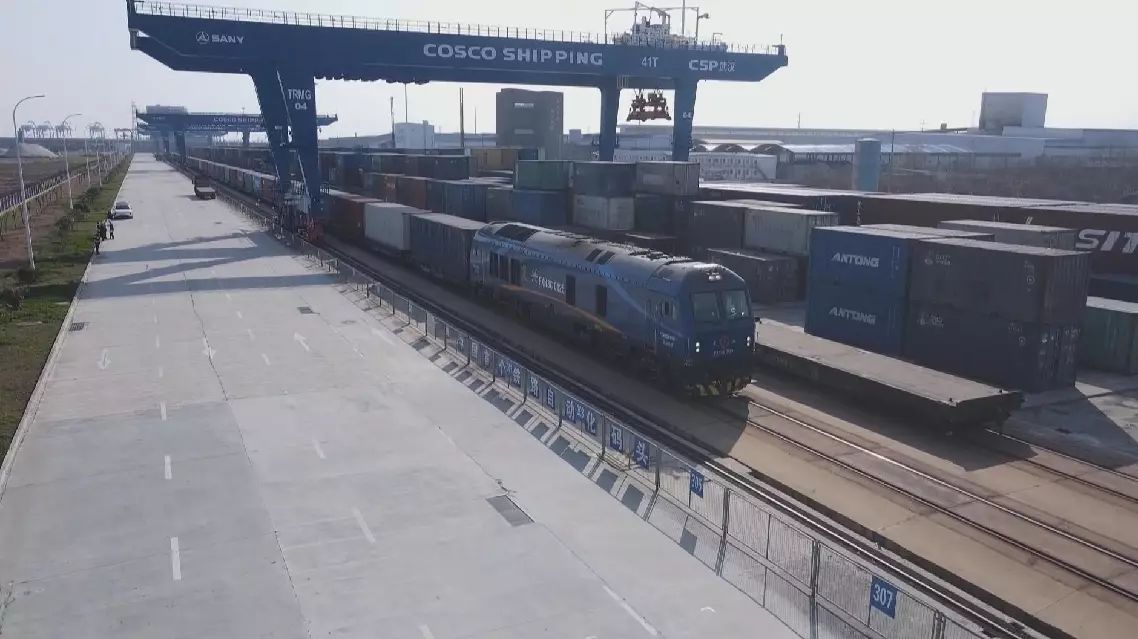
Foreign trade logistics across many regions in China are also operating at full capacity.

As of Feb 20, the volume of international freight trains from Wuhan City, central China's Hubei Province, has risen by 55 percent compared to the same period last year.

"Cargo volume has surged recently, with many companies focusing their initial shipments during these few days. We need to dispatch an average of three trains per day. Through pre-checks, consolidated shipping, and coordinated operations of dual starting stations, we have shortened transport time by one to two days and reduced logistics costs by 15 percent," said Zhang Yupeng, manager of Shekou Business Department at the Wuhan Railway Bureau Logistics Center.

In Zhejiang Province, the Ningbo-Zhoushan Port has maintained 24-hour, uninterrupted loading and unloading operations throughout the Spring Festival. From the first to the sixth day of the Chinese New Year, the port's container throughput exceeded 780,000 standard containers, surged 17 percent year on year.

"The volume of export containers has significantly increased in recent days. We ensure that machines are running while workers are taking time off. The first wave of post-holiday exports is focused, and customers are racing against time to secure shipping slots. We are committed to dispatching goods on time," said Zhou Dehai, operations manager at the Ningbo Beilun Third Container Terminal Co., Ltd.
Chinese foreign trade companies continue uninterrupted operations during Spring Festival

Chinese foreign trade companies continue uninterrupted operations during Spring Festival

A World Health Organization (WHO) medical epidemiologist on Sunday sought to ease public concerns over a hantavirus outbreak linked to a cruise ship, stressing that the virus is not airborne like COVID-19 and that the average person has no reason to worry.

Spain began evacuating passengers the same day from the hantavirus-stricken cruise ship MV Hondius, which had anchored earlier off the Port of Granadilla on the island of Tenerife.

The MV Hondius departed Argentina on April 1 with more than 140 passengers and crew from 23 countries on board. The ship has reported eight infections, including three deaths. Six of the cases have been laboratory-confirmed as Andes virus infections, caused by a rodent-borne hantavirus endemic to South America and the only known hantavirus strain capable of limited human-to-human transmission.

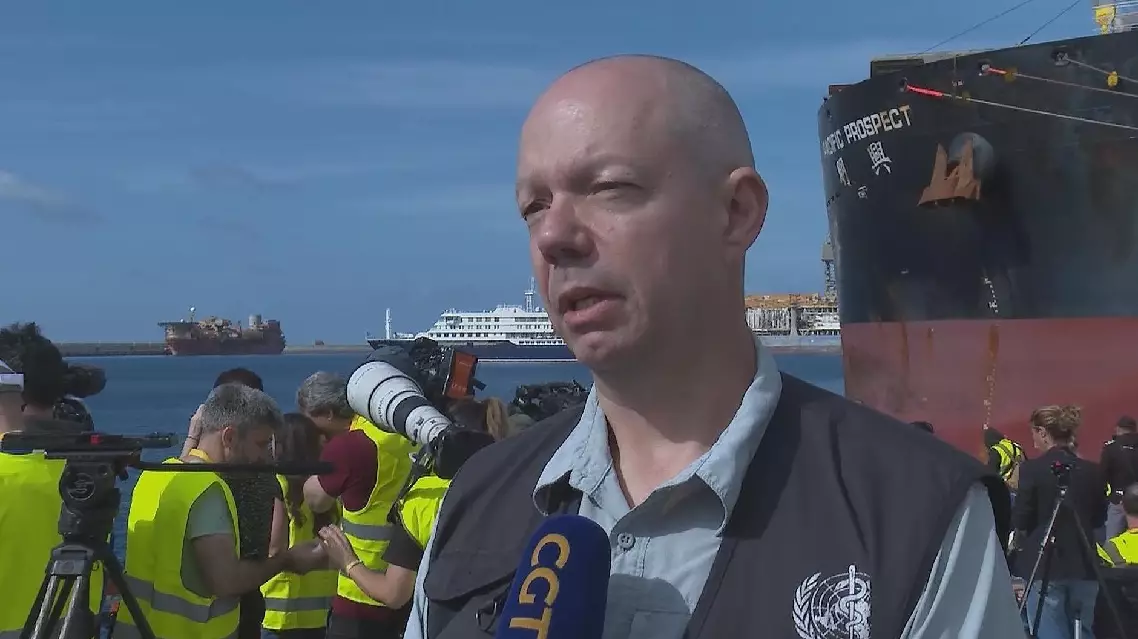
Boris Pavlin, a medical epidemiologist with the WHO, said the cruise ship affected by a hantavirus outbreak had been carefully managed by Spanish authorities and posed little risk to the general public. "This is not COVID. The average person does not need to be worried about hantavirus here in this setting. These folks are being managed very carefully, very deliberately, by the Spanish authorities; they're getting off the ship, they are getting into small boats, they are being spaced apart in the buses so there's no risk to one another. Even if one were to become symptomatic -- we know that none of them were symptomatic as they have been leaving the ship -- they're going straight to their aircraft and they're being taken to their respective national jurisdictions," he said.

Pavlin said the exact source of exposure remained under investigation, but the initial cases appeared to be linked to a pre-cruise land excursion in South America.

"From what we understand of the initial cases, there was -- as one does often on a cruise -- there was a land-side excursion before the cruise in which places were visited that are home to these specific rodents that are associated with the Andes hantavirus. These are not worldwide rodents; the long-tailed rice rat is very specific to the Andes Cordillera region of South America, and that's where people who are exposed to the rodents were. So it was in one of those places they were exposed. We don't know exactly because there are several possibilities, and I believe that the Argentinian authorities are actually even going to look at that and try to do some animal sampling to get to the very bottom of it. But that part's not unexpected at all," he said.

The official praised Spanish authorities' handling of the ship and described the response as a closely coordinated international effort.

"This has been an extremely cooperative, collegial international effort. The Spanish authorities are very diligent and deliberate about what's happening here. There's nothing that would surprise us. I think that somebody might become exposed; we want to obviously make sure that people who are coming off the ship are not newly exposed to one another as they get off and go to their respective places, and we're not seeing that," Pavlin said.

But while the immediate disembarkation process had gone smoothly, he emphasized that health officials were not letting their guard down.

"However, the contact tracing and follow-up of every person who has been in even the lightest contact with the patients will continue until a maximum incubation period. In any case, there are contingency plans should someone become ill, and we know that it doesn't just spread like wildfire, so even if they were to become ill, we don't expect a large outbreak after this," the official said.

Cruise ship hantavirus outbreak "not COVID," poses low public risk: WHO expert

Cruise ship hantavirus outbreak "not COVID," poses low public risk: WHO expert

Recommended Articles