The advanced drone industry in south China's Guangdong Province is helping the country's low-altitude economy soar, powered by the wide-ranging applications of unmanned aerial vehicles.
Guangdong -- China's manufacturing powerhouse -- is now dominating the skies with advanced drones.
Ninety five percent of the country's consumer drones and more than half of its industrial drones are made in Guangdong, powering China's command over the global market.
Backed by the 15th Five-Year Plan for national socioeconomic development in the 2026-2030 period, Guangdong is not only making drones, but also shaping the future of China's low-altitude economy.
Every day from 10:30 in Guangdong's tech hub of Shenzhen City, drones take to the skies from Qianhai to deliver parcels to neighboring cities Zhongshan and Zhuhai.
What used to be a hours-long road trip is now a quick flight overhead.
With hundreds of drones crisscrossing the skies, one question stands out: how is all of this managed? The answer lies in a nerve center, where a real-time control screen tracks every drone's flight path and cargo.
"We currently have 168 drones actively operating in Shenzhen alone, managing 383 established routes, with daily flight sorties surpassing 1,000," said Heng Shilong, a drone operator of Phoenix Wings, a cargo drone manufacturer in Shenzhen.
Beyond commerce, the drones are lifesavers. In emergencies, they can deliver critical medical supplies, cutting through traffic to create "five-minute rescue circles."
At factories, drones are being built not for delivery, but for firefighting, maritime rescue and to reach places humans cannot. This is the other crucial side of the low-altitude economy.
A particular production line at United Aircraft, an industrial drone manufacturer headquartered in Shenzhen, is dedicated to drones for agriculture and plant protection.
Their drones are more efficient than manual labor and fairly reliable.
"Three key elements: a reliable flight controller for steady operation in all conditions; a precise positioning system, like China's BeiDou system; and artificial intelligence-enabled obstacle avoidance and path planning. Together, these ensure safety and reliability," said Li Xiaoliang, general manager of the Shenzhen Base of United Aircraft.
This reliability is what's attracting customers worldwide to this technology.
"Our main markets are Southeast Asia and the Middle East. Last year, we exported over 1,000 agricultural drones," Li said.
This is not just one company's story. It's an entire ecosystem, built on a cluster of 15,000 specialized firms, driving Chinese drones to taking over 70 percent of the global market.
"The Greater Bay Area is a global hub for the low-altitude economy, with leading companies and a complete supply chain. It's not just a factory -- it's a living lab for innovation, transforming how we handle logistics, delivery and connectivity, from cities to across borders. This model is now a template for the world," said Cao Zhongxiong, assistant president of China Development Institute, a think tank headquartered in Shenzhen.
The Greater Bay Area consists of the Hong Kong Special Administrative Region, the Macao Special Administrative Region, as well as nine cities in Guangdong Province -- Guangzhou, Shenzhen, Zhuhai, Foshan, Huizhou, Dongguan, Zhongshan, Jiangmen and Zhaoqing. China plans to vigorously develop the Greater Bay Area into a world-class bay area and a top international city cluster as an important driver for national economic growth.
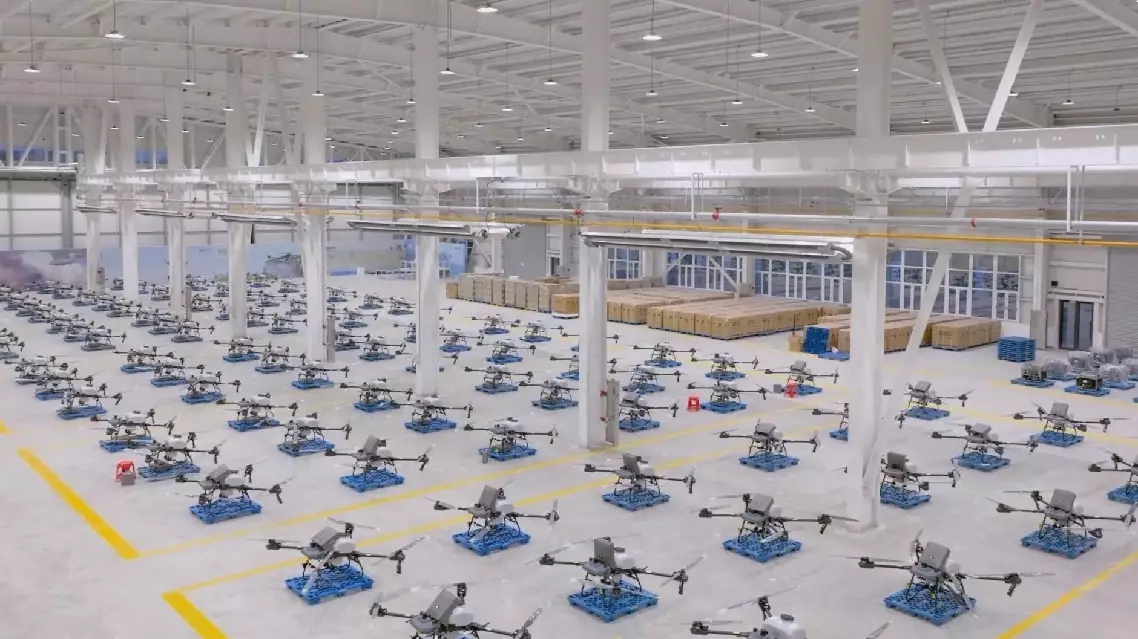
Drone industry in south China's Guangdong powers country's low-altitude economy