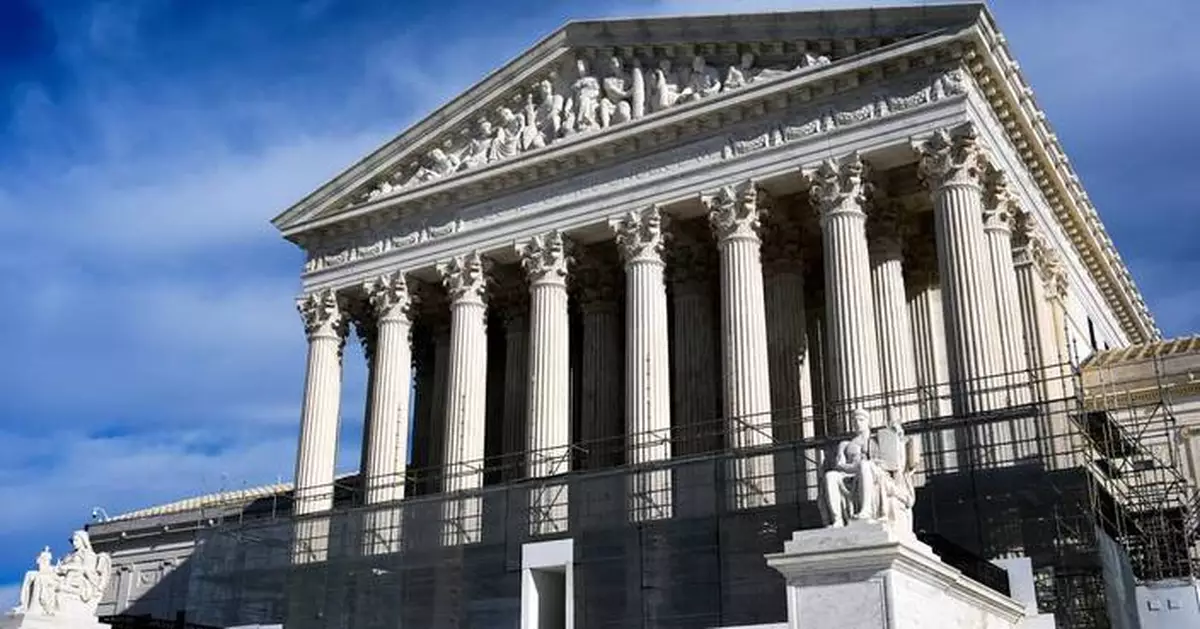
WASHINGTON (AP) — The Supreme Court said Monday that it will hear from oil and gas companies trying to block lawsuits seeking to hold the industry liable for billions of dollars in damage linked to climate change.
The conservative-majority court agreed to take up a case from Boulder, Colorado, one of multiple lawsuits alleging the companies deceived the public about how fossil fuels contribute to climate change.
Governments around the country have sought damages totaling billions of dollars, arguing it's necessary to help pay for rebuilding after wildfires, rising sea levels and severe storms worsened by climate change. The lawsuits come amid a wave of legal actions in California, Hawaii and New Jersey and worldwide seeking to leverage action through the courts.
The case out of Boulder County will likely have implications for other lawsuits, some of which have been dismissed while others work their way through state courts.
Suncor Energy and ExxonMobil appealed to the Supreme Court after Colorado’s highest court let the Boulder case proceed. The companies argue emissions are a national issue that should be heard in federal court, where similar suits have been tossed out.
“The use of state law to address global climate change represents a serious threat to one of our Nation’s most critical sectors,” attorneys wrote. ExxonMobil said Monday that “climate policy shouldn’t be set through fragmented state‑court actions."
President Donald Trump's administration weighed in to support the companies and urge the justices to reverse the Colorado Supreme Court decision, saying it would mean “every locality in the country could sue essentially anyone in the world for contributing to global climate change.”
Trump, a Republican, criticized the lawsuits in an executive order, and the Justice Department has sought to head some off in court.
Attorneys for Boulder had agued that the litigation is still in early stages and should stay in state court. “There is no constitutional bar to states addressing in-state harms caused by out-of-state conduct, be it the negligent design of an automobile or sale of asbestos,” they wrote.
City officials said the case was about dealing with problems people are facing in Colorado. “Our case is, fundamentally, about fairness. Boulder is already experiencing the effects of a rapidly warming climate, and the financial burden of adaptation should not fall solely on local taxpayers," said Jonathan Koehn, its climate initiatives director.
The Supreme Court also asked the two sides to present arguments on whether the case is truly ready to be heard by the justices. Arguments are expected in the fall.
Follow the AP's coverage of the U.S. Supreme Court at https://apnews.com/hub/us-supreme-court.
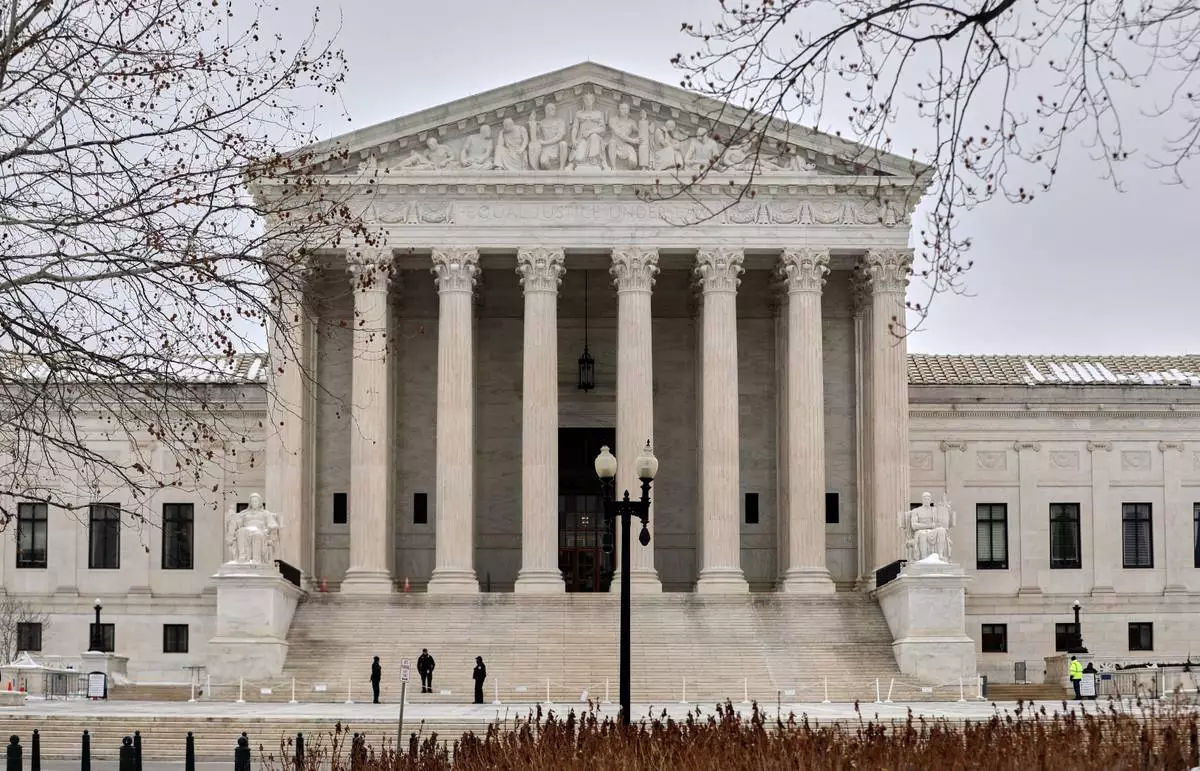
FILE - The Supreme Court is photographed, Feb. 6, 2026, in Washington. (AP Photo/Rahmat Gul, File)
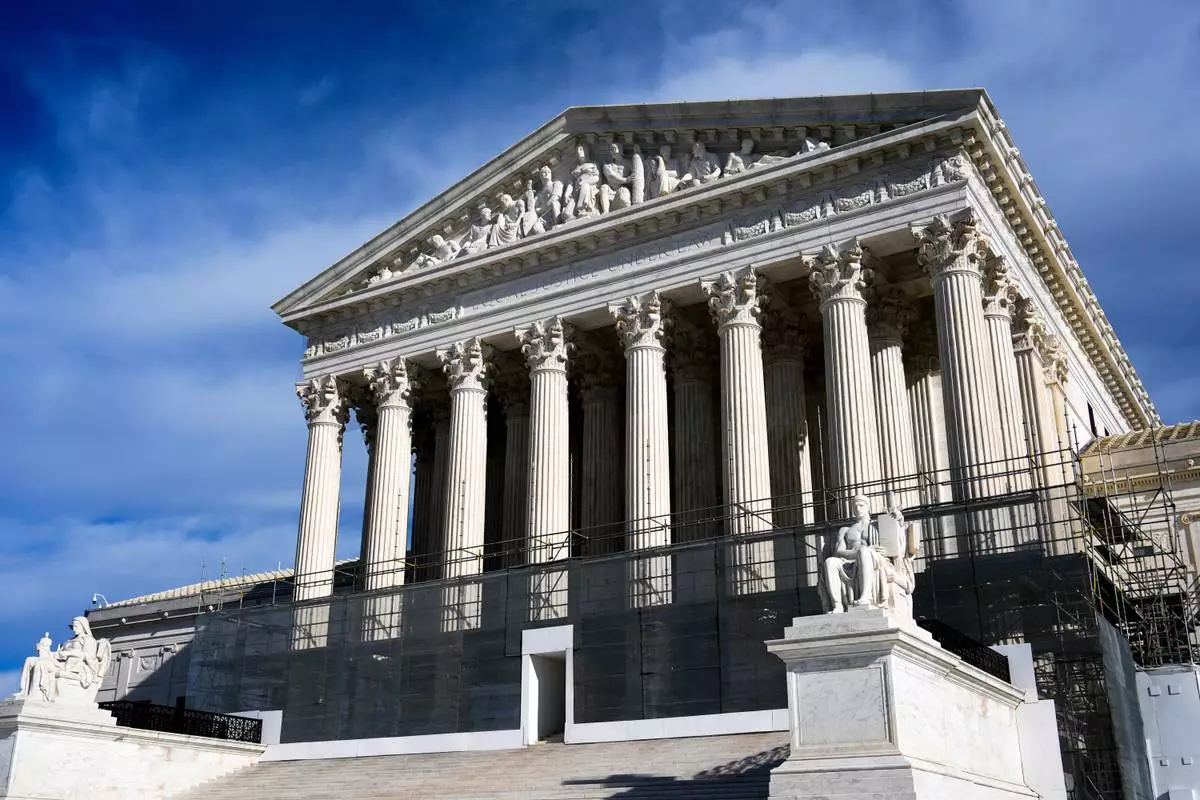
FILE - The Supreme Court is seen, Jan. 13, 2026, in Washington. (AP Photo/Julia Demaree Nikhinson, File)
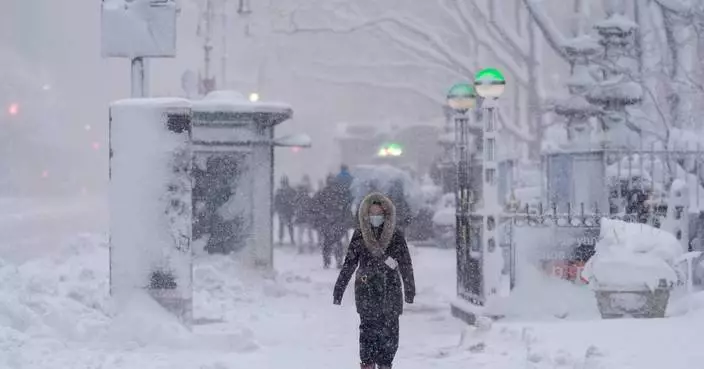
WASHINGTON (AP) — The nor’easter smacking much of the Northeast with nearly 3 feet of snow in places is as classic and powerful a blizzard as you can get, the strongest in a decade and up there with the most intense in history, meteorologists said.
The nor'easter quickly intensified to easily qualify as a “ bomb cyclone " and featured thundersnow and lightning, two things rarely seen in snowstorms. And while it was paralyzing and potentially dangerous for millions along the Eastern Seaboard, meteorologists found themselves rhapsodizing over its combination of power and beauty.
The storm hit the “Goldilocks situation" of just the right temperature for wet, heavy snow — any warmer and its precipitation wouldn't have fallen as snow. Any colder and there wouldn't have been as much moisture in the air to feed that snowfall, said Owen Shieh, warning coordination meteorologist at the National Weather Service's Weather Prediction Center in Maryland.
It also followed the ideal track for maximum snowfall. A little farther inland and it would have lost its warm ocean energy; a bit farther out to sea, and the heaviest snow would have fallen over the water, said Jeff Masters, co-founder of Weather Underground and now meteorologist at Yale Climate Connections.
“I’ve always been fascinated about how Mother Nature figures out how to put all the pieces together in order to maximize the most extreme outcome,'' said private meteorologist Ryan Maue, a former chief scientist for the National Oceanic and Atmospheric Administration. ”I think you could make a pretty good case that this is on par with some of the most impressive blizzards in history."
“There’s this sweet spot that can generate your highest snow totals and that’s kind of where we’re at, so in a way that kind of adds to that classic-ness of it,” Shieh said.
At 32.8 inches (83.3 centimeters) by about midday Monday, Providence set its all-time record for snowfall, beating 1978, and it was still snowing, the National Weather Service office in Boston reported.
Islip Airport in Long Island, New York, had 26.5 inches (67.3 centimeters). Freehold, New Jersey had 24.2 inches (61.5 centimeters) and Southampton, New York, had 24 inches (61 centimeters), all before noon Monday as the snow continued to fall. New York City had more than 15 inches (38 centimeters) and counting, while Philadelphia was well over 13 inches (33 centimeters), according to preliminary weather service calculations.
And it's the type of wet heavy snow that often triggers heart attacks, Shieh said.
“Just a word of caution for those who are going to be out shoveling the snow, that this will be easy to overexert yourself on,” Shieh said. “So take frequent breaks.”
Meteorologists measure how strong a storm gets by the atmospheric pressure at its center. The lower it goes, the stronger. This storm intensified quickly, dropping 39 millibars in 24 hours, easily passing the threshold of 24 millibars per day drop to be classified as “bombogenesis” or a “bomb cyclone,” Shieh and Maue said.
“I guess you could call it a superbomb,” Maue said.
Winter storms like this get their energy from the contrast in temperature between the cold air on land and the warm moist air over the ocean along with heat energy from the seas themselves, Masters said.
“This is about as intense as you can get,” Maue said. Its lowest pressure of 966 millibars would be a Category 2 hurricane if it were tropical, he said. He called it “a hurricane with snow."
“It is a classic in terms of not only the snowfall rates, but the intensity of the storm itself,” said former weather service director Louis Uccellini, who wrote meteorological textbooks on winter storms, comparing it to storms in 2016 and 1961. “It was just an amazing storm system.”
A study last summer found that in a warming world, the strongest nor'easters were becoming significantly stronger.
MIT's Judah Cohen said that a stretched polar vortex — when ultra-cold air usually penned up near the North Pole pushes further south — started just before the storm and was a factor. And he had a separate study last year finding these polar vortex stretches are increasing with a warmer Arctic.
An unusual combination of winter and summer weather — thundersnow and lightning — flashed at times with this storm, thrilling meteorologists on air. That's because “you only see it in the most intense winter storms,” Masters said.
Weather Channel extreme weather meteorologist Jim Cantore was reporting live from Plymouth, Massachusetts, when lightning struck nearby — the same place he was at 11 years ago when lightning struck during a storm he was reporting on.
“Holy smokes. We got it again baby,” Cantore screamed. “In the same place. Unbelievable.”
Meteorologist Matthew Cappucci, who grew up in Plymouth and said he yearned for thundersnow, rhapsodized about how "really cool” it was that this winter storm sparked a lightning strike to a New York City skyscraper and to wind turbines off the Massachusetts coast. Shieh said the weather service doesn't have reports of thundersnow in New York.
Meteorologists like Cappucci, Cohen and Uccellini, who love snow and extreme weather, gushed over satellite images of the storm, where they could see all the features that made this one come together perfectly.
Shieh said it looked almost too good, like something from a disaster movie.
“It almost looks like CGI (computer generated image)," he said.
The Associated Press’ climate and environmental coverage receives financial support from multiple private foundations. AP is solely responsible for all content. Find AP’s standards for working with philanthropies, a list of supporters and funded coverage areas at AP.org.
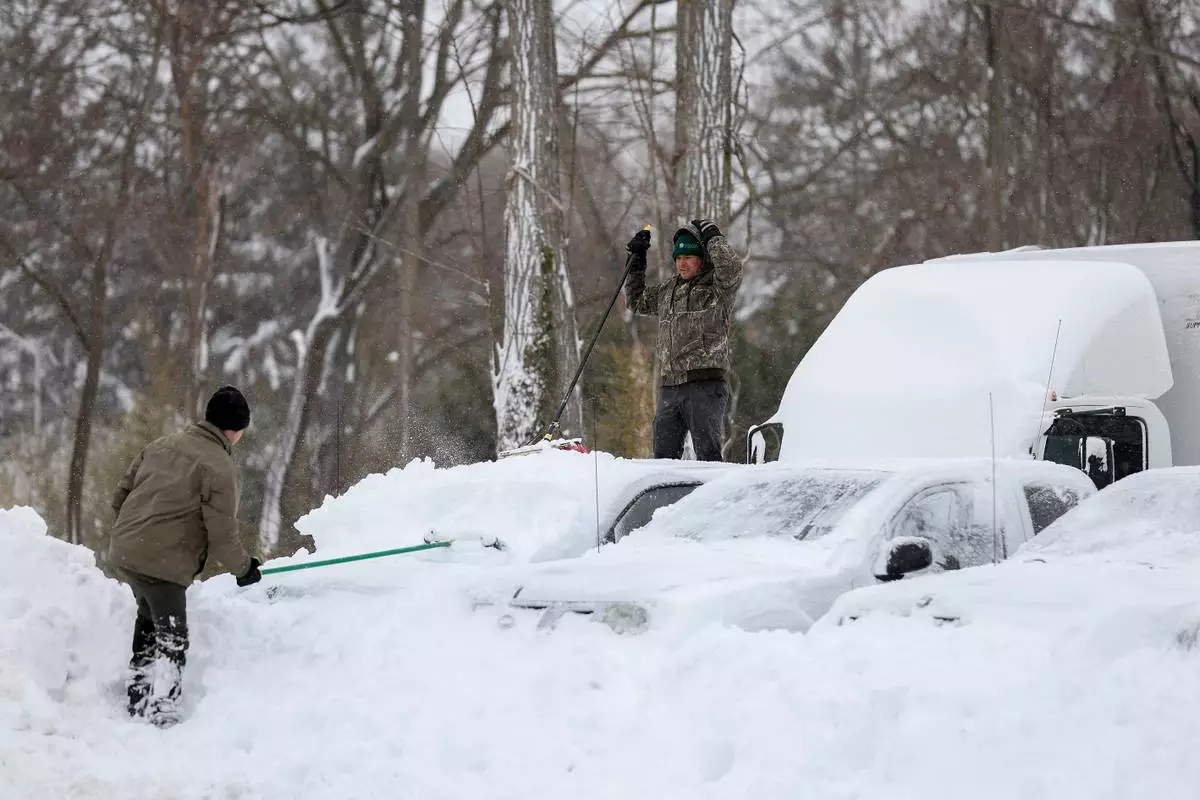
Men clear snow off of cars and trucks in a parking lot, Monday, Feb. 23, 2026, in St. James, N.Y. (AP Photo/Heather Khalifa)
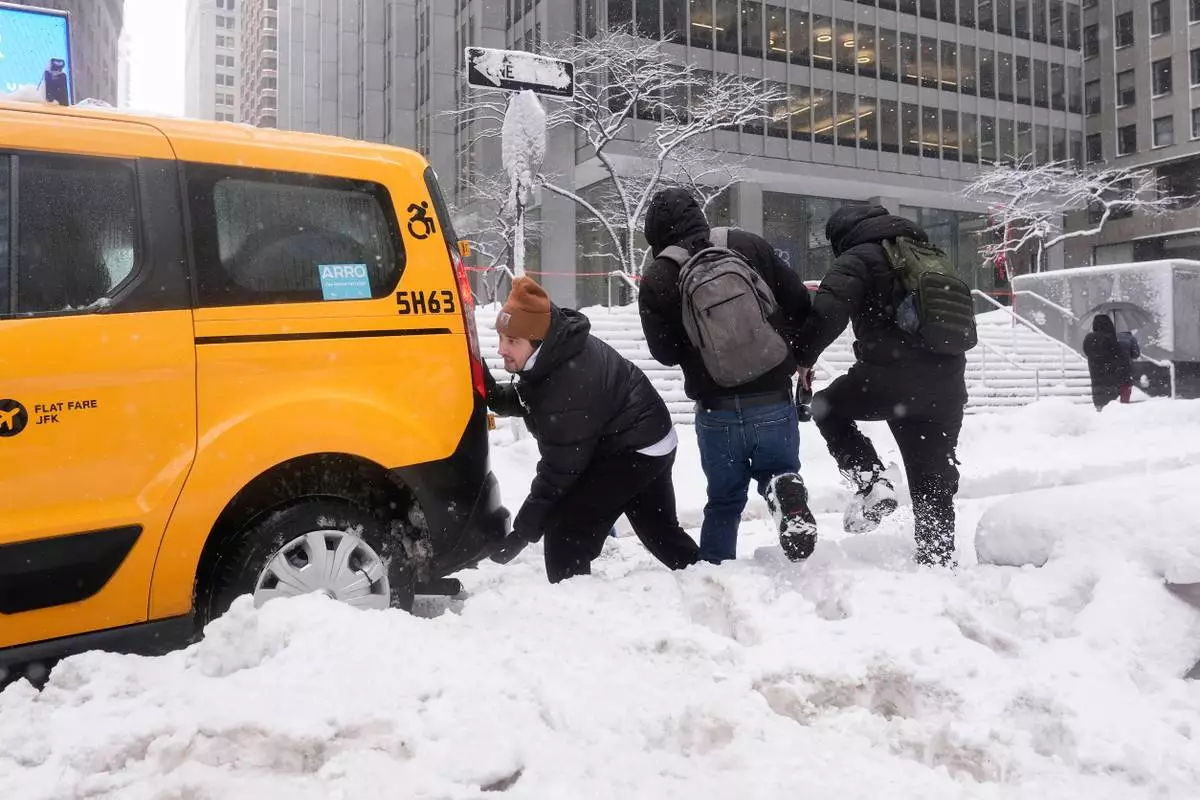
Cameron Betz helps push a taxi stuck in the snow during a snow storm, Monday, Feb. 23, 2026, in New York. (AP Photo/Seth Wenig)
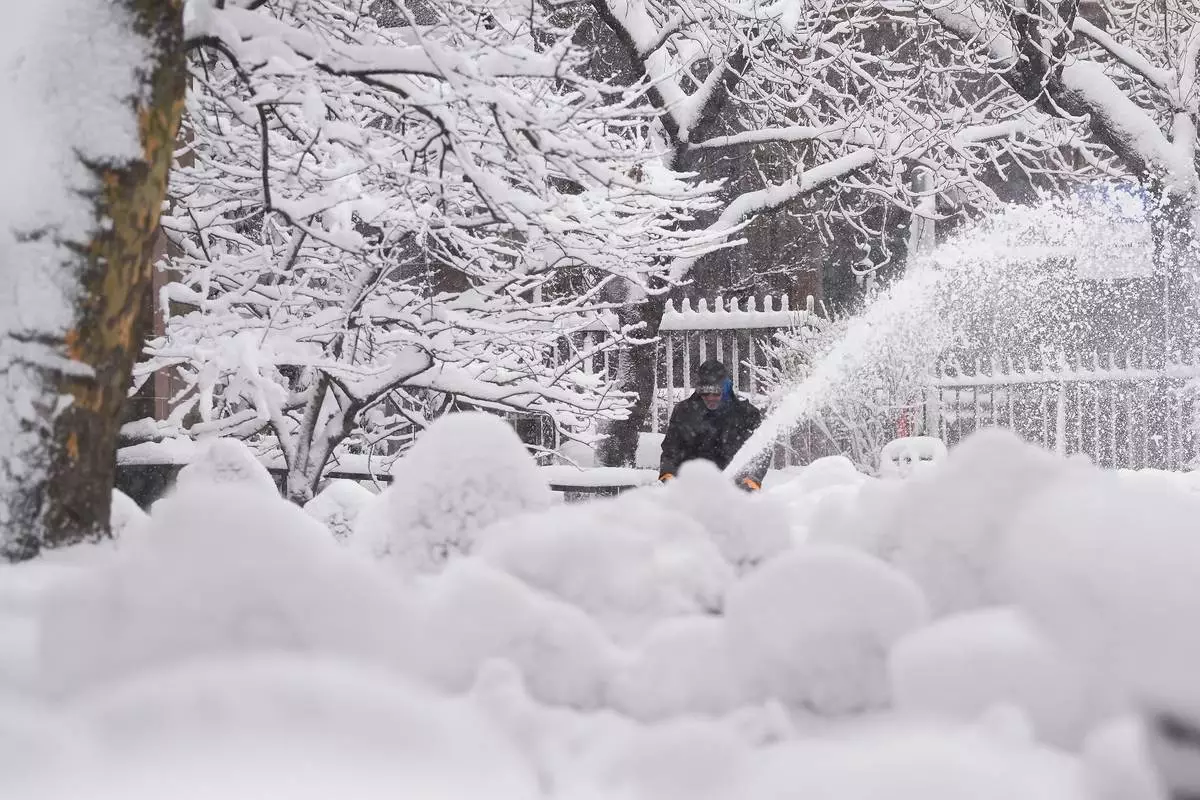
A groundskeeper clears snow from the walkways inside the Trinity Church graveyard in lower Manhattan during a snow storm, Monday, Feb. 23, 2026, in New York. (AP Photo/Seth Wenig)