Skip to Content Facebook Feature Image

Traditional village tourism thrives during Spring Festival holiday

China

China

China

Traditional village tourism thrives during Spring Festival holiday

2026-02-24 14:04 Last Updated At:14:59

Traditional villages across China emerged as new tourism highlights during the Spring Festival holiday from Feb 15 to 23, drawing over 73 million visits, according to the Ministry of Housing and Urban-Rural Development.

Centered on local culture and traditions, villages across China staged more than 10,000 village events during the holiday, bringing a new momentum for rural development, the data shows.

In Dongyuan Village, central China's Hubei Province, visitors from across the country explored the rustic charm while taking part in folk activities such as paper-cutting and making glutinous rice cakes. The immersive experiences turned centuries-old customs into living heritage that could be seen, tasted and actively engaged with.

Hongcun Village in east China's Anhui Province, often described as a "village in a traditional Chinese painting," attracted many foreign tourists during the holiday. Dressed in traditional Chinese costumes, they joined lantern parades and experienced Chinese New Year traditions firsthand.

Qingfeng Village in southwest China's Sichuan Province attracted tourists with its centuries-old architecture adorned with red Spring Festival couplets and hanging lanterns. Visitors flocked to the mountain village to savor what many described as an authentic taste of the New Year.

"The ancient buildings are captivating, the natural scenery is beautiful, and we can also enjoy the traditional 'baba banquet.' This has been such an interesting Spring Festival," said a tourist.

The open-air "baba banquet" is the traditional feast for festivals and celebrations in southwest China. Featuring steaming specialties served amid lively serving calls from hosts, the banquets have been proved especially popular with local hospitality. The influx of tourists also spurred brisk sales of local specialty products.

"Our family enjoyed everything, food, lodging, sightseeing, and shopping, and we spent just over 1,000 yuan (about 145 U.S. dollars). It was absolutely worth it," another visitor said.

By Monday, the seventh day of the Chinese New Year, more than 4,000 traditional villages nationwide had hosted 15,472 events, including village galas, folk performances, intangible cultural heritage showcases, seasonal farming activities, sports competitions, and creative cultural fairs. These activities attracted about 73.87 million visits and generated 5.884 billion yuan (around 851 million U.S. dollars) in consumer spending, according to ministry data.

Traditional village tourism thrives during Spring Festival holiday

Traditional village tourism thrives during Spring Festival holiday

People in Yemen are struggling for survival as the country continues to grapple with a deepening labor crisis after more than a decade of war, with many lamenting the lack of opportunities which are leaving the livelihoods of many hanging in the balance.

As the world marks International Workers' Day on Friday, the situation in Yemen seems all the more poignant as millions of people are finding it increasingly hard to find any work at all.

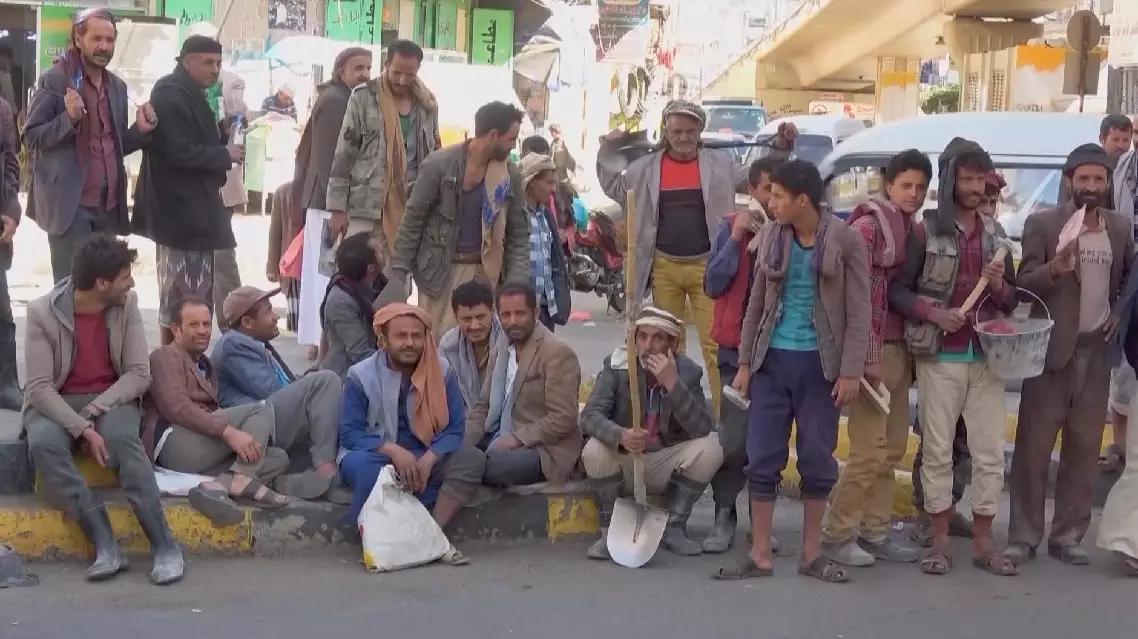
In the crowded streets of the capital Sana'a, workers gather on street corners, waiting for jobs that may never come. Ahmed Muawadah is one of the many who are sitting here, watching passing cars, desperately hoping that one will stop and offer work.

"Our suffering is that we sit here without work. Sometimes we spend a whole month without working, except for one day, or just one day every two weeks. Work is very limited, almost non-existent. I have nine children, and I only work one day a month. I cannot support them. Jobs have completely disappeared. If opportunities were opened for us, I and all the workers would work," said Muawadah.

This individual story reflects a broader reality affecting an estimated eight million workers across Yemen. Many of them are hoping to receive a daily wage, but the challenges are mounting in an increasingly strained labor market.

Activity in key sectors such as construction and services has dropped sharply, largely due to the suspension of several international initiatives, including those backed by the World Bank. As a result, income opportunities have narrowed for those who rely primarily on daily wages.

Meanwhile, the widening impact of the U.S.-Israeli war on Iran and the disruption caused along the key Strait of Hormuz -- a key shipping route for global trade -- has brought more misery in recent weeks.

"There has been a significant decline in business activity as a result of the war, the blockade, and the disruption of work. Foreign capital has also left the country, and large companies have moved out of Yemen and stopped their operations. This is one of the main reasons," said Abdul Karim Al, secretary general of the General Federation of Trade Unions in Sana'a.

Yemen residents struggling to survive as work dries up amid deepening labor crisis

Yemen residents struggling to survive as work dries up amid deepening labor crisis

Recommended Articles