Ranks among the top-performing agents on OpenAI's MLE-Bench and sets new performance milestones
NEW YORK, Feb. 24, 2026 /PRNewswire/ -- Fractal (www.fractal.ai), a publicly listed global enterprise AI company serving Fortune 500® organizations, today announced the launch of PiEvolve, an evolutionary, agentic engine designed for autonomous machine learning and scientific discovery.
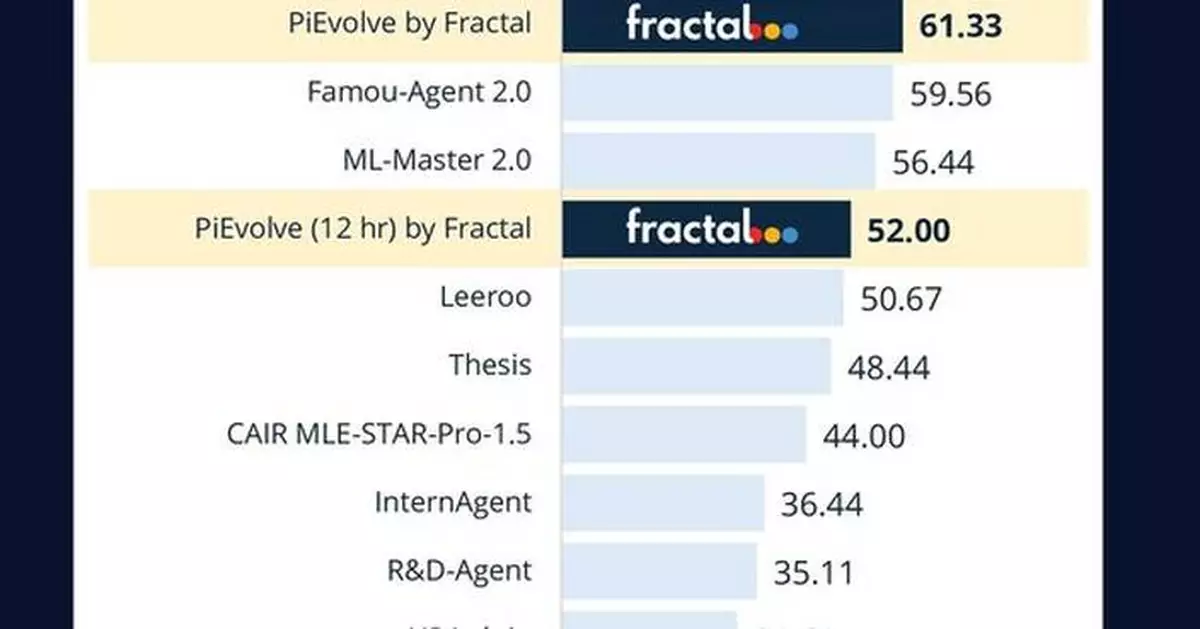
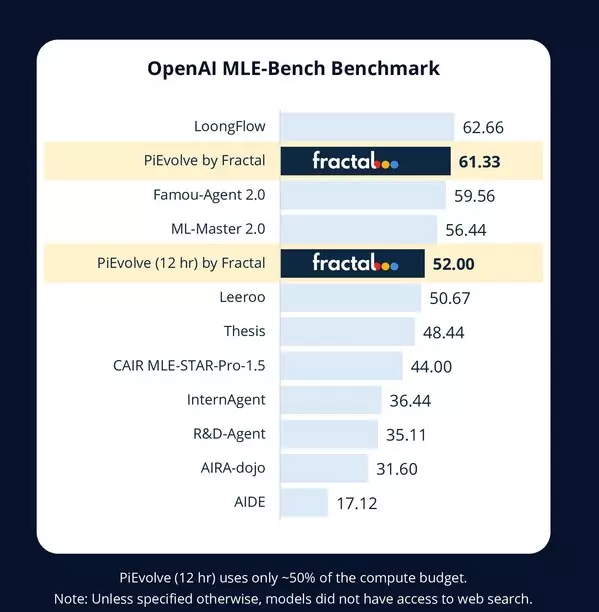
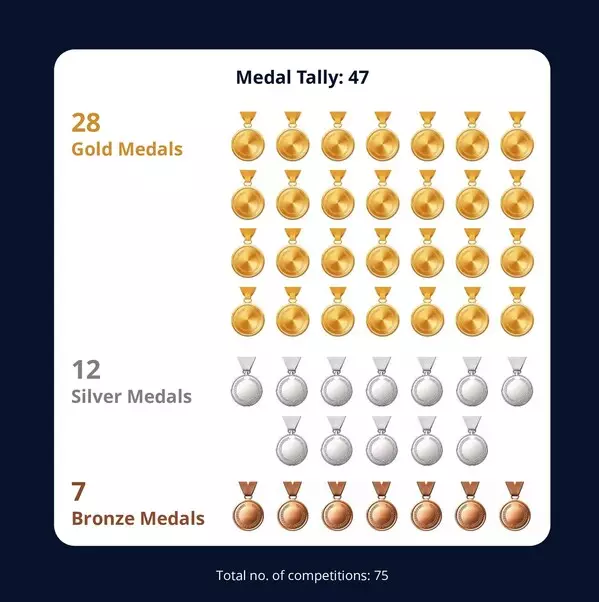
PiEvolve by Fractal ranks among the top-performing agents on OpenAI's MLE-Bench, a benchmark that evaluates how effectively AI systems can solve real-world machine learning challenges. It is the first evaluated agent to surpass 60 percent in Overall Medal Rate and 80 percent in MLE-Bench-Lite performance, crossing thresholds widely viewed as significant milestones in autonomous machine learning. These results mark a meaningful advance in agentic AI capability.
PiEvolve also combines strong performance with efficiency. Within a standard 24-hour run, it delivers results comparable to systems that require longer runtimes and greater compute. Even after 12 hours, it ranks among the top-performing agents, identifying high-quality solutions early.
Unlike traditional machine learning models that are trained once and then deployed, PiEvolve continuously tests and improves its own solutions until the available compute budget is fully utilized. Built on a graph-structured search architecture, it integrates reasoning, code generation, and validation within a unified iterative process. This enables it to tackle complex, multi-variable optimization problems across supply chains, financial services, and data center operations, where static AI systems often struggle to perform at scale.
"MLE-Bench is widely regarded as the gold standard for evaluating AI agents on real-world machine learning tasks," said Srikanth Velamakanni, Co-founder, Group Chief Executive and Vice Chairman, Fractal. "PiEvolve's ranking among the top systems globally is a meaningful validation of our research direction. At Fractal, our ambition has always been to power every human decision in the enterprise. PiEvolve advances that mission by enabling AI systems that continuously improve and deliver measurable business outcomes."
Key features of PiEvolve include:
- Continuous Optimization: Iteratively evolves candidate solutions, improving performance until computational limits are reached.
- Intelligent Memory: Uses priority-based sampling with decay to avoid local optima and ensure diverse exploration of solution paths.
- Dual Strategy: Improves high-performing solutions while actively debugging weaker ones to elevate overall system performance.
- Production-Ready: Includes Pause and Resume capabilities for long-running workloads and integrates seamlessly into enterprise ML pipelines.
- Graph-Structured Search: Systematically explores reasoning, code, and validation loops to generate and refine solutions.
"PiEvolve ranks among the top agents evaluated on OpenAI's MLE-Bench, including systems developed by leading global research labs. Achieving top-tier performance on OpenAI's MLE-Bench is a significant milestone for our research team and reinforces Fractal's commitment to advancing enterprise-grade AI," said Suraj Amonkar, Chief AI Research and Platforms Officer at Fractal. "We are building autonomous systems capable of sustained reasoning, self-improvement, and evolutionary learning, bringing next-generation agentic intelligence to real-world machine learning challenges."
With the launch of PiEvolve, Fractal reinforces its position at the forefront of enterprise AI innovation. PiEvolve brings continuous improvement, efficiency, and production reliability together in a single system, helping organizations solve complex challenges with confidence and scale. For more information, visit https://fractal.ai/ai-research/pi-evolve
About Fractal
Fractal (NSE: FRACTAL) is a publicly listed global enterprise AI company with a vision to power every human decision in the enterprise.
Fractal's suite of businesses includes Asper.ai (enabling interconnected decisions for revenue growth) and Analytics Vidhya (among the world's largest data science communities). Fractal spun out Qure.ai, a global healthcare AI leader enhancing the rapid identification and management of tuberculosis, lung cancer, and stroke. Fractal's dedicated AI Research team is focused on foundational AI advancements, including knowledge-based foundational models, reasoning-based systems, and agentic systems. The team has launched successful products, including MarshallGoldsmith.ai, Vaidya.ai, Kalaido.ai, and the open-source reasoning model Fathom-R1-14B and tool-based reasoning model Fathom-DeepResearch.
Fractal employs over 5,000 professionals across global locations, including the United States, Canada, the UK, the Netherlands, Ukraine, India, Singapore, South Africa, the UAE, and Australia. It has consistently earned recognition as one of India's Best Companies to Work For (Top 100, 2025), a 'Great Workplace' for eight consecutive years, and as one of 'India's Best Workplaces for Women' for five years running by the Great Place to Work® Institute. Fractal was also named a Leader in the 2025 Forrester Wave™ for Customer Analytics Service Providers and earned leadership positions in the Everest Group Peak Matrix Assessment 2025 for AI and Analytics Services, and Information Services Group's 2024 assessments for Data Engineering and Data Science Services.
** The press release content is from PR Newswire. Bastille Post is not involved in its creation. **
Fractal Launches PiEvolve, an Evolutionary Agentic Engine for Autonomous Machine Learning and Scientific Discovery
Fractal Launches PiEvolve, an Evolutionary Agentic Engine for Autonomous Machine Learning and Scientific Discovery
|
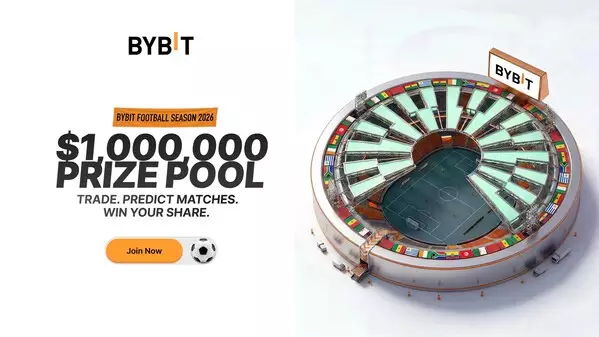
DUBAI, UAE, June 9, 2026 /PRNewswire/ -- Bybit, the world's second-largest cryptocurrency exchange by trading volume, has announced the launch of its Football Season 2026 campaign, a multi-stage trading and prediction event centered on the theme "The Pitch is Everywhere," where users can trade, predict and share a prize pool of up to $1 million in rewards.
The campaign will run from June 9, 2026, at 10 a.m. UTC through July 19, 2026, at 11:59 p.m. UTC, bringing together trading activity and football match predictions through a multi-stage rewards experience. Framed by the idea that "The Pitch is Everywhere," the campaign positions Bybit as a new kind of financial platform – where every product, feature, and action mirrors a role on the field, giving users multiple ways to participate, strategize, and win.
Participants can trade on Bybit, predict match outcomes, and earn a proportional share of the prize pool. There are no rankings or winner-takes-all mechanics, every qualifying user receives rewards based on their share of total Points. The more Points a user holds, the larger their share of the rewards.
The event is structured across three independent stages, each offering a separate opportunity to earn rewards. Stage 1 runs from June 9–28, 2026, during the Group Stage; Stage 2 runs from June 28–July 12, 2026, during the Knockout Stage; and Stage 3 runs from July 12–19, 2026, during the Finals. Points balances reset at the start of each stage, giving participants a fresh start and a new chance to compete for rewards throughout the campaign.
To participate, users must first earn Points by completing daily tasks and reaching trading volume milestones. A minimum of 30 net Points is required to qualify for rewards in any given stage. Users can then stake Points on football match outcomes, where correct predictions multiply their Points based on a community-determined dynamic match multiplier, while incorrect predictions result in forfeited stakes.
At the conclusion of each stage, the prize pool is allocated proportionally among qualifying users according to their net Points. Each stage features an independently scaled prize pool determined by total community net Points and subject to predefined minimum and maximum thresholds. Across the campaign, stage prize pools range from $50,000 to $325,000 depending on the stage and total community net Points.
All rewards are distributed in Mantle (MNT) token at a USD-equivalent value at the time of distribution, which is scheduled within 10 business days following each stage's close.
New users can also access an introductory incentive, receiving a $5 MNT airdrop after depositing at least $100 and completing a minimum $10 trade.
Participation is subject to eligibility requirements, including Identity Verification Level 1 and geographic restrictions. The campaign is not available in certain jurisdictions, including the United Kingdom and countries within the European Economic Area, among others.
#Bybit / #NewFinancialPlatform
About Bybit
Bybit is the world's second-largest cryptocurrency exchange by trading volume, serving a global community of over 80 million users. Founded in 2018, Bybit is redefining openness in the decentralized world by creating a simpler, open and equal ecosystem for everyone. With a strong focus on Web3, Bybit partners strategically with leading blockchain protocols to provide robust infrastructure and drive on-chain innovation. Renowned for its secure custody, diverse marketplaces, intuitive user experience, and advanced blockchain tools, Bybit bridges the gap between TradFi and DeFi, empowering builders, creators, and enthusiasts to unlock the full potential of Web3. Discover the future of decentralized finance at Bybit.com.
For more details about Bybit, please visit Bybit Press
For media inquiries, please contact: media@bybit.com
For updates, please follow: Bybit's Communities and Social Media
Discord | Facebook | Instagram | LinkedIn | Reddit | Telegram | TikTok | X | Youtube
DUBAI, UAE, June 9, 2026 /PRNewswire/ -- Bybit, the world's second-largest cryptocurrency exchange by trading volume, has announced the launch of its Football Season 2026 campaign, a multi-stage trading and prediction event centered on the theme "The Pitch is Everywhere," where users can trade, predict and share a prize pool of up to $1 million in rewards.
The campaign will run from June 9, 2026, at 10 a.m. UTC through July 19, 2026, at 11:59 p.m. UTC, bringing together trading activity and football match predictions through a multi-stage rewards experience. Framed by the idea that "The Pitch is Everywhere," the campaign positions Bybit as a new kind of financial platform – where every product, feature, and action mirrors a role on the field, giving users multiple ways to participate, strategize, and win.
Participants can trade on Bybit, predict match outcomes, and earn a proportional share of the prize pool. There are no rankings or winner-takes-all mechanics, every qualifying user receives rewards based on their share of total Points. The more Points a user holds, the larger their share of the rewards.
The event is structured across three independent stages, each offering a separate opportunity to earn rewards. Stage 1 runs from June 9–28, 2026, during the Group Stage; Stage 2 runs from June 28–July 12, 2026, during the Knockout Stage; and Stage 3 runs from July 12–19, 2026, during the Finals. Points balances reset at the start of each stage, giving participants a fresh start and a new chance to compete for rewards throughout the campaign.
To participate, users must first earn Points by completing daily tasks and reaching trading volume milestones. A minimum of 30 net Points is required to qualify for rewards in any given stage. Users can then stake Points on football match outcomes, where correct predictions multiply their Points based on a community-determined dynamic match multiplier, while incorrect predictions result in forfeited stakes.
At the conclusion of each stage, the prize pool is allocated proportionally among qualifying users according to their net Points. Each stage features an independently scaled prize pool determined by total community net Points and subject to predefined minimum and maximum thresholds. Across the campaign, stage prize pools range from $50,000 to $325,000 depending on the stage and total community net Points.
All rewards are distributed in Mantle (MNT) token at a USD-equivalent value at the time of distribution, which is scheduled within 10 business days following each stage's close.
New users can also access an introductory incentive, receiving a $5 MNT airdrop after depositing at least $100 and completing a minimum $10 trade.
Participation is subject to eligibility requirements, including Identity Verification Level 1 and geographic restrictions. The campaign is not available in certain jurisdictions, including the United Kingdom and countries within the European Economic Area, among others.
#Bybit / #NewFinancialPlatform
About Bybit
Bybit is the world's second-largest cryptocurrency exchange by trading volume, serving a global community of over 80 million users. Founded in 2018, Bybit is redefining openness in the decentralized world by creating a simpler, open and equal ecosystem for everyone. With a strong focus on Web3, Bybit partners strategically with leading blockchain protocols to provide robust infrastructure and drive on-chain innovation. Renowned for its secure custody, diverse marketplaces, intuitive user experience, and advanced blockchain tools, Bybit bridges the gap between TradFi and DeFi, empowering builders, creators, and enthusiasts to unlock the full potential of Web3. Discover the future of decentralized finance at Bybit.com.
For more details about Bybit, please visit Bybit Press
For media inquiries, please contact: media@bybit.com
For updates, please follow: Bybit's Communities and Social Media
Discord | Facebook | Instagram | LinkedIn | Reddit | Telegram | TikTok | X | Youtube
** This press release is distributed by PR Newswire through automated distribution system, for which the client assumes full responsibility. **
Bybit Launches Football Season 2026 Campaign With Up To $1 Million Prize Pool