NEW YORK (AP) — Last October, 35 major donor families, calling their collaborative The Audacious Project, gathered in California and committed $1.03 billion to more than a dozen nonprofits whose proposed projects span multiple years and take on major challenges.
The collaborative, housed at TED, announced the winning nonprofits Tuesday, after spending more than a year selecting the groups and helping them sharpen pitches for larger projects than philanthropic funders typically support. It's not until the donors meet in person that they decide how much to give to each group.
Click to Gallery
Jennifer Loving, CEO of Destination: Home, poses for a portrait outside of her office on Monday, Feb. 23, 2026, in San Jose, Calif. (AP Photo/Laure Andrillon)
Jennifer Loving, CEO of Destination: Home, poses for a portrait outside of her office and housing units on Monday, Feb. 23, 2026, in San Jose, Calif. (AP Photo/Laure Andrillon)
Jennifer Loving, CEO of Destination: Home, poses for a portrait at her office on Monday, Feb. 23, 2026, in San Jose, Calif. (AP Photo/Laure Andrillon)
Jennifer Loving, CEO of Destination: Home, poses for a portrait outside of her office and housing units, Monday, Feb. 23, 2026, in San Jose, Calif. (AP Photo/Laure Andrillon)
Jennifer Loving, the CEO of the San Jose-based nonprofit Destination: Home, said it was “shock and awe,” when they learned the donors had met their funding request to help expand homeless prevention services to multiple U.S. cities.
“It’s not for the faint of heart to work on this issue in America,” Loving said, referencing the stigma around poverty. “And so you kind of brace yourself. You never know if people are going to see what you see and it was beautiful. It was really beautiful.”
Connie Ballmer, cofounder of Ballmer Group along with her husband Steve Ballmer, the former CEO of Microsoft and owner of the Los Angeles Clippers, has been a donor since 2021, when she went with one of their sons to learn more about funding around climate change.
“Nowhere that I know of can you raise a billion dollars in two days,” she said. “For an organization to raise an amount — whether it’s $40, $60, $80 million, I mean, do you know how long that takes them to do that kind of fundraising?”
This year, the grantees also include the Arc Institute, a relatively new research group in California, to support its development of a virtual model of a cell that it hopes will help scientists identify treatments for complex diseases like Alzheimer’s.
The nonprofit Tiko, which is based in Africa, also received funding to expand its services for teenage girls, including contraception, HIV services and responses to sexual violence. It was the third time Tiko had applied for funding from Audacious, said co-CEO Serah Joy Malaba, with the hope of scaling their work to reach more girls.
In total, 55 major donor families have participated in at least one round of The Audacious Project’s work. The group expands by invitation and the formal criteria that donors be willing to commit at least $10 million to the funding round. Many end up donating more, in part inspired by the commitments that others make in the room.
Another donor, Tegan Acton, who cofounded Wildcard Giving along with her husband, Brian Acton, a cofounder of WhatsApp, said she participates because she believes in collective action and values the focus on funding solutions developed by people close to the problems. Acton also said she’s enjoyed seeing how different donors approach their funding decisions.
“Some people come and they have a binder printed and they have a thousand tabs with little notes about every project and they’ve marked up the appendices” she said, whereas others, “show up and watch the videos and see what sparks interest.”
As part of the application process, finalists record something like a TED Talk that introduces themselves and their project.
Loving, from Destination: Home, said the guidance from Audacious and The Bridgespan Group, a nonprofit consulting firm, helped sharpen their plan for scaling their approach to homelessness prevention. The initiative, Right at Home, identifies people and families most at risk of losing their housing and gives them money and support so they don’t. The approach now has won significant public funding in San Jose.
“Going through this process was probably one of the most rigorous things we’ve ever done,” Loving said. “I can say with total confidence that it made us smarter.”
Loving’s project is a good example of the kind of big change that The Audacious Project seeks to identify. Her group had not aspired to work nationally but identified a solution they think may help other places. Rather than opening new offices or expanding, they will partner with local groups, bring them funding and ask them to participate in research to assess the impact.
For the first time this year, some organizations received a second commitment from Audacious donors, including Last Mile Health. Their initial grant in 2018 helped to train many more community health workers in multiple African countries, going from 2,000 to 23,000. This time, they received $20 million to again train more of these front line health workers but also to support an ongoing project to coordinate and mobilize more domestic funding from the countries where they work.
“It’s not just a philanthropic investment and then a cliff,” said Lisha McCormick, CEO of Last Mile Health. Instead, the funds will support a reworking of how governments fund their public health systems following major cuts to U.S. foreign aid, which made up a significant portion of some countries' health budgets.
Anna Verghese, executive director of The Audacious Project, said they'd considered making second round grants for a while.
“The honest question that we and our donor community had to wrestle with is, what kinds of partners are we if we walk away right when that momentum is building?” she said.
The other nonprofits that received funding include: Braven, Imagine Worldwide, Ipas, Plastic Solutions Fund, Pure Earth, Solutions for Our Climate, The Ocean Cleanup, Humanitarian OpenStreetMap Team and Thorn.
Associated Press coverage of philanthropy and nonprofits receives support through the AP’s collaboration with The Conversation US, with funding from Lilly Endowment Inc. The AP is solely responsible for this content. For all of AP’s philanthropy coverage, visit https://apnews.com/hub/philanthropy.

Jennifer Loving, CEO of Destination: Home, poses for a portrait outside of her office on Monday, Feb. 23, 2026, in San Jose, Calif. (AP Photo/Laure Andrillon)

Jennifer Loving, CEO of Destination: Home, poses for a portrait outside of her office and housing units on Monday, Feb. 23, 2026, in San Jose, Calif. (AP Photo/Laure Andrillon)

Jennifer Loving, CEO of Destination: Home, poses for a portrait at her office on Monday, Feb. 23, 2026, in San Jose, Calif. (AP Photo/Laure Andrillon)

Jennifer Loving, CEO of Destination: Home, poses for a portrait outside of her office and housing units, Monday, Feb. 23, 2026, in San Jose, Calif. (AP Photo/Laure Andrillon)
It has been exactly four years since Russia launched its large-scale invasion of Ukraine, attacking the country from multiple directions. On Feb. 24, 2022, Russian President Vladimir Putin announced a “special operation," a campaign that many expected to be brief and to end with Kyiv's capitulation.
Instead, European officials are traveling to the Ukrainian capital on Tuesday to show their support for President Volodymyr Zelenskyy and the Ukrainian people, who are fighting on.
While Putin did not get the quick and overwhelming victory he had hoped for, the cost has been high on both sides. And as Europe’s biggest conflict enters its fifth year, there is no sign of any peace deal despite U.S. diplomatic efforts over the past year.
Here’s the latest:
President Vladimir Putin held a meeting with top officials of Russia’s top counterintelligence agency on Tuesday without mentioning the anniversary.
Putin told the officials of Federal Security Service, or FSB, that the threat of attacks against Russia had increased, including those carried out by Ukraine’s special forces. He said greater protection would be needed for energy and transport infrastructure, as well as for leading defense industry officials.
He also said that Russia’s adversaries were attempting to derail peace negotiations with Ukraine.
“They want to attack, They can’t live without it,” Putin said during his speech. “They absolutely must have the defeat of Russia. They are looking for any way.” He also held a minute’s silence in honor of FSB officers killed in service.
Ukraine’s Western allies offered Ukraine their “full and sustained support” on the four years since the start of Russia’s full-scale invasion, French President Emmanuel Macron and British Prime Minister Keir Starmer said in a joint statement.
Over 30 leaders of the so-called Coalition of the Willing co-chaired by France and the U.K. to provide Ukraine with security guarantees once a peace deal is achieved held talks Tuesday via videoconference and in-person in Kyiv with President Volodimir Zelenskyy, the statement said.
They “reiterated their unwavering commitment to working together to achieve a just and lasting peace,” it said.
Leaders “urged Russia to engage in the discussions in a meaningful way, and to agree to a full, unconditional ceasefire.” They reaffirmed their commitment to ramp up economic pressure on Russia including through additional sanctions, the statement said.
South Africa's President Cyril Ramaphosa said Tuesda y that a group of 11 South African men allegedly lured to fight alongside Russian soldiers in the war against Ukraine are expected to return home soon.
South Africa’s government said in December that it had received distress calls from the men who were trapped in Ukraine’s war-torn eastern Donbas region. The men had joined mercenary forces under the pretext of lucrative employment contracts, the government said.
Their travel to Russia appears consistent with other reports of African men who have been recruited to fight in the war against Ukraine, including over 1,000 from Kenya, according to an intelligence report presented to the Kenyan parliament last week. Four other South Africans returned home last week.
At least 200,000 Russian troops have died during Russia’s four-year invasion of Ukraine, independent media outlets reported Tuesday.
Russian news outlet Mediazona, together with the BBC and a team of volunteers, has collected the names of 200,186 troops killed in the war by scouring news reports, social media and government websites.
Neither Moscow nor Kyiv gives timely data on military losses, and each is at pains to amplify the other side’s casualties. Russia has publicly acknowledged the deaths of just over 6,000 soldiers.
European lawmakers cheered Zelenskyy who met with them on a videoconference during an extraordinary session of the European Parliament commemorating the anniversary of the war's start.
Lawmakers from Portugal to Finland praised Ukraine and blasted Hungarian Prime Minister Victor Orbán, whose last minute objection sank new efforts to help Ukraine and raise the costs on Russia for prosecuting the war.
“He has become Putin's cheap servant, Viktor Orbán, in the last years and also today has not only betrayed Ukraine, he has betrayed all of us. He has betrayed Europe,” said German member of parliament Terry Reintke.
While a few criticized Ukraine, an overwhelming majority of lawmakers lauded Ukrainian resolve, wore blue and yellow flower pins, blasted Putin and pledged continued support for the war-ravaged nation many see as a future EU member.
British Prime Minister Keir Starmer has paid tribute to the resilience of Ukrainians as he told his Cabinet that Kyiv’s allies “must defeat the falsehood that Russia is winning.”
“When this conflict broke out four years ago, it was assumed it would be a matter of weeks before Putin took the whole of Ukraine. That’s what everybody believed," Starmer said.
“Four years later, the Ukrainians are holding out against that aggression, holding out on the front line where the circumstances are extremely challenging, but also holding out in civilian life where every day Ukrainians get up and go to work as a sign of resilience and defiance.
Starmer said that over the last year alone, "Russia took 0.8% of land in Ukraine at a terrible cost to themselves, half a million losses.”
Kremlin spokesperson Dmitry Peskov said Russia has not achieved all of its goals in its war on Ukraine, but that Russia’s operation would continue and that Russian interests would be secured.
When asked how Russia had changed over the last four years, Peskov said that Russian society had rallied around Putin. He also said that Russian society had matured in “understanding our roots” and “understanding what is good and what is bad in international affairs around the world.”
He said the past four years have been very important in Russia's history and that the country will move forward.
More than a dozen senior European officials arrived in Kyiv on Tuesday in a show of support. But they also come without two new deals they had hoped to present to Kyiv — a new package of sanctions on Russia and a 90 billion euro loan to fund Ukraine's defense for the next two years.
Hungary, seen as most pro-Russian country in the European Union, blocked them both. It's a sign of how difficult it has been sometimes to maintain solidarity as the war drags on.
Zelenskyy said his country has withstood the onslaught by Russia’s bigger and better equipped army, which over the past year of fighting captured just 0.79% of Ukraine’s territory, according to the Institute for the Study of War, a Washington-based think tank.
“Looking back at the beginning of the invasion and reflecting on today, we have every right to say: we have defended our independence, we have not lost our statehood; Putin has not achieved his goals,” Zelenskyy said on social media.
“He has not broken Ukrainians; he has not won this war,” Zelenskyy said.
French President Emmanuel Macron said in a post on the social platform X that “this war is a triple failure for Russia: military, economic, and strategic.”
“It has strengthened NATO — the very expansion Russia sought to prevent — galvanized Europeans it hoped to weaken, and laid bare the fragility of an imperialism from another age," Macron said.
Macron also urged the EU to issue the 90 billion euro ($106 billion) loan to Ukraine, a plan that requires the unanimity of the 27 member states.
“There is no justification for calling this into question. We must now deliver on it,” he wrote.
Macron and British Prime Minister Keir Starmer were to join a meeting of Western leaders supporting Ukraine, the so-called Coalition of the Willing, via videoconference on Tuesday.
Britain’s Armed Forces Minister Al Carns says the war has been “the most defining conflict” in decades due to the way it has revolutionized warfare and upended Europe’s security.
“I would never have guessed in my lifetime I would see North Korean troops fighting on the border of Europe,” Carns told reporters on Monday. “Which I think is a significant warning signal to all of us.”
Carns said the conflict had brought a “revolution in military affairs,” especially through the rapid development of drone technology. Drones now account for the vast majority of battlefield casualties in the war.
Western officials say that in the last three months, Russia has lost more casualties than the number of troops it recruits, a potential tipping point.
“The cost on Russia has been almost unimaginable,” Carns said, calling a Western estimate of 1.25 million Russian personnel killed and wounded since 2022 likely an underestimate.
European leaders visiting Kyiv hailed the Ukrainian struggle.
Danish Prime Minister Mette Frederiksen said the Ukrainians are “standing up for the freedom of us all. Their courage and strength shine in the fight against Putin’s darkness. And they give hope to those of us who want a Europe at peace.”
Swedish Prime Minister Ulf Kristersson, said: “We don’t yet know when the war will end, but how it ends will affect Sweden’s security for at least a generation to come. And that’s why our continued support is so crucial.”
Poland’s Foreign Minister Radosław Sikorski vowed from Kyiv that his country would remain “steadfast in its support for the Ukrainian people and in its pursuit of a just and lasting peace.”
“A victory parade was supposed to take place here after a few days,” Sikorski said in an address from Kyiv referring to Russia’s initial plans of a quick takeover of Ukraine. “Instead, four years later, Kyiv is still defending itself.”
NATO Secretary-General Mark Rutte said Ukraine’s allies will continue to militarily support the war-ravaged nation to end the war and ensure a lasting peace.
“Ukraine needs ammunition today and every day, until the bloodshed stops. Ukraine continues to blunt Russia’s aggression, and despite Putin’s posturing, Russia has failed to meet their ambitions on the battlefield,” he said during a ceremony at NATO headquarters in Brussels.
“There cannot be true peace in Europe without real peace in Ukraine. When the fighting eventually stops, the peace has to hold with strong Ukrainian forces ready to deter and defend and effective security guarantees from Ukraine’s partners: Europe, Canada, and the United States.”
A Chinese government spokesperson noted that the door to dialogue had recently opened in what she called the Ukraine crisis, avoiding describing the conflict as a war.
“We hope all parties will seize the opportunity to reach a comprehensive, lasting and binding peace agreement,” Foreign Ministry spokesperson Mao Ning said when asked about the fourth anniversary of the outbreak of the war.
China has been accused of not doing enough to pressure Russia to end the fighting. It has maintained ties and trade with Russia, relieving some of the pressure of economic sanctions. China says its position is impartial and objective.
“China never fans the flames or seeks to profit from the situation, and of course we do not accept any attempts to shift blame onto China,” Mao said.
Matthias Schmale, the U.N. humanitarian coordinator in Ukraine, noted that the costs for the country’s recovery from the war are now estimated at $590 billion over a decade — three times Ukraine’s GDP last year.
Schmale said by video link to a U.N. briefing in Geneva on Tuesday that over 10.8 million people, roughly a quarter of Ukraine’s population, remain in need of humanitarian assistance – including up to 1 million in Russian-occupied territory.
He also noted that that Ukraine is one of the world’s most-mined countries, with almost a quarter of its territory “potentially contaminated.”
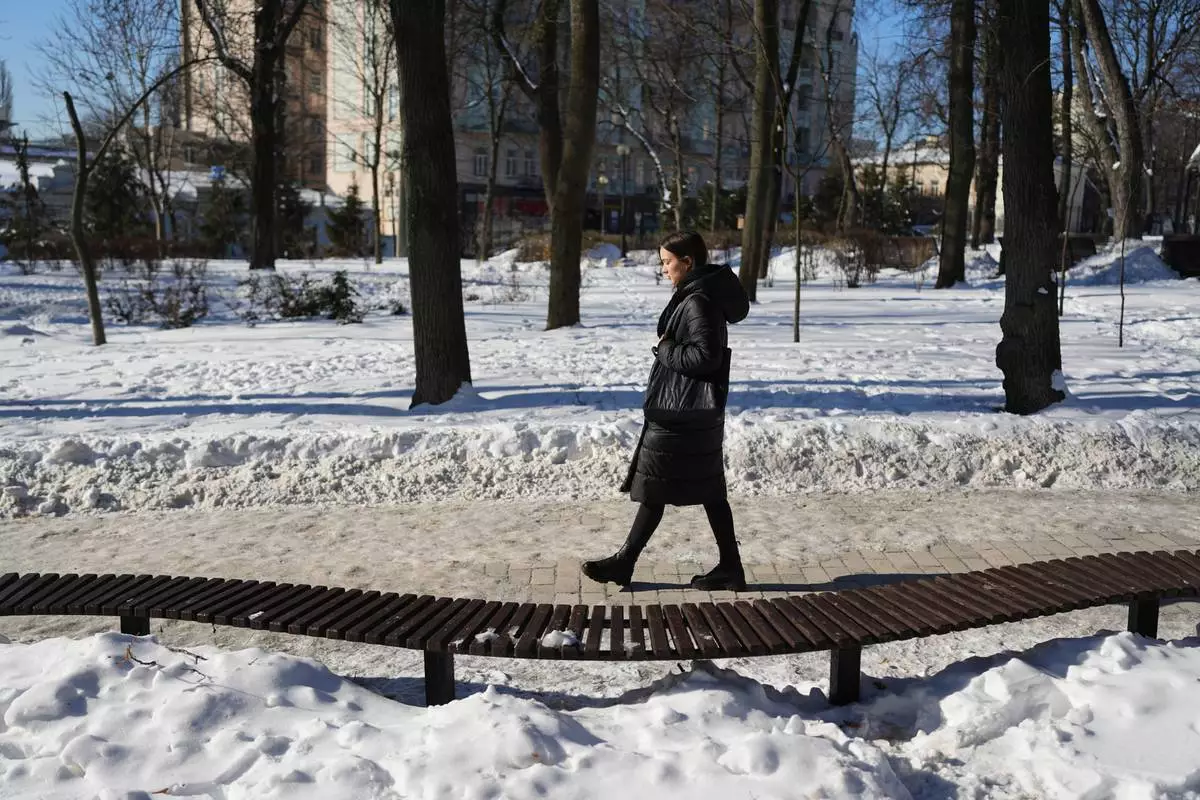
Liliia, 30, whose boyfriend is a prisoner of war, walks through a city park in Kyiv, Ukraine, Saturday, Feb. 21, 2026. (AP Photo/Sergei Grits)
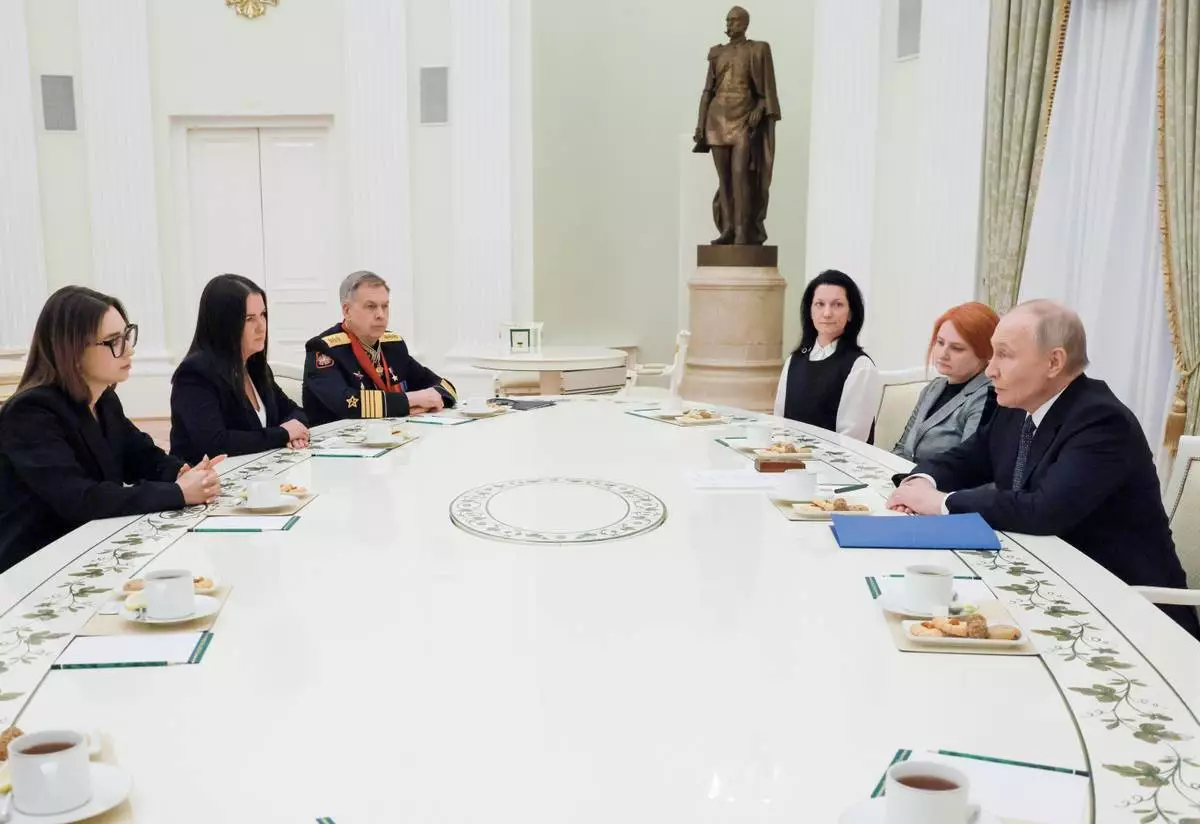
Russian President Vladimir Putin speaks to widows of Russian fallen servicemen during a military action in Ukraine, as Admiral Igor Kostyukov, head of Russian military intelligence (GRU), third left, attends a meeting at the Kremlin in Moscow, on Monday, Feb. 23, 2026. (Mikhail Metzel, Sputnik, Kremlin Pool Photo via AP)
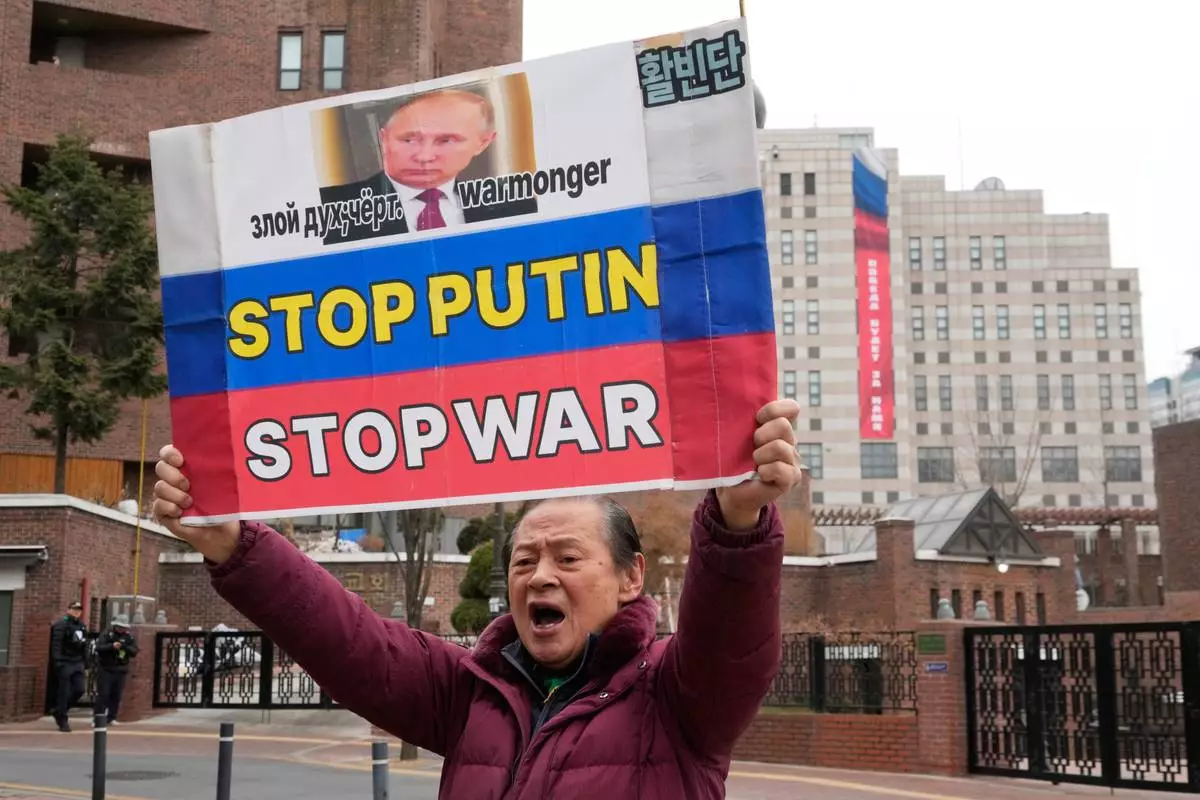
A South Korean protester holds a banner to denounce Russia's invasion of Ukraine on the fourth anniversary of the Russia-Ukraine war, near the Russian Embassy in Seoul, South Korea, Tuesday, Feb. 24, 2026. A banner reads "Victory will be ours." (AP Photo/Ahn Young-joon)