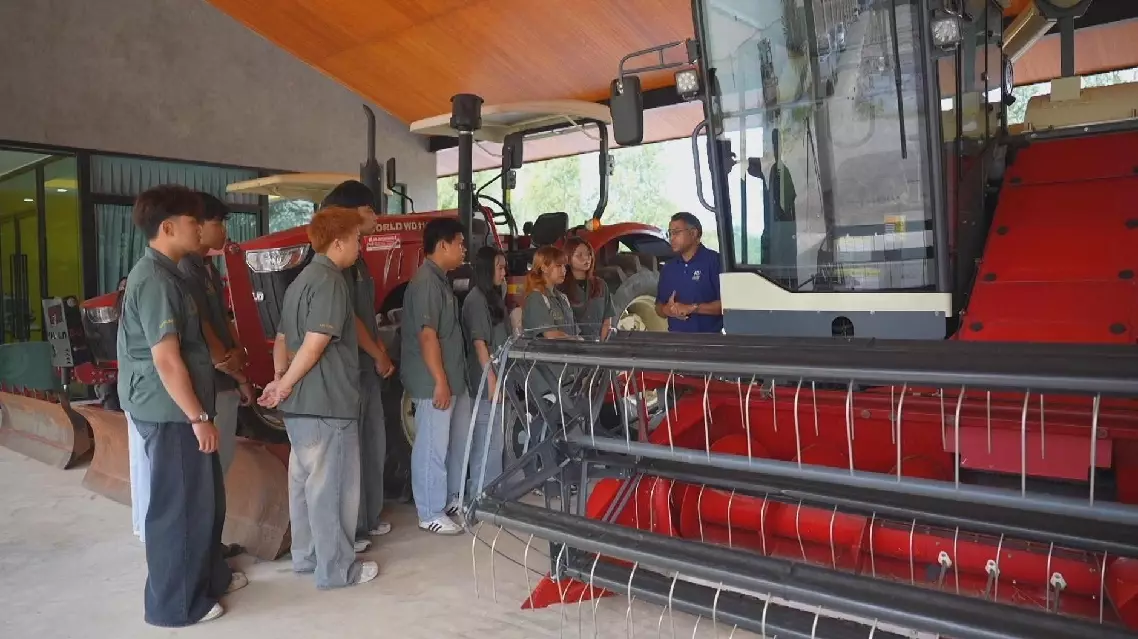
At Kasetsart University Kamphaeng Saen Campus in Nakhon Pathom in central Thailand, the future of Thai agriculture is taking shape, not just in the fields, but in classrooms and workshops where students learn to operate and adapt cutting-edge machinery from China.
The recently inaugurated Lancang-Mekong Countries Joint Innovation Center Agriculture and Agricultural Mechanization Technology (China-Thailand) marks a significant milestone in bilateral cooperation, aiming to train young agricultural engineers equipped to tackle evolving farming practices across the region.
"Our students could practice with real agricultural machinery. In fact, in order to train agricultural engineers, we need to learn a variety of technologies. China itself has very advanced and modern technology," said Wanrat Abdullakasim, associate professor at the Faculty of Engineering of Kasetsart University Kamphaeng Saen Campus.
For students like Surasek Inthararakthap, who grew up in an agricultural province in central Thailand, the center offers a direct pathway to impact his community.
"I have been interested in machinery, like tractors and similar equipment. When I was a kid, I tried driving a tractor. That is how I developed a passion for it, and it made me want to study agricultural engineering. I could learn how to repair machinery and understand how it works. I want to know more about it," said Inthararakthap.
The goal here is practical: to study how machines perform in tough conditions and how they can be improved for local farms.
"It has to be said that the most advanced and fastest-developing technology is undoubtedly from China. We have to acknowledge that. However, whether we can use it in our country depends on further development and improvement. I believe that collaboration allows us to gain the best ideas from many people. This is the principle of collaborative research and brainstorming," said Chouw Inprasit, associate professor at the Faculty of Engineering of the university.
The urgency is real. As rural labor pools shrink and seasons shift, Thai farmers increasingly rely on mechanization to maintain productivity. But technology alone isn't enough, knowledge transfer is critical.
"You can't rely on laborers because you can't find enough of them. Therefore, you have to rely on technology. However, if you lack knowledge, technology may be used incorrectly. As the use of agricultural machinery increases, the cost of maintenance per unit can decrease. This will have a positive impact on agriculture by lowering overall costs. You do the same work, but replace human labor, which reduces investment costs," said Somchai Donjadee, associate professor and dean of Faculty of Engineering of the university.
Chinese expertise is flowing into the partnership alongside hardware. Professor Yang Minli from China Agricultural University emphasized the benefits for countries participating in the Lancang-Mekong Cooperation, a sub-regional cooperation mechanism established between China, Cambodia, Laos, Myanmar, Thailand, and Vietnam.
"We are now filled with anticipation, and it's not just us. Together with Kasetsart University and the Thailand Institute of Agricultural Engineering, we are conducting joint research and development, collaborating to cultivate young scientists, facilitating exchanges and visits for students and teachers, as well as jointly training postgraduate students. We also hope that some of China's development experiences, including products and technologies, can benefit Thailand and countries involved in the Lancang-Mekong Cooperation," said Yang.
In a nation where rice fields have shaped culture and economy for centuries, transformation requires patience and partnership. There are no overnight solutions in agriculture, but only steady adjustments, season by season, harvest by harvest.
With Chinese technology meeting Thai ingenuity and a new generation of engineers ready to bridge the gap, Thailand's fields are poised for a more resilient, mechanized future.
China-Thailand partnership cultivates next generation of agricultural engineers